Recognition: no theorem link
Pre-computed aerosol extinction, scattering and asymmetry grids for scalable atmospheric retrievals
Pith reviewed 2026-05-16 12:14 UTC · model grok-4.3
The pith
Pre-computed grids for seven aerosol species reduce exoplanet retrieval computation times by 1.4 to 17 times with negligible impact on results.
A machine-rendered reading of the paper's core claim, the machinery that carries it, and where it could break.
Core claim
Rather than computing aerosol Mie coefficients for each sampled model, the authors pre-compute extinction efficiency (Qext), scattering efficiency (Qscat) and asymmetry parameter (g) grids for seven condensate species relevant in exoplanet atmospheres. The pre-computed Qext grids significantly reduce computation time between 1.4 and 17 times with negligible differences on the retrieved parameters. They also scale effortlessly with the number of aerosol species while maintaining the accuracy of cloud models.
What carries the argument
Pre-computed grids of extinction efficiency Qext, scattering efficiency Qscat, and asymmetry parameter g for seven condensate species, which replace on-the-fly Mie calculations inside retrieval frameworks.
Load-bearing premise
That interpolation from the pre-computed grids introduces negligible error across the full range of particle sizes, wavelengths, and atmospheric conditions encountered during retrievals.
What would settle it
Running identical retrievals on the same JWST transmission spectrum once with direct Mie calculations and once with the pre-computed grids, then checking whether any retrieved parameter differs by more than the reported negligible amount.
Figures



read the original abstract
The unprecedented wavelength coverage and sensitivity of the James Webb Space Telescope (JWST) permits to measure the absorption features of a wide range of condensate species from Silicates to Titan tholins. Atmospheric retrievals are uniquely suited to analyse these datasets and characterize the aerosols present in exoplanet atmospheres. However, including the optical properties of condensed particles within retrieval frameworks remains computationally expensive, limiting our ability to fully exploit JWST observations. In this work, we improve the computational efficiency and scaling behavior of aerosol models in atmospheric retrievals, enabling in-depth studies including multiple condensate species within practical time scales. Rather than computing the aerosol Mie coefficients for each sampled model, we pre-compute extinction efficiency (Qext), scattering efficiency (Qscat) and asymmetry parameter (g) grids for seven condensate species relevant in exoplanet atmospheres (Mg2SiO4 amorph sol - gel, MgSiO3 amorph glass, MgSiO3 amorph sol - gel, SiO2 alpha, SiO2 amorph, SiO and Titan tholins). The pre-computed Qext grids significantly reduce computation time between 1.4 and 17 times with negligible differences on the retrieved parameters. They also scale effortlessly with the number of aerosol species while maintaining the accuracy of cloud models. Thereby enabling more complex retrievals as well as broader population studies without increasing the overall error budget. The Qext, Qscat and g grids are freely available on Zenodo as well as a public TauREx plugin -TauREx-PCQ- that utilize them.
Editorial analysis
A structured set of objections, weighed in public.
Referee Report
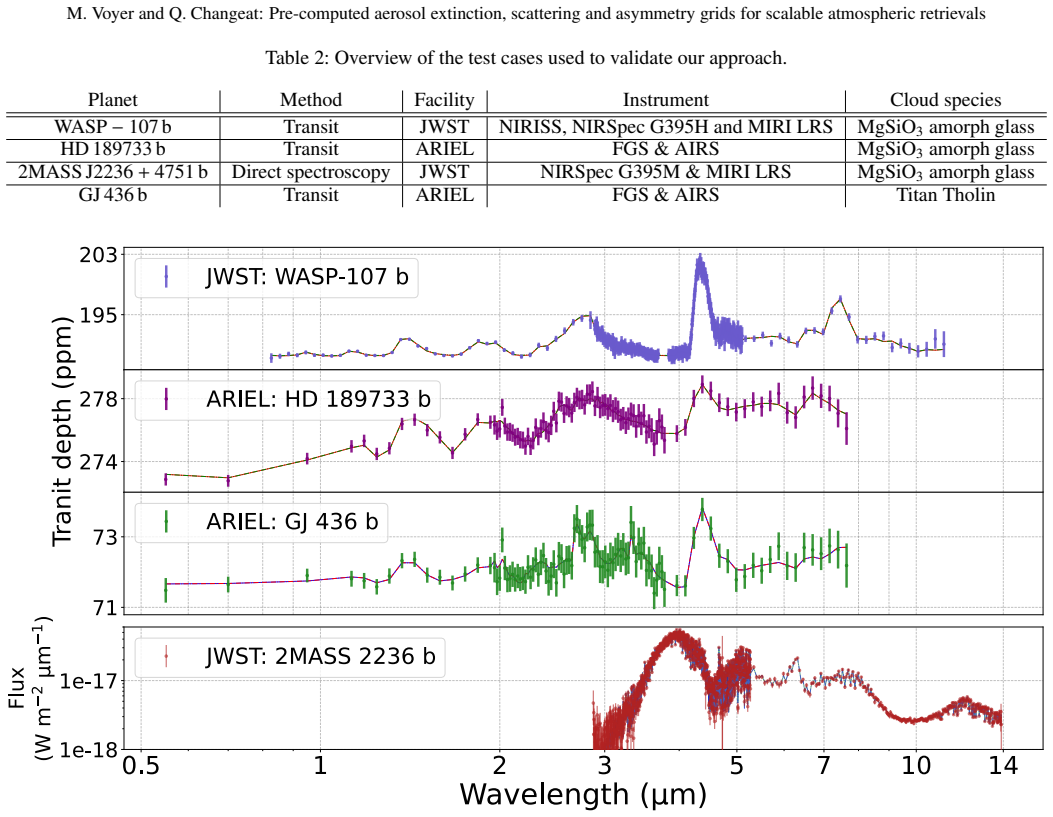
Summary. The manuscript presents pre-computed grids of extinction efficiency (Qext), scattering efficiency (Qscat), and asymmetry parameter (g) for seven fixed condensate species (Mg2SiO4 amorphous sol-gel, MgSiO3 amorphous glass, MgSiO3 amorphous sol-gel, SiO2 alpha, SiO2 amorphous, SiO, and Titan tholins). These grids replace on-the-fly Mie calculations within the TauREx retrieval framework via a public plugin (TauREx-PCQ), yielding reported speed-ups of 1.4–17× while producing retrieved parameters that differ negligibly from full Mie-based runs. The grids are released on Zenodo to support scalable multi-species aerosol modeling in JWST-era retrievals.
Significance. If the reported speed-ups and parameter agreement hold under the tested conditions, the work materially improves the practicality of including multiple aerosol species in atmospheric retrievals without expanding the error budget. The public availability of the grids and plugin strengthens reproducibility and enables population-level studies that would otherwise be computationally prohibitive.
minor comments (3)
- §3 (Methods): specify the exact interpolation scheme (e.g., linear, spline) and the grid spacing in particle size and wavelength to allow independent verification of the claimed negligible interpolation error.
- Figure 4 caption: clarify whether the shown residuals are for a single retrieval or averaged over the test ensemble, and state the maximum parameter deviation observed across all species.
- §4.2: add a brief statement on the refractive-index sources used for each species and confirm that the grids cover the full JWST wavelength range without extrapolation.
Simulated Author's Rebuttal
We thank the referee for their positive assessment of the manuscript and their recommendation to accept. No major comments were raised in the report.
Circularity Check
No significant circularity
full rationale
The paper describes a straightforward engineering optimization: pre-computing Mie-derived Qext/Qscat/g grids for seven fixed condensate species and replacing per-model calculations with table lookup plus interpolation. The reported speedups (1.4-17x) and negligible parameter shifts follow directly from this substitution without any derivation that reduces a claimed prediction back to a fitted input, self-defined quantity, or load-bearing self-citation chain. The method is self-contained against external benchmarks (standard Mie theory) and introduces no uniqueness theorems or ansatzes smuggled via prior work by the same authors.
Axiom & Free-Parameter Ledger
axioms (1)
- domain assumption Mie theory accurately describes light scattering by the chosen condensate particles over the relevant size and wavelength ranges
Forward citations
Cited by 1 Pith paper
-
HAT-P-70b through the Eyes of MAROON-X: Constraining Elemental Abundances of Metals and Insights on Atmosphere Dynamics
New MAROON-X observations of HAT-P-70b detect multiple neutral and ionized metals with day-to-night wind signatures and demonstrate that ionization-aware retrievals yield abundance ratios closer to solar values except...
Reference graph
Works this paper leans on
-
[1]
Al-Refaie, A. F., Changeat, Q., Waldmann, I. P., & Tinetti, G. 2021, The Astro- physical Journal, 917, 37
work page 2021
-
[2]
Barrado, D., Mollière, P., Patapis, P., et al. 2023, Nature, 624, 263
work page 2023
-
[3]
E., Mandell, A., Pontoppidan, K., et al
Batalha, N. E., Mandell, A., Pontoppidan, K., et al. 2017, Publications of the Astronomical Society of the Pacific, 129, 064501
work page 2017
-
[4]
Batalha, N. E., Rooney, C. M., Visscher, C., et al. 2025, Condensation Clouds in Substellar Atmospheres with Virga, arXiv:2508.15102 [astro-ph]
-
[5]
Bohren, C. F. & Huffman, D. R. 1983, Absorption and scattering of light by small particles
work page 1983
-
[6]
Bowler, B. P., Liu, M. C., Mawet, D., et al. 2017, The Astronomical Journal, 153, 18
work page 2017
-
[7]
L., Rocchetto, M., Yurchenko, S
Chubb, K. L., Rocchetto, M., Yurchenko, S. N., et al. 2021, Astronomy & Astro- physics, 646, A21
work page 2021
-
[8]
1995, Astronomy & Astrophysics, 300, 503
Dorschner, J., Begemann, B., Henning, T., Jaeger, C., & Mutschke, H. 1995, Astronomy & Astrophysics, 300, 503
work page 1995
- [9]
-
[10]
2023, The Astrophysical Journal Letters, 957, L36
Gandhi, S., de Regt, S., Snellen, I., et al. 2023, The Astrophysical Journal Letters, 957, L36
work page 2023
-
[11]
Gao, P., Thorngren, D. P., Lee, E. K. H., et al. 2020, Nature Astronomy, 4, 951, arXiv:2005.11939 [astro-ph]
-
[12]
Grant, D., Lewis, N. K., Wakeford, H. R., et al. 2023, The Astrophysical Journal Letters, 956, L32
work page 2023
-
[13]
2023, Astronomy & Astrophysics, 671, A122
Helling, C., Samra, D., Lewis, D., et al. 2023, Astronomy & Astrophysics, 671, A122
work page 2023
- [14]
-
[15]
Inglis, J., Batalha, N. E., Lewis, N. K., et al. 2024, The Astrophysical Journal Letters, 973, L41 Jäger, C., Dorschner, J., Mutschke, H., Posch, T., & Henning, T. 2003, Astron- omy & Astrophysics, 408, 193
work page 2024
-
[16]
Khare, B. N., Sagan, C., Arakawa, E. T., et al. 1984, Icarus, 60, 127
work page 1984
- [17]
- [18]
-
[19]
Kothari, H., Cushing, M. C., Burningham, B., et al. 2024, The Astrophysical Journal, 971, 121 Kühnle, H., Patapis, P., Mollière, P., et al. 2025, Astronomy & Astrophysics, 695, A224
work page 2024
- [20]
-
[21]
C., Mollière, P., Kühnle, H., et al
Matthews, E. C., Mollière, P., Kühnle, H., et al. 2025, The Astrophysical Journal, 981, L31
work page 2025
-
[22]
Miles, B. E., Biller, B. A., Patapis, P., et al. 2023, The Astrophysical Journal Letters, 946, L6
work page 2023
-
[23]
W., Chubb, K., Helling, C., & Kawashima, Y
Min, M., Ormel, C. W., Chubb, K., Helling, C., & Kawashima, Y . 2020, Astron- omy & Astrophysics, 642, A28 Mollière, P., Kühnle, H., Matthews, E. C., et al. 2025, Astronomy & Astro- physics, 703, A79 Mollière, P., Wardenier, J. P., van Boekel, R., et al. 2019, Astronomy & Astro- physics, 627, A67
work page 2020
-
[24]
Moses, J. I., Visscher, C., Fortney, J. J., et al. 2011, The Astrophysical Journal, 737, 15
work page 2011
-
[25]
V ., Pascale, E., Edwards, B., Papageorgiou, A., & Sarkar, S
Mugnai, L. V ., Pascale, E., Edwards, B., Papageorgiou, A., & Sarkar, S. 2020, Experimental Astronomy, 50, 303
work page 2020
- [26]
-
[27]
Murphy, M. M., Beatty, T. G., Schlawin, E., et al. 2024, Nature Astronomy, 8, 1562
work page 2024
-
[28]
2020, The Astrophysical Journal, 891, 131
Ohno, K., Okuzumi, S., & Tazaki, R. 2020, The Astrophysical Journal, 891, 131
work page 2020
-
[29]
Palik, E. D. 1985, Handbook of optical constants of solids
work page 1985
-
[30]
2023, Publications of the Astronomi- cal Society of the Pacific, 135, 048001
Rigby, J., Perrin, M., McElwain, M., et al. 2023, Publications of the Astronomi- cal Society of the Pacific, 135, 048001
work page 2023
-
[31]
Sumlin, B. J., Heinson, W. R., & Chakrabarty, R. K. 2018, Journal of Quantitative Spectroscopy and Radiative Transfer, 205, 127
work page 2018
-
[32]
Teinturier, L., Charnay, B., Spiga, A., & Bezard, B. 2025, Clouds as the driver of variability and colour changes in brown dwarf atmospheres, arXiv:2510.18090 [astro-ph]
-
[33]
Tennyson, J., Yurchenko, S. N., Al-Refaie, A. F., et al. 2016, Journal of Molecu- lar Spectroscopy, 327, 73
work page 2016
-
[34]
2021, Ariel: Enabling planetary sci- ence across light-years, arXiv:2104.04824 [astro-ph]
Tinetti, G., Eccleston, P., Haswell, C., et al. 2021, Ariel: Enabling planetary sci- ence across light-years, arXiv:2104.04824 [astro-ph]
-
[35]
Tsai, S.-M., Lee, E. K. H., Powell, D., et al. 2023, Nature, 617, 483 V oyer, M., Changeat, Q., Lagage, P.-O., et al. 2025, The Astrophysical Journal Letters, 982, L38
work page 2023
-
[36]
2013, Astronomy & Astrophysics, 553, A81
Zeidler, S., Posch, T., & Mutschke, H. 2013, Astronomy & Astrophysics, 553, A81
work page 2013
-
[37]
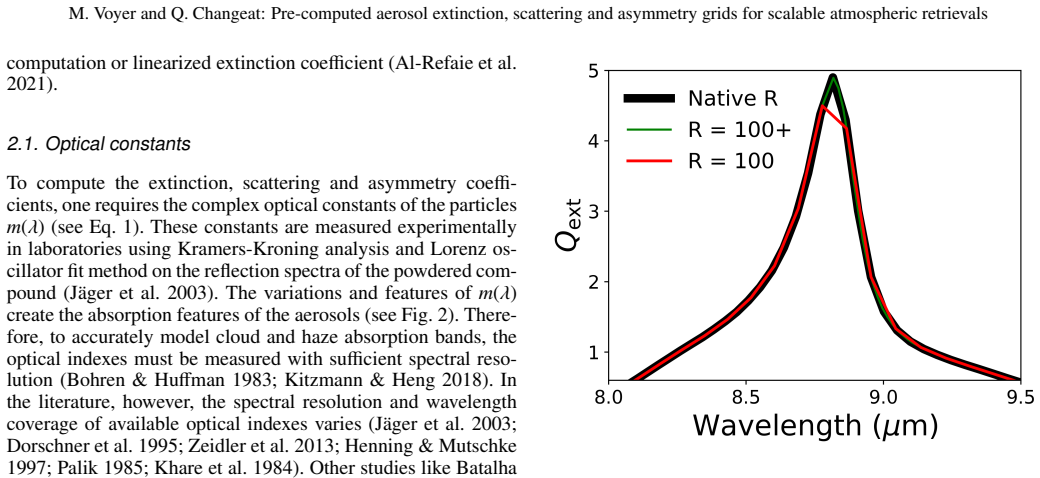
Zhang, M., Paragas, K., Bean, J. L., et al. 2024, The Astronomical Journal, 169, 38 Article number, page 8 of 13 M. V oyer and Q. Changeat: Pre-computed aerosol extinction, scattering and asymmetry grids for scalable atmospheric retrievals Appendix A: Appendix: additional figures We present Fig. A.1 which shows the impact of the resolution of the optical ...
work page 2024
discussion (0)
Sign in with ORCID, Apple, or X to comment. Anyone can read and Pith papers without signing in.