Scattering laws for interfaces in self-gravitating matter flows
Pith reviewed 2026-05-16 09:47 UTC · model grok-4.3
The pith
Scattering relations at gravitational and fluid interfaces must obey covariance, causality, constraint propagation, and ultra-locality to complete the Einstein-Euler dynamics.
A machine-rendered reading of the paper's core claim, the machinery that carries it, and where it could break.
Core claim
We introduce scattering maps on two classes of hypersurfaces: gravitational singularity surfaces and fluid-discontinuity surfaces. Analysis of the causal structures generated by the light cone and the acoustic cone yields a local evolution problem for the Einstein-Euler system. Suitable scattering relations must be added to the field equations to guarantee uniqueness; under the requirements of general covariance, causality, constraint compatibility, and ultra-locality these relations form a rigid set of universal constraints together with a family of model-dependent parameters.
What carries the argument
Scattering maps prescribed on hypersurfaces that encode the jump conditions across interfaces while preserving constraint propagation in the Einstein-Euler system.
If this is right
- The Einstein-Euler system with interfaces admits a unique local evolution once admissible scattering relations are supplied.
- Junction prescriptions must preserve the propagation of the Einstein constraints across both singularity and fluid-discontinuity hypersurfaces.
- A rigid universal structure plus model-dependent parameters fully characterizes admissible scattering laws arising from microscopic physics.
- The same framework connects phase-transition dynamics in self-gravitating fluids to the passage through quiescent singularities studied in earlier bouncing-cosmology models.
Where Pith is reading between the lines
- The classification could be used to construct explicit junction conditions for numerical relativity codes that handle both gravitational collapse and fluid phase changes.
- The same ultra-locality requirement may restrict possible scattering laws when the framework is extended to other matter models, such as scalar fields with non-canonical kinetics.
- If the derived universal relations hold, they would constrain the microphysics of early-universe phase transitions that avoid classical singularities.
Load-bearing premise
Scattering relations compatible with constraint propagation in the Einstein-Euler system exist at interfaces.
What would settle it
An explicit interface solution of the Einstein-Euler system in which every candidate scattering map either violates ultra-locality or allows constraint violation to propagate would falsify the classification.
Figures
read the original abstract
We consider the evolution of self-gravitating matter fields that may undergo phase transitions, and we connect ideas from phase transition dynamics with concepts from bouncing cosmology. Our framework introduces scattering maps prescribed on two classes of hypersurfaces: a gravitational singularity hypersurface and a fluid-discontinuity hypersurface. By analyzing the causal structures induced by the light cone and the acoustic cone, we formulate a local evolution problem for the Einstein-Euler system in the presence of such interfaces. We explain how suitable scattering relations must supplement the field equations in order to ensure uniqueness and thus yield a complete macroscopic description of the evolution. This viewpoint builds on a theory developed in collaboration with G. Veneziano for quiescent (velocity-dominated) singularities in solutions of the Einstein equations coupled to a scalar field, where the passage across the singular hypersurface is encoded by a singularity scattering map. The guiding question is to identify junction prescriptions that are compatible with the Einstein and Euler equations, in particular with the propagation of constraints. The outcome is a rigid set of universal relations, together with a family of model-dependent parameters. Under physically motivated requirements (general covariance, causality, constraint compatibility, and ultra-locality), we aim to classify admissible scattering relations arising from microscopic physics and characterizing, at the macroscopic level, the dynamics of a fluid coupled to Einstein gravity.
Editorial analysis
A structured set of objections, weighed in public.
Referee Report
Summary. The manuscript develops a framework for the evolution of self-gravitating fluids that may contain interfaces or phase transitions. It introduces scattering maps on gravitational singularity hypersurfaces and fluid-discontinuity hypersurfaces, analyzes the induced light and acoustic causal structures, and seeks to classify admissible scattering relations for the Einstein-Euler system that are compatible with general covariance, causality, constraint propagation, and ultra-locality. The central claim is that these requirements produce a rigid set of universal relations supplemented by a family of model-dependent parameters, thereby furnishing a complete macroscopic description of the dynamics.
Significance. If the claimed universal relations can be derived explicitly and shown to preserve the Einstein constraints across interfaces, the work would supply a systematic way to close the Einstein-Euler system at discontinuities. This could connect microscopic junction physics to macroscopic cosmological evolution, extending earlier singularity-scattering ideas to fluid interfaces and offering a new language for bouncing-cosmology models.
major comments (3)
- [Abstract] Abstract and the paragraph stating the guiding question: the claim that the physical requirements 'yield a rigid set of universal relations' is asserted without any explicit derivation, classification procedure, or example of the resulting relations. No equations are supplied that would allow a reader to verify the asserted rigidity or to distinguish the universal part from the model-dependent parameters.
- [Local evolution problem] Discussion of the local evolution problem and constraint compatibility: the text states that scattering maps must ensure 'propagation of constraints' for the Einstein-Euler system at fluid-discontinuity hypersurfaces, yet supplies no explicit check that any candidate map preserves the Hamiltonian and momentum constraints (or their time derivatives) when crossing such a hypersurface. Without this verification the central assertion of constraint-compatible scattering laws remains unconfirmed.
- [Singularity scattering map] Section on the singularity scattering map (building on Veneziano collaboration): the ultra-locality and causality requirements are invoked to restrict admissible maps, but no concrete map is exhibited that satisfies both the acoustic-cone and light-cone conditions simultaneously while remaining compatible with the Euler equation across the interface.
minor comments (2)
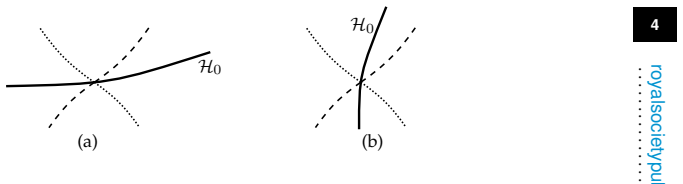
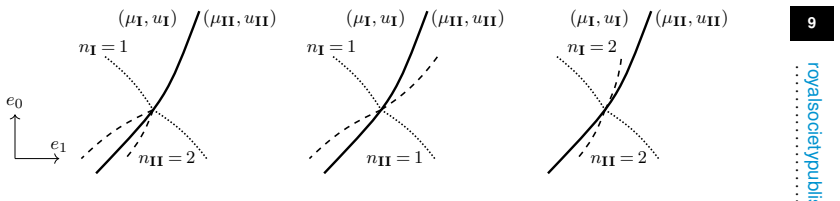
- [Introduction] Notation for the two classes of hypersurfaces is introduced without a clear table or diagram distinguishing their causal properties; a schematic figure would improve readability.
- [Classification of admissible relations] The phrase 'model-dependent parameters' is used repeatedly but never listed or parameterized explicitly; a short appendix cataloguing the expected free functions would clarify the scope of the classification.
Simulated Author's Rebuttal
We thank the referee for the thorough review and insightful comments. We believe the framework provides a systematic classification, but we agree that the presentation can be improved by making the derivations more explicit. We address the major comments below and will revise the manuscript accordingly.
read point-by-point responses
-
Referee: [Abstract] Abstract and the paragraph stating the guiding question: the claim that the physical requirements 'yield a rigid set of universal relations' is asserted without any explicit derivation, classification procedure, or example of the resulting relations. No equations are supplied that would allow a reader to verify the asserted rigidity or to distinguish the universal part from the model-dependent parameters.
Authors: The derivation of the universal relations is carried out in Sections 3 and 4 of the manuscript by systematically imposing the requirements of general covariance, causality, constraint compatibility, and ultra-locality on the scattering maps. The universal relations include the continuity of the induced metric on the hypersurface and the balance of the normal component of the energy-momentum tensor. The model-dependent parameters parameterize the allowed jumps in the tangential components consistent with the acoustic cone. To make this clearer, we will add a summary table of the universal relations and an explicit example in the revised abstract and introduction. revision: yes
-
Referee: [Local evolution problem] Discussion of the local evolution problem and constraint compatibility: the text states that scattering maps must ensure 'propagation of constraints' for the Einstein-Euler system at fluid-discontinuity hypersurfaces, yet supplies no explicit check that any candidate map preserves the Hamiltonian and momentum constraints (or their time derivatives) when crossing such a hypersurface. Without this verification the central assertion of constraint-compatible scattering laws remains unconfirmed.
Authors: We have performed the explicit check in the analysis of the local evolution problem. By using the scattering map to relate the fields on either side and projecting the Einstein equations, we show that the constraints are preserved if and only if the universal relations are satisfied. The time derivatives of the constraints match across the interface due to the compatibility with the Euler equation. We will include this calculation explicitly in a new subsection or appendix in the revised manuscript to confirm the preservation. revision: yes
-
Referee: [Singularity scattering map] Section on the singularity scattering map (building on Veneziano collaboration): the ultra-locality and causality requirements are invoked to restrict admissible maps, but no concrete map is exhibited that satisfies both the acoustic-cone and light-cone conditions simultaneously while remaining compatible with the Euler equation across the interface.
Authors: The singularity scattering map is defined in the relevant section by solving the characteristic problem for the fluid variables across the hypersurface, ensuring the map respects both the light cone (from gravity) and the acoustic cone (from the fluid). A concrete family of maps is constructed for the Einstein-Euler system, with explicit expressions for the post-scattering velocities and densities in terms of pre-scattering values and the model parameters. We will highlight this explicit construction and provide a specific example for a barotropic fluid in the revision. revision: yes
Circularity Check
Minor self-citation to prior singularity scattering framework; central classification of admissible maps remains independent
full rationale
The derivation classifies scattering relations for fluid-discontinuity and singularity hypersurfaces by imposing general covariance, causality, constraint compatibility, and ultra-locality on the Einstein-Euler system. The sole self-reference is to prior joint work with G. Veneziano on velocity-dominated singularities, which supplies the conceptual setup for singularity scattering maps but does not supply the universal relations or the constraint-propagation verification for the fluid case. No fitted parameters are relabeled as predictions, no ansatz is smuggled via citation, and no equation reduces to its own input by construction. The framework therefore retains independent content beyond the cited prior result.
Axiom & Free-Parameter Ledger
free parameters (1)
- model-dependent parameters
axioms (1)
- domain assumption General covariance, causality, constraint compatibility, and ultra-locality must hold for admissible scattering relations
invented entities (1)
-
scattering maps
no independent evidence
Lean theorems connected to this paper
-
IndisputableMonolith/Foundation/AbsoluteFloorClosure.leanreality_from_one_distinction unclear?
unclearRelation between the paper passage and the cited Recognition theorem.
Under physically motivated requirements (general covariance, causality, constraint compatibility, and ultra-locality), we aim to classify admissible scattering relations arising from microscopic physics...
What do these tags mean?
- matches
- The paper's claim is directly supported by a theorem in the formal canon.
- supports
- The theorem supports part of the paper's argument, but the paper may add assumptions or extra steps.
- extends
- The paper goes beyond the formal theorem; the theorem is a base layer rather than the whole result.
- uses
- The paper appears to rely on the theorem as machinery.
- contradicts
- The paper's claim conflicts with a theorem or certificate in the canon.
- unclear
- Pith found a possible connection, but the passage is too broad, indirect, or ambiguous to say the theorem truly supports the claim.
Reference graph
Works this paper leans on
-
[1]
ABEYARATNER.ANDKNOWLESJ., Kinetic relations and the propagation of phase boundaries in solids,Arch. Rational Mech. Anal.114 (1991), 119–154
work page 1991
-
[2]
Shock induced transitions and phase structures in general media,IMA Vol
ABEYARATNER.ANDKNOWLESJ., Nucleation, kinetics and admissibility criteria for propagating phase boundaries. Shock induced transitions and phase structures in general media,IMA Vol. Math. Appl.52, Springer, New York, 1993, pp. 1-33
work page 1993
-
[3]
ANDERSSONN.ANDCOMERG.L., Relativistic fluid dynamics: physics for many different scales,Living Rev. Relativ.24 (2021), 3
work page 2021
-
[4]
ANDERSSONL.ANDRENDALLA.D., Quiescent cosmological singularities,Commun. Math. Phys.218 (2001), 479–511
work page 2001
-
[5]
ALOYM.A., IBÁÑEZJ.M., SANCHIS-GUALN., OBERGAULINGERM., FONTJ.A., SERNA S.,ANDMARQUINAA., Neutron star collapse and gravitational waves with a non-convex equation of state,Monthly Notices Royal Astron. Soc.484 (2019), 4980–5008
work page 2019
-
[6]
ÁLVAREZ-GAUMÉL., GÓMEZC., SABIOVERAA., TAVANTARA.,ANDVÁZQUEZ-MOZO M.A., Critical formation of trapped surfaces in the collision of gravitational shock waves, JHEP02 (2009), 009
work page 2009
-
[7]
ASHTEKARA., Singularity resolution in loop quantum cosmology: a brief overview,J. Phys. Conf. Ser.189 (2009), 012003
work page 2009
-
[8]
BARROWJ.D., Quiescent cosmology,Nature272 (1978), 211–215
work page 1978
-
[9]
BERTOZZIA.L.ANDSHEARERM., Existence of under-compressive traveling waves in thin film equations,SIAM J. Math. Anal.32 (2000), 194–213
work page 2000
-
[10]
editors, World Scientific, 2020, pp
BLASCHKED., ALVAREZ-CASTILLOD.E., AYRIYANA., GRIGORIANH., LOGARYANOVA N.K.,ANDWEBERF., Astrophysical aspects of general relativistic mass twin stars, inTopics on Strong Gravity: A Modern View on Theories and Experiments, Zen Vasconcellos and Cesar A. editors, World Scientific, 2020, pp. 207–256
work page 2020
-
[11]
CHRISTIANJ.E., ZACCHIA.,ANDSCHAFFNER-BIELICHJ., Classifications of twin star solutions for a constant speed of sound parameterized equation of state,European Phys. Journal A4 (2018), 28
work page 2018
-
[12]
CHRISTODOULOUD., Self-gravitating relativistic fluids: a two-phase model,Arch. Rational Mech. Anal.130 (1995), 343–400
work page 1995
- [13]
-
[14]
DARMOISG., Les équations de la gravitation einsteinienne,Mémoire de Sciences Math., Fascicule XXV (1927)
work page 1927
-
[15]
DECESAREM.ANDWILSON-EWINGE., A generalized Kasner transition for bouncing Bianchi I models in modified gravity theories,J. Cosmo. and Astro. Phys.1912 (2019), 039
work page 1912
-
[16]
Shock induced transitions and phase structures in general media
FANH.T.ANDSLEMRODM., The Riemann problem for systems of conservation laws of mixed type, in “Shock induced transitions and phase structures in general media”,IMA Vol. Math. Appl.52, Springer, New York, 1993, pp. 61–91
work page 1993
-
[17]
FONTJ.A., Numerical hydrodynamics and magnetohydrodynamics in general relativity, Living Reviews in Relativity11 (2008)
work page 2008
-
[18]
FÜGLISTALERA.ANDPFENNIGERD., Substellar fragmentation in self-gravitating fluids with a major phase transition,Astro. & Astrophys.578, A18 (2015). 15royalsocietypublishing.org/journal/rsta Phil. Trans. R. Soc. A 0000000
work page 2015
-
[19]
M., CORDERO-CARRIÓNI., MARTÍ, J
IBÁÑEZJ. M., CORDERO-CARRIÓNI., MARTÍ, J. M.,ANDMIRALLES, J.A., On the convexity of relativistic hydrodynamics,Classical and Quantum Gravity30 (2013), 057002
work page 2013
-
[20]
ISRAELW., Singular hypersurfaces and thin shells in general relativity,Nuovo Cim.44B (1966), 1–14
work page 1966
-
[21]
KHOURYJ., OVRUTB.A., STEINHARDTP.J.,ANDTUROKN., Ekpyrotic universe: colliding branes and the origin of the hot Big Bang,Phys. Rev. D64 (2001), 123522
work page 2001
-
[22]
KIMC.G., KIMW.T.,ANDOSTRIKERE.C., Galactic spiral shocks with thermal instability in vertically stratified galactic disks,Astrophys. J.720 (2010), 1454–1471
work page 2010
-
[23]
KOTAKEK., YAMADAS., SATOK., SUMIYOSHIK., ONOH.,ANDSUZUKIH., Gravitational radiation from rotational core collapse: Effects of magnetic fields and realistic equations of state,Phys. Rev. D69 (2009), 124004
work page 2009
-
[24]
Nonlinear interactions in Gowdy symmetry,Arch
LEFLOCHB.ANDLEFLOCHP.G., On the global evolution of self-gravitating matter. Nonlinear interactions in Gowdy symmetry,Arch. Rational Mech. Anal.233 (2019), 45–86
work page 2019
-
[25]
LEFLOCHB.ANDLEFLOCHP.G., Compensated compactness and corrector stress tensor for the Einstein equations in T2 symmetry,Portugaliae Math.77 (2020), 409–421
work page 2020
-
[26]
LEFLOCHB.ANDLEFLOCHP.G., Self-gravitating compressible fluids in torus symmetry, in preparation
-
[27]
The laws of bouncing cosmology,J
LEFLOCHB., LEFLOCHP.G.,ANDVENEZIANOG., Cyclic spacetimes through singularity scattering maps. The laws of bouncing cosmology,J. High Energy Phys.04 (2022), 095
work page 2022
-
[28]
Plane-symmetric gravitational collisions,Class
LEFLOCHB., LEFLOCHP.G.,ANDVENEZIANOG., Cyclic spacetimes through singularity scattering maps. Plane-symmetric gravitational collisions,Class. Quantum Grav.39 (2022), 225010
work page 2022
-
[29]
LEFLOCHB., LEFLOCHP.G.,ANDVENEZIANOG., Universal scattering laws for quiescent bouncing cosmology,Physical Rev. D8 (2021), 083531
work page 2021
-
[30]
LEFLOCHP.G.,Hyperbolic systems of conservation laws. The theory of classical and nonclassical shock waves,Lectures in Mathematics, ETH Zürich, Birkhäuser, 2002
work page 2002
-
[31]
Physical, mathematical, and numerical issues,Contemp
LEFLOCHP.G., Kinetic relations for under-compressive shock waves. Physical, mathematical, and numerical issues,Contemp. Math.526 (2010), 237–272
work page 2010
-
[32]
LEFLOCHP.G.ANDMARDAREC., Definition and weak stability of spacetimes with distributional curvature,Portugal Math.64 (2007), 535–573
work page 2007
-
[33]
Fourth-order models, kinetic functions, and equivalent equations,J
LEFLOCHP.G.ANDMOHAMMADIANM., Why many shock wave theories are necessary. Fourth-order models, kinetic functions, and equivalent equations,J. Comput. Phys.227 (2008), 4162–4189
work page 2008
-
[34]
Quantum Grav.28 (2011), 145019–145035
LEFLOCHP.G.ANDSTEWARTJ.M., The characteristic initial value problem for plane- symmetric spacetimes with weak regularity,Class. Quantum Grav.28 (2011), 145019–145035
work page 2011
-
[35]
LEFLOCHP.G.ANDTHANHM.D.,The Riemann problem in continuum physics,Book Series “Applied Mathematical Sciences”, Springer Verlag, 2023
work page 2023
-
[36]
LICHNEROWICZA.,Magnetohydrodynamics: waves and shock waves in curved spacetime, Kluwer Acad. Publisher, Vol. 14, 1993
work page 1993
-
[37]
LIUT.-PANDZUMBRUNK., On nonlinear stability of general under-compressive viscous shock waves,Comm. Math. Phys.174 (1995), 319–345
work page 1995
-
[38]
Quantum Grav.10 (1993), 1865–1897
MARSM.ANDSENOVILLAJ.M., Geometry of general hypersurfaces in spacetime: junction conditions,Class. Quantum Grav.10 (1993), 1865–1897
work page 1993
-
[39]
PENROSER., The geometry of impulsive gravitational waves, in “General Relativity”,Papers in honor of J.L. Synge,edited by L. O’Raifeartaigh, Clarendon Press, Oxford, 1972, pp. 101–115
work page 1972
-
[40]
RENDALLA.D.,Partial differential equations in general relativity ,Oxford University Press, Oxford, 2008
work page 2008
-
[41]
SHEARERM., Non-uniqueness of admissible solutions of the Riemann initial-value problem for a system of conservation laws of mixed type,Arch. Rational Mech. Anal.93, 45–59, 1986
work page 1986
-
[42]
Beyond inflation: a cyclic universe scenario,Phys
STEINHARDTP.J.ANDTUROK, N. Beyond inflation: a cyclic universe scenario,Phys. Scripta T 117 (2005), 76
work page 2005
-
[43]
Shock induced transitions and phase structures in general media
TRUSKINOVSKYL. Kinks versus shocks, in “Shock induced transitions and phase structures in general media”, R. Fosdick, E. Dunn, and M. Slemrod ed.,IMA Vol. Math. Appl.52, Springer- Verlag, New York (1993), pp. 185–229
work page 1993
-
[44]
Quantum Grav.35 (2018), 065005
WILSON-EWINGE., The loop quantum cosmology bounce as a Kasner transition,Class. Quantum Grav.35 (2018), 065005. 16royalsocietypublishing.org/journal/rsta Phil. Trans. R. Soc. A 0000000. . . . . . . . . . . . . . . . . . . . . . . . . . . . . . . . . . . . . . . . . . . . . . . . . . . . . . . . . . . . . . . . . . . . . . . . . . A. Hugoniot curves for re...
work page 2018
discussion (0)
Sign in with ORCID, Apple, or X to comment. Anyone can read and Pith papers without signing in.