Ferroelectric switching at edge dislocations in BaTiO₃ modelled at the atomic scale
Pith reviewed 2026-05-16 09:29 UTC · model grok-4.3
The pith
Edge dislocation cores in BaTiO3 nucleate ferroelectric switching or pin domain walls depending on applied field direction
A machine-rendered reading of the paper's core claim, the machinery that carries it, and where it could break.
Core claim
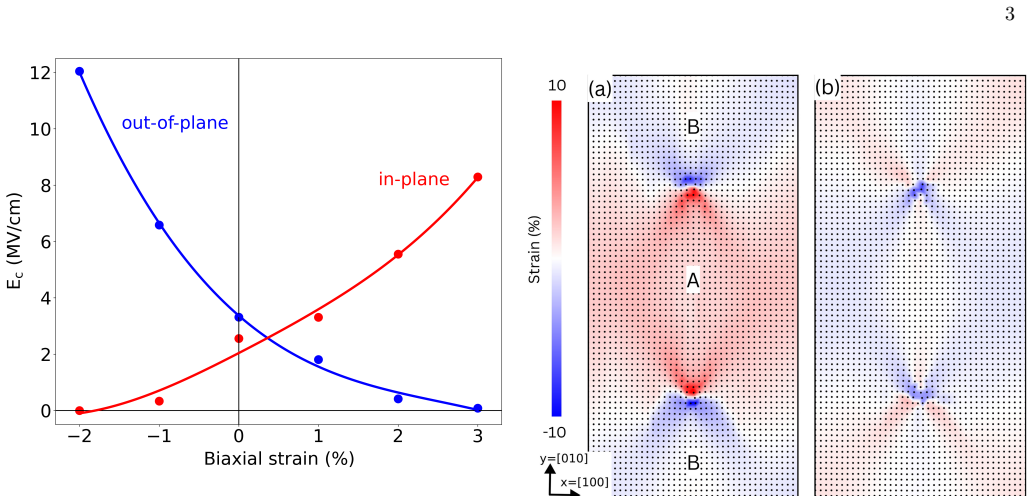
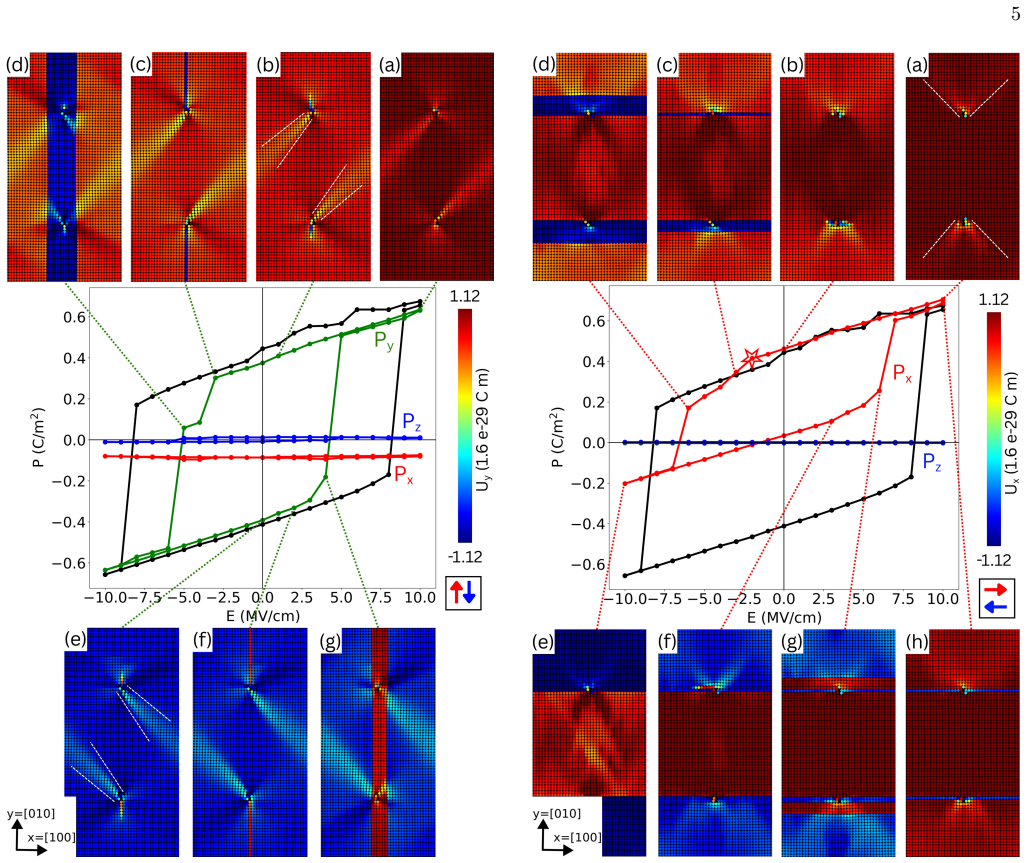
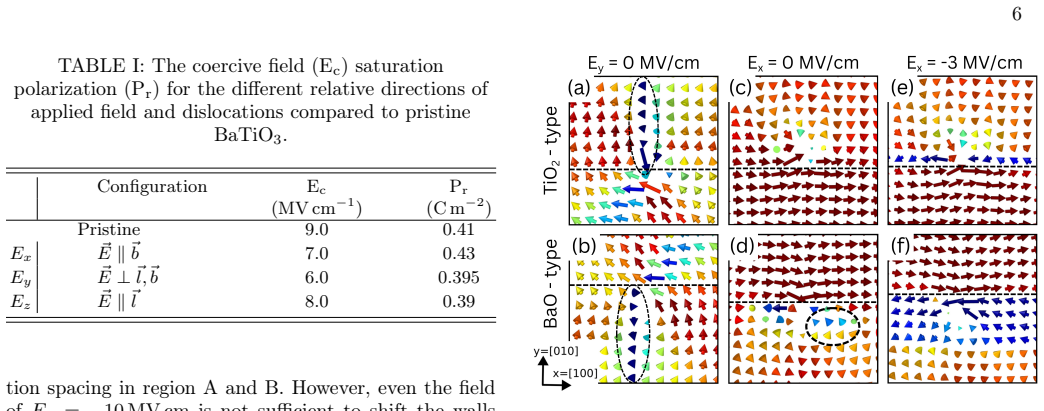
Using atomistic simulations, we show how the cores of ⟨100⟩ edge dislocations in BaTiO₃ can either act as nucleation centers for ferroelectric switching or pin walls depending on the direction of the applied field. The coupling between electric field and polarization is strongest when the field is applied parallel to the Burgers vector of the dislocation.
What carries the argument
Direction-dependent coupling of applied electric field to local polarization at the atomic core of ⟨100⟩ edge dislocations, captured through atomistic simulations.
Load-bearing premise
The interatomic potential used in the simulations accurately reproduces the coupling between local strain, electric field, and polarization at the dislocation core.
What would settle it
Microscopy observation of whether new ferroelectric domains nucleate at dislocation cores when the electric field is applied parallel to the Burgers vector versus whether switching is suppressed when the field is reversed.
Figures


read the original abstract
Ferroelectric switching governs the functional properties of ferroelectric perovskites. It is widely accepted that this switching depends on domain nucleation and pinning and that these processes can be controlled by the defect structure. However, an atomistic picture of the influence of one important class of defects - dislocations on ferroelectric switching is missing. This is an important gap in knowledge as dislocations cannot be avoided at interfaces and can also be engineered by plastic deformation at high temperatures. Using atomistic simulations, we show how the cores of $\langle100\rangle$ edge dislocations in BaTiO$_3$ can either act as nucleation centers for ferroelectric switching or pin walls depending on the direction of the applied field. The coupling between electric field and polarization is strongest when the field is applied parallel to the Burgers vector of the dislocation.
Editorial analysis
A structured set of objections, weighed in public.
Referee Report
Summary. The manuscript uses atomistic simulations with a classical interatomic potential to investigate ferroelectric switching at ⟨100⟩ edge dislocations in BaTiO₃. It reports that the dislocation cores act either as nucleation sites for switching or as pinning centers for domain walls, depending on the direction of the applied electric field relative to the Burgers vector, with the strongest field-polarization coupling occurring when the field is applied parallel to the Burgers vector.
Significance. If the central results are robust, the work supplies a direct atomistic picture of dislocation-mediated nucleation and pinning in a prototypical ferroelectric perovskite. This addresses a recognized gap in defect-controlled switching and is obtained from direct numerical integration of the model without post-hoc fitting to the target behavior. The finding that the nucleation/pinning dichotomy is field-direction dependent relative to the Burgers vector is a concrete, falsifiable prediction that could guide future experiments on engineered dislocation arrays.
major comments (1)
- [Methods] Methods section (simulation protocol and potential description): The manuscript does not report explicit benchmarks of the interatomic potential against DFT or experiment for the polarization response, switching energy barriers, or piezoelectric coefficients under the large local strains present at the dislocation core. Because the reported nucleation-versus-pinning behavior is a direct consequence of the strain-polarization-electric-field coupling encoded in the potential, the absence of such core-specific validation leaves open the possibility that the direction-dependent effect is an artifact of the chosen potential rather than a general physical feature.
minor comments (1)
- [Abstract] The abstract would benefit from a brief quantitative statement (e.g., the ratio of critical fields for the two orientations or the magnitude of the local field enhancement at the core) to allow readers to gauge the strength of the reported effect without reading the full text.
Simulated Author's Rebuttal
We thank the referee for the positive assessment of the significance of our work and for highlighting the need for potential validation. We address the major comment below by expanding the Methods section with additional benchmarks.
read point-by-point responses
-
Referee: [Methods] Methods section (simulation protocol and potential description): The manuscript does not report explicit benchmarks of the interatomic potential against DFT or experiment for the polarization response, switching energy barriers, or piezoelectric coefficients under the large local strains present at the dislocation core. Because the reported nucleation-versus-pinning behavior is a direct consequence of the strain-polarization-electric-field coupling encoded in the potential, the absence of such core-specific validation leaves open the possibility that the direction-dependent effect is an artifact of the chosen potential rather than a general physical feature.
Authors: We agree that explicit validation strengthens the conclusions. In the revised manuscript we have added a dedicated subsection to the Methods section that benchmarks the interatomic potential (the Ti-O-Ba potential of [standard reference for BaTiO3]) against both experiment and DFT. We now report: (i) bulk spontaneous polarization and piezoelectric coefficients compared to measured values and DFT; (ii) switching energy barriers for 180° reversal in bulk cells; and (iii) polarization response under uniform strains up to 8 % (matching the maximum local strains extracted from the dislocation core). These additional calculations show quantitative agreement within 10-15 % for the strain-polarization coupling. While a full DFT treatment of the ~10^4-atom dislocation supercell remains computationally prohibitive, the bulk and uniformly strained benchmarks reproduce the same qualitative field-direction dependence relative to the Burgers vector. We have inserted a new paragraph, Table S1, and Figure S2 documenting these comparisons. revision: yes
Circularity Check
No circularity: results emerge directly from atomistic simulation
full rationale
The paper reports emergent behavior from direct numerical integration of an atomistic model under applied fields. No parameters are fitted to the target nucleation/pinning outcomes, no self-definitional loops exist in the equations, and no load-bearing self-citations reduce the central claim to prior unverified assertions by the same authors. The interatomic potential is an external input whose validity is a separate question from circularity; the reported direction-dependent switching is an output of the simulation protocol, not a renaming or re-derivation of its inputs.
Axiom & Free-Parameter Ledger
free parameters (1)
- interatomic potential parameters
axioms (1)
- domain assumption The chosen interatomic potential correctly captures ferroelectric switching energetics and strain-polarization coupling at defect cores.
Reference graph
Works this paper leans on
-
[1]
Ferroelectric switching at edge dislocations in BaTiO$_3$ modelled at the atomic scale
and piezoelectric responses [23]. However, experi- mentsdonotoffertherequiredspatialandtemporalreso- lutiontorevealthemicroscopiccouplingmechanisms. In- stead, phase-field simulations have been used to link the observed functional properties to the stabilization and pinning of elastic domain walls at the dislocation cores [22, 24]. Furthermore, it has bee...
work page internal anchor Pith review Pith/arXiv arXiv 2026
-
[2]
together with the particle-particle-particle mesh al- gorithm to treat the Coulomb interaction with a relative accuracy of10 −5 and a cutoff of 15.0 Å. As the room- temperature tetragonal phase of BaTiO3 is not the ener- getic ground state at 0 K, we initialized this metastable state in a10×10×10unit cells by an external elec- tric field (Ez =10 MV cm−1)....
-
[3]
R. Khosla and S. K. Sharma, Integration of ferroelectric materials: An ultimate solution for next-generation com- puting and storage devices, ACS Appl. Electron. Mater. 3, 2862 (2021)
work page 2021
-
[4]
V. Veerapandiyan, F. Benes, T. Gindel, and M. Deluca, Strategies to improve the energy storage properties of perovskite lead-free relaxor ferroelectrics: A review, Ma- terials13, 5742 (2020)
work page 2020
-
[5]
R. W. Whatmore, Y.-M. You, R.-G. Xiong, and C.-B. Eom, 100 years of ferroelectricity—a celebration, APL Mater.9, 070401 (2021)
work page 2021
-
[6]
A. Grünebohm, M. Marathe, R. Khachaturyan, R. Schiedung, D. C. Lupascu, and V. V. Shvartsman, Interplay of domain structure and phase transitions: the- ory, experiment and functionality, J. Phys. Condens. Matter34, 073002 (2021), publisher: IOP Publishing
work page 2021
-
[7]
S. Jesse, B. J. Rodriguez, S. Choudhury, A. P. Baddorf, I. Vrejoiu, D. Hesse, M. Alexe, E. A. Eliseev, A. N. Moro- zovska, J. Zhang, L.-Q. Chen, and S. V. Kalinin, Direct imaging of the spatial and energy distribution of nucle- ation centres in ferroelectric materials, Nat. Mater.7, 209–215 (2008)
work page 2008
-
[8]
P. Mokrý and T. Sluka, Identification of microscopic do- main wall motion from temperature dependence of non- linear dielectric response, Appl. Phys. Lett.110, 162906 (2017)
work page 2017
-
[9]
C. Fancher, S. Brewer, C. Chung, S. Röhrig, T. Rojac, G. Esteves, M. Deluca, N. Bassiri-Gharb, and J. Jones, The contribution of 180°domain wall motion to dielectric properties quantified from in situ x-ray diffraction, Acta Mater.126, 36–43 (2017)
work page 2017
-
[10]
A. Grünebohm, S.-H. Teng, and M. Marathe, Influence of domain walls and defects on the electrocaloric effect, J. Phys. Energy5, 034010 (2023)
work page 2023
-
[11]
R. Bulanadi, K. Cordero-Edwards, P. Tückmantel, S. Saremi, G. Morpurgo, Q. Zhang, L. W. Martin, V. Na- garajan, and P. Paruch, Interplay between point and extended defects and their effects on jerky domain-wall motion in ferroelectric thin films, Phys. Rev. Lett.133, 106801 (2024)
work page 2024
-
[12]
Y. Feng, J. Wu, Q. Chi, W. Li, Y. Yu, and W. Fei, De- fects and aliovalent doping engineering in electroceram- ics, Chem. Rev.120, 1710–1787 (2020)
work page 2020
-
[13]
A. Grünebohm and T. Nishimatsu, Influence of defects on ferroelectric and electrocaloric properties ofbatio 3, Phys. Rev. B93, 134101 (2016)
work page 2016
-
[14]
S.-H. Teng, A. Dimou, B. Udofia, M. Ghasemi, M. Stricker, and A. Grünebohm, Control of ferroelectric domain wall dynamics by point defects: Insights from ab initio based simulations, J. Appl. Phys.137, 154103 (2025)
work page 2025
-
[15]
L. J. McGilly, L. Feigl, and N. Setter, Dynamics of ferro- electric 180°domain walls at engineered pinning centers, Appl. Phys. Lett.111, 022901 (2017)
work page 2017
-
[16]
Y. A. Genenko, J. Glaum, M. J. Hoffmann, and K. Albe, Mechanisms of aging and fatigue in ferroelectrics, Mater. Sci. Eng. B192, 52–82 (2015)
work page 2015
-
[17]
P. Paruch and J. Guyonnet, Nanoscale studies of ferro- electric domain walls as pinned elastic interfaces, C. R. Physique14, 667–684 (2013)
work page 2013
-
[18]
N. Doukhan and J. C. Doukhan, Dislocations in per- ovskites BaTiO3 and CaTiO3, Phys. Chem. Miner.13, 403–410 (1986)
work page 1986
-
[19]
O. Eibl, P. Pongratz, P. Skalicky, and H. Schmelz, Dislo- cations in BaTiO3 ceramics, Phys. Status Solidi A108, 495–502 (1988)
work page 1988
- [20]
- [21]
-
[22]
Z. R. Dai, Z. L. Wang, X. F. Duan, and J. Zhang, Link- up of 90°domain boundaries with interface dislocations in BaTiO3/LaAlO3, Appl. Phys. Lett.68, 3093 (1996)
work page 1996
-
[23]
S. P. Alpay, I. B. Misirlioglu, V. Nagarajan, and R. Ramesh, Can interface dislocations degrade ferroelec- tric properties?, Appl. Phys. Lett.85, 2044 (2004)
work page 2044
-
[24]
F. Zhuo, X. Zhou, S. Gao, M. Höfling, F. Dietrich, P. B. Groszewicz, L. Fulanović, P. Breckner, A. Wohninsland, B.-X. Xu, H.-J. Kleebe, X. Tan, J. Koruza, D. Dam- janovic, and J. Rödel, Anisotropic dislocation-domain wall interactions in ferroelectrics, Nat Commun13, 6676 8 (2022)
work page 2022
-
[25]
M. Höfling, X. Zhou, L. M. Riemer, E. Bruder, B. Liu, L. Zhou, P. B. Groszewicz, F. Zhuo, B.-X. Xu, K. Durst, X. Tan, D. Damjanovic, J. Koruza, and J. Rödel, Con- trol of polarization in bulk ferroelectrics by mechanical dislocation imprint, Science372, 961 (2021)
work page 2021
-
[26]
F. Zhuo, X. Zhou, S. Gao, F. Dietrich, P. B. Groszewicz, L. Fulanović, P. Breckner, B.-X. Xu, H.-J. Kleebe, D. Damjanovic, and J. Rödel, Intrinsic-strain engineer- ing by dislocation imprint in bulk ferroelectrics, Phys. Rev. Lett.131, 016801 (2023)
work page 2023
-
[27]
X. Zhou, Z. Liu, and B.-X. Xu, Influence of dislocations on domain walls in perovskite ferroelectrics: Phase-field simulation and driving force calculation, Int. J. Solids Struct.238, 111391 (2022)
work page 2022
-
[28]
A.KontsosandC.M.Landis,Computationalmodelingof domain wall interactions with dislocations in ferroelectric crystals, Int. J. Solids Struct.46, 1491
-
[29]
X. Liu, X. Shan, S. Feng, X. Xu, and L. Jiang, Effects of dislocations with different locations, orientations and density on domain evolution of ferroelectric thin film: A phase field study, Comput. Mater. Sci.169, 109102 (2019)
work page 2019
- [30]
-
[31]
D. Marrocchelli, L. Sun, and B. Yildiz, Dislocations in SrTiO3: Easy To Reduce but Not so Fast for Oxygen Transport, J. Am. Chem. Soc.137, 4735 (2015)
work page 2015
-
[32]
A. J. Klomp, L. Porz, and K. Albe, The nature and motion of deformation-induced dislocations in srtio3: Insights from atomistic simulations, Acta Mater.242, 118404 (2023)
work page 2023
- [33]
-
[34]
G. Deguchi, R. Kobayashi, H. Azuma, S. Ogata, M. Uranagase, and S. Spreafico, Asymmetric Domain Nucleation from Dislocation Core in Barium Titanate: Molecular Dynamics Simulation Using Machine-Learning Potential through Active Learning, Phys. Status Solidi RRL , 2300292 (2023)
work page 2023
-
[35]
M. Sepliarsky, A. Asthagiri, S. Phillpot, M. Stachiotti, and R. Migoni, Atomic-level simulation of ferroelectricity in oxide materials, Curr. Opin. Solid State Mater. Sci9, 107 (2005)
work page 2005
- [36]
- [37]
-
[38]
A. P. Thompson, H. M. Aktulga, R. Berger, D. S. Bolin- tineanu, W. M. Brown, P. S. Crozier, P. J. in ’t Veld, A. Kohlmeyer, S. G. Moore, T. D. Nguyen, R. Shan, M. J. Stevens, J. Tranchida, C. Trott, and S. J. Plimpton, LAMMPS - a flexible simulation tool for particle-based materials modeling at the atomic, meso, and continuum scales, Comp. Phys. Comm.271,...
work page 2022
-
[39]
Hirel, Atomsk: A tool for manipulating and converting atomicdatafiles,Comput.Phys.Comm.197,212(2015)
P. Hirel, Atomsk: A tool for manipulating and converting atomicdatafiles,Comput.Phys.Comm.197,212(2015)
work page 2015
-
[40]
M. Sepliarsky and R. E. Cohen, First-principles based atomistic modeling of phase stability in PMN–xPT, J. Phys. Condens. Matter23, 435902 (2011), publisher: IOP Publishing
work page 2011
-
[41]
A. Stukowski, Visualization and analysis of atomistic simulation data with OVITO-the open visualization tool, Modelling Simul. Mater. Sci. Eng.18, 015012 (2010)
work page 2010
-
[42]
Landauer, Electrostatic considerations in BaTiO3 do- main formation during polarization reversal, J
R. Landauer, Electrostatic considerations in BaTiO3 do- main formation during polarization reversal, J. Appl. Phys.28, 227–234 (1957)
work page 1957
-
[43]
S. Choudhury, Y. L. Li, L. Q. Chen, and Q. X. Jia, Strain effect on coercive field of epitaxial barium titanate thin films, Appl. Phys. Lett.92, 142907 (2008)
work page 2008
- [44]
-
[45]
J.P.HirthandJ.Lothe,Theory of Dislocations(McGraw Hill, Tokyo, 1982)
work page 1982
-
[46]
R. Khachaturyan, A. Dimou, and A. Grünebohm, Do- main wall acceleration by ultrafast field application: An ab initio-based molecular dynamics study, Phys. Status Solidi RRL16, 2200038 (2022)
work page 2022
- [47]
- [48]
-
[49]
P. Hirel, P. Marton, M. Mrovec, and C. Elsässer, Theo- retical investigation of{110}generalized stacking faults and their relation to dislocation behavior in perovskite oxides, Acta Mater.58, 6072 (2010). 9 Appendix A: Core-shell potential We used the isotropic core-shell model from [33] pre- sented in table II. Each atom is represented by a core and shel...
work page 2010
discussion (0)
Sign in with ORCID, Apple, or X to comment. Anyone can read and Pith papers without signing in.