Pushing and Pulling Ponderomotive Forces in Wavepackets and Beat Waves
Pith reviewed 2026-05-21 14:54 UTC · model grok-4.3
The pith
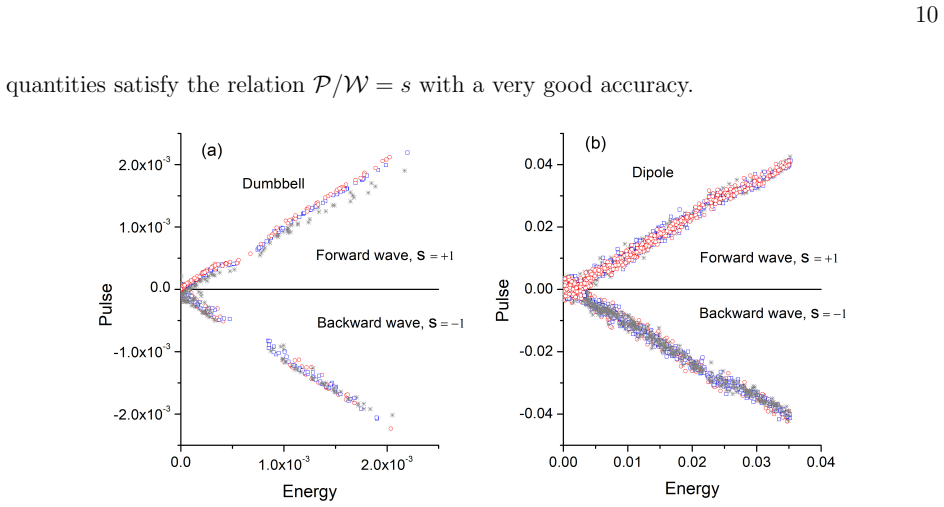
Ponderomotive forces in wave packets can pull particles toward the source or push them away depending on packet properties.
A machine-rendered reading of the paper's core claim, the machinery that carries it, and where it could break.
Core claim
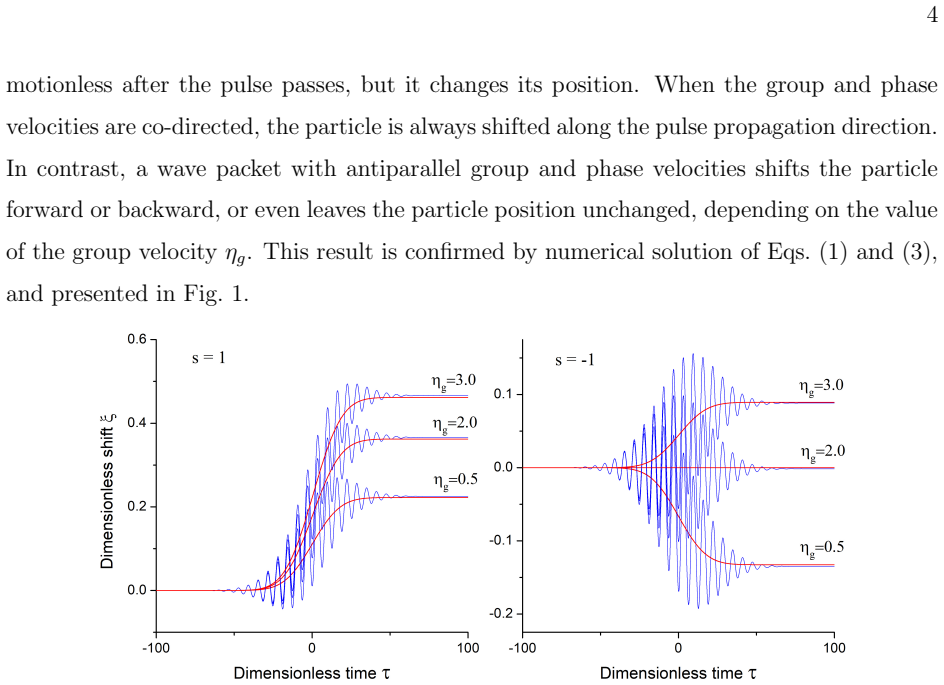
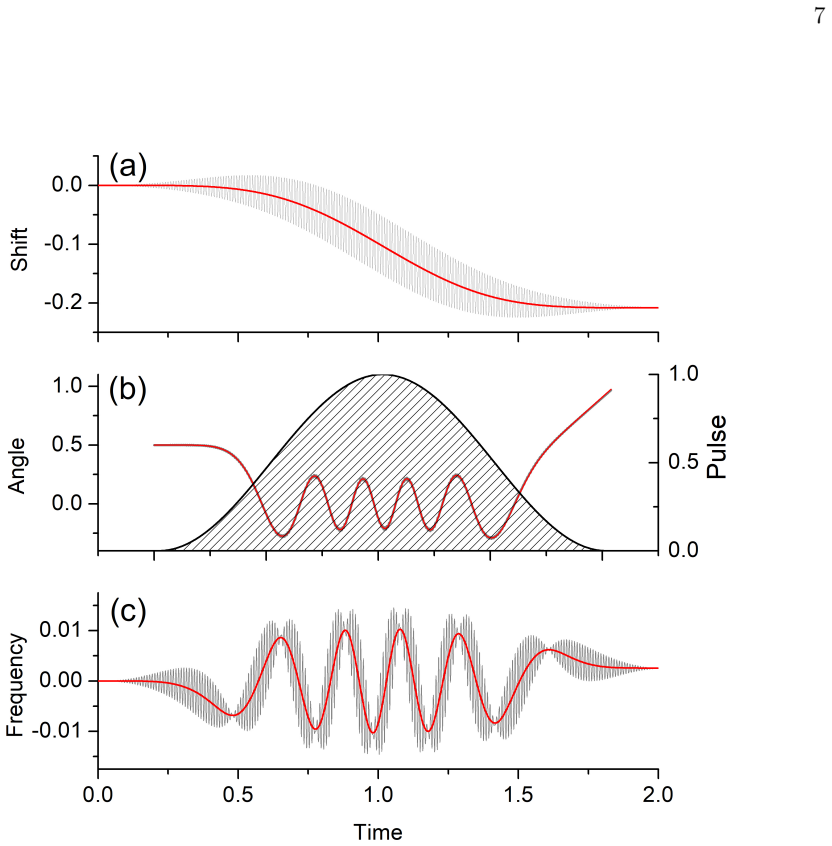
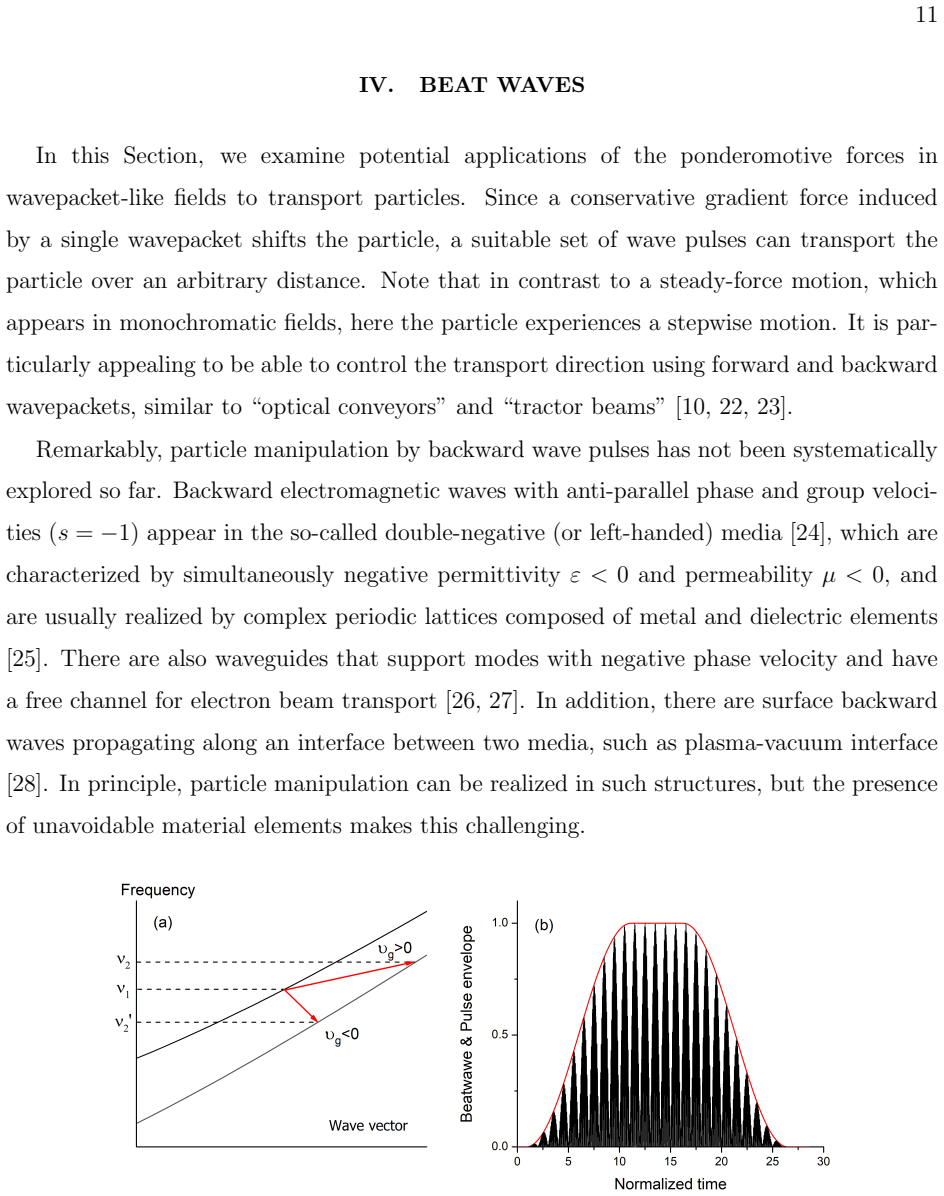
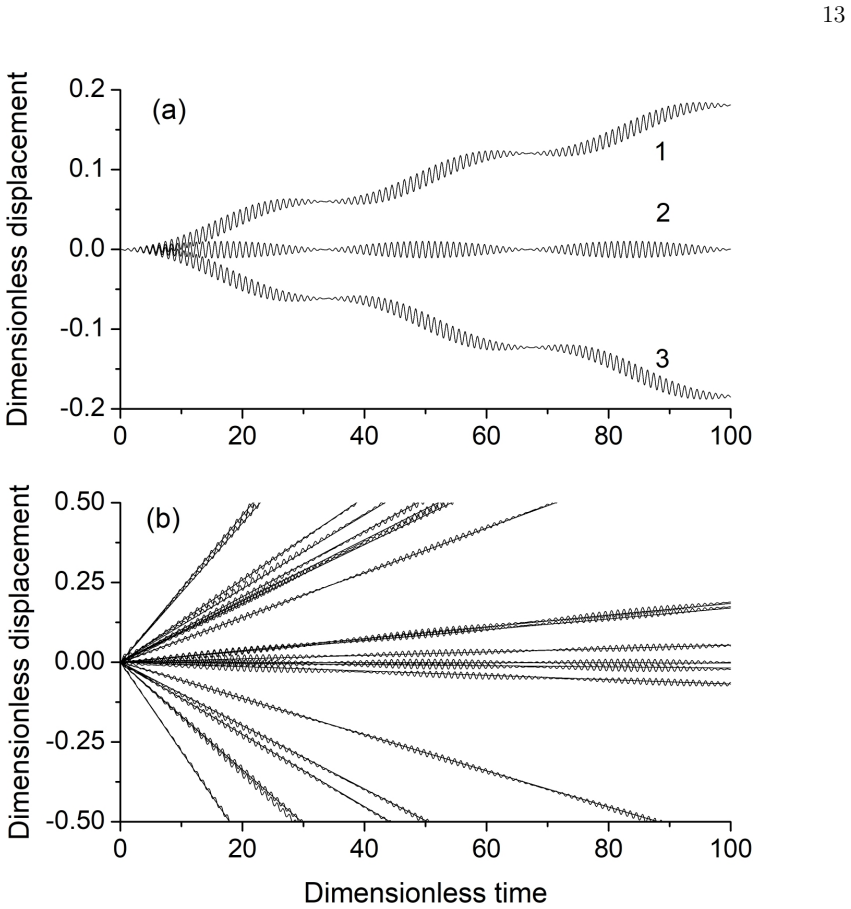
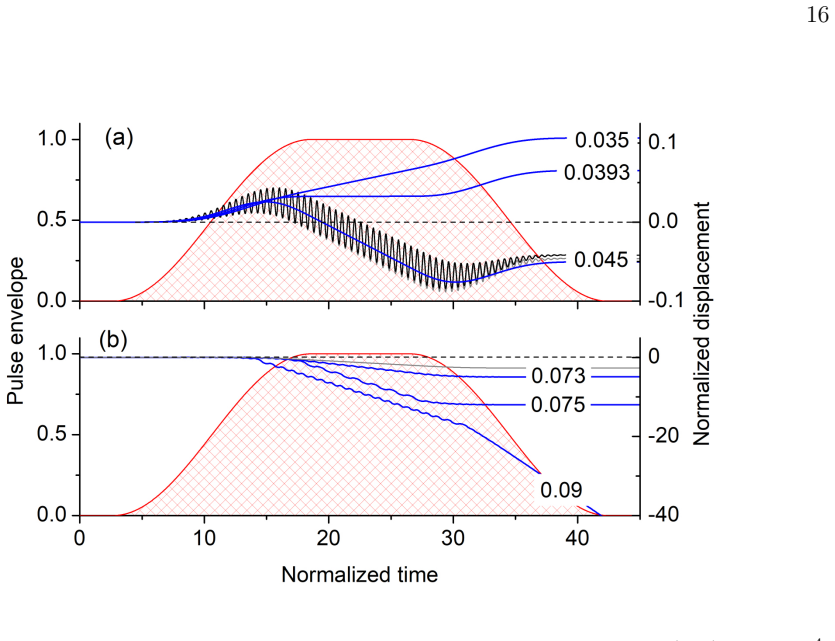
In the fields of forward-propagating and backward-propagating wave packets, small particles experience ponderomotive forces that can either push them away from or pull them toward the source. A beat wave generated by two forward-propagating waves with slightly different frequencies can emulate a periodic sequence of either forward- or backward-propagating pulses, providing a mechanism for realizing pulling forces.
What carries the argument
Ponderomotive force derived from time-averaged field intensity acting on small point particles, dipoles, and dumbbells in propagating wave packets.
If this is right
- Particles experience attractive forces toward the source in wave packets with appropriate characteristics.
- Beat waves allow emulation of backward-propagating pulses using only forward-propagating waves.
- This provides a simple mechanism for realizing pulling forces in optical and acoustic tractor beam applications.
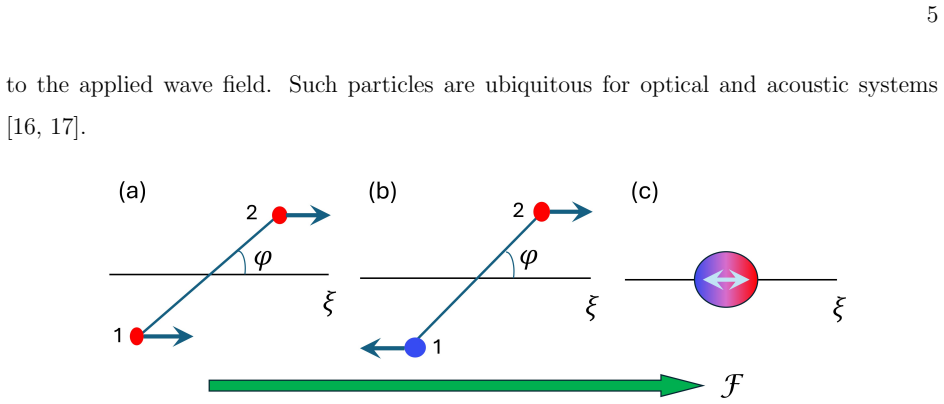
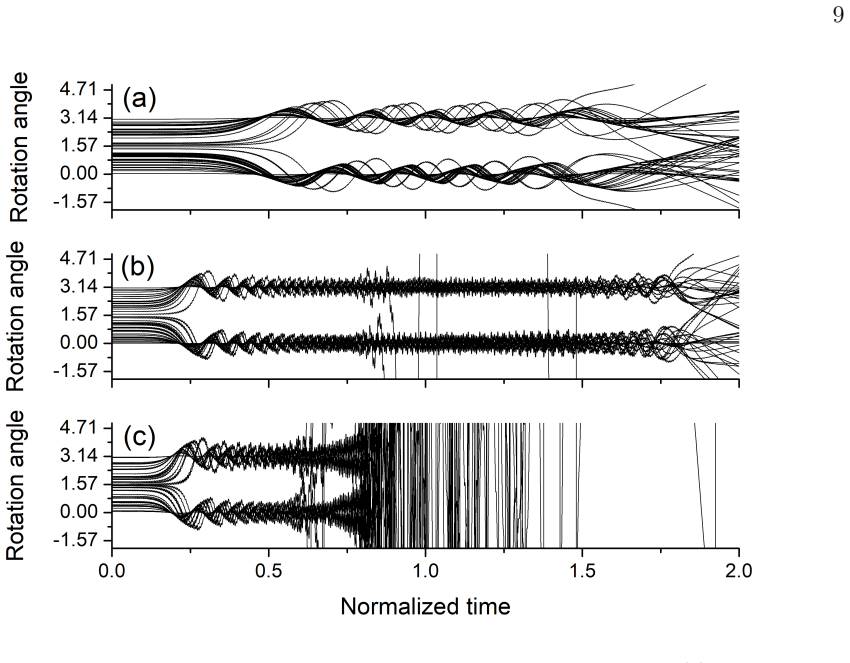
- Composite particles such as dipoles and dumbbells exhibit dynamics distinct from those of point particles.
Where Pith is reading between the lines
- Laboratory setups using laser beams could test the predicted pulling in beat wave configurations.
- The approach may extend to acoustic waves for non-contact manipulation of particles in fluids.
- Cases where particle size becomes comparable to wavelength would require separate analysis of scattering effects.
Load-bearing premise
Particles remain small compared to the wavelength and the force follows directly from time-averaged intensity without higher-order scattering or radiation reaction altering the outcome.
What would settle it
Place a small test particle in a beat wave formed by two forward waves and measure whether its motion is toward or away from the source in a pattern matching the emulated backward pulse direction.
Figures
read the original abstract
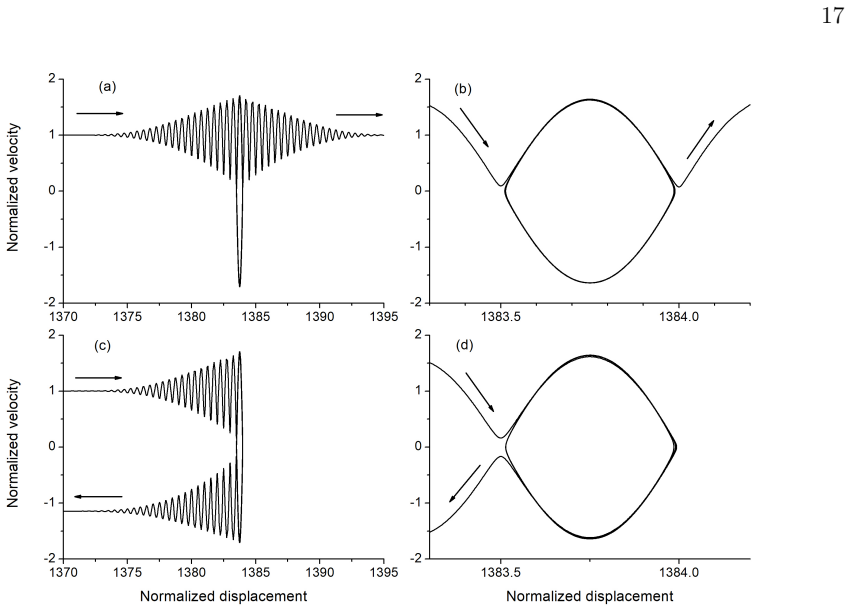
We consider ponderomotive forces acting on small particles in propagating wave packets (pulses). Specifically, we analyze simple point particles as well as composite dipole and dumbbell particles in the fields of forward-propagating (parallel phase and group velocities) and backward-propagating (antiparallel phase and group velocities) wave packets. Depending on the characteristics of the wave packet, particles may be pushed away from the wave source or pulled toward it. We also examine particle dynamics in the field of a beat wave generated by two forward-propagating waves with slightly different frequencies. Such a beat wave can emulate a periodic sequence of either forward- or backward-propagating pulses. In particular, this provides a simple mechanism for realizing pulling forces as employed in optical and acoustic `tractor beams'.
Editorial analysis
A structured set of objections, weighed in public.
Referee Report
Summary. The manuscript analyzes ponderomotive forces on small point particles as well as composite dipole and dumbbell particles in forward-propagating and backward-propagating wave packets. It shows that particles can experience either pushing or pulling forces depending on wave-packet characteristics. The central new element is the demonstration that a beat wave formed by two forward-propagating waves with slightly different frequencies can emulate a periodic train of either forward- or backward-propagating pulses, thereby furnishing a simple mechanism for realizing pulling forces of the type used in optical and acoustic tractor beams.
Significance. If the force calculations are robust, the work supplies a transparent theoretical route to pulling forces that avoids the need for actual backward-propagating waves or complex phase engineering. The explicit treatment of both point-like and extended composite particles is a constructive feature that broadens applicability. The result, if confirmed, could inform experimental designs for tractor-beam implementations.
major comments (2)
- [Beat-wave analysis (likely §4 or §5)] The pulling-force claim for the beat-wave configuration rests on computing the ponderomotive force from the time-averaged intensity gradient alone. The manuscript should supply an explicit estimate (or order-of-magnitude calculation) showing that radiation-reaction and higher-order scattering remain negligible when the net force is directed opposite to the carrier propagation direction; otherwise the phase relationship between the two carriers can be altered and the sign of the effective force reversed.
- [Beat-wave section] The statement that the beat wave 'emulates a periodic sequence of either forward- or backward-propagating pulses' requires a side-by-side comparison of the derived force expressions for the beat wave versus an actual backward-propagating pulse. Without this comparison it is unclear whether the emulation is quantitative or merely qualitative.
minor comments (2)
- [Introduction or Methods] Clarify the precise definition of 'small particle' (size relative to wavelength) and state the regime of validity for the dipole approximation used for the composite particles.
- [Discussion] Add a brief discussion of how the results change if the particles have finite mass or if damping is included; this would help readers assess experimental realizability.
Simulated Author's Rebuttal
We thank the referee for the careful reading of the manuscript and the constructive comments. We address each major comment below and will revise the manuscript to incorporate the requested clarifications.
read point-by-point responses
-
Referee: [Beat-wave analysis (likely §4 or §5)] The pulling-force claim for the beat-wave configuration rests on computing the ponderomotive force from the time-averaged intensity gradient alone. The manuscript should supply an explicit estimate (or order-of-magnitude calculation) showing that radiation-reaction and higher-order scattering remain negligible when the net force is directed opposite to the carrier propagation direction; otherwise the phase relationship between the two carriers can be altered and the sign of the effective force reversed.
Authors: We agree that an explicit estimate is needed to confirm the robustness of the pulling-force result. In the revised manuscript we will add a dedicated paragraph in the beat-wave section that provides an order-of-magnitude comparison of the radiation-reaction force to the ponderomotive force for the intensities and particle sizes under consideration. The estimate shows that radiation-reaction remains smaller by at least two orders of magnitude, preserving the carrier phase relationship and the sign of the net force. Higher-order scattering contributions will be shown to be negligible on the same grounds. revision: yes
-
Referee: [Beat-wave section] The statement that the beat wave 'emulates a periodic sequence of either forward- or backward-propagating pulses' requires a side-by-side comparison of the derived force expressions for the beat wave versus an actual backward-propagating pulse. Without this comparison it is unclear whether the emulation is quantitative or merely qualitative.
Authors: The manuscript already derives the time-averaged ponderomotive force for the beat wave and shows that it reduces to the identical expression obtained for a train of backward-propagating pulses in the small-detuning limit. To make this equivalence fully transparent we will insert a side-by-side table of the force formulas (beat-wave versus backward-pulse-train cases) together with the limiting expressions. This addition will demonstrate that the emulation is quantitative for the purpose of determining force direction and magnitude. revision: yes
Circularity Check
No circularity; derivation is self-contained in standard wave mechanics
full rationale
The paper derives pushing and pulling ponderomotive forces from the time-averaged intensity gradient acting on small particles in wave packets and beat waves. The central mechanism—that a beat wave from two forward-propagating carriers can emulate forward or backward pulses—follows directly from linear superposition and the standard expression for the ponderomotive force, without any quantity being defined in terms of itself, without fitted parameters renamed as predictions, and without load-bearing self-citations or imported uniqueness theorems. All steps remain externally verifiable against classical electromagnetism and do not reduce to the paper's own inputs by construction.
Axiom & Free-Parameter Ledger
Lean theorems connected to this paper
-
IndisputableMonolith/Cost/FunctionalEquation.leanwashburn_uniqueness_aczel unclear?
unclearRelation between the paper passage and the cited Recognition theorem.
Fpond =−1/4(1+2sηg)da2/dθ̄ (Eq. 4); beat-wave double averaging yielding controlled forward/backward transport (Eqs. 22–23)
-
IndisputableMonolith/Foundation/RealityFromDistinction.leanreality_from_one_distinction unclear?
unclearRelation between the paper passage and the cited Recognition theorem.
conservative character of the gradient force … particle remains motionless after the pulse passes (Sec. II)
What do these tags mean?
- matches
- The paper's claim is directly supported by a theorem in the formal canon.
- supports
- The theorem supports part of the paper's argument, but the paper may add assumptions or extra steps.
- extends
- The paper goes beyond the formal theorem; the theorem is a base layer rather than the whole result.
- uses
- The paper appears to rely on the theorem as machinery.
- contradicts
- The paper's claim conflicts with a theorem or certificate in the canon.
- unclear
- Pith found a possible connection, but the passage is too broad, indirect, or ambiguous to say the theorem truly supports the claim.
Reference graph
Works this paper leans on
-
[1]
P. L. Kapitsa, Dynamic stability of a pendulum when its point of suspension vibrates, Sov. Phys. JETP21, 588 (1951)
work page 1951
-
[2]
A. V. Gaponov and M. A. Miller, Potential wells for charged particles in a high-frequency electromagnetic field, Zh. Eksp. Teor. Fiz.34, 242 (1958). 22
work page 1958
-
[3]
Ashkin,Optical Trapping and Manipulation of Neutral Particles Using Lasers(World Sci- entific, 2006)
A. Ashkin,Optical Trapping and Manipulation of Neutral Particles Using Lasers(World Sci- entific, 2006)
work page 2006
-
[4]
D. G. Grier, A revolution in optical manipulation, Nature424, 810 (2003)
work page 2003
- [5]
-
[6]
A. Ozcelik, J. Rufo, F. Guo, Y. Gu, P. Li, J. Lata, and T. J. Huang, Acoustic tweezers for the life sciences, Nat. Methods15, 1021 (2018)
work page 2018
-
[7]
K. Dholakia, B. W. Drinkwater, and M. Ritsch-Marte, Comparing acoustic and optical forces for biomedical research, Nat. Rev. Phys.2, 480 (2020)
work page 2020
-
[8]
I. Toftul, S. Golat, F. J. Rodr´ ıguez-Fortu˜ no, F. Nori, Y. Kivshar, and K. Y. Bliokh, Radiation forces and torques in optics and acoustics, Rev. Mod. Phys. https://doi.org/10.1103/7zdw- p26g (2026)
-
[9]
T. Tajima and J. Dawson, Laser electron accelerator, Phys. Rev. Lett.43, 267 (1979)
work page 1979
-
[10]
D. B. Ruffner and D. G. Grier, Optical Conveyors: A Class of Active Tractor Beams, Phys. Rev. Lett.109, 163903 (2012)
work page 2012
-
[11]
F. G. Mitri, Dynamic acoustic tractor beams, J. Appl. Phys.117, 094903 (2015)
work page 2015
-
[12]
S. Lepeshov and A. Krasnok, Virtual optical pulling force, Optica7, 1024 (2020)
work page 2020
-
[13]
K. Y. Bliokh, Y. P. Bliokh, and F. Nori, Ponderomotive forces, Stokes drift, and momentum in acoustic and electromagnetic waves, Phys. Rev. A106, L021503 (2022)
work page 2022
-
[14]
G. D. Bruce, P. Rodr´ ıguez-Sevilla, and K. Dholakia, Initiating revolutions for optical manip- ulation: the origins and applications of rotational dynamics of trapped particles, Adv. Phys. X6, 1838322 (2021)
work page 2021
-
[15]
J. F. Barry, D. J. McCarron, E. B. Norrgard, M. H. Steinecker, and D. DeMille, Magneto- optical trapping of a diatomic molecule, Nature512, 286 (2014)
work page 2014
-
[16]
C. Maher-McWilliams, P. Douglas, and P. Barker, Laser-driven acceleration of neutral parti- cles, Nat. Photonics6, 386 (2012)
work page 2012
-
[17]
B. W. Drinkwater, A perspective on acoustical tweezers -— devices, forces, and biomedical applications, Appl. Phys. Lett.117, 180501 (2020)
work page 2020
-
[18]
L. D. Landau and E. M. Lifshitz,Mechanics(Elsevier, 1982)
work page 1982
-
[19]
J. B. McLaughlin, Period-doubling bifurcations and chaotic motion for a parametrically forced pendulum, J. Stat. Physics24, 375 (1981). 23
work page 1981
-
[20]
W. van de Water, M. Hoppenbrouwers, and F. Christiansen, Unstable periodic orbits in the parametrically excited pendulum, Phys. Rev. A44, 6388 (1991)
work page 1991
-
[21]
G. B. Whitham,Linear and Nonlinear Waves(John Wiley & Sons, Inc., 1999)
work page 1999
-
[22]
J. Chen, J. Ng, Z. Lin, and C. T. Chan, Optical pulling force, Nat. Photonics5, 531 (2011)
work page 2011
-
[23]
A. Novitsky, C.-W. Qiu, and H. Wang, Single Gradientless Light Beam Drags Particles as Tractor Beams, Phys. Rev. Lett.107, 203601 (2011)
work page 2011
-
[24]
V. G. Veselago, The electrodynamics of substances with simultaneously negative values ofϵ andµ, Sov. Phys. Usp.10, 509 (1968)
work page 1968
-
[25]
D. R. Smith, W. J. Padilla, D. C. Vier, S. C. Nemat-Nasser, and S. Schultz, Composite medium with simultaneously negative permeability and permittivity, Phys. Rev. Lett.84, 4184 (2001)
work page 2001
-
[26]
J. S. Hummelt, X. Lu, H. Xu, I. Mastovsky, M. A. Shapiro, and R. J. Temkin, Coherent Cherenkov-Cyclotron Radiation Excited by an Electron Beam in a Metamaterial Waveguide, Phys. Rev. Lett.117, 237701 (2016)
work page 2016
-
[27]
P. J. B. Clarricoats and R. A. Waldron, Non-periodic slow-wave and backward-wave structures, Journal of Electronics and Control8, 455 (1960)
work page 1960
-
[28]
A. W. Trivelpiece,Slow Wave Propagation in Plasma Waveguides(San Francisco Press Inc., 1967)
work page 1967
-
[29]
O. Brzobohat´ y, V. Kar´ asek, M.ˇSiler, L. Chv´ atal, T.ˇCiˇ zm´ ar, and P. Zem´ anek, Experimental demonstration of optical transport, sorting and self-arrangement using a ‘tractor beam’, Nat. Photonics7, 123 (2013)
work page 2013
-
[30]
M. Yang, Y. Shi, Q. Song, Z. Wei, X. Dun, Z. Wang, Z. Wang, C.-W. Qiu, H. Zhang, and X. Cheng, Optical sorting: past, present and future, Light Sci. Appl.14, 103 (2025)
work page 2025
-
[31]
Sakai, Particle trapping and acceleration by beats of two laser beams in vacuum, J
K. Sakai, Particle trapping and acceleration by beats of two laser beams in vacuum, J. Phys. Soc. Jpn.58, 2325 (1989)
work page 1989
- [32]
- [33]
-
[34]
T. ˇCiˇ zm´ ar, V. Koll´ arov´ a, Z. Bouchal, and P. Zem´ anek, Sub-micron particle organization by self-imaging of non-diffracting beams’, New J. of Phys.8, 43 (2006). 24
work page 2006
-
[35]
M. Sadgrove, S. Wimberger, and S. Chormaic, Quantum coherent tractor beam effect for atoms trapped near a nanowaveguide, Sci. Rep.6, 28905 (2016)
work page 2016
discussion (0)
Sign in with ORCID, Apple, or X to comment. Anyone can read and Pith papers without signing in.