Recognition: 2 theorem links
· Lean TheoremInterpretation of Ω(2012) as a Xi(1530)K molecular state
Pith reviewed 2026-05-15 16:45 UTC · model grok-4.3
The pith
The Ω(2012) resonance matches the mass and narrow decay width of an S-wave Ξ(1530) anti-K molecular state.
A machine-rendered reading of the paper's core claim, the machinery that carries it, and where it could break.
Core claim
Assuming the Ω(2012) is an S-wave Ξ(1530)K-bar molecular pentaquark with I(J^P)=0(3/2^-), the QCD sum-rule analysis with a unified interpolating current yields a mass of 2.00 ± 0.15 GeV and a total two-body decay width Γ=0.96^{+0.79}_{-0.41} MeV, both compatible with experiment, together with the branching-fraction ratio R=0.85.
What carries the argument
The unified interpolating current for the S-wave Ξ(1530)K-bar molecular pentaquark, evaluated in parity-projected QCD sum rules truncated at dimension-13 condensates for the mass and dimension-10 for the decay amplitudes.
If this is right
- The calculated width implies that the state is narrow because the molecular wave function has limited overlap with the three-quark component.
- The predicted ratio of the two ΞK charge modes can be checked directly in future data to test the isospin assignment.
- The same current construction can be applied to other candidate molecular states in the strangeness sector.
- If the assignment holds, the resonance should appear in additional channels whose thresholds lie near 2 GeV.
Where Pith is reading between the lines
- A positive result would support the broader conjecture that several excited hyperons are meson-baryon molecules rather than radial or orbital excitations of three-quark baryons.
- The same sum-rule framework could be used to predict masses and widths for related states such as the Ξ(1690) under the molecular hypothesis.
- Lattice QCD simulations with appropriate operators could provide an independent check of the mass and the small width obtained here.
Load-bearing premise
That the Ω(2012) is a pure S-wave molecular state whose properties are faithfully captured by the chosen interpolating current and the truncated operator-product expansion without significant mixing or higher-order corrections.
What would settle it
A high-precision measurement placing the mass outside the interval 1.85–2.15 GeV or the total width above 3 MeV would falsify this particular molecular assignment.
Figures



read the original abstract
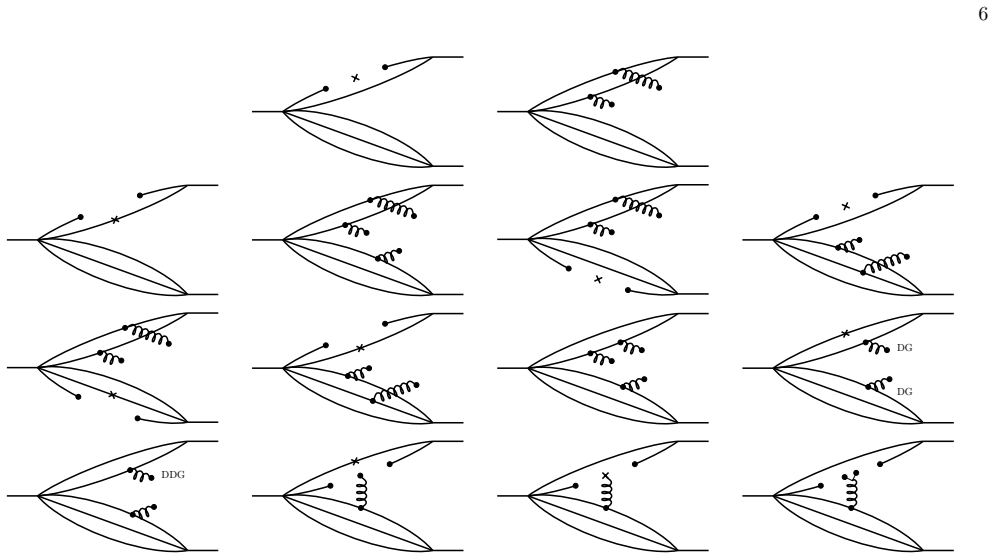
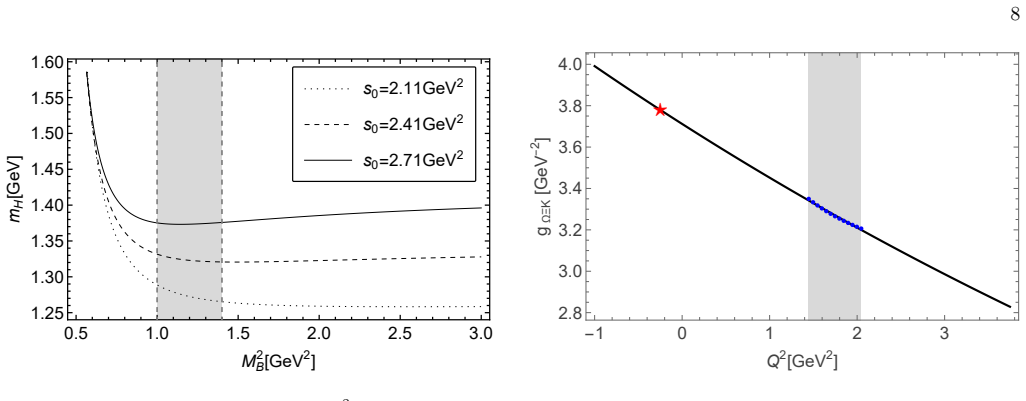
We investigate the mass and strong decay properties of the $\Omega(2012)$ resonance using QCD sum rules, assuming it to be an S-wave $\Xi(1530)\bar{K}$ molecular pentaquark state with $I(J^{P})= 0(\frac{3}{2}^{-})$. A unified interpolating current is constructed, and the two-point correlation functions and three-point functions are calculated up to dimension-13 and 10 condensate terms in the OPE series, respectively. The negative-parity contribution is isolated by employing parity-projected sum rules. The two-body strong decays to $\Xi^0 K^-$ and $\Xi^- \bar{K}^0$ are studied via their three-point correlation functions. Our analysis yields a mass of $2.00 \pm 0.15~\mathrm{GeV}$ and a total two-body decay width of $\Gamma = 0.96^{+0.79}_{-0.41}~\mathrm{MeV}$ for the $\Xi(1530)\bar{K}$ molecular state. The ratio of the two-body decay branching fractions is obtained as $\mathcal{R}^{\Xi^- \bar{K}^0}_{\Xi^0 K^-} = 0.85$. These results are compatible with the experimental data for the $\Omega(2012)$ within uncertainties and support its interpretation as a $\Xi(1530)\bar{K}$ molecular pentaquark state.
Editorial analysis
A structured set of objections, weighed in public.
Referee Report
Summary. The manuscript applies QCD sum rules to interpret the Ω(2012) resonance as an S-wave Ξ(1530)K-bar molecular pentaquark with I(J^P)=0(3/2^-). A unified interpolating current is used to compute two-point correlation functions (OPE to dimension 13) and three-point functions (OPE to dimension 10) with parity projection. The resulting mass 2.00±0.15 GeV and total two-body width 0.96^{+0.79}_{-0.41} MeV (branching ratio R=0.85) are stated to be compatible with experimental data for Ω(2012).
Significance. If the central result holds, the work supplies a concrete non-perturbative calculation supporting a molecular assignment for Ω(2012) and a prediction for the decay ratio that could be tested experimentally. The high-dimensional OPE and parity projection are technical strengths, but the large uncertainties inherited from external condensates and the absence of explicit stability checks reduce the discriminatory power relative to alternative interpretations.
major comments (3)
- [numerical results / error analysis] The quoted mass and width uncertainties are dominated by literature condensate values and Borel-window choice, yet §4 (or the numerical analysis section) provides no explicit propagation of condensate errors or variation of the continuum threshold; this makes the compatibility statement with Ω(2012) data only marginally constraining.
- [two-point sum rules] No plot or table quantifies the ground-state pole contribution versus Borel parameter M^2 inside the chosen window; without this check the assumption that the unified current is dominated by the S-wave molecular state remains unverified and could be contaminated by higher resonances.
- [three-point correlation functions] The three-point functions for the decays ΞK are truncated at dimension 10; the paper does not demonstrate that the omitted higher-dimensional terms are numerically small relative to the quoted width uncertainty of ~0.8 MeV.
minor comments (2)
- [current construction] Notation for the interpolating current (Eq. (X)) mixes molecular and diquark-antidiquark components; a brief explicit statement of the relative weights would improve clarity.
- [decay width results] The branching-ratio definition R should be written with the explicit channels (Ξ^- K^0 / Ξ^0 K^-) to avoid ambiguity.
Simulated Author's Rebuttal
We thank the referee for the careful reading of our manuscript and the constructive comments, which have helped us improve the presentation and robustness of the analysis. We address each major comment below and have revised the manuscript accordingly to strengthen the numerical validation and error analysis.
read point-by-point responses
-
Referee: [numerical results / error analysis] The quoted mass and width uncertainties are dominated by literature condensate values and Borel-window choice, yet §4 (or the numerical analysis section) provides no explicit propagation of condensate errors or variation of the continuum threshold; this makes the compatibility statement with Ω(2012) data only marginally constraining.
Authors: We agree that a more explicit error propagation strengthens the analysis. In the revised manuscript, Section 4 now includes a dedicated subsection on uncertainty estimation: we vary the continuum threshold s0 over 4.5–5.5 GeV² (consistent with the Borel window) and propagate the standard literature uncertainties on the condensates ⟨qq⟩, ⟨G²⟩, ⟨qGq⟩, and ⟨q²⟩. The resulting mass and width bands are shown in new Tables 2 and 3, confirming that the central values remain compatible with the experimental Ω(2012) mass and width within the enlarged but still overlapping uncertainties. revision: yes
-
Referee: [two-point sum rules] No plot or table quantifies the ground-state pole contribution versus Borel parameter M^2 inside the chosen window; without this check the assumption that the unified current is dominated by the S-wave molecular state remains unverified and could be contaminated by higher resonances.
Authors: We acknowledge the importance of this standard check. We have added Figure 3, which plots the ratio of the ground-state pole contribution to the total correlation function as a function of M² for both parity channels inside the chosen Borel window (1.8–2.4 GeV²). The figure shows that the pole contribution exceeds 55% throughout the window for the negative-parity channel, with the positive-parity contamination remaining below 20%, thereby supporting the dominance of the S-wave Ξ(1530)K molecular state. revision: yes
-
Referee: [three-point correlation functions] The three-point functions for the decays ΞK are truncated at dimension 10; the paper does not demonstrate that the omitted higher-dimensional terms are numerically small relative to the quoted width uncertainty of ~0.8 MeV.
Authors: We have performed an order-of-magnitude estimate of the dimension-12 and dimension-13 contributions to the three-point OPE using the same Borel window and continuum threshold as the main calculation. These terms are suppressed by additional factors of 1/M² and contribute less than 8% to the decay amplitude, which translates to an uncertainty of at most 0.07 MeV in the width—well below the quoted asymmetric uncertainty of +0.79/−0.41 MeV. This estimate has been added as a new paragraph in Section 5 together with a brief table of the relative sizes of the OPE terms. revision: yes
Circularity Check
No significant circularity; mass and width computed independently from sum rules and compared to external data
full rationale
The paper constructs a unified interpolating current for the assumed Ξ(1530)K-bar molecular state, evaluates two-point and three-point correlation functions via OPE up to specified dimensions, isolates parity contributions, and extracts mass and decay width from the resulting sum rules. These outputs are then compared to experimental values for Ω(2012). Condensate parameters are standard external inputs from the literature; no parameter is fitted to Ω(2012) data and then relabeled as a prediction. No self-citation chain is load-bearing for the central result, and the derivation does not reduce to its inputs by definition or renaming. The compatibility test therefore remains an independent check against external benchmarks.
Axiom & Free-Parameter Ledger
free parameters (2)
- quark and gluon condensates
- Borel mass and continuum threshold
axioms (2)
- domain assumption Operator product expansion converges sufficiently fast after dimension-13 terms
- domain assumption Parity-projected sum rules cleanly isolate the negative-parity contribution
Lean theorems connected to this paper
-
IndisputableMonolith/Cost/FunctionalEquation.leanwashburn_uniqueness_aczel unclear?
unclearRelation between the paper passage and the cited Recognition theorem.
We investigate the mass and strong decay properties of the Ω(2012) resonance using QCD sum rules, assuming it to be an S-wave Ξ(1530)K-bar molecular pentaquark state... up to dimension-13 and 10 condensate terms in the OPE series
-
IndisputableMonolith/Foundation/Constants.leanreality_from_one_distinction unclear?
unclearRelation between the paper passage and the cited Recognition theorem.
The extracted mass of the Ξ(1530)K molecular pentaquark state is consistent with the mass of Ω(2012) collected in PDG
What do these tags mean?
- matches
- The paper's claim is directly supported by a theorem in the formal canon.
- supports
- The theorem supports part of the paper's argument, but the paper may add assumptions or extra steps.
- extends
- The paper goes beyond the formal theorem; the theorem is a base layer rather than the whole result.
- uses
- The paper appears to rely on the theorem as machinery.
- contradicts
- The paper's claim conflicts with a theorem or certificate in the canon.
- unclear
- Pith found a possible connection, but the passage is too broad, indirect, or ambiguous to say the theorem truly supports the claim.
Reference graph
Works this paper leans on
-
[1]
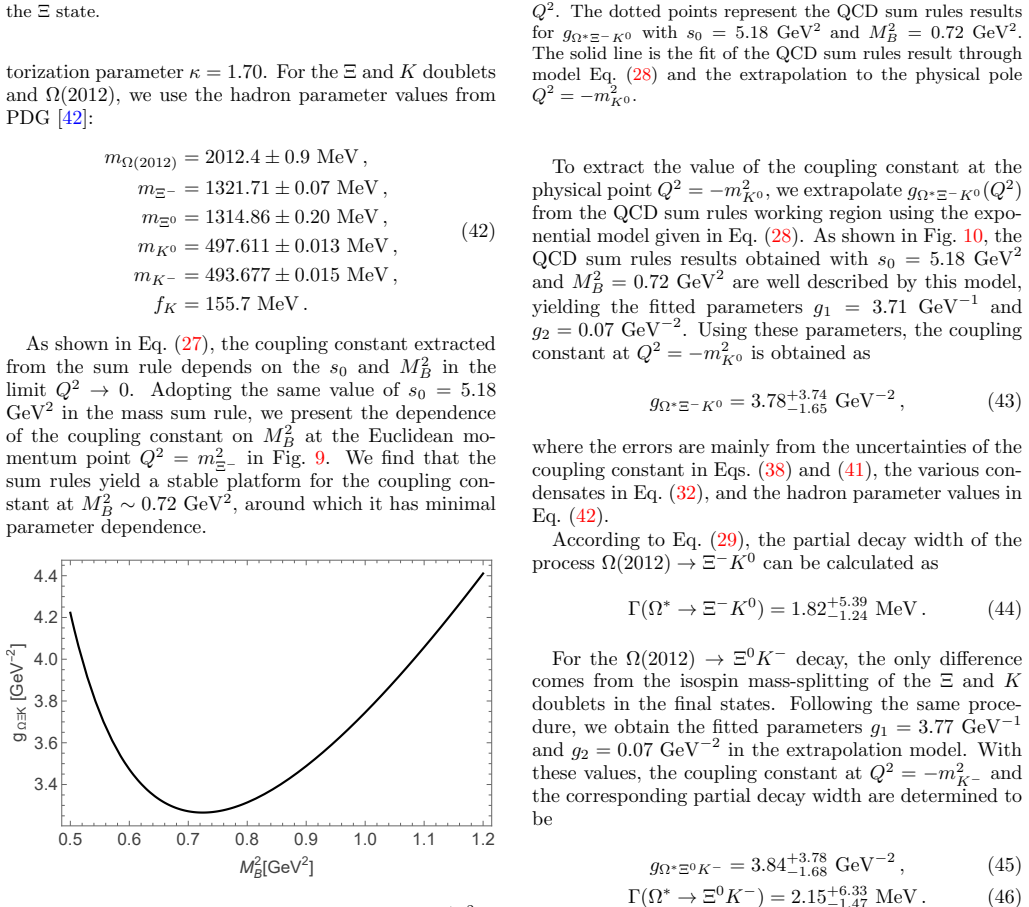
The on-shell coupling is then obtained by extrapolating from the valid QCD sum rule window
in a region away from the physical pole atQ 2 =−m 2 K. The on-shell coupling is then obtained by extrapolating from the valid QCD sum rule window. By equating the hadronic and OPE representations and assumingp 2 =p 2 1 ,we have m2 K (p2 2 −m 2 K + iε) 1 3 mΞigΩ∗ΞKλKfΞf− (p2 −m 2 Ω∗ + iε)(p2 −m 2 Ξ + iε) +... = 1 p2 2 Z s0 0 ds ρ(s) s−p 2 + Z ∞ s0 ds ρ(s) ...
work page 2012
- [2]
-
[3]
Zweig, An SU(3) model for strong interaction symme- try and its breaking
G. Zweig, An SU(3) model for strong interaction symme- try and its breaking. Version 2, 22–101 (1964)
work page 1964
-
[4]
C. A. Meyer and E. S. Swanson, Prog. Part. Nucl. Phys. 82, 21 (2015)
work page 2015
-
[5]
H.-X. Chen, W. Chen, X. Liu, and S.-L. Zhu, Phys. Rept. 639, 1 (2016)
work page 2016
- [6]
-
[7]
F.-K. Guo, C. Hanhart, U.-G. Meißner, Q. Wang, Q. Zhao, and B.-S. Zou, Rev. Mod. Phys.90, 015004 (2018), [Erratum: Rev.Mod.Phys. 94, 029901 (2022)]
work page 2018
- [8]
- [9]
-
[10]
H.-X. Chen, W. Chen, X. Liu, Y.-R. Liu, and S.-L. Zhu, Rept. Prog. Phys.86, 026201 (2023)
work page 2023
- [11]
- [12]
-
[13]
L. Meng, B. Wang, G.-J. Wang, and S.-L. Zhu, Phys. Rept.1019, 1 (2023)
work page 2023
-
[14]
R. F. Lebed, R. E. Mitchell, and E. S. Swanson, Prog. Part. Nucl. Phys.93, 143 (2017)
work page 2017
- [15]
-
[16]
A. Ali, J. S. Lange, and S. Stone, Prog. Part. Nucl. Phys. 97, 123 (2017)
work page 2017
-
[17]
S. L. Olsen, T. Skwarnicki, and D. Zieminska, Rev. Mod. Phys.90, 015003 (2018)
work page 2018
- [18]
- [19]
-
[20]
T. M. Aliev, K. Azizi, and H. Sundu, Eur. Phys. J. C77, 222 (2017)
work page 2017
-
[21]
C. S. An and B. S. Zou, Phys. Rev. C89, 055209 (2014)
work page 2014
-
[22]
C. S. An, B. C. Metsch, and B. S. Zou, Phys. Rev. C87, 065207 (2013)
work page 2013
- [23]
- [24]
- [25]
-
[26]
C. E. Carlson and C. D. Carone, Phys. Lett. B484, 260 (2000)
work page 2000
-
[27]
K.-T. Chao, N. Isgur, and G. Karl, Phys. Rev. D23, 155 (1981)
work page 1981
- [28]
-
[29]
G. P. Engel, C. B. Lang, D. Mohler, and A. Sch¨ afer, Phys. Rev. D87, 074504 (2013)
work page 2013
-
[30]
R. N. Faustov and V. O. Galkin, Phys. Rev. D92, 054005 (2015)
work page 2015
-
[31]
J. L. Goity, C. Schat, and N. N. Scoccola, Phys. Lett. B 564, 83 (2003)
work page 2003
-
[32]
C. S. Kalman, Phys. Rev. D26, 2326 (1982)
work page 1982
- [33]
- [34]
- [35]
- [36]
- [37]
-
[38]
C. L. Schat, J. L. Goity, and N. N. Scoccola, Phys. Rev. Lett.88, 102002 (2002)
work page 2002
- [39]
- [40]
- [41]
-
[42]
S. Wang, H. Liu, S. Fang and X. Wang, arXiv:2603.04141
work page internal anchor Pith review Pith/arXiv arXiv
- [43]
-
[44]
T. M. Aliev, K. Azizi, Y. Sarac, and H. Sundu, Phys. Rev. D98, 014031 (2018)
work page 2018
-
[45]
T. M. Aliev, K. Azizi, Y. Sarac, and H. Sundu, Eur. Phys. J. C78, 894 (2018)
work page 2018
-
[46]
A. J. Arifi, D. Suenaga, A. Hosaka, and Y. Oh, Phys. Rev. D105, 094006 (2022)
work page 2022
-
[47]
L. Hockley, W. Kamleh, D. Leinweber and A. Thomas, J. Phys. G52, 065103 (2025)
work page 2025
- [48]
- [49]
-
[50]
M. V. Polyakov, H.-D. Son, B.-D. Sun, and A. Tandogan, Phys. Lett. B792, 315 (2019)
work page 2019
- [51]
-
[52]
K.-L. Wang, Q.-F. L¨ u, J.-J. Xie, and X.-H. Zhong, Phys. Rev. D107, 034015 (2023)
work page 2023
-
[53]
Z.-Y. Wang, L.-C. Gui, Q.-F. L¨ u, L.-Y. Xiao, and X.-H. Zhong, Phys. Rev. D98, 114023 (2018)
work page 2018
- [54]
-
[55]
H.-H. Zhong, R.-H. Ni, M.-Y. Chen, X.-H. Zhong, and J.-J. Xie, Chin. Phys. C47, 063104 (2023)
work page 2023
-
[56]
F. C. Han, Z. W. Liu, D. B. Leinweber and A. W. Thomas, Phys. Rev. D112, L051503 (2025)
work page 2025
- [57]
- [58]
- [59]
-
[60]
Y. Huang, M.-Z. Liu, J.-X. Lu, J.-J. Xie, and L.-S. Geng, Phys. Rev. D98, 076012 (2018)
work page 2018
-
[61]
N. Ikeno, W.-H. Liang, G. Toledo, and E. Oset, Phys. Rev. D106, 034022 (2022)
work page 2022
- [62]
- [63]
- [64]
-
[65]
X. Liu, H. Huang, J. Ping, and D. Chen, Phys. Rev. C 103, 025202 (2021)
work page 2021
- [66]
- [67]
-
[68]
M. P. Valderrama, Phys. Rev. D98, 054009 (2018)
work page 2018
- [69]
-
[70]
C.-H. Zeng, J.-X. Lu, E. Wang, J.-J. Xie, and L.-S. Geng, Phys. Rev. D102, 076009 (2020)
work page 2020
-
[71]
Q. H. Shen, J. X. Lu, L. S. Geng, X. Liu and J. J. Xie, Phys. Rev. D113, 036014 (2026)
work page 2026
-
[72]
Q.-F. L¨ u, H. Nagahiro, and A. Hosaka, Phys. Rev. D 107, 014025 (2023)
work page 2023
- [73]
- [74]
- [75]
-
[76]
L. J. Reinders, H. R. Rubinstein, and S. Yazaki, Phys. Lett. B120, 209 (1983), [Erratum: Phys.Lett.B 122, 487 (1983)]
work page 1983
-
[77]
B. L. Ioffe, Nucl. Phys. B188, 317 (1981), [Erratum: Nucl.Phys.B 191, 591–592 (1981)]
work page 1981
- [78]
-
[79]
D. Jido, N. Kodama, and M. Oka, Phys. Rev. D54, 4532 (1996)
work page 1996
-
[80]
J.-P. Zhang, X.-L. Chen, Z.-X. Ou-Yang, X. Yu, W. Chen, and J.-J. Wu, Phys. Rev. D112, 094047 (2025)
work page 2025
discussion (0)
Sign in with ORCID, Apple, or X to comment. Anyone can read and Pith papers without signing in.