On topological frustration and graphene magnonics
Pith reviewed 2026-05-15 07:58 UTC · model grok-4.3
The pith
Topological frustration in honeycomb lattices produces fully flat bands at the Fermi level in graphene nanomeshes.
A machine-rendered reading of the paper's core claim, the machinery that carries it, and where it could break.
Core claim
Graph-theoretic topological frustration on finite honeycomb lattice pieces with even site count persists in 2D systems, yielding fully flat electronic bands located at the Fermi level that can be systematically constructed for graphene monolayer nanomeshes, which are prone to antiferromagnetic ordering and hybrid spin-wave excitations mixing weak ferromagnetic and strong antiferromagnetic features.
What carries the argument
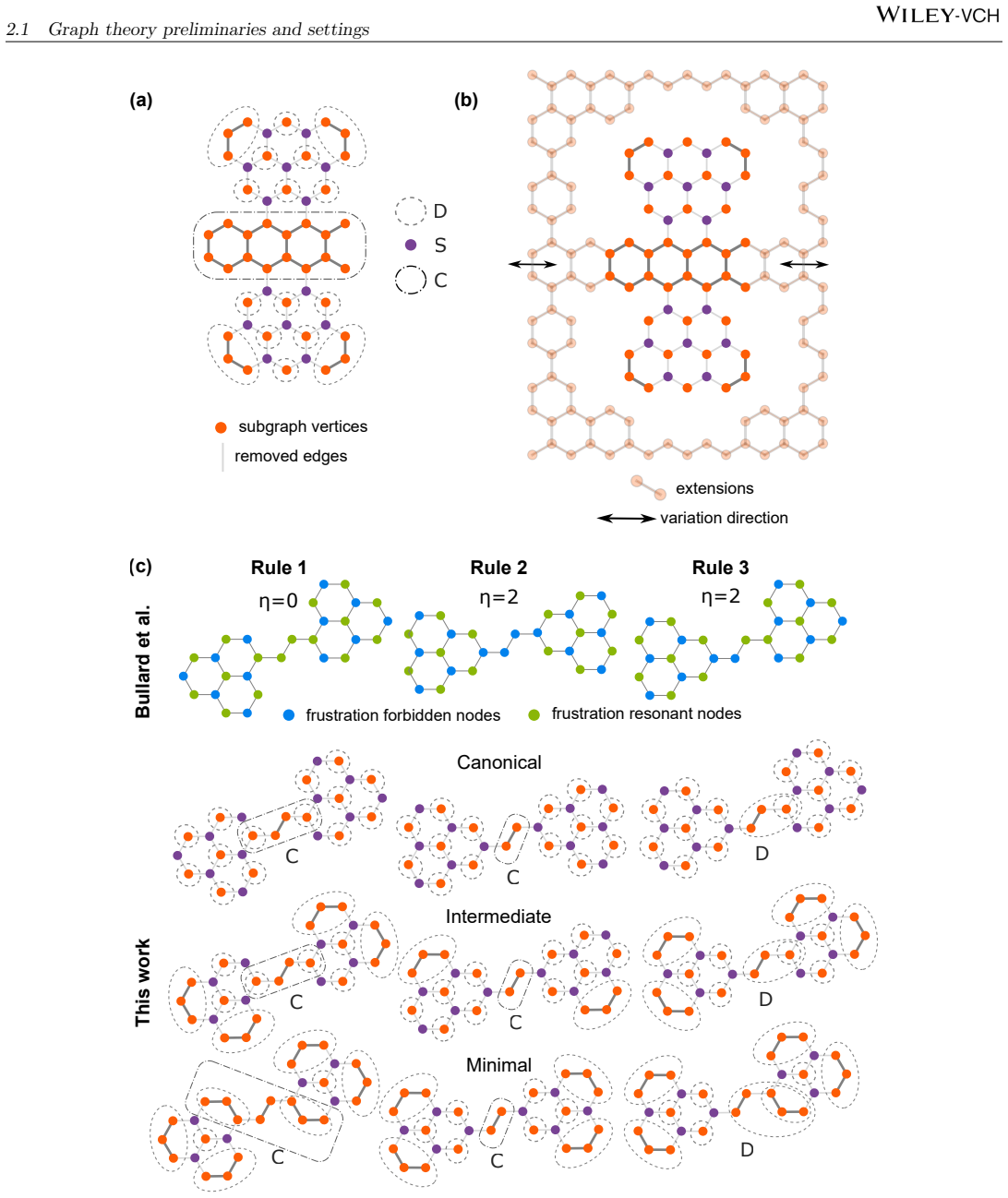
Graph-theoretic topological frustration on finite honeycomb pieces, which prevents full pairwise coupling of sites via nearest-neighbor links despite an even total site count.
Load-bearing premise
The assumption that topological frustration defined on finite even-site honeycomb pieces directly generates fully flat bands and the associated magnetic ordering in extended or periodic 2D nanomeshes without boundary or periodicity effects changing the outcome.
What would settle it
A band-structure calculation or measurement on a periodic graphene nanomesh constructed from even-site honeycomb units that shows the bands are not flat at the Fermi level or that antiferromagnetic ordering is absent.
Figures
read the original abstract
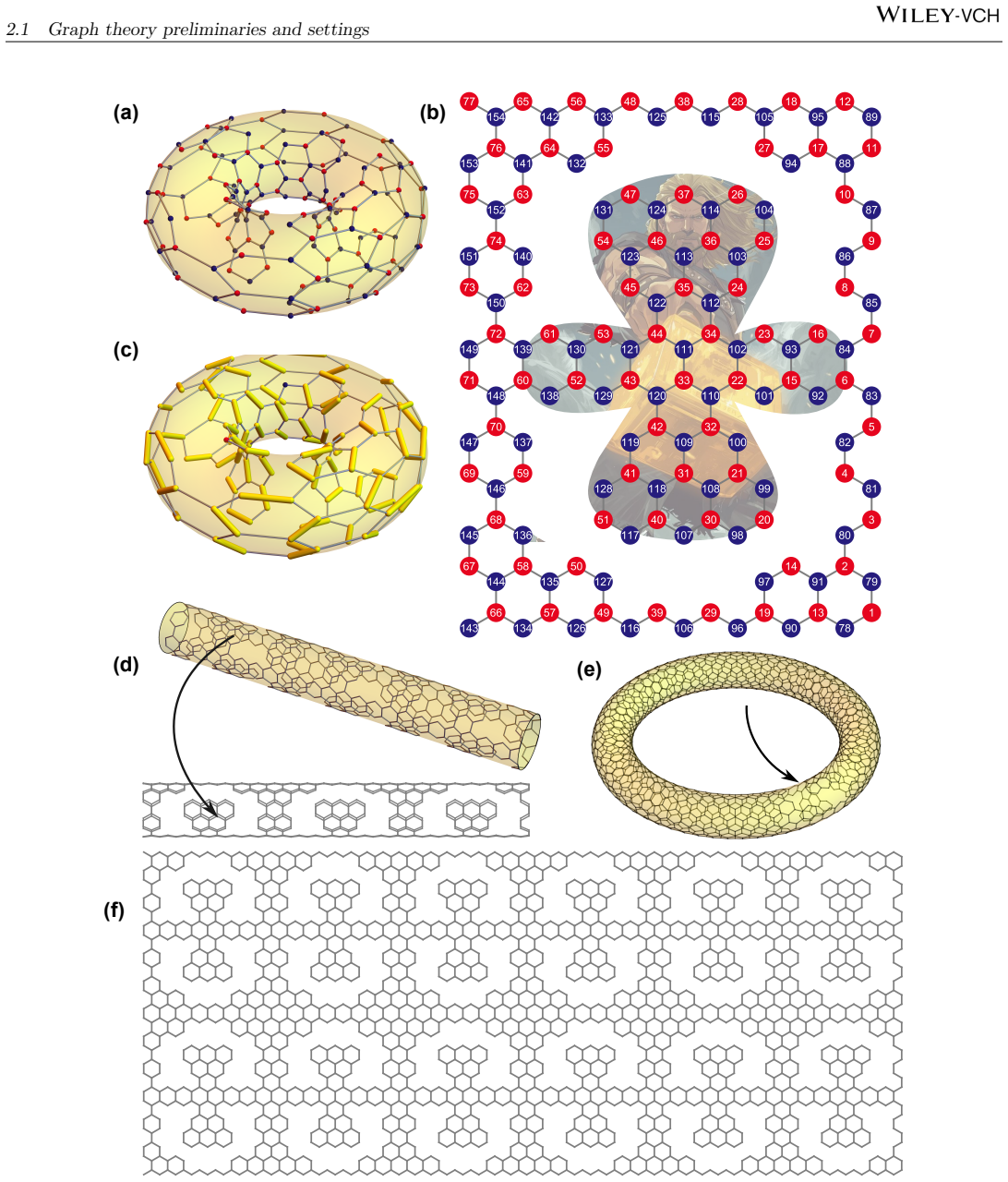
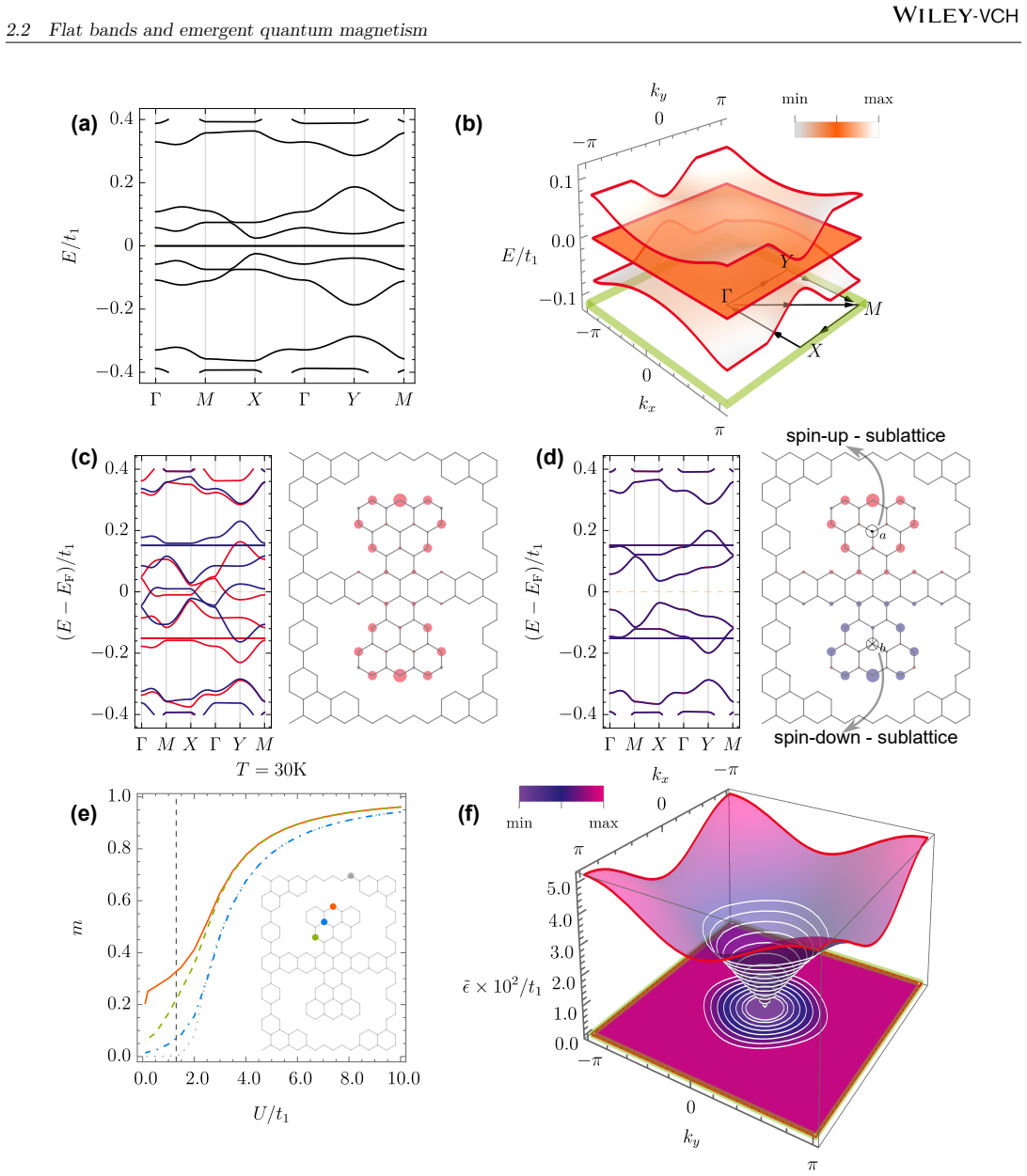
The graph-theoretic topological frustration is a peculiar situation on a finite piece of the honeycomb lattice that prevents a full pairwise coupling of the lattice sites via nearest neighbor links, even when the total number of sites is an even number. This type of frustration is inherent for organic molecules that are classified as concealed non-Kekulean hydrocarbons, representing peculiar diradicals. Here we show that this topological frustration persists in 2D systems based on honeycomb lattice. Such systems exhibit fully flat electronic energy bands located at the Fermi level. Therefore, 2D ultimately flat bands can be systematically and predictably constructed for graphene monolayer nanomeshes. These systems are prone to antiferromagnetic ordering and hybrid spin-wave excitations mixing weak ferromagnetic and strong antiferromagnetic features, which could pave the way towards low-power, compact, and ultrafast organic spintronics with near room-temperature operation.
Editorial analysis
A structured set of objections, weighed in public.
Referee Report
Summary. The manuscript argues that graph-theoretic topological frustration—preventing full Kekulé pairing even on even-site finite honeycomb fragments—persists when such structures are extended to two-dimensional graphene monolayer nanomeshes. This produces fully flat electronic bands at the Fermi level, which in turn drive antiferromagnetic ordering and hybrid spin-wave excitations mixing weak ferromagnetic and strong antiferromagnetic character, offering a route to low-power, room-temperature organic spintronics.
Significance. If the flat bands remain exactly dispersionless under periodic boundary conditions and the magnetic ordering follows rigorously from the frustration, the work would supply a systematic, graph-theoretic route to engineer flat bands in graphene-derived systems. This could advance magnonics by enabling predictable hybrid spin waves, provided the derivations are parameter-free and the predictions are falsifiable via transport or spectroscopy.
major comments (2)
- [Abstract] Abstract: the claim that topological frustration on finite even-site honeycomb pieces 'persists' and yields 'fully flat' bands in periodic 2D nanomeshes is load-bearing yet unsupported by any displayed tight-binding Hamiltonian or Bloch-state calculation; standard supercell models of honeycomb meshes allow residual inter-cell hoppings that generically disperse zero modes unless the geometry enforces exact sublattice isolation per cell.
- [Magnetic ordering and spin waves] Section on magnetic ordering and spin waves: the assertion of antiferromagnetic ordering together with 'hybrid spin-wave excitations' mixing weak FM and strong AFM features lacks an explicit Heisenberg or t-J model, spin-wave dispersion, or magnon band structure; without these the hybrid character and room-temperature stability cannot be assessed.
minor comments (2)
- Notation for the graph-theoretic frustration (e.g., definition of incomplete pairing) should be introduced with an equation or figure in the main text rather than left implicit from the abstract.
- The manuscript would benefit from a clear statement of the tight-binding parameters (hopping t, on-site energies) used to obtain the flat bands, even if they are set to standard graphene values.
Simulated Author's Rebuttal
We thank the referee for the careful reading and constructive criticism. We address each major comment below and indicate the revisions that will be incorporated.
read point-by-point responses
-
Referee: [Abstract] Abstract: the claim that topological frustration on finite even-site honeycomb pieces 'persists' and yields 'fully flat' bands in periodic 2D nanomeshes is load-bearing yet unsupported by any displayed tight-binding Hamiltonian or Bloch-state calculation; standard supercell models of honeycomb meshes allow residual inter-cell hoppings that generically disperse zero modes unless the geometry enforces exact sublattice isolation per cell.
Authors: We agree that an explicit calculation is required to substantiate the persistence of exactly flat bands. The manuscript's graph-theoretic construction selects supercell geometries that enforce sublattice isolation, eliminating residual inter-cell hoppings that would otherwise disperse the zero modes. To make this rigorous, we will add the periodic tight-binding Hamiltonian together with the Bloch-state diagonalization demonstrating that the flat bands at the Fermi level remain dispersionless throughout the Brillouin zone. revision: yes
-
Referee: [Magnetic ordering and spin waves] Section on magnetic ordering and spin waves: the assertion of antiferromagnetic ordering together with 'hybrid spin-wave excitations' mixing weak FM and strong AFM features lacks an explicit Heisenberg or t-J model, spin-wave dispersion, or magnon band structure; without these the hybrid character and room-temperature stability cannot be assessed.
Authors: We accept that a quantitative spin-wave analysis is needed. The antiferromagnetic order is expected from the flat-band Hubbard model at half filling, while the hybrid character arises from the residual frustration that mixes weak ferromagnetic and strong antiferromagnetic exchange. We will add an explicit effective Heisenberg Hamiltonian derived from the electronic structure and the corresponding magnon dispersion, which will allow assessment of the hybrid modes and the relevant energy scales. revision: yes
Circularity Check
No circularity: flat-band claim presented as extension of graph-theoretic frustration without definitional reduction
full rationale
The abstract asserts that topological frustration on finite even-site honeycomb fragments persists in 2D nanomeshes and thereby produces fully flat bands at the Fermi level, allowing systematic construction. No equations, fitted parameters, or self-citations appear in the provided text. The central step is framed as a 'show that' result rather than a renaming, self-definition, or prediction forced by prior inputs. Because the derivation chain is not exhibited as reducing to its own premises by construction, the paper remains self-contained against external benchmarks and receives the default non-circularity finding.
Axiom & Free-Parameter Ledger
axioms (1)
- standard math Graph-theoretic definition of topological frustration on finite honeycomb pieces with even site count prevents perfect nearest-neighbor matching
Lean theorems connected to this paper
-
IndisputableMonolith/Foundation/AlexanderDuality.leanalexander_duality_circle_linking unclear?
unclearRelation between the paper passage and the cited Recognition theorem.
graph-theoretic topological frustration ... on a torus ... fully flat electronic energy bands located at the Fermi level
What do these tags mean?
- matches
- The paper's claim is directly supported by a theorem in the formal canon.
- supports
- The theorem supports part of the paper's argument, but the paper may add assumptions or extra steps.
- extends
- The paper goes beyond the formal theorem; the theorem is a base layer rather than the whole result.
- uses
- The paper appears to rely on the theorem as machinery.
- contradicts
- The paper's claim conflicts with a theorem or certificate in the canon.
- unclear
- Pith found a possible connection, but the passage is too broad, indirect, or ambiguous to say the theorem truly supports the claim.
Reference graph
Works this paper leans on
-
[1]
T. Jiao, C.-H. Wu, Y.-S. Zhang, X. Miao, S. Wu, S.-D. Jiang, J. Wu,Nat. Chem.2025,17, 6 924
work page 2025
- [2]
- [3]
-
[4]
A. Janˇ caˇ r´ ık, D. Mildner, Y. Nagata, M. Banasiewicz, J. Olas, B. Kozankiewicz, J. Holec, A. Gour- don,Chem. Eur. J.2021,27, 48 12388
work page 2021
-
[5]
A. Janˇ caˇ r´ ık, J. Holec, Y. Nagata, M.ˇS´ amal, A. Gourdon,Nat. Commun.2022,13, 1 223
work page 2022
-
[6]
Z. Ruan, J. Schramm, J. B. Bauer, T. Naumann, H. F. Bettinger, R. Tonner-Zech, J. M. Gottfried, J. Am. Chem. Soc.2024,146, 6 3700
work page 2024
-
[7]
Z. Ruan, J. Schramm, J. B. Bauer, T. Naumann, L. V. M¨ uller, F. S¨ attele, H. F. Bettinger, R. Tonner-Zech, J. M. Gottfried,J. Am. Chem. Soc.2025,147, 6 4862–4870
work page 2025
-
[8]
P. Ruffieux, S. Wang, B. Yang, C. S´ anchez-S´ anchez, J. Liu, T. Dienel, L. Talirz, P. Shinde, C. A. Pignedoli, D. Passerone, T. Dumslaff, X. Feng, K. M¨ ullen, R. Fasel,Nature2016,531, 7595 489
-
[9]
L. H. C. M. Nunes, C. M. Smith,Phys. Rev. B2020,101, 22 224514. 20
discussion (0)
Sign in with ORCID, Apple, or X to comment. Anyone can read and Pith papers without signing in.