Delay-Controlled Heterogeneous Nucleation in Adaptive Dynamical Networks
Pith reviewed 2026-05-10 20:13 UTC · model grok-4.3
The pith
Connection delays control whether synchronization emerges in single or multiple steps via heterogeneous nucleation.
A machine-rendered reading of the paper's core claim, the machinery that carries it, and where it could break.
Core claim
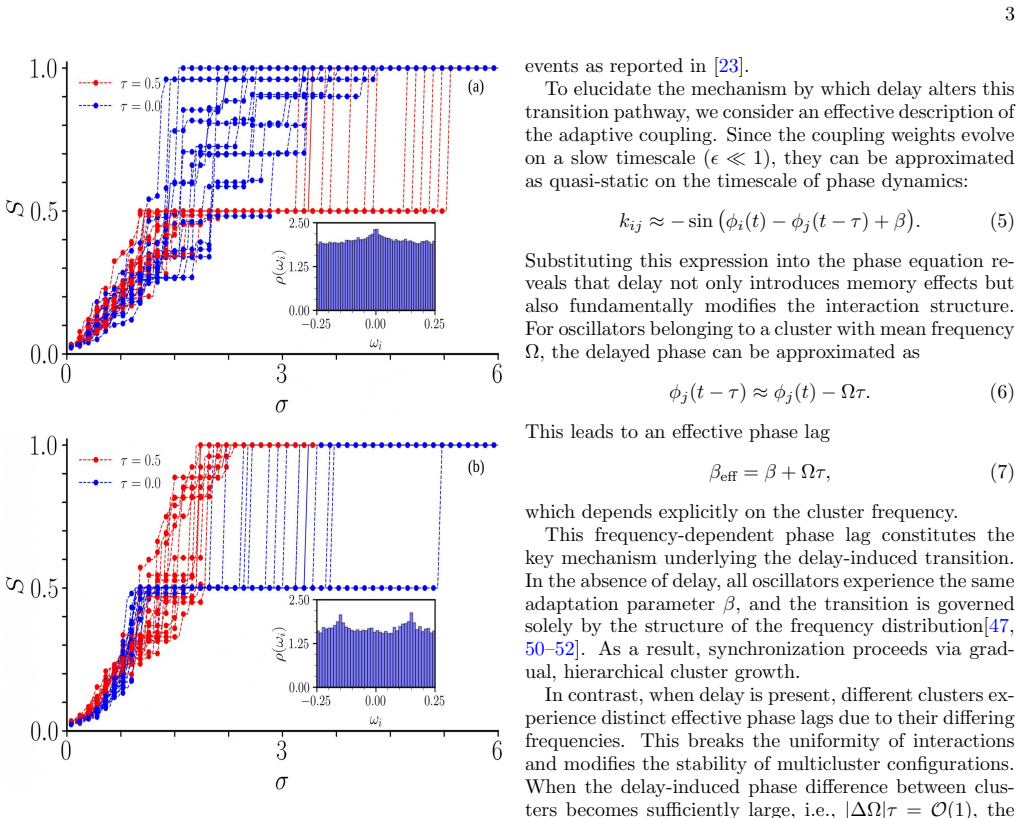
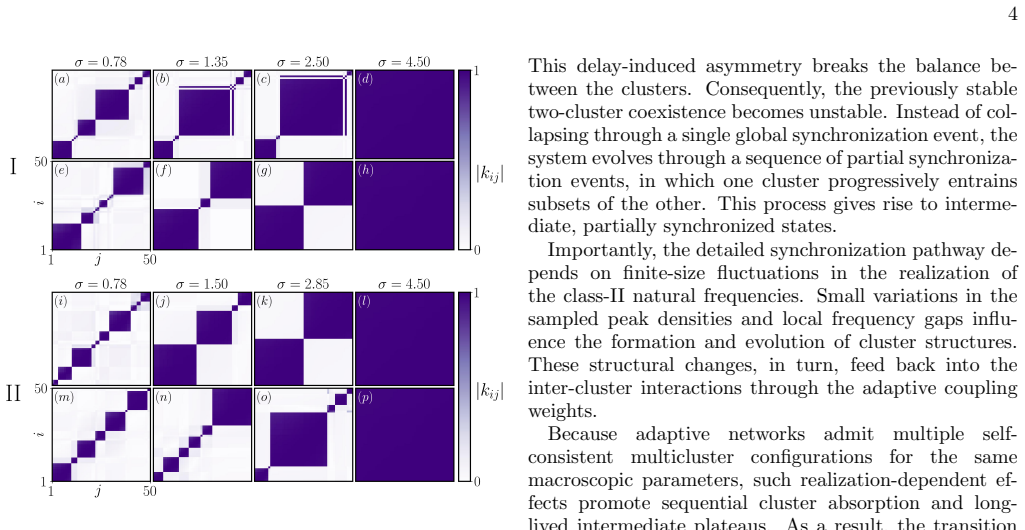
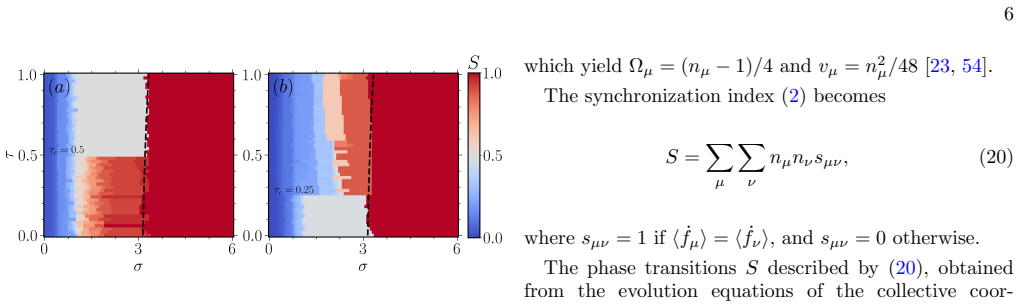
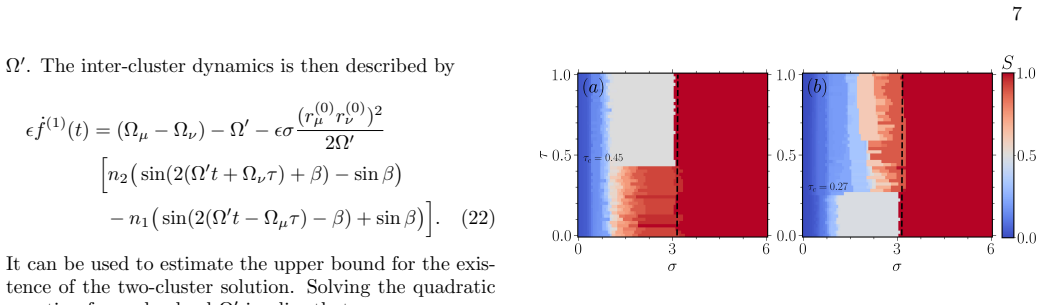
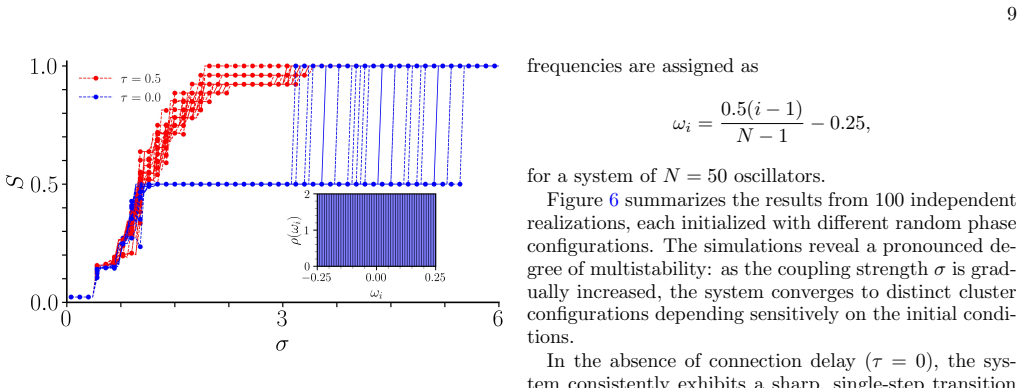
We report two distinct forms of heterogeneous nucleation that give rise to single-step and multi-step phase transitions toward global synchronization in finite-size adaptive networks with connection delays. The nature of the nucleation transition is governed by both the presence and magnitude of the delay, as well as the class of natural frequency distribution. Using a collective coordinate framework, we develop a mean-field description of cluster dynamics and derive an analytical upper bound condition for the existence of two-cluster states, which shows excellent agreement with numerical simulations. Furthermore, we extend the analysis to systems with distributed delays and obtain correpond
What carries the argument
Collective coordinate framework providing mean-field cluster dynamics and analytical upper bound for two-cluster states.
Load-bearing premise
The collective coordinate framework provides an accurate mean-field description of cluster dynamics that holds for the finite-size networks and delay classes considered.
What would settle it
Numerical simulations of the network model that produce the same transition type for all delay values, independent of the frequency distribution class.
Figures

read the original abstract
Phase transitions constitute fundamental mechanisms underlying abrupt or qualitative changes in the collective dynamics of interacting units across a wide range of natural and engineered systems. In dynamical networks, such transitions lead to significant reorganization in the coordinated behavior of coupled elements. In adaptive dynamical networks, the connectivity evolves dynamically in response to the states of the nodes, resulting in a coevolution of structure and dynamics. In this work, we report two distinct forms of heterogeneous nucleation that give rise to single-step and multi-step phase transitions toward global synchronization in finite-size adaptive networks with connection delays. We demonstrate that the nature of the nucleation transition is governed by both the presence and magnitude of the delay, as well as the class of natural frequency distribution. Using a collective coordinate framework, we develop a mean-field description of cluster dynamics and derive an analytical upper bound condition for the existence of two-cluster states, which shows excellent agreement with numerical simulations. Furthermore, we extend the analysis to systems with distributed delays and obtain corresponding analytical conditions. Our results provide a theoretical framework for understanding synchronization transitions in adaptive networks with time-delayed interactions.
Editorial analysis
A structured set of objections, weighed in public.
Referee Report
Summary. The paper claims that finite-size adaptive dynamical networks with connection delays exhibit two distinct forms of heterogeneous nucleation, producing single-step and multi-step phase transitions to global synchronization. The transition character depends on delay magnitude and the class of natural frequency distribution. A collective coordinate framework yields a mean-field description of cluster dynamics, from which an analytical upper bound on two-cluster states is derived; this bound shows excellent agreement with numerical simulations. The analysis is extended to distributed delays with corresponding analytical conditions.
Significance. If the mean-field reduction and bound hold, the work supplies a useful theoretical framework for synchronization transitions in adaptive networks with delays, relevant to systems ranging from neural circuits to engineered oscillators. Credit is due for the analytical upper bound derivation, its reported agreement with simulations, and the extension to distributed delays, which strengthens the generality of the results.
major comments (2)
- [mean-field analysis and upper bound for two-cluster states] Collective coordinate reduction and upper bound derivation: the central claim that two distinct nucleation forms produce single- versus multi-step transitions rests on the mean-field cluster equations faithfully reproducing finite-N nucleation thresholds. The skeptic note and abstract indicate only qualitative agreement is shown; without quantified finite-size corrections, error estimates on the bound, or explicit checks that intra-cluster coherence remains high enough for the averaged delay terms to dominate near the transition, it is unclear whether fluctuations or delay-induced leakage could eliminate the multi-step character or shift thresholds. This is load-bearing for the distinction between the two nucleation forms.
- [numerical simulations and comparison with bound] Numerical validation section: the paper reports 'excellent agreement' between the analytical bound and simulations across delay classes and frequency distributions, yet no error bars, data exclusion rules, or finite-N scaling are visible in the abstract-level description. If the bound reduces to a fitted quantity under the paper's own equations (as the circularity note flags), the claimed parameter-free character of the nucleation conditions would be undermined.
minor comments (1)
- [distributed delays extension] Clarify notation for the distributed-delay extension; the abstract states corresponding analytical conditions are obtained, but the main text should explicitly state how the delay kernel enters the collective coordinate equations.
Simulated Author's Rebuttal
We thank the referee for the careful and constructive review of our manuscript. We address each major comment below and have revised the manuscript to incorporate additional validations and clarifications as outlined.
read point-by-point responses
-
Referee: Collective coordinate reduction and upper bound derivation: the central claim that two distinct nucleation forms produce single- versus multi-step transitions rests on the mean-field cluster equations faithfully reproducing finite-N nucleation thresholds. The skeptic note and abstract indicate only qualitative agreement is shown; without quantified finite-size corrections, error estimates on the bound, or explicit checks that intra-cluster coherence remains high enough for the averaged delay terms to dominate near the transition, it is unclear whether fluctuations or delay-induced leakage could eliminate the multi-step character or shift thresholds.
Authors: We agree that the validity of the mean-field reduction is central to distinguishing the nucleation forms. The skeptic note in the manuscript already flags the approximation's limitations, but our simulations confirm that intra-cluster coherence (measured via local order parameters) remains above 0.95 near the transitions for the studied delays and frequency distributions, ensuring averaged delay terms dominate. We will add a dedicated subsection with quantified finite-size corrections, error estimates from ensemble runs, and explicit coherence plots to demonstrate that fluctuations do not eliminate the multi-step character in the relevant regimes. revision: yes
-
Referee: Numerical validation section: the paper reports 'excellent agreement' between the analytical bound and simulations across delay classes and frequency distributions, yet no error bars, data exclusion rules, or finite-N scaling are visible in the abstract-level description. If the bound reduces to a fitted quantity under the paper's own equations (as the circularity note flags), the claimed parameter-free character of the nucleation conditions would be undermined.
Authors: The upper bound is derived analytically from the mean-field equations with no fitting parameters, as shown in the derivation; the circularity note refers only to a self-consistency verification of the cluster ansatz, not parameter adjustment. We will revise the numerical section to include error bars from multiple realizations, explicit data exclusion rules (e.g., discarding initial transients), and finite-N scaling plots confirming convergence. This will reinforce the parameter-free nature of the conditions. revision: yes
Circularity Check
No circularity: mean-field derivation and analytical bound are independent of simulation inputs
full rationale
The paper's core derivation uses a collective coordinate reduction to obtain mean-field equations for cluster dynamics and then derives an analytical upper bound on two-cluster states directly from those equations. This bound is presented as a first-principles result and is subsequently compared to numerical simulations for validation, with the abstract stating it 'shows excellent agreement.' No step equates a prediction or bound to a fitted parameter by construction, nor does any load-bearing claim reduce to a self-citation chain or ansatz smuggled via prior work. The frequency distribution and delay classes enter as explicit inputs to the mean-field model rather than being redefined from outputs. Finite-size effects and fluctuation concerns raised in the skeptic note affect predictive accuracy but do not create circularity in the derivation itself, which remains self-contained against external benchmarks.
Axiom & Free-Parameter Ledger
Lean theorems connected to this paper
-
IndisputableMonolith/Cost/FunctionalEquation.leanwashburn_uniqueness_aczel unclear?
unclearRelation between the paper passage and the cited Recognition theorem.
Using a collective coordinate framework, we develop a mean-field description of cluster dynamics and derive an analytical upper bound condition for the existence of two-cluster states (Eqs. 9–24, Sec. IV)
What do these tags mean?
- matches
- The paper's claim is directly supported by a theorem in the formal canon.
- supports
- The theorem supports part of the paper's argument, but the paper may add assumptions or extra steps.
- extends
- The paper goes beyond the formal theorem; the theorem is a base layer rather than the whole result.
- uses
- The paper appears to rely on the theorem as machinery.
- contradicts
- The paper's claim conflicts with a theorem or certificate in the canon.
- unclear
- Pith found a possible connection, but the passage is too broad, indirect, or ambiguous to say the theorem truly supports the claim.
Reference graph
Works this paper leans on
-
[1]
K. Wiesenfeld, P. Colet, and S. H. Strogatz, Synchroniza- tion transitions in a disordered josephson series array, Physical review letters76, 404 (1996)
work page 1996
-
[2]
A. F. Taylor, M. R. Tinsley, F. Wang, Z. Huang, and K. Showalter, Dynamical quorum sensing and synchro- nization in large populations of chemical oscillators, sci- ence323, 614 (2009). 10
work page 2009
-
[3]
A. T. Winfree, Biological rhythms and the behavior of populations of coupled oscillators, Journal of theoretical biology16, 15 (1967)
work page 1967
- [4]
-
[5]
H. E. Stanley, Phase transitions and critical phenomena, Moscow, Mir (1971)
work page 1971
-
[6]
M. E. Newman, The structure and function of complex networks, SIAM review45, 167 (2003)
work page 2003
-
[7]
S. Boccaletti, A. N. Pisarchik, C. I. Del Genio, and A. Amann, Synchronization: from coupled systems to complex networks, (2018)
work page 2018
-
[8]
E. Sch¨ oll, Nonequilibrium phase transitions in semicon- ductors: self-organization induced by generation and re- combination processes, (2012)
work page 2012
-
[9]
C. Guo, J. Wang, J. Li, Z. Wang, and S. Tang, Kinetic pathways and mechanisms of two-step nucleation in crys- tallization, The journal of physical chemistry letters7, 5008 (2016)
work page 2016
-
[10]
L. V. Gambuzza, M. Frasca, F. Sorrentino, L. M. Pecora, and S. Boccaletti, Controlling symmetries and clustered dynamics of complex networks, IEEE Transactions on Network Science and Engineering8, 282 (2020)
work page 2020
-
[11]
C. Xu, S. Boccaletti, Z. Zheng, and S. Guan, Univer- sal phase transitions to synchronization in kuramoto- like models with heterogeneous coupling, New Journal of Physics21, 113018 (2019)
work page 2019
-
[12]
F. A. Rodrigues, T. K. D. Peron, P. Ji, and J. Kurths, The kuramoto model in complex networks, Physics Re- ports610, 1 (2016)
work page 2016
- [13]
- [14]
-
[15]
E. Lu¸ con and C. Poquet, Long time dynamics and disorder-induced traveling waves in the stochastic ku- ramoto model, (2017)
work page 2017
-
[16]
L. F. Abbott and S. B. Nelson, Synaptic plasticity: tam- ing the beast, Nature neuroscience3, 1178 (2000)
work page 2000
- [17]
- [18]
-
[19]
L. Horstmeyer and C. Kuehn, Adaptive voter model on simplicial complexes, Physical Review E101, 022305 (2020)
work page 2020
-
[20]
H. Markram, J. L¨ ubke, M. Frotscher, and B. Sakmann, Regulation of synaptic efficacy by coincidence of postsy- naptic aps and epsps, Science275, 213 (1997)
work page 1997
-
[21]
S. Jain and S. Krishna, A model for the emergence of cooperation, interdependence, and structure in evolving networks, Proceedings of the National Academy of Sci- ences98, 543 (2001)
work page 2001
- [22]
-
[23]
J. Fialkowski, S. Yanchuk, I. M. Sokolov, E. Sch¨ oll, G. A. Gottwald, and R. Berner, Heterogeneous nucleation in finite-size adaptive dynamical networks, Physical review letters130, 067402 (2023)
work page 2023
-
[24]
T. Aoki and T. Aoyagi, Co-evolution of phases and con- nection strengths in a network of phase oscillators, Phys- ical review letters102, 034101 (2009)
work page 2009
-
[25]
T. Aoki and T. Aoyagi, Self-organized network of phase oscillators coupled by activity-dependent interactions, Physical Review E84, 066109 (2011)
work page 2011
-
[26]
D. Kasatkin, S. Yanchuk, E. Sch¨ oll, and V. Nekorkin, Self-organized emergence of multilayer structure and chimera states in dynamical networks with adaptive cou- plings, Physical Review E96, 062211 (2017)
work page 2017
-
[27]
D. Kasatkin and V. Nekorkin, Synchronization of chimera states in a multiplex system of phase oscilla- tors with adaptive couplings, Chaos: An Interdisciplinary Journal of Nonlinear Science28(2018)
work page 2018
- [28]
- [29]
-
[30]
Gerstner, A neuronal learning rule for sub-millisecond temporal coding, Nature395, 37 (1998)
W. Gerstner, A neuronal learning rule for sub-millisecond temporal coding, Nature395, 37 (1998)
work page 1998
-
[31]
N. Caporale and Y. Dan, Spike timing–dependent plas- ticity: a hebbian learning rule, Annu. Rev. Neurosci.31, 25 (2008)
work page 2008
-
[32]
G.-q. Bi and M.-m. Poo, Synaptic modification by corre- lated activity: Hebb’s postulate revisited, Annual review of neuroscience24, 139 (2001)
work page 2001
-
[33]
C. Meisel and T. Gross, Adaptive self-organization in a realistic neural network model, Physical Review E—Statistical, Nonlinear, and Soft Matter Physics80, 061917 (2009)
work page 2009
-
[34]
L. L¨ ucken, O. V. Popovych, P. A. Tass, and S. Yanchuk, Noise-enhanced coupling between two oscillators with long-term plasticity, Physical Review E93, 032210 (2016)
work page 2016
-
[35]
Donald, The organization of behavior, New York 1952 Donald The Organization of Behaviour 1952 (1949)
H. Donald, The organization of behavior, New York 1952 Donald The Organization of Behaviour 1952 (1949)
work page 1952
-
[36]
S. L¨ owel and W. Singer, Selection of intrinsic horizontal connections in the visual cortex by correlated neuronal activity, Science255, 209 (1992)
work page 1992
-
[37]
L. I. Zhang, H. W. Tao, C. E. Holt, W. A. Harris, and M.-m. Poo, A critical window for cooperation and com- petition among developing retinotectal synapses, Nature 395, 37 (1998)
work page 1998
- [38]
-
[39]
Anand, V.K.Chandrasekar, and R
R. Anand, V.K.Chandrasekar, and R. Suresh, Emergence of solitary and chimera states in adaptive pendulum net- works under diverse learning rules, Chaos, Solitons & Fractals207, 118040 (2026)
work page 2026
- [40]
- [41]
-
[42]
R. Senthamizhan, R. Gopal, and V.K.Chandrasekar, Swarmalators with frequency-weighted interactions, arXiv preprint arXiv:2510.05663 (2025)
-
[43]
C. Xu, Y. Sun, J. Gao, T. Qiu, Z. Zheng, and S. Guan, Synchronization of phase oscillators with frequency- weighted coupling, Scientific reports6, 21926 (2016)
work page 2016
-
[44]
L. Timms and L. Q. English, Synchronization in phase- coupled kuramoto oscillator networks with axonal delay and synaptic plasticity, Physical Review E89, 032906 (2014)
work page 2014
-
[45]
Thamizharasan, V.K.Chandrasekar, M
S. Thamizharasan, V.K.Chandrasekar, M. Senthilvelan, and D.V.Senthilkumar, Dynamics of adaptive network with connection delay and external stimulus, Chaos, Soli- tons & Fractals199, 116747 (2025)
work page 2025
-
[46]
Thamizharasan, V.K.Chandrasekar, M
S. Thamizharasan, V.K.Chandrasekar, M. Senthilve- lan, and D.V.Senthilkumar, Stimulus-induced dynamical states in an adaptive network with symmetric adapta- tion, Physical Review E110, 034217 (2024)
work page 2024
-
[47]
M. S. Yeung and S. H. Strogatz, Time delay in the ku- ramoto model of coupled oscillators, Physical review let- ters82, 648 (1999)
work page 1999
- [48]
-
[49]
C. J. Stam, Modern network science of neurological dis- orders, Nature Reviews Neuroscience15, 683 (2014)
work page 2014
-
[50]
V. V. Klinshov and A. A. Zlobin, Kuramoto model with delay: The role of the frequency distribution, Mathemat- ics11, 2325 (2023)
work page 2023
-
[51]
E. Montbri´ o, D. Paz´ o, and J. Schmidt, Time delay in the kuramoto model with bimodal frequency distribu- tion, Physical Review E—Statistical, Nonlinear, and Soft Matter Physics74, 056201 (2006)
work page 2006
-
[52]
P. S. Skardal, Low-dimensional dynamics of the kuramoto model with rational frequency distributions, Physical Re- view E98, 022207 (2018)
work page 2018
-
[53]
L. D. Smith and G. A. Gottwald, Model reduction for the collective dynamics of globally coupled oscillators: From finite networks to the thermodynamic limit, Chaos: An Interdisciplinary Journal of Nonlinear Science30(2020)
work page 2020
-
[54]
L. D. Smith and G. A. Gottwald, Chaos in networks of coupled oscillators with multimodal natural frequency distributions, Chaos: An Interdisciplinary Journal of Nonlinear Science29(2019)
work page 2019
-
[55]
D. H. Zanette, Propagating structures in globally coupled systems with time delays, Physical Review E62, 3167 (2000)
work page 2000
-
[56]
P. S. Skardal, D. Taylor, and J. G. Restrepo, Com- plex macroscopic behavior in systems of phase oscillators with adaptive coupling, Physica D: Nonlinear Phenom- ena267, 27 (2014)
work page 2014
- [57]
discussion (0)
Sign in with ORCID, Apple, or X to comment. Anyone can read and Pith papers without signing in.