EAGLE: Edge-Aware Graph Learning for Proactive Delivery Delay Prediction in Smart Logistics Networks
Pith reviewed 2026-05-10 18:38 UTC · model grok-4.3
The pith
A hybrid model with edge-aware graph attention and transformers predicts delivery delays more accurately and stably than standard methods.
A machine-rendered reading of the paper's core claim, the machinery that carries it, and where it could break.
Core claim
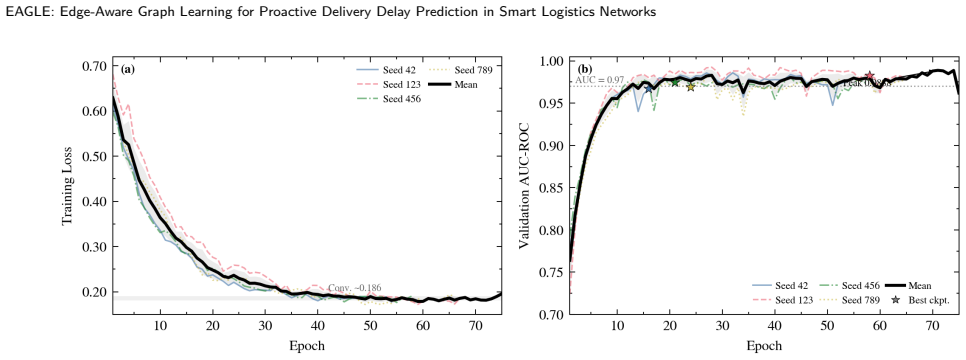
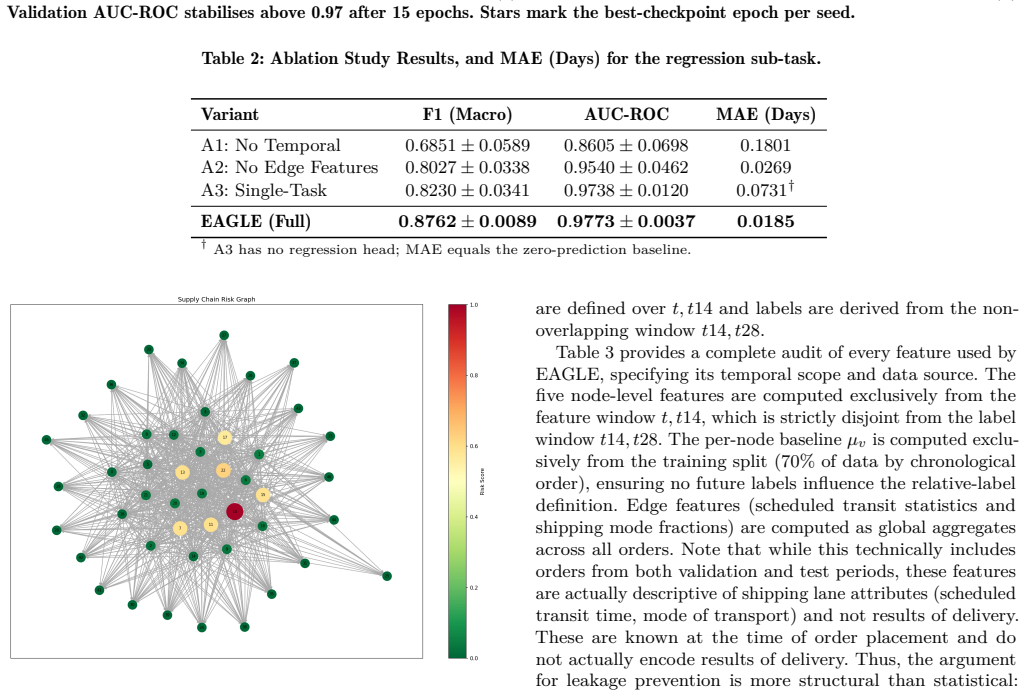
The central claim is that jointly modeling temporal order-flow dynamics with a lightweight Transformer patch encoder and inter-hub relational dependencies through an Edge-Aware Graph Attention Network, optimized via a multi-task learning objective, produces consistent gains over baselines on real logistics data, reaching an F1-score of 0.8762 and AUC-ROC of 0.9773 with a cross-seed F1 standard deviation of only 0.0089.
What carries the argument
The Edge-Aware Graph Attention Network (E-GAT) that attends over both node features and explicit edge attributes to capture relational dependencies among logistics hubs, paired with a Transformer encoder for sequential order data under a shared multi-task loss.
If this is right
- Supply chain operators can shift from reacting to delays after they occur to scheduling buffers or reroutes before shipments leave the warehouse.
- The low variance across random seeds implies the model can be deployed in production with less need for repeated retraining or extensive hyperparameter search.
- Multi-task training lets the network learn representations useful for both delay classification and related auxiliary tasks such as route feasibility checks.
- Because edge features are explicitly modeled, the framework can incorporate richer shipping manifest data without additional preprocessing steps.
Where Pith is reading between the lines
- The same hybrid pattern could be tested on other networked prediction problems such as traffic congestion or power-grid fault forecasting where both timing and connection structure matter.
- If edge attributes prove decisive here, logistics platforms might benefit from collecting finer-grained lane or carrier metadata rather than relying on node-only graphs.
- The reported stability across seeds suggests the architecture could reduce the cost of model maintenance when new warehouses or lanes are added to the network over time.
- Extending the model to handle streaming updates to the graph could turn the current offline predictor into a continuously adapting system for live operations.
Load-bearing premise
The DataCo Smart Supply Chain dataset contains the same temporal patterns and graph structures that appear in other real-world logistics networks, so that performance gains will carry over without overfitting to its particular features.
What would settle it
Retraining and testing the same architecture on a second logistics dataset that differs in network density, edge types, or order-volume seasonality and observing whether the F1-score falls below 0.80 or the cross-seed standard deviation rises above 0.03 would falsify the claim of broad improvement.
Figures

read the original abstract
Modern logistics networks generate rich operational data streams at every warehouse node and transportation lane -- from order timestamps and routing records to shipping manifests -- yet predicting delivery delays remains predominantly reactive. Existing predictive approaches typically treat this problem either as a tabular classification task, ignoring network topology, or as a time-series anomaly detection task, overlooking the spatial dependencies of the supply chain graph. To bridge this gap, we propose a hybrid deep learning framework for proactive supply chain risk management. The proposed method jointly models temporal order-flow dynamics via a lightweight Transformer patch encoder and inter-hub relational dependencies through an Edge-Aware Graph Attention Network (E-GAT), optimized via a multi-task learning objective. Evaluated on the real-world DataCo Smart Supply Chain dataset, our framework achieves consistent improvements over baseline methods, yielding an F1-score of 0.8762 and an AUC-ROC of 0.9773. Across four independent random seeds, the framework exhibits a cross-seed F1 standard deviation of only 0.0089 -- a 3.8 times improvement over the best ablated variant -- achieving the strongest balance of predictive accuracy and training stability among all evaluated models.
Editorial analysis
A structured set of objections, weighed in public.
Referee Report
Summary. The paper proposes EAGLE, a hybrid deep learning framework for proactive delivery delay prediction in logistics networks. It combines an Edge-Aware Graph Attention Network (E-GAT) to model inter-hub relational dependencies with a lightweight Transformer patch encoder for temporal order-flow dynamics, trained via a multi-task objective. On the real-world DataCo Smart Supply Chain dataset, it reports an F1-score of 0.8762, AUC-ROC of 0.9773, and strong cross-seed stability (F1 std of 0.0089 across four seeds, 3.8× better than the best ablation).
Significance. If the results hold under rigorous verification, the work provides a concrete demonstration that jointly modeling graph topology and temporal dynamics via E-GAT plus patch-based Transformer yields measurable gains in both accuracy and training stability for supply-chain delay prediction. The explicit reporting of seed-wise variance and ablation comparisons is a strength that supports reproducibility claims.
minor comments (2)
- [Abstract and Evaluation] The abstract and evaluation section report specific metrics and a 3.8× stability improvement but do not list the exact baseline models or ablation variants by name; adding a concise table or sentence naming them (e.g., “compared to GAT, Transformer-only, and XGBoost”) would improve clarity without altering the central claim.
- [Dataset and Evaluation] The manuscript states that the DataCo dataset is used but provides no explicit description of the train/validation/test split ratios, class imbalance handling, or how the graph is constructed from the tabular records; a short paragraph or figure caption addressing these choices would strengthen the reproducibility of the reported F1 and AUC numbers.
Simulated Author's Rebuttal
We thank the referee for the positive assessment of our manuscript and for recommending minor revision. The referee's summary correctly identifies the core elements of EAGLE, including the hybrid use of Edge-Aware GAT and lightweight Transformer patch encoding under a multi-task objective, as well as the reported performance on the DataCo dataset.
Circularity Check
No significant circularity; empirical evaluation is self-contained
full rationale
The manuscript proposes a hybrid neural architecture (E-GAT + Transformer patch encoder) trained end-to-end with a multi-task objective on the DataCo dataset. All headline numbers (F1 0.8762, AUC-ROC 0.9773, cross-seed std 0.0089) are produced by standard supervised training followed by held-out evaluation; no equations, uniqueness theorems, or fitted parameters are redefined as predictions. Component citations (GAT, Transformer) refer to externally published methods whose correctness does not depend on the present results. The derivation chain therefore contains no self-definitional, fitted-input, or self-citation-load-bearing reductions.
Axiom & Free-Parameter Ledger
free parameters (1)
- model hyperparameters and training settings
axioms (1)
- domain assumption The DataCo Smart Supply Chain dataset is representative of real-world logistics networks and delay patterns
Reference graph
Works this paper leans on
-
[1]
K. R. Ahmed, M. E. Ansari, M. N. Ahsan, A. Rohan, M. B. Uddin, and M. A. H. Rivin. 2025. Deep learning framework for interpretable supply chain forecasting using SOM ANN and SHAP. Scientific Reports15, 1, Article 26355 (2025). https://doi.org/ 10.1038/s41598-025-11510-z
-
[2]
W. Kong, Z. Guo, and Y. Liu. 2024. Spatio-Temporal Pivotal Graph Neural Networks for Traffic Flow Forecasting. InProceed- ings of the 38th AAAI Conference on Artificial Intelligence (AAAI ’24), vol. 38, no. 8, pp. 8933–8941
work page 2024
-
[3]
Z. Xue, S. Zhao, Y. Qi, X. Zeng, and Z. Yu. 2026. Resilient Routing: Risk-Aware Dynamic Routing in Smart Logistics via Spatiotemporal Graph Learning. arXiv preprint arXiv:2601.13632. https://arxiv.org/abs/2601.13632
work page internal anchor Pith review arXiv 2026
-
[4]
Z. Shao, Z. Zhang, W. Wei, F. Wang, Y. Xu, X. Cao, and C. Guo
-
[5]
Decoupled Dynamic Spatial-Temporal Graph Neural Net- work for Traffic Forecasting.Proceedings of the VLDB Endow- ment15, 11 (2022), 2733–2746
work page 2022
-
[6]
K. Lu, M. Huo, Y. Li, Q. Zhu, and Z. Chen. 2025. CT-PatchTST: Channel-Time Patch Time-Series Transformer for Long-Term Re- newable Energy Forecasting. InProceedings of the 2025 10th International Conference on Computer and Information Pro- cessing Technology (ISCIPT ’25), pp. 86–95. https://doi.org/10. 1109/ISCIPT67144.2025.11265471
- [7]
-
[8]
A. Deng and B. Hooi. 2021. Graph Neural Network-Based Anom- aly Detection in Multivariate Time Series. InProceedings of the 35th AAAI Conference on Artificial Intelligence (AAAI ’21), vol. 35, no. 5, pp. 4372–4380
work page 2021
-
[9]
S. Tuli, G. Casale, and N. R. Jennings. 2022. TranAD: Deep Transformer Networks for Anomaly Detection in Multivariate Time Series Data.Proceedings of the VLDB Endowment15, 6 (2022), 1201–1214
work page 2022
-
[10]
International Journal of Production Research , volume =
E. Kosasih and A. Brintrup. 2022. A machine learning approach for predicting hidden links in supply chain with graph neural networks.International Journal of Production Research60, 17 (2022), 5380–5393. https://doi.org/10.1080/00207543.2021. 1956697
-
[11]
J. Park, J. Song, J. Yang, J. Lee, J. Cho, S. Kim, and K. Shin
-
[12]
InProceedings of the 10th International Conference on Learning Representations (ICLR ’22)
GraphENS: Neighbor-Aware Ego Network Synthesis for Class-Imbalanced Node Classification. InProceedings of the 10th International Conference on Learning Representations (ICLR ’22)
-
[13]
T. Song, Z. Li, Y. Huang, S. Jiang, and Z. Hu. 2022. TAM: Topology-Aware Margin Loss for Class-Imbalanced Node Classifi- cation. InProceedings of the 39th International Conference on Machine Learning (ICML ’22), vol. 162, pp. 20369–20390
work page 2022
- [14]
discussion (0)
Sign in with ORCID, Apple, or X to comment. Anyone can read and Pith papers without signing in.