Towards National Quantum Communication in Europe: Planning and Sizing Terrestrial QKD Networks
Pith reviewed 2026-05-10 18:10 UTC · model grok-4.3
The pith
A reproducible planning method estimates national terrestrial QKD network sizes across Europe by modeling Austria and scaling with population and geography.
A machine-rendered reading of the paper's core claim, the machinery that carries it, and where it could break.
Core claim
The central claim is that a reproducible methodology, demonstrated through a synthetic structured network model of Austria evaluated by Monte Carlo simulation and then scaled by population and geographic extent, produces first-order estimates of national QKD backbone sizes, total fiber lengths, endpoint counts, trusted repeater requirements, and hop-length distributions for terrestrial infrastructure across EU Member States.
What carries the argument
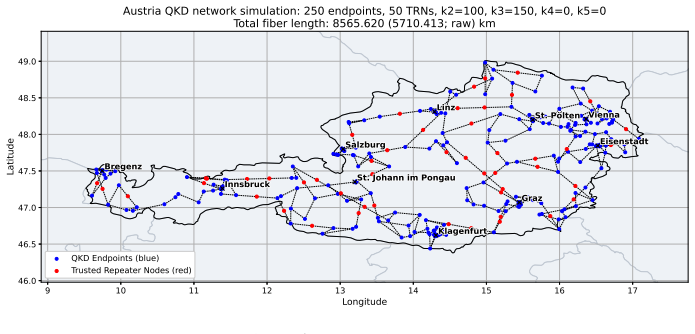
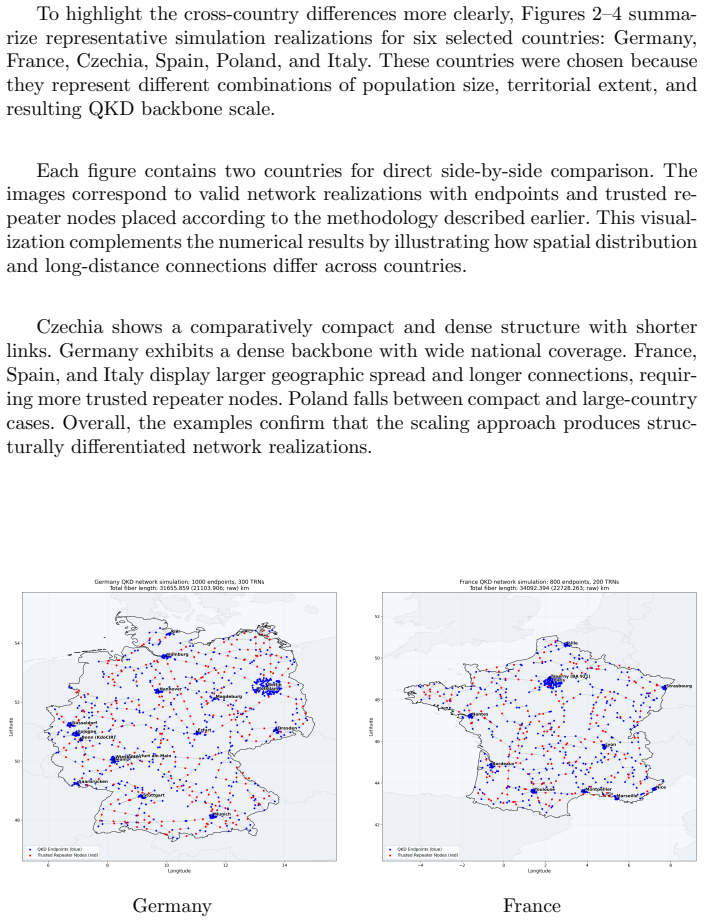
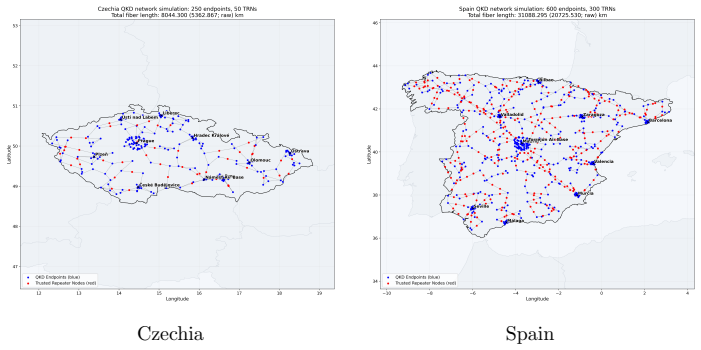
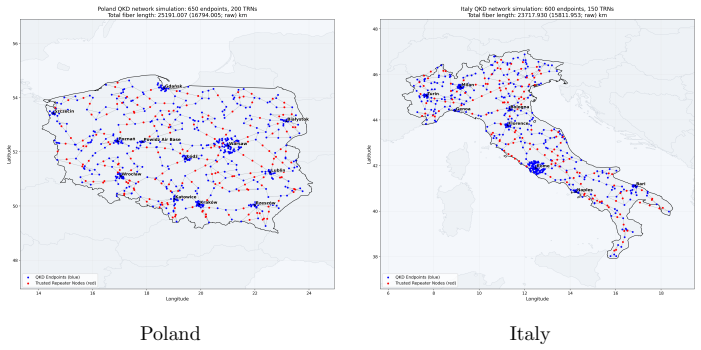
The synthetic but structured network model for Austria, evaluated via Monte Carlo simulation to determine endpoint counts, trusted repeater nodes, and hop-length distributions, combined with scaling rules based solely on population and geographic extent.
If this is right
- The estimates supply planning-level references for infrastructure dimensioning under the EuroQCI framework.
- They enable early-stage cost assessment for national QKD backbones.
- Endpoint counts, trusted repeater node requirements, and hop-length distributions are quantified for each member state.
- The approach remains limited to terrestrial segments and excludes space-based QKD components.
Where Pith is reading between the lines
- Incorporating country-specific data on existing fiber routes could refine the scaling rules without changing the overall methodology.
- The same population-and-area scaling could be tested against actual QKD pilot deployments already underway in several EU states.
- The planning numbers might inform prioritized investment decisions for countries with lower population density or more dispersed critical infrastructure.
Load-bearing premise
The synthetic network model constructed for Austria, together with scaling rules based only on population and geographic extent, accurately captures the requirements for other EU Member States despite differences in existing fiber infrastructure and geography.
What would settle it
Direct comparison of the model's predicted fiber length, repeater count, or backbone size for a second EU country such as Germany or France against independent national QKD deployment studies or actual installed infrastructure in that country.
Figures
read the original abstract
The European Union is developing the European Quantum Communication Infrastructure (EuroQCI) as a pan-European network to provide secure communication capabilities across Member States, including governmental and critical-infrastructure domains. While the strategic objective is defined at EU level, the required scale and structure of national quantum key distribution (QKD) networks remain largely unspecified. This work addresses the question of how to plan and size national terrestrial QKD networks to support critical infrastructure and public authorities. We propose a reproducible planning methodology that estimates network size, total fiber length, and the number of required QKD components based on a small set of explicit assumptions. The approach is demonstrated for Austria, where a synthetic but structured network model is constructed and evaluated using Monte Carlo simulation. The model focuses on terrestrial QKD infrastructure and explicitly excludes space-based segments. It estimates endpoint counts, trusted repeater node requirements, and hop-length distributions under realistic operational constraints. The Austrian case is then used as a baseline to derive scaling rules for other EU Member States based on population and geographic extent. The results provide first-order planning estimates for national QKD backbone sizes across Europe. These estimates are not intended as deployment designs but as planning-level references that support early-stage cost assessment and infrastructure dimensioning under the EuroQCI framework.
Editorial analysis
A structured set of objections, weighed in public.
Referee Report
Summary. The manuscript proposes a reproducible planning methodology for sizing national terrestrial QKD networks under the EuroQCI framework. It constructs a synthetic but structured network model for Austria, evaluates endpoint counts, trusted repeater requirements, and hop-length distributions via Monte Carlo simulation under explicit operational constraints, and derives scaling rules based on population and geographic extent to generate first-order estimates of network size, fiber length, and QKD components for other EU Member States. The results are framed as planning-level references rather than deployment designs.
Significance. If the scaling rules prove robust, the work supplies a transparent, assumption-explicit framework for early-stage cost assessment and infrastructure dimensioning of national QKD backbones, addressing a current gap in EuroQCI planning. Strengths include the reproducible methodology, explicit assumptions, and Monte Carlo evaluation on the Austrian synthetic graph, which together provide a clear baseline for further refinement.
major comments (1)
- [Scaling rules section (post-Austria case study)] The derivation of scaling rules from the Austrian synthetic model (following the Monte Carlo evaluation) relies solely on population and geographic extent. This two-parameter extrapolation does not incorporate differences in pre-existing fiber topology, spatial distribution of critical infrastructure, or terrain constraints, which vary substantially across Member States and directly affect fiber length and repeater placement. This step is load-bearing for the central claim of providing usable estimates across Europe.
minor comments (1)
- [Abstract] The abstract states that the model 'explicitly excludes space-based segments' but does not clarify how this boundary affects the terrestrial estimates or whether hybrid scenarios were considered in the Monte Carlo runs.
Simulated Author's Rebuttal
We thank the referee for the constructive review and recommendation for major revision. We address the single major comment below, agreeing on the need to better frame the scaling rules while preserving the manuscript's focus on first-order, reproducible estimates.
read point-by-point responses
-
Referee: [Scaling rules section (post-Austria case study)] The derivation of scaling rules from the Austrian synthetic model (following the Monte Carlo evaluation) relies solely on population and geographic extent. This two-parameter extrapolation does not incorporate differences in pre-existing fiber topology, spatial distribution of critical infrastructure, or terrain constraints, which vary substantially across Member States and directly affect fiber length and repeater placement. This step is load-bearing for the central claim of providing usable estimates across Europe.
Authors: We agree that the scaling rules rely exclusively on population and geographic extent derived from the Austrian Monte Carlo baseline. This two-parameter approach was deliberately chosen to support a transparent, data-minimal methodology using only publicly available national statistics, enabling reproducible first-order estimates without requiring proprietary infrastructure data. The manuscript already qualifies the results as 'first-order planning estimates' and 'not intended as deployment designs' (Abstract and Introduction). To address the referee's concern directly, we will revise the scaling-rules section to add an explicit limitations paragraph enumerating the omitted factors (existing fiber topology, terrain, critical-infrastructure distribution) and their expected influence on fiber length and repeater counts. We will also insert a short forward-looking subsection outlining how national fiber maps or terrain data could be incorporated in follow-on work. These additions will temper the central claim without altering the core methodology or results. revision: yes
Circularity Check
No circularity: explicit model construction and extrapolation from stated assumptions
full rationale
The paper constructs a synthetic network model for Austria from explicit population and geographic inputs, evaluates it via Monte Carlo simulation to produce endpoint counts, fiber lengths, and component estimates, then applies the resulting scaling relations (based on the same two parameters) to other Member States. This is a forward modeling and extrapolation procedure whose outputs are not forced by definition to equal the inputs. No equations reduce predictions to fitted parameters, no self-citations are load-bearing for the central claims, and no uniqueness theorems or ansatzes are imported from prior author work. The derivation remains self-contained against the stated assumptions.
Axiom & Free-Parameter Ledger
free parameters (2)
- network topology parameters
- scaling coefficients
axioms (2)
- domain assumption The synthetic Austrian network model is representative of realistic terrestrial QKD constraints and hop-length distributions.
- domain assumption Population and geographic extent are sufficient proxies for QKD network size across EU countries.
Reference graph
Works this paper leans on
-
[1]
Official Journal of the European Union, L 72, 17.3.2015, pp. 53–88. Eur15b. European Telecommunications Standards Institute. Quantum safe cryp- tography and security: An introduction, benefits, enablers and challenges. White Paper ETSI White Paper No. 8, European Telecommunications Standards Institute, Sophia Antipolis, France, June 2015. Eur19. European ...
work page 2015
-
[2]
Association for Computing Machinery. KW19. Wojciech Kozlowski and Stephanie Wehner. Towards large-scale quantum networks. InProceedings of the 6th ACM International Conference on Nanoscale Computing and Communication, NANOCOM ’19, pages 1–7, New York, NY, USA, 9 2019. Association for Computing Machinery. LBP+21. Diego R. L´ opez, Juan Pedro Brito, Antonio...
work page 2019
discussion (0)
Sign in with ORCID, Apple, or X to comment. Anyone can read and Pith papers without signing in.