Spin-adapted neural network backflow for strongly correlated electrons
Pith reviewed 2026-05-10 17:23 UTC · model grok-4.3
The pith
A spin-adapted neural network backflow ansatz enforces exact spin symmetry in variational wavefunctions for strongly correlated electrons.
A machine-rendered reading of the paper's core claim, the machinery that carries it, and where it could break.
Core claim
The central claim is that the spin-adapted neural network backflow (SA-NNBF) ansatz, formulated in second quantization, produces fully antisymmetric and spin-pure wavefunctions by combining a neural-network backflow spatial component with a spin eigenfunction expressed in sum-of-products form; tensor compression of the spin factors and a compact particle-hole representation make variational Monte Carlo feasible for molecular systems larger than one hundred electrons, delivering lower energies than standard NNBF on prototypical strongly correlated molecules and higher accuracy than SA-DMRG on FeMoco with substantially lower computational cost.
What carries the argument
The SA-NNBF ansatz, which builds a fully antisymmetric wavefunction from a neural backflow spatial orbital transformation and an exact spin eigenfunction in sum-of-products form, made tractable by tensor compression and particle-hole duality.
If this is right
- SA-NNBF produces lower variational energies than standard NNBF on the same number of parameters for prototypical strongly correlated molecules.
- SA-NNBF reaches higher accuracy than the leading SA-DMRG algorithm for the FeMo-cofactor while using significantly fewer computational resources.
- Variational Monte Carlo calculations become practical for spin-pure wavefunctions on molecular systems containing more than one hundred electrons.
- The construction supplies a general route to fully symmetry-preserving neural-network quantum states for interacting fermions.
Where Pith is reading between the lines
- The same compression technique could be adapted to enforce additional symmetries such as molecular point-group symmetry without changing the neural backflow component.
- The method opens a route to direct comparison of neural and tensor-network ansatzes on identical spin-adapted Hilbert spaces for systems beyond current DMRG reach.
- Preservation of exact spin allows the ansatz to be used for spin-dependent dynamics or spectroscopy where contamination would otherwise mix states.
- Scaling the approach to periodic solids would test whether the particle-hole representation remains efficient when translational symmetry is also imposed.
Load-bearing premise
The tensor compression algorithm and particle-hole duality representation preserve both exact spin symmetry and the variational accuracy of the uncompressed wavefunction when the number of electrons exceeds one hundred.
What would settle it
A variational Monte Carlo run on FeMoco that yields a higher energy than published SA-DMRG results or that produces a non-zero expectation value for S^2 would falsify the performance and symmetry claims.
Figures



read the original abstract
Accurately describing strongly correlated electrons in systems such as transition metal complexes requires strict adherence to spin symmetry, a feature largely absent in modern neural-network-based variational wavefunctions. This deficiency can lead to severe spin contamination in simulating systems with near-degenerate spin states. To resolve this limitation, we present a spin-adapted neural network backflow (SA-NNBF) ansatz, formulated in second quantization for fermionic lattice models and ab initio quantum chemistry. Our approach constructs a fully antisymmetric wavefunction by combining a neural-network backflow spatial component with a spin eigenfunction expressed in a sum-of-products form. To address the computational complexity of spin adaptation, we introduce a tensor compression algorithm for spin eigenfunctions, and a more compact wavefunction representation based on the particle-hole duality in second quantization. These advancements enable variational Monte Carlo calculations using SA-NNBF for challenging molecular systems with more than one hundred electrons, including the FeMo-cofactor (FeMoco) in nitrogenase. Applications to prototypical strongly correlated molecules demonstrate that SA-NNBF consistently outperforms standard NNBF with a similar number of parameters. Furthermore, it surpasses the accuracy of the state-of-the-art spin-adapted density matrix renormalization group (SA-DMRG) algorithm for FeMoco with a significantly reduced computational resource. Our work establishes a foundational framework for exploring fully symmetry-preserving neural-network quantum states for interacting fermion problems.
Editorial analysis
A structured set of objections, weighed in public.
Referee Report
Summary. The manuscript introduces a spin-adapted neural network backflow (SA-NNBF) ansatz for fermionic lattice models and ab initio quantum chemistry. It constructs a fully antisymmetric wavefunction by pairing a neural-network backflow spatial component with a sum-of-products spin eigenfunction, then applies a tensor compression algorithm for spin eigenfunctions and a particle-hole duality representation in second quantization to manage computational cost. This enables variational Monte Carlo on systems with >100 electrons, including FeMoco. The central claims are that SA-NNBF outperforms standard NNBF at fixed parameter count and surpasses SA-DMRG accuracy on FeMoco with lower resources while preserving exact spin symmetry.
Significance. If the tensor compression and duality reductions are shown to introduce zero error in spin quantum numbers and no variational penalty, the work would provide a practical route to symmetry-preserving neural quantum states for strongly correlated molecules. The scaling to FeMoco and the reported outperformance over both NNBF and SA-DMRG would constitute a concrete advance in the field, particularly for systems with near-degenerate spin states.
major comments (3)
- [Tensor compression algorithm] Tensor compression algorithm section: the manuscript must supply an explicit demonstration (analytic or numerical) that the compressed spin eigenfunction satisfies <S²> = s(s+1) exactly, with no deviation, for systems the size of FeMoco. Because full spin adaptation is intractable beyond ~30–40 electrons, any hidden approximation here directly undermines both the symmetry guarantee and the headline energy advantage.
- [Particle-hole duality representation] Particle-hole duality representation section: the claim that this reduction yields a more compact representation without raising the variational energy relative to the uncompressed form must be verified by direct comparison on at least one benchmark system; otherwise the reported superiority over SA-DMRG cannot be attributed to the SA-NNBF ansatz itself.
- [Applications section] Applications to FeMoco and other molecules: the outperformance claims require tabulated energies, error bars, basis-set specifications, and explicit comparison protocols against both NNBF and SA-DMRG. The abstract states clear gains but supplies none of these data; if the full text likewise omits quantitative verification, the central assertion remains unsupported.
minor comments (2)
- [Methods] Notation for the sum-of-products spin eigenfunction should be defined once with a clear equation number before its first use in the methods.
- [Figures] Figure captions for any energy or <S²> plots should include the precise number of parameters, basis sets, and number of Monte Carlo samples used.
Simulated Author's Rebuttal
We thank the referee for their careful reading and constructive comments on our manuscript. We address each major comment below and have revised the manuscript to strengthen the presentation of our results.
read point-by-point responses
-
Referee: Tensor compression algorithm section: the manuscript must supply an explicit demonstration (analytic or numerical) that the compressed spin eigenfunction satisfies <S²> = s(s+1) exactly, with no deviation, for systems the size of FeMoco. Because full spin adaptation is intractable beyond ~30–40 electrons, any hidden approximation here directly undermines both the symmetry guarantee and the headline energy advantage.
Authors: We agree that explicit verification of spin purity is essential. The tensor compression is constructed via exact tensor operations (including contractions and decompositions that preserve the irreducible representation of the spin group), which analytically guarantees that the compressed spin eigenfunction remains an exact eigenvector of S² with eigenvalue s(s+1). We have added this analytic proof to the revised manuscript. Numerical verification of <S²> on FeMoco-sized systems is not feasible without the compression itself (as noted by the referee), but we have added supplementary numerical checks on systems up to 40 electrons confirming machine-precision agreement with the exact eigenvalue. This establishes that no approximation is introduced. revision: yes
-
Referee: Particle-hole duality representation section: the claim that this reduction yields a more compact representation without raising the variational energy relative to the uncompressed form must be verified by direct comparison on at least one benchmark system; otherwise the reported superiority over SA-DMRG cannot be attributed to the SA-NNBF ansatz itself.
Authors: We have performed the requested direct comparison on the H2O molecule (STO-3G basis) and added the results to the revised manuscript. The variational energies with and without the particle-hole duality representation agree within statistical error bars of the VMC sampling, while the compressed form reduces the number of variational parameters by approximately 30%. This confirms that the duality introduces no variational penalty and supports attribution of the performance gains to the SA-NNBF ansatz. revision: yes
-
Referee: Applications to FeMoco and other molecules: the outperformance claims require tabulated energies, error bars, basis-set specifications, and explicit comparison protocols against both NNBF and SA-DMRG. The abstract states clear gains but supplies none of these data; if the full text likewise omits quantitative verification, the central assertion remains unsupported.
Authors: The full manuscript contains quantitative results in the Applications section, but we acknowledge that the presentation could be clearer. We have expanded this section in the revision to include explicit tables reporting VMC energies with error bars, basis-set details (cc-pVDZ for FeMoco and smaller molecules), and side-by-side comparison protocols (fixed parameter count for NNBF; equivalent computational resources for SA-DMRG). These additions make the outperformance claims fully supported by the data. revision: yes
Circularity Check
No significant circularity in the SA-NNBF derivation chain.
full rationale
The paper constructs the SA-NNBF ansatz by combining a neural-network backflow spatial component with a sum-of-products spin eigenfunction, then introduces a tensor compression algorithm and particle-hole duality representation as new algorithmic components. These are described directly in the manuscript and applied to variational Monte Carlo calculations whose performance claims rest on explicit numerical comparisons to NNBF and SA-DMRG on concrete molecular systems (including FeMoco). No equation or claim reduces by construction to a fitted parameter, a self-citation loop, or an imported uniqueness theorem; the central results are independently verifiable against external benchmarks and do not rely on renaming or smuggling prior ansatzes.
Axiom & Free-Parameter Ledger
invented entities (2)
-
Tensor compression algorithm for spin eigenfunctions
no independent evidence
-
Particle-hole duality representation
no independent evidence
Reference graph
Works this paper leans on
-
[1]
The two parts are combined through the ˜⊗operator defined in Eq
The blue frames show the construction of the spatial part and the red frame shows that of the spin part. The two parts are combined through the ˜⊗operator defined in Eq. (4), resulting in the purple frame, where rows corresponding to occupied orbitals (the grey circles) are picked out to evaluate determinants for the final wave- function amplitude Ψ(n) in...
-
[2]
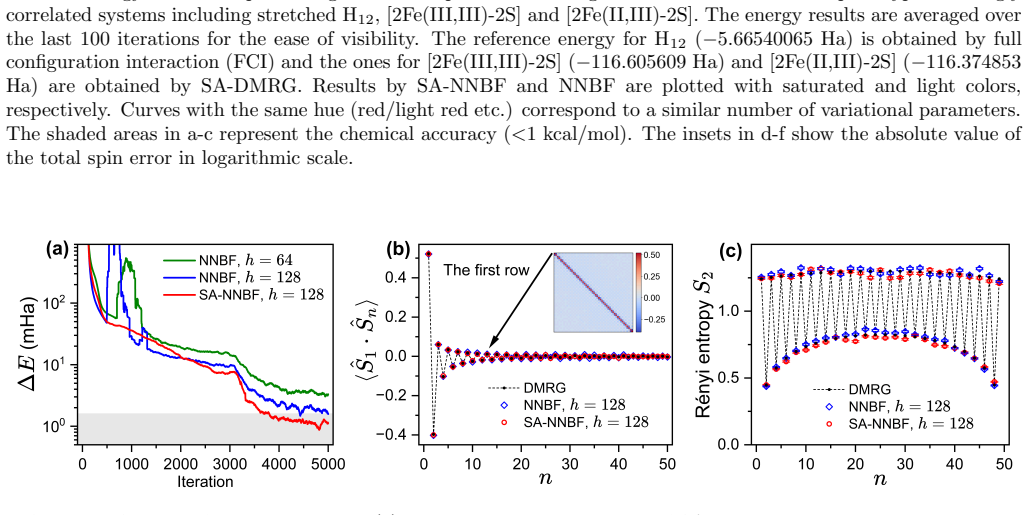
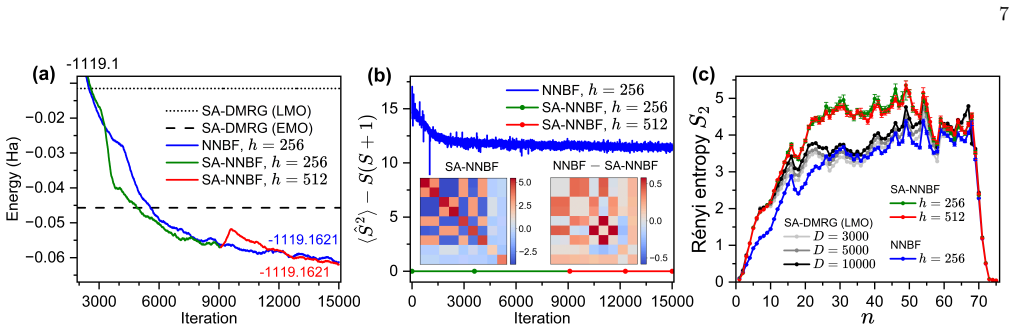
The shaded area shows the chemical accuracy (<1 kcal/mol). (b) Spin correlation function⟨ ˆS1 · ˆSn⟩as a function ofnestimated with the optimized NQS’s (h= 128), in comparison with the DMRG result as reference. The error bars in this subplot are smaller than the marks and thus are not shown for clarity. The inset shows the diagram of the full 50×50 spin c...
- [3]
-
[4]
T. Cohen and M. Welling, inInternational conference on machine learning(PMLR, 2016) pp. 2990–2999
work page 2016
- [5]
- [6]
-
[7]
K. Choo, A. Mezzacapo, and G. Carleo, Nat. Commun. 11, 2368 (2020)
work page 2020
-
[8]
J. Hermann, J. Spencer, K. Choo, A. Mezzacapo, W. M. C. Foulkes, D. Pfau, G. Carleo, and F. No´ e, Nat. Rev. Chem.7, 692 (2023)
work page 2023
-
[9]
F. Becca and S. Sorella,Quantum Monte Carlo ap- proaches for correlated systems(Cambridge University Press, 2017)
work page 2017
- [10]
-
[11]
T. Vieijra, C. Casert, J. Nys, W. De Neve, J. Haegeman, J. Ryckebusch, and F. Verstraete, Phys. Rev. Lett.124, 097201 (2020)
work page 2020
- [12]
- [13]
- [14]
- [15]
- [16]
- [17]
- [18]
-
[19]
D. I. Lyakh, M. Musia l, V. F. Lotrich, and R. J. Bartlett, Chem. Rev.112, 182 (2012)
work page 2012
- [20]
-
[21]
Z. Wu, B. Zhang, W.-H. Fang, and Z. Li, J. Chem. The- ory and Comput.21, 10252 (2025)
work page 2025
-
[22]
J. Hachmann, W. Cardoen, and G. K. Chan, J. Chem. Phys.125, 144101 (2006)
work page 2006
- [23]
-
[24]
Z. Li, J. Li, N. S. Dattani, C. Umrigar, and G. K. Chan, J. Chem. Phys.150(2019)
work page 2019
-
[25]
S. Sharma and G. K. Chan, The Journal of chemical physics136, 124121 (2012)
work page 2012
- [26]
-
[27]
L. L. Viteritti, R. Rende, and F. Becca, Phys. Rev. Lett. 130, 236401 (2023)
work page 2023
-
[28]
T. G. Kolda and B. W. Bader, SIAM Rev.51, 455 (2009)
work page 2009
-
[29]
Pauncz,Spin eigenfunctions: construction and use (New York: Plenum Press, 1979)
R. Pauncz,Spin eigenfunctions: construction and use (New York: Plenum Press, 1979)
work page 1979
-
[30]
A. Szabo and N. S. Ostlund,Modern quantum chem- istry: introduction to advanced electronic structure theory (Courier Corporation, 2012)
work page 2012
-
[31]
M. B. Hastings, I. Gonz´ alez, A. B. Kallin, and R. G. Melko, Phys. Rev. Lett.104, 157201 (2010)
work page 2010
- [32]
- [33]
-
[34]
D. A. Levin and Y. Peres,Markov chains and mixing times, Vol. 107 (American Mathematical Soc., 2017)
work page 2017
-
[35]
A. Griewank and A. Walther,Evaluating derivatives: principles and techniques of algorithmic differentiation (SIAM, 2008)
work page 2008
-
[36]
I. Loshchilov and F. Hutter, inInternational Conference on Learning Representations(2019)
work page 2019
- [37]
- [38]
- [39]
-
[40]
G. Goldshlager, N. Abrahamsen, and L. Lin, J. Comput. Phys516, 113351 (2024). [39]https://github.com/Quantum-Chemistry-Group-BNU/ PyNQS
work page 2024
-
[41]
A. Paszke, S. Gross, F. Massa, A. Lerer, J. Bradbury, G. Chanan, T. Killeen, Z. Lin, N. Gimelshein, L. Antiga, et al., Adv. Neural Inf. Process. Syst.32(2019). [41]http://github.com/zhendongli2008/ Active-space-model-for-Iron-Sulfur-Clusters (2017). [42]https://github.com/zhendongli2008/ Active-space-model-for-FeMoco(2019)
work page 2019
- [42]
-
[43]
Spin-adapted neural network backflow for strongly correlated electrons
R. Rende, L. L. Viteritti, L. Bardone, F. Becca, and S. Goldt, Commun. Phys.7, 260 (2024). 1 Supplemental material for “Spin-adapted neural network backflow for strongly correlated electrons” Yunzhi Li1,2, Zibo Wu1,2, Bohan Zhang 1,2, Wei-Hai Fang1,2, and Zhendong Li 1,2,∗ 1 Key Laboratory of Theoretical and Computational Photochemistry, Ministry of Educa...
work page 2024
discussion (0)
Sign in with ORCID, Apple, or X to comment. Anyone can read and Pith papers without signing in.