REVIEW 2 major objections 2 minor 3 references
Do We Need Distinct Representations for Every Speech Token? Unveiling and Exploiting Redundancy in Large Speech Language Models
T0 review · 2 major / 2 minor · reviewed 2026-05-10 · grok-4.3
Pith's one-line read Large speech language models can merge similar tokens in deep layers to cut computation by 27% without losing task accuracy.
desk verdict The paper shows deep layers in speech LSLMs hold exploitable redundancy via oracle analysis, and Affinity Pooling delivers real efficiency gains on tasks, but task accuracy alone leaves open whether fine acoustic details survive. read the letter →
The pith
A machine-rendered reading of the paper's core claim, the machinery that carries it, and where it could break.
The reading
What carries the argument
Affinity Pooling, a training-free mechanism that merges tokens based on similarity to compress representations while preserving semantics.
What would settle it
A measurable drop in accuracy on a task requiring fine acoustic distinctions, such as phoneme-level recognition in noisy conditions, when the merging is applied.
Extended reading notes
Core claim
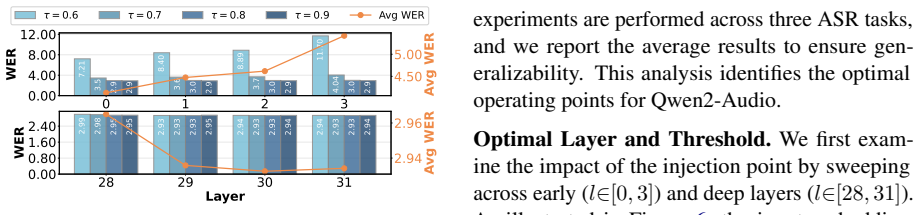
Through layer-wise oracle interventions, the paper reveals a structured redundancy hierarchy in which shallow layers encode essential acoustic details while deep layers exhibit extreme redundancy that permits aggressive compression. Motivated by this, it presents Affinity Pooling as a training-free similarity-based token merging mechanism that strategically reduces speech representations at both input and deep layers without compromising semantic information, achieving a 27.48% reduction in prefilling FLOPs across evaluated tasks.
Load-bearing premise
That matching overall task accuracy after merging is enough to confirm that all semantic and subtle acoustic information has been retained.
Editorial extensions
If this is right
- Prefilling FLOPs drop by 27.48% while accuracy stays competitive on three evaluated tasks.
- Memory usage falls by up to 1.7 times and time-to-first-token improves by about 1.1 times on long utterances.
- Aggressive token compression becomes possible in deep layers without semantic loss.
- The assumption that every speech token must have a unique representation is no longer required for effective model performance.
Reading between the lines
- The same layer-wise redundancy pattern may appear in other sequence models that process high-rate inputs into lower-rate semantics.
- Model architectures could be redesigned to use fewer tokens from the outset rather than merging after the fact.
- Deployment on devices with limited memory would become more feasible for long-form speech processing.
Signed reviews
Editorial analysis
A structured set of objections, weighed in public.
Referee Report
Summary. The paper claims that large speech language models (LSLMs) contain a structured redundancy hierarchy: shallow layers encode essential acoustic details while deep layers show extreme redundancy. Using layer-wise oracle interventions, it introduces Affinity Pooling—a training-free, similarity-based token merging method applied at input and deep layers—to compress representations. This yields a 27.48% reduction in prefilling FLOPs with competitive accuracy on three downstream tasks, plus practical gains of ~1.7× memory savings and ~1.1× faster time-to-first-token on long utterances, challenging the need for fully distinct token representations.
Significance. If the redundancy hierarchy and preservation claims hold, the work offers a practical, training-free route to substantial inference efficiency gains in LSLMs without retraining. The empirical layer-wise findings could inform future model design, and the concrete efficiency metrics (FLOPs, memory, TTFT) demonstrate deployability. The absence of invented parameters or fitted components in the core method strengthens its appeal as a lightweight intervention.
major comments (2)
- [§4] §4 (layer-wise oracle interventions and downstream evaluations): The central claim that aggressive compression via Affinity Pooling preserves all semantic information without compromise rests on maintained accuracy across three tasks. However, task-level metrics may lack sensitivity to losses in subtle acoustic or contextual details encoded in shallow layers, leaving the no-loss assertion and the redundancy hierarchy vulnerable to undetected degradation.
- [§3.2] §3.2 (Affinity Pooling definition): The method is presented as purely similarity-based and training-free, yet the precise merging criterion, threshold selection, and layer-specific application lack explicit equations or pseudocode. This makes it difficult to verify that the approach remains parameter-free and does not implicitly rely on task-specific tuning, which is load-bearing for the reproducibility of the reported 27.48% FLOPs reduction.
minor comments (2)
- [Abstract] Abstract and §4: The efficiency numbers (27.48% FLOPs, 1.7× memory) would be clearer with immediate reference to the exact baselines and utterance lengths used, rather than appearing only in the results narrative.
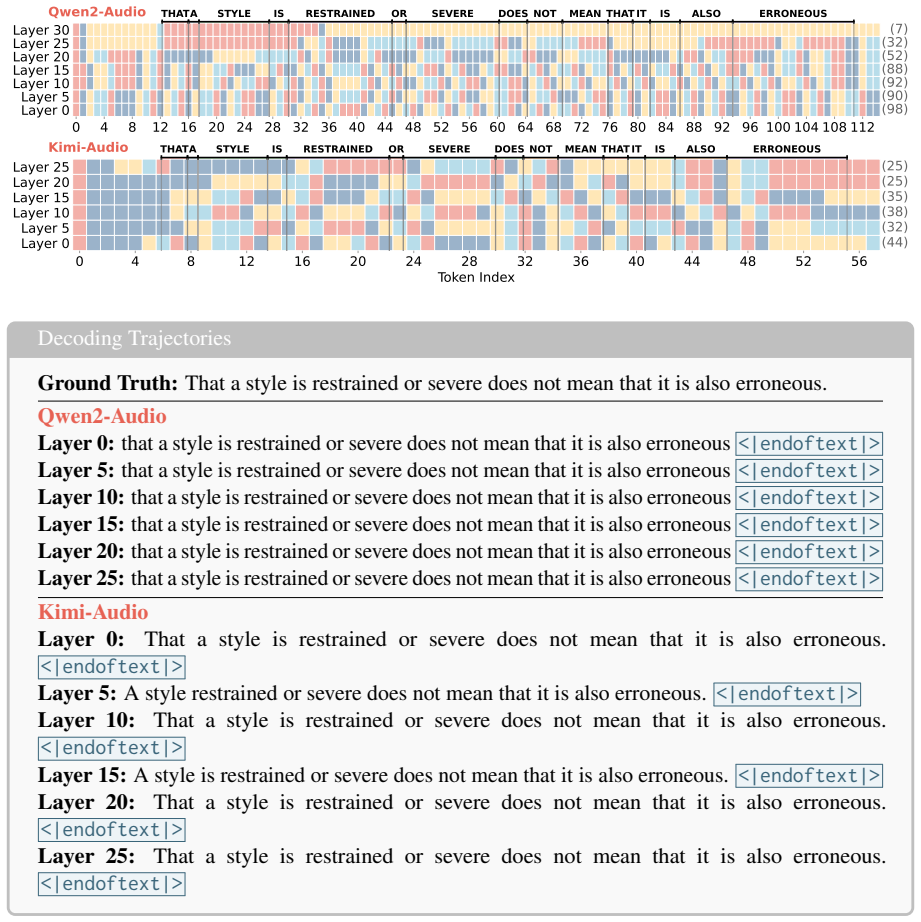
- Figure captions and notation: Some similarity-matrix visualizations would benefit from explicit axis labels and a short legend clarifying how merged tokens are represented post-pooling.
Simulated Author's Rebuttal
We thank the referee for the thoughtful and constructive comments. We address each major point below with our responses and indicate the revisions we will incorporate.
read point-by-point responses
-
Referee: [§4] §4 (layer-wise oracle interventions and downstream evaluations): The central claim that aggressive compression via Affinity Pooling preserves all semantic information without compromise rests on maintained accuracy across three tasks. However, task-level metrics may lack sensitivity to losses in subtle acoustic or contextual details encoded in shallow layers, leaving the no-loss assertion and the redundancy hierarchy vulnerable to undetected degradation.
Authors: We appreciate this observation on metric sensitivity. The layer-wise oracle interventions provide direct, controlled evidence of redundancy by measuring the effect of token compression at each layer independently, which goes beyond aggregate task accuracy and supports the hierarchy claim. Our downstream tasks include speech recognition and understanding benchmarks that require both semantic and acoustic fidelity. To address the concern more explicitly, we will expand the discussion in §4 to acknowledge limitations of task-level metrics and add qualitative examples or auxiliary acoustic preservation metrics in the revision. revision: partial
-
Referee: [§3.2] §3.2 (Affinity Pooling definition): The method is presented as purely similarity-based and training-free, yet the precise merging criterion, threshold selection, and layer-specific application lack explicit equations or pseudocode. This makes it difficult to verify that the approach remains parameter-free and does not implicitly rely on task-specific tuning, which is load-bearing for the reproducibility of the reported 27.48% FLOPs reduction.
Authors: We agree that a more formal specification will improve clarity and reproducibility. Affinity Pooling applies a fixed cosine-similarity threshold for token merging, with the threshold chosen via analysis on a small held-out validation set independent of the downstream tasks and applied at the input layer plus deep layers identified by the oracles. In the revised manuscript we will add the exact mathematical definition of the merging criterion, the specific threshold value with its selection procedure, and pseudocode for the layer-wise application to confirm the method is training-free and contains no task-tuned parameters. revision: yes
Circularity Check
Empirical redundancy analysis is self-contained with no definitional or fitted reductions
full rationale
The paper derives its redundancy hierarchy claim directly from layer-wise oracle interventions on existing LSLM activations and validates compression via a training-free similarity-based Affinity Pooling method, with performance checked on independent downstream tasks. No step equates a claimed prediction or result to its own inputs by construction, nor relies on self-citation chains for uniqueness or ansatz smuggling. The approach remains externally falsifiable through task metrics and efficiency measurements without circular renaming or parameter fitting presented as discovery.
Assumptions & free parameters
Cite this review
Pith. "Pith review of Do We Need Distinct Representations for Every Speech Token? Unveiling and Exploiting Redundancy in Large Speech Language Models." pith.science (2026). https://pith.science/paper/2604.06871
@misc{pith2026260406871,
  author       = {Pith},
  title        = {Pith review of: Do We Need Distinct Representations for Every Speech Token? Unveiling and Exploiting Redundancy in Large Speech Language Models},
  year         = {2026},
  howpublished = {\url{https://pith.science/paper/2604.06871}},
  note         = {Machine review of arXiv:2604.06871}
}
abstract
Large Speech Language Models (LSLMs) typically operate at high token rates (tokens/s) to ensure acoustic fidelity, yet this results in sequence lengths that far exceed the underlying semantic content, incurring prohibitive inference costs. In this paper, we empirically revisit the necessity of such granular token-level processing. Through layer-wise oracle interventions, we unveil a structured redundancy hierarchy: while shallow layers encode essential acoustic details, deep layers exhibit extreme redundancy, allowing for aggressive compression. Motivated by these findings, we introduce Affinity Pooling, a training-free, similarity-based token merging mechanism. By strategically applying this method at both input and deep layers, we effectively compress speech representations without compromising semantic information. Extensive evaluations across three tasks demonstrate that our approach reduces prefilling FLOPs by 27.48\% while maintaining competitive accuracy. Practical deployment further confirms significant efficiency gains, yielding up to $\sim$1.7$\times$ memory savings and $\sim$1.1$\times$ faster time-to-first-token on long utterances. Our results challenge the necessity of fully distinct token representations, providing new perspectives on LSLM efficiency.
Figures


Figures from the paper (8 more)





Reference graph
Works this paper leans on
-
[1]
Token Merging: Your ViT But Faster
Token merging: Your vit but faster.Preprint, arXiv:2210.09461. Fan Bu, Yuhao Zhang, Xidong Wang, Benyou Wang, Qun Liu, and Haizhou Li. 2024. Roadmap towards superhuman speech understanding using large lan- guage models.Preprint, arXiv:2410.13268. Yiming Chen, Xianghu Yue, Chen Zhang, Xiaoxue Gao, Robby T. Tan, and Haizhou Li. 2024. V oicebench: Benchmarki...
work page Pith review arXiv 2024
-
[2]
Qwen2-audio technical report.Preprint, arXiv:2407.10759. Wenqian Cui, Dianzhi Yu, Xiaoqi Jiao, Ziqiao Meng, Guangyan Zhang, Qichao Wang, Yiwen Guo, and Ir- win King. 2025. Recent advances in speech language models: A survey.Preprint, arXiv:2410.03751. Tianyu Fu, Tengxuan Liu, Qinghao Han, Guohao Dai, Shengen Yan, Huazhong Yang, Xuefei Ning, and Yu Wang. 2...
work page Pith review arXiv 2025
-
[3]
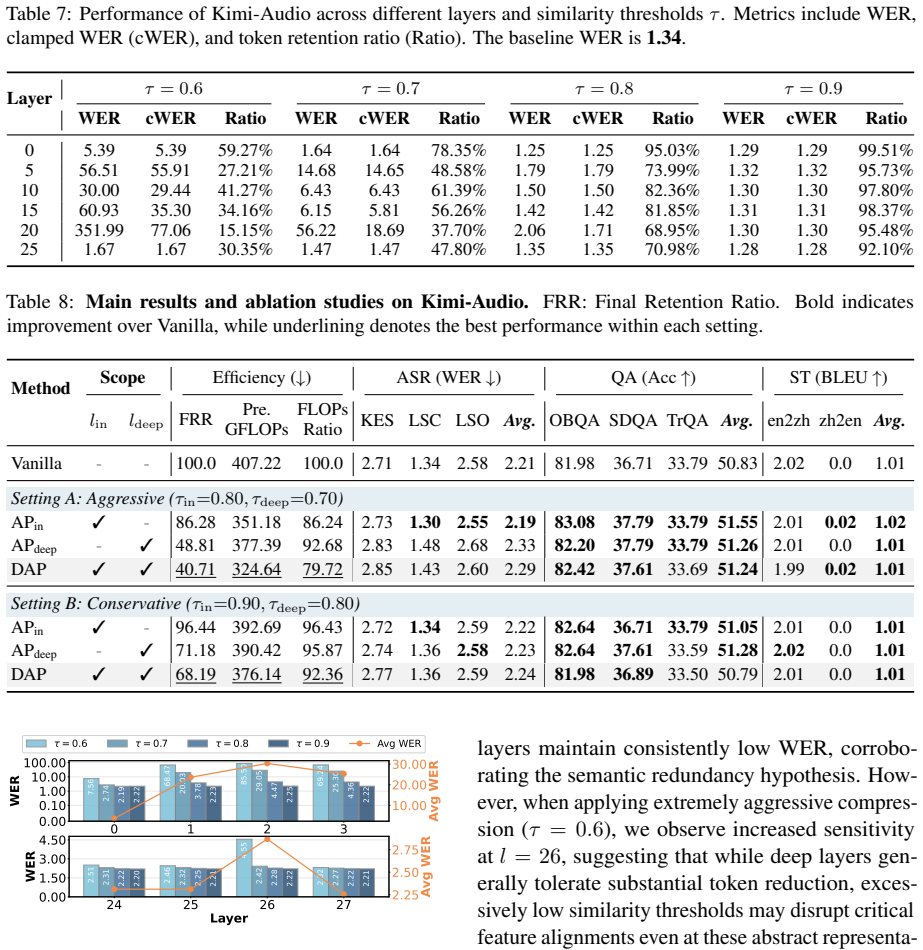
Consistent with the observations on Qwen2- Audio, our method achieves substantial computa- tional savings with negligible impact on semantic preservation. Specifically, under theAggressivesetting, the Dual Affinity Pooling(DAP) strategy reduces the Fi- nal Retention Ratio (FRR) to ∼40.7%, translating to a significant reduction in prefilling GFLOPs. De- sp...
Reviewed May 10, 2026 · model on record in the stance chip above.
Discussion (0). Continue with ORCID to comment.