Trajectory-Based Nonlinear Indices for Real-Time Monitoring and Quantification of Short-Term Voltage Stability
Pith reviewed 2026-05-10 18:25 UTC · model grok-4.3
The pith
Decomposed voltage trajectories and Lyapunov exponents yield fast quantitative short-term voltage stability indices.
A machine-rendered reading of the paper's core claim, the machinery that carries it, and where it could break.
Core claim
The paper claims that applying Lyapunov exponents to the oscillatory and residual components obtained from empirical mode decomposition of voltage trajectories, then measuring divergence from a predefined critical signal via Kullback-Leibler distance, produces indices that quantify short-term voltage stability in real time and detect both oscillatory instability and delayed recovery substantially faster than direct Lyapunov analysis of the raw signal.
What carries the argument
Empirical mode decomposition of post-fault voltage trajectories into residual and oscillatory components, followed by Lyapunov exponent computation on each component and Kullback-Leibler divergence comparison against a critical reference signal to form the stability indices.
If this is right
- Operators receive a numerical stability margin rather than a binary classification, enabling graduated responses.
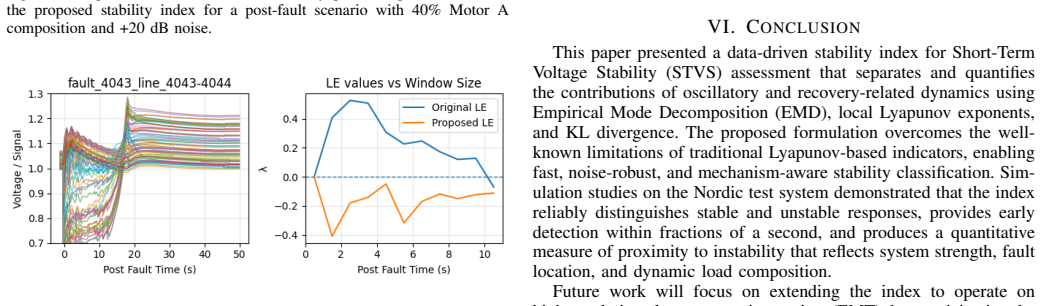
- Detection of oscillatory stability occurs within 0.6 seconds after fault clearing instead of the 10 seconds needed by direct Lyapunov exponent application.
- The delayed-recovery index identifies generator over-excitation trips at 3 seconds, giving roughly 17 seconds of advance warning before the actual trip at 20 seconds.
- Derived thresholds allow distinction between stable, marginally stable, and unstable regimes on the tested Nordic system under varying loads.
Where Pith is reading between the lines
- The indices could feed directly into automated control actions that adjust reactive support or shed load before thresholds are crossed.
- The same decomposition-plus-divergence structure may extend to monitoring other transient stability margins such as frequency or angle stability.
- Field data from actual disturbances would reveal whether the chosen critical signal needs periodic recalibration as the grid evolves.
Load-bearing premise
A single fixed critical signal and its thresholds remain representative across all loads, faults, and system configurations while empirical mode decomposition cleanly separates components without mixing artifacts.
What would settle it
A simulation run on the Nordic system or a comparable grid in which the indices either require more than one second to correctly classify an unstable post-fault trajectory or misclassify a known stable case as unstable under changed load or fault conditions.
Figures


read the original abstract
Existing short term voltage stability (STVS) methods typically address either voltage oscillations or delayed voltage recovery; however, the coexistence of both phenomena has not been adequately covered in the literature. Moreover, existing real-time STVS assessment methods often provide only binary stability classifications. This paper proposes novel indices that enable early detection and quantify the degree of stability. The proposed method decomposes post-fault voltage trajectories using Empirical Mode Decomposition (EMD) into residual and oscillatory components. It then employs Lyapunov Exponents (LEs) to characterize the dynamic behavior of each component and evaluates the stability degree using Kullback Leibler (KL) divergence by comparing the LEs of each component with those of a predefined critical signal. The proposed indices assess oscillatory stability significantly faster than the traditional LE method applied directly to the original signal. Specifically, they detect stability within 0.6 seconds after a fault, compared to approximately 10 seconds for the conventional LE approach. In addition, the delayed-recovery index can identify generator trips caused by over-excitation limits within 3 seconds, well before the actual trip occurs at approximately 20 seconds, thereby providing operators and controllers sufficient time to take preventive actions. Furthermore, thresholds are derived to distinguish between stable and unstable cases, offering a graded measure of the stability margin. Simulation studies on the Nordic test system under varying load conditions demonstrate the effectiveness of the proposed indices.
Editorial analysis
A structured set of objections, weighed in public.
Referee Report
Summary. The manuscript proposes novel trajectory-based nonlinear indices for real-time monitoring and quantification of short-term voltage stability (STVS). Post-fault voltage trajectories are decomposed via Empirical Mode Decomposition (EMD) into residual and oscillatory components; Lyapunov Exponents (LEs) are computed for each component; and Kullback-Leibler (KL) divergence is evaluated against a predefined critical signal to produce graded oscillatory-stability and delayed-recovery indices. Nordic-system simulations under varying loads are reported to show oscillatory-stability detection in 0.6 s (versus ~10 s for direct LE on the raw signal) and early identification of over-excitation-limit trips in 3 s (versus ~20 s actual trip time).
Significance. If the indices prove robust, the work would supply a quantitative, early-warning alternative to binary STVS classifiers, potentially giving operators actionable lead time for preventive control in systems exhibiting both oscillatory and delayed-recovery phenomena.
major comments (3)
- [Abstract and Simulation Studies] The stability degree is defined via KL divergence to a single predefined critical signal whose LEs and the associated thresholds are both obtained from the same Nordic simulations; this circular construction is not mitigated by cross-validation, out-of-sample testing, or sensitivity analysis to alternate critical signals, load levels, or fault types (Abstract; Simulation Studies section).
- [Method description] No diagnostics are supplied for EMD mode-mixing, IMF orthogonality, or energy leakage; without these checks the subsequent LE estimates on the separated components—and therefore the KL-based indices—may be contaminated (Method description).
- [Abstract and Simulation Studies] Detection-time claims (0.6 s and 3 s) are stated without the number of test cases, confidence intervals, or explicit comparison protocol for the baseline LE method; this leaves the performance advantage unquantified (Abstract; Simulation Studies).
minor comments (2)
- [Method] Provide explicit equations for the oscillatory-stability and delayed-recovery indices, including the precise KL-divergence formula and how thresholds are computed from the critical-signal LEs.
- [Method] Clarify the selection procedure for the predefined critical signal and state whether it is fixed or re-derived for each operating point.
Simulated Author's Rebuttal
We thank the referee for the detailed and constructive comments. We address each major point below, indicating where revisions will be made to strengthen the manuscript.
read point-by-point responses
-
Referee: [Abstract and Simulation Studies] The stability degree is defined via KL divergence to a single predefined critical signal whose LEs and the associated thresholds are both obtained from the same Nordic simulations; this circular construction is not mitigated by cross-validation, out-of-sample testing, or sensitivity analysis to alternate critical signals, load levels, or fault types (Abstract; Simulation Studies section).
Authors: We acknowledge that the critical signal and thresholds are derived from the Nordic simulations used in the study. The critical signal is chosen as a representative boundary case of instability to enable a graded KL-based measure rather than a binary classifier. To address the concern about circularity, we will add sensitivity analysis in the revised Simulation Studies section, including tests with alternate critical signals from different load levels and fault types, plus out-of-sample evaluation on held-out scenarios. This will quantify robustness beyond the original cases. revision: yes
-
Referee: [Method description] No diagnostics are supplied for EMD mode-mixing, IMF orthogonality, or energy leakage; without these checks the subsequent LE estimates on the separated components—and therefore the KL-based indices—may be contaminated (Method description).
Authors: We agree that explicit EMD diagnostics would improve transparency and confidence in the component separation. In the revised Method description, we will add quantitative checks: mode-mixing assessment via visual inspection and frequency overlap metrics, IMF orthogonality via inner-product indices close to zero, and energy leakage by comparing reconstructed signal energy to the original. These will be reported for the Nordic test cases. revision: yes
-
Referee: [Abstract and Simulation Studies] Detection-time claims (0.6 s and 3 s) are stated without the number of test cases, confidence intervals, or explicit comparison protocol for the baseline LE method; this leaves the performance advantage unquantified (Abstract; Simulation Studies).
Authors: The reported times reflect the earliest consistent detection across the presented Nordic simulations under varying loads. To quantify the advantage rigorously, the revised Abstract and Simulation Studies section will state the exact number of test cases, include confidence intervals on detection times, and detail the comparison protocol (identical post-fault windows, same LE computation settings, and measurement from fault clearance). revision: yes
Circularity Check
KL stability degree and thresholds fitted to the same Nordic simulations used for validation
specific steps
-
fitted input called prediction
[Abstract (proposed method paragraph)]
"evaluates the stability degree using Kullback Leibler (KL) divergence by comparing the LEs of each component with those of a predefined critical signal. ... thresholds are derived to distinguish between stable and unstable cases, offering a graded measure of the stability margin. Simulation studies on the Nordic test system under varying load conditions demonstrate the effectiveness of the proposed indices."
The critical signal is chosen and the thresholds are fitted from the same Nordic simulations that are later used to claim 0.6 s detection and early-warning performance. The KL-based index and its decision boundaries are therefore calibrated to the test data; the reported speed advantage versus direct LE is a property of this internal calibration rather than an out-of-sample prediction.
full rationale
The central indices are constructed by (1) selecting a single predefined critical trajectory, (2) computing LEs on EMD components, (3) measuring KL divergence to the critical LEs, and (4) deriving numerical thresholds from the identical set of Nordic load-variation simulations. Because both the reference signal and the cut-off values are obtained from the evaluation data, the reported 0.6 s detection time and graded stability margins are characterizations of a fitted model on its own training cases rather than independent predictions. No cross-validation against alternate critical signals or external systems is described, producing partial circularity in the performance claims while the underlying EMD+LE decomposition itself remains non-circular.
Axiom & Free-Parameter Ledger
free parameters (2)
- predefined critical signal
- stability thresholds
axioms (3)
- domain assumption Empirical Mode Decomposition cleanly separates post-fault voltage trajectories into residual and oscillatory modes without significant mixing.
- domain assumption Lyapunov exponents computed on the decomposed components meaningfully characterize oscillatory and recovery stability.
- ad hoc to paper Kullback-Leibler divergence between component LEs and the critical-signal LEs quantifies a graded stability margin.
invented entities (2)
-
oscillatory stability index
no independent evidence
-
delayed-recovery index
no independent evidence
Reference graph
Works this paper leans on
-
[1]
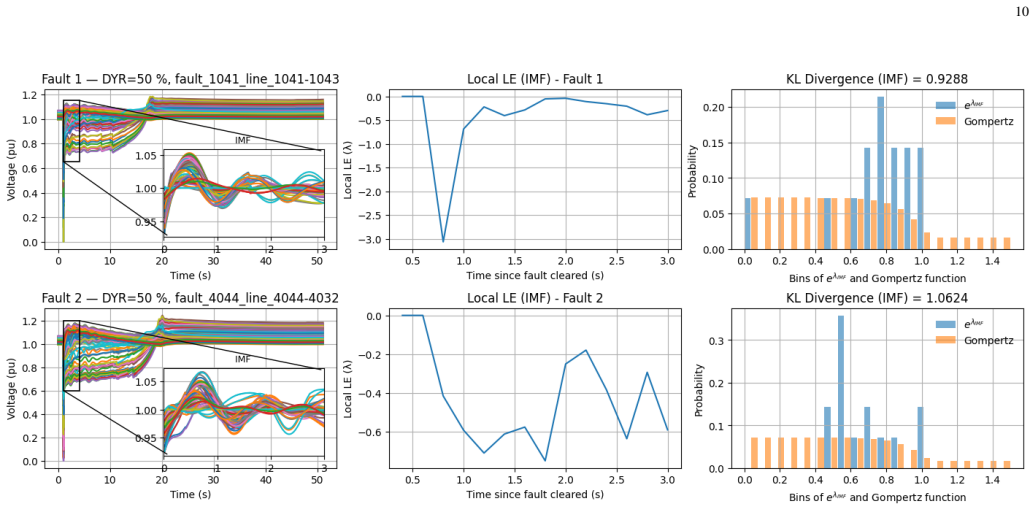
P. Kundur, J. Paserba, V . Ajjarapu, G. Andersson, A. Bose, C. Canizares, N. Hatziargyriou, D. Hill, A. Stankovic, C. Tayloret al., “Definition and classification of power system stability ieee/cigre joint task force on 10 Fig. 6. Quantification of the proposed stability index for faults applied at the 132 kV bus (1041) and the 400 kV bus (4044) under 50%...
work page 2004
-
[2]
M. Sarwar, M. Almomani, and V . Ajjarapu, “Short-term voltage stability in modern power systems: A comprehensive review of challenges and solutions for inverter-based resource integration.”
-
[3]
Time series power flow framework for the analysis of fidvr using linear regression,
W. Wang, M. Diaz-Aguil ´o, K. B. Mak, F. de Le ´on, D. Czarkowski, and R. E. Uosef, “Time series power flow framework for the analysis of fidvr using linear regression,”IEEE Transactions on Power Delivery, vol. 33, no. 6, pp. 2946–2955, 2018
work page 2018
-
[4]
Whitepaper on transient voltage response criteria,
North American Electric Reliability Corporation (NERC), “Whitepaper on transient voltage response criteria,” NERC, Tech. Rep., Dec. 2022, available:
work page 2022
-
[5]
A model of voltage collapse in electric power systems,
I. Dobson, H.-D. Chiang, J. Thorp, and L. Fekih-Ahmed, “A model of voltage collapse in electric power systems,” inProceedings of the 27th IEEE Conference on Decision and Control, 1988, pp. 2104–2109 vol.3
work page 1988
-
[6]
H. Mohsenian-Rad, M. Kezunovic, and F. Rahmatian, “Synchro- waveforms in wide-area monitoring, control, and protection: Real-world examples and future opportunities,”IEEE Power and Energy Magazine, vol. 23, no. 1, pp. 69–80, 2025
work page 2025
-
[7]
J. D. Pinz ´on, F. Santamaria, and A. Espinel, “Fault-induced delayed voltage recovery assessment in the colombian power system using synchrophasor measurements,” in2023 IEEE PES Innovative Smart Grid Technologies Latin America (ISGT-LA), 2023, pp. 20–24
work page 2023
-
[8]
Grid incident in spain and portugal on 28 april 2025: Final report,
ICS Investigation Expert Panel, “Grid incident in spain and portugal on 28 april 2025: Final report,” Mar. 2026, final Report
work page 2025
-
[9]
Lyapunov functions for multimachine power systems with dynamic loads,
R. Davy and I. Hiskens, “Lyapunov functions for multimachine power systems with dynamic loads,”IEEE Transactions on Circuits and Systems I: Fundamental Theory and Applications, vol. 44, no. 9, pp. 796–812, 1997
work page 1997
-
[10]
A transient energy function for power systems including the induction motor model,
Y . Min and L. Chen, “A transient energy function for power systems including the induction motor model,”Science in China Series E: Technological Sciences, vol. 50, no. 5, pp. 575–584, 2007
work page 2007
-
[11]
An energy function method for determining voltage collapse during a power system transient,
K. L. Praprost and K. A. Loparo, “An energy function method for determining voltage collapse during a power system transient,”IEEE Transactions on Circuits and Systems I: Fundamental Theory and Applications, vol. 41, no. 10, pp. 635–651, 2002
work page 2002
-
[12]
Time series shapelet classification based online short-term voltage stability assessment,
L. Zhu, C. Lu, and Y . Sun, “Time series shapelet classification based online short-term voltage stability assessment,”IEEE Transactions on Power Systems, vol. 31, no. 2, pp. 1430–1439, 2015
work page 2015
-
[13]
Imbalance learning machine- based power system short-term voltage stability assessment,
L. Zhu, C. Lu, Z. Y . Dong, and C. Hong, “Imbalance learning machine- based power system short-term voltage stability assessment,”IEEE Transactions on Industrial Informatics, vol. 13, no. 5, pp. 2533–2543, 2017
work page 2017
-
[14]
H. Yang, W. Zhang, J. Chen, and L. Wang, “Pmu-based voltage stability prediction using least square support vector machine with online learning,”Electric Power Systems Research, vol. 160, pp. 234–242, 2018
work page 2018
-
[15]
J. D. Pinz ´on and D. G. Colom ´e, “Real-time multi-state classification of short-term voltage stability based on multivariate time series machine learning,”International Journal of Electrical Power & Energy Systems, vol. 108, pp. 402–414, 2019
work page 2019
-
[16]
A. H. Babaali and M. T. Ameli, “Weighted ensemble learning for real- time short-term voltage stability assessment with phasor measurements data,”IET Generation, Transmission & Distribution, vol. 17, no. 10, pp. 2331–2343, 2023
work page 2023
-
[17]
F. Luo, Z. Wang, X. Wang, and Q. Wu, “Data-driven short-term volt- age stability assessment based on spatial–temporal graph convolutional network,”International Journal of Electrical Power & Energy Systems, vol. 130, p. 106753, 2021
work page 2021
-
[18]
Z. Li, Y . Wang, and J. Zhang, “Pmu measurements-based short-term voltage stability assessment of power systems via deep transfer learning,” IEEE Transactions on Instrumentation and Measurement, vol. 72, pp. 1–12, 2023
work page 2023
-
[19]
Real- time monitoring of short-term voltage stability using pmu data,
S. Dasgupta, M. Paramasivam, U. Vaidya, and V . Ajjarapu, “Real- time monitoring of short-term voltage stability using pmu data,”IEEE Transactions on Power Systems, vol. 28, no. 4, pp. 3702–3711, 2013
work page 2013
-
[20]
Pmu-based online monitoring of short- term voltage stability using lyapunov exponents,
J. D. Pinz ´on and D. G. Colom ´e, “Pmu-based online monitoring of short- term voltage stability using lyapunov exponents,”IEEE Latin America Transactions, vol. 17, no. 10, pp. 1578–1587, 2019
work page 2019
-
[21]
G. Benettin, L. Galgani, A. Giorgilli, and J.-M. Strelcyn, “Lyapunov characteristic exponents for smooth dynamical systems and for hamil- tonian systems; a method for computing all of them. part 1: Theory,” Meccanica, vol. 15, pp. 9–20, 1980
work page 1980
-
[22]
An improved real-time short-term voltage stability monitoring method based on phase rectification,
H. Ge, Q. Guo, H. Sun, B. Wang, B. Zhang, J. Liu, Y . Yang, and F. Qian, “An improved real-time short-term voltage stability monitoring method based on phase rectification,”IEEE Transactions on Power Systems, vol. 33, no. 1, pp. 1068–1070, 2018
work page 2018
-
[23]
Koopman operator-based prediction of short-term voltage stability,
H. Zhang, B. Li, X. Lv, J. Zhang, X. Zhao, and X. Peng, “Koopman operator-based prediction of short-term voltage stability,” in2024 5th In- ternational Conference on Smart Grid and Energy Engineering (SGEE), 2024, pp. 76–79
work page 2024
-
[24]
H. Gao, D. Yang, Y . Lv, and L. Wang, “Short-term voltage stability prediction for power systems based on a dominant koopman operator- enhanced mle,”IEEE Access, vol. 13, pp. 61 056–61 066, 2025
work page 2025
-
[25]
Important notes on lyapunov exponents,
K. Guan, “Important notes on lyapunov exponents,”arXiv preprint arXiv:1401.3315, 2014
-
[26]
Local and global lyapunov expo- nents,
A. Eden, C. Foias, and R. Temam, “Local and global lyapunov expo- nents,”Journal of dynamics and differential equations, vol. 3, no. 1, pp. 133–177, 1991. 11
work page 1991
-
[27]
Characteristic distributions of finite- time lyapunov exponents,
A. Prasad and R. Ramaswamy, “Characteristic distributions of finite- time lyapunov exponents,”Physical Review E, vol. 60, no. 3, p. 2761, 1999
work page 1999
-
[28]
Nonlinear finite-time lyapunov exponent and predictability,
R. Ding and J. Li, “Nonlinear finite-time lyapunov exponent and predictability,”Physics Letters A, vol. 364, no. 5, pp. 396–400, 2007
work page 2007
-
[29]
Finite size lyapunov exponent: review on applications,
M. Cencini and A. Vulpiani, “Finite size lyapunov exponent: review on applications,”Journal of Physics A: Mathematical and Theoretical, vol. 46, no. 25, p. 254019, 2013
work page 2013
-
[30]
Birkhoff’s ergodic theorem and the maximal ergodic theorem,
K. Yosida and S. Kakutani, “Birkhoff’s ergodic theorem and the maximal ergodic theorem,”Proceedings of the Imperial Academy, vol. 15, no. 6, pp. 165–168, 1939
work page 1939
-
[31]
A multiplicative ergodic theorem, lyapunov charac- teristic numbers for dynamical systems,
V . I. Oseledec, “A multiplicative ergodic theorem, lyapunov charac- teristic numbers for dynamical systems,”Transactions of the Moscow Mathematical Society, vol. 19, pp. 197–231, 1968
work page 1968
-
[32]
Vulpiani,Chaos: from simple models to complex systems
A. Vulpiani,Chaos: from simple models to complex systems. World Scientific, 2010, vol. 17
work page 2010
-
[33]
A. Pikovsky and A. Politi,Lyapunov exponents: a tool to explore complex dynamics. Cambridge University Press, 2016
work page 2016
-
[34]
Determining lyapunov exponents from a time series,
A. Wolf, J. B. Swift, H. L. Swinney, and J. A. Vastano, “Determining lyapunov exponents from a time series,”Physica D: nonlinear phenom- ena, vol. 16, no. 3, pp. 285–317, 1985
work page 1985
-
[35]
N. E. Huang, Z. Shen, S. R. Long, M. C. Wu, H. H. Shih, Q. Zheng, N.- C. Yen, C. C. Tung, and H. H. Liu, “The empirical mode decomposition and the hilbert spectrum for nonlinear and non-stationary time series analysis,”Proceedings of the Royal Society of London. Series A: mathematical, physical and engineering sciences, vol. 454, no. 1971, pp. 903–995, 1998
work page 1971
-
[36]
G. Wang, X.-Y . Chen, F.-L. Qiao, Z. Wu, and N. E. Huang, “On intrinsic mode function,”Advances in Adaptive Data Analysis, vol. 2, no. 03, pp. 277–293, 2010
work page 2010
-
[37]
D. P. Mandic, N. u. Rehman, Z. Wu, and N. E. Huang, “Empirical mode decomposition-based time-frequency analysis of multivariate signals: The power of adaptive data analysis,”IEEE Signal Processing Magazine, vol. 30, no. 6, pp. 74–86, 2013
work page 2013
-
[38]
Entropy- based metric for characterization of delayed voltage recovery,
S. Dasgupta, M. Paramasivam, U. Vaidya, and V . Ajjarapu, “Entropy- based metric for characterization of delayed voltage recovery,”IEEE Transactions on Power Systems, vol. 30, no. 5, pp. 2460–2468, 2014
work page 2014
-
[39]
A practical method for calculating largest lyapunov exponents from small data sets,
M. T. Rosenstein, J. J. Collins, and C. J. De Luca, “A practical method for calculating largest lyapunov exponents from small data sets,”Physica D: Nonlinear Phenomena, vol. 65, no. 1-2, pp. 117–134, 1993
work page 1993
-
[40]
H. Kantz and T. Schreiber,Nonlinear time series analysis. Cambridge university press, 2003
work page 2003
-
[41]
Test systems for voltage stability studies,
T. Van Cutsem, M. Glavic, W. Rosehart, C. Canizares, M. Kanatas, L. Lima, F. Milano, L. Papangelis, R. A. Ramos, J. A. dos Santoset al., “Test systems for voltage stability studies,”IEEE Transactions on Power Systems, vol. 35, no. 5, pp. 4078–4087, 2020
work page 2020
-
[42]
Wecc dynamic composite load model (cmpldw) specifications,
WECC, “Wecc dynamic composite load model (cmpldw) specifications,” Western Electricity Coordinating Council, Tech. Rep., January 2015, accessed: 2025-09-29. [Online]. Available: https: //home.engineering.iastate.edu/∼jdm/ee554/WECC%20Composite% 20Load%20Model%20Specifications%2001-27-2015.pdf
work page 2015
-
[43]
Technical reference document: Dynamic load modeling,
NERC, “Technical reference document: Dynamic load modeling,” North American Electric Reliability Corporation, Atlanta, GA, Tech. Rep., December 2016, accessed: 2025-09-29. [Online]. Avail- able: https://www.nerc.com/comm/PC/LoadModelingTaskForceDL/ NERC TechnicalReference DynamicLoadModeling Dec2016.pdf
work page 2016
discussion (0)
Sign in with ORCID, Apple, or X to comment. Anyone can read and Pith papers without signing in.