Aerial Booster-Cell Enabled Inter-Cell Interference Coordination for 5G NR Networks
Pith reviewed 2026-05-10 17:30 UTC · model grok-4.3
The pith
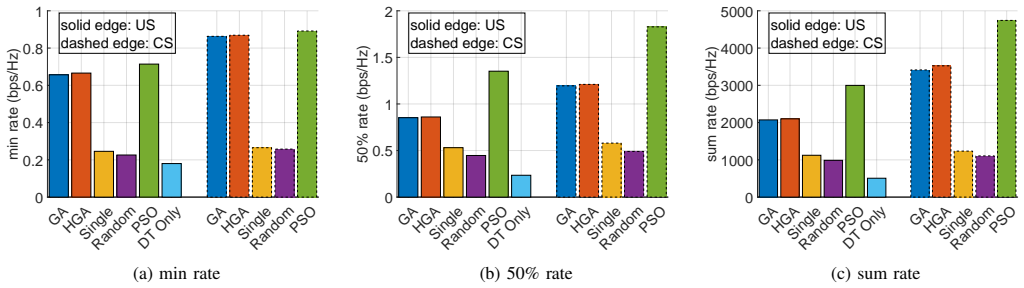
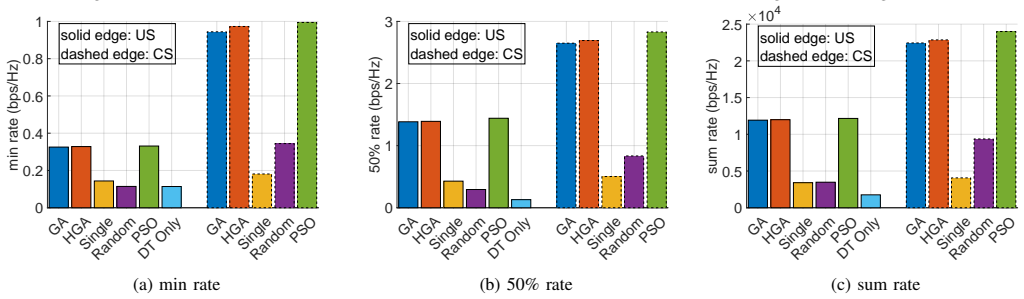
Coordinated uptilt optimization in booster cells raises worst-case UAV SIR in multi-cell 5G NR networks while preserving ground user performance.
A machine-rendered reading of the paper's core claim, the machinery that carries it, and where it could break.
Core claim
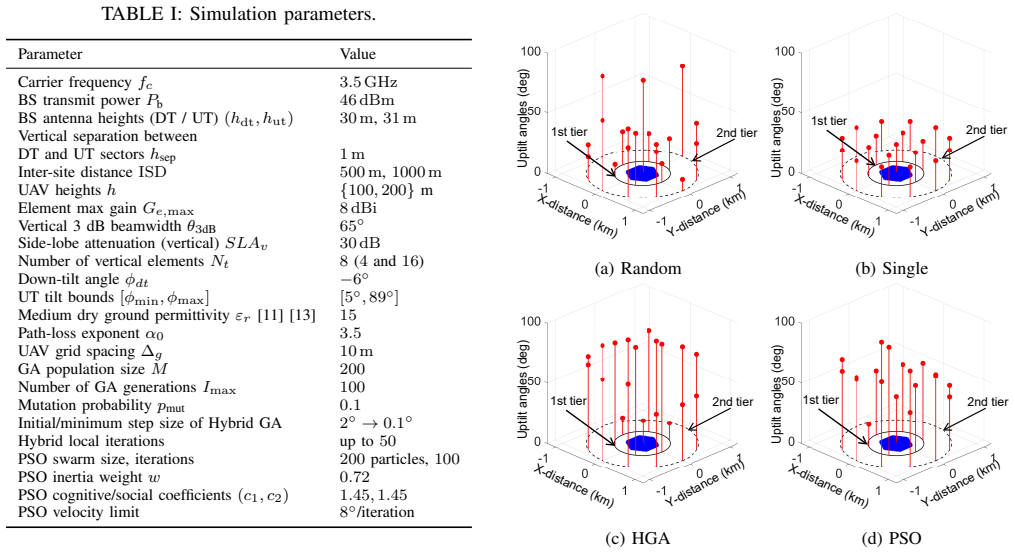
By formulating a multi-cell optimization that maximizes minimum UAV SIR across a grid of aerial locations while constraining GUE impact, and solving it through bio-inspired methods for joint BS uptilt angles plus NR-compliant TDIC scheduling, the booster-cell architecture delivers higher worst-case UAV SIR and downlink reliability than uncoordinated baselines.
What carries the argument
Booster-cell architecture that enables joint antenna-domain uptilt optimization and time-domain interference coordination (TDIC) via NR scheduling.
If this is right
- Higher minimum UAV SIR across dense macro deployments
- Improved downlink reliability for aerial users without new hardware
- Ground user equipment performance remains within acceptable limits
- Practical implementation using standard NR scheduling rules
Where Pith is reading between the lines
- The same tilt-coordination idea could extend to other high-altitude or mobile aerial platforms beyond current UAVs
- Field trials in actual operator networks would be needed to confirm whether simulation gains survive real propagation and traffic variations
- This coordination approach might inform antenna-tilt policies in future integrated aerial-terrestrial spectrum sharing
- It suggests that software-level scheduling tweaks alone are insufficient and must be combined with physical-layer antenna adjustments
Load-bearing premise
The idealized network model and interference patterns used in simulations match real 5G NR deployments, and the optimizers reliably locate solutions that do not require further tuning to protect ground users.
What would settle it
A side-by-side measurement of worst-case UAV SIR in a live multi-cell 5G NR testbed with and without the coordinated uptilt and scheduling, checking whether the predicted reliability gain appears.
Figures


read the original abstract
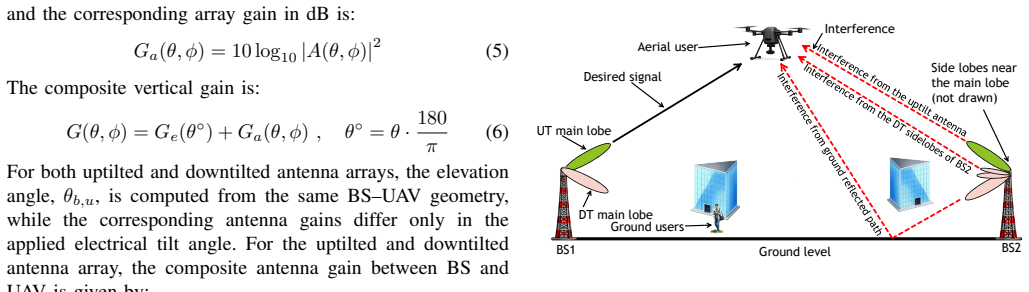
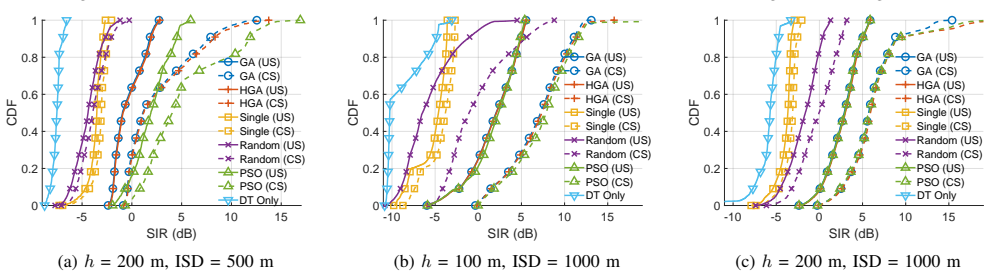
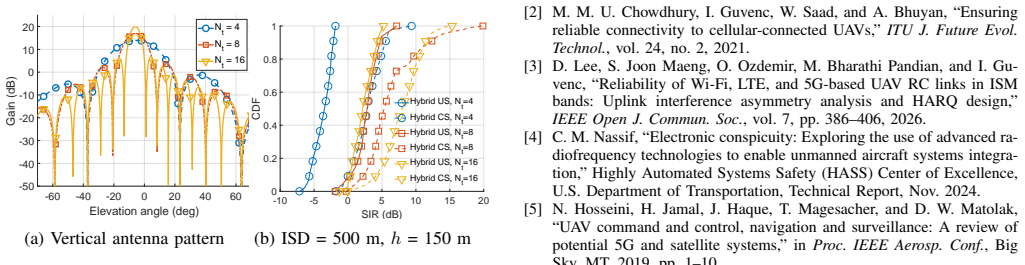
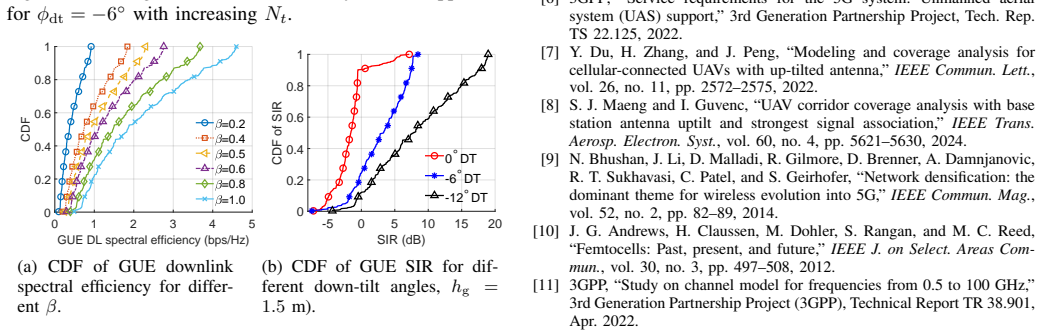
Cellular-connected unmanned aerial vehicles (UAVs) operating in 5G New Radio (NR) macro networks experience severe and spatially non-uniform downlink interference. This is primarily caused by the interference from the sidelobes of downtilted base station (BS) antennas serving terrestrial users, which limits the ability of the network to provide uniform and high-quality coverage to aerial users. Supporting aerial users requires boosting the coverage of certain cells or sectors, which can further exacerbate inter-cell interference in dense macro deployments. This motivates the need for inter-cell interference coordination (ICIC) in multi-cell 5G NR networks serving both aerial and terrestrial users. In this work, we propose an ICIC framework that jointly optimizes antenna-domain coordination through BS uptilt angle optimization and time-domain interference coordination (TDIC) through NR-compliant scheduling. The framework is formulated as a multi-cell NR macro deployment problem that maximizes the minimum UAV signal-to-interference ratio (SIR) over a spatial grid of UAV locations while maintaining acceptable performance for ground user equipment (GUEs). The resulting optimization problem is non-convex and is solved using bio-inspired optimization techniques, including particle swarm optimization (PSO) and genetic algorithm (GA). Simulation results demonstrate that coordinated uptilt optimization with the booster-cell architecture significantly improves worst-case UAV SIR and downlink reliability in multi-cell 5G NR networks. booster-cell architecture significantly improves worst-case UAV SIR and downlink reliability in multi-cell 5G NR networks.
Editorial analysis
A structured set of objections, weighed in public.
Referee Report
Summary. The manuscript proposes a booster-cell architecture for inter-cell interference coordination (ICIC) in multi-cell 5G NR networks serving both UAVs and ground user equipment (GUEs). It formulates a non-convex optimization problem that jointly tunes base-station uptilt angles and NR-compliant time-domain interference coordination (TDIC) scheduling, solved via particle swarm optimization (PSO) and genetic algorithm (GA), with the objective of maximizing the minimum UAV signal-to-interference ratio (SIR) over a spatial grid while preserving acceptable GUE performance. Simulation results are claimed to demonstrate that the coordinated uptilt optimization significantly improves worst-case UAV SIR and downlink reliability.
Significance. If the underlying network model, propagation assumptions, and optimizer behavior prove representative of actual 5G NR deployments, the framework could supply a practical, standards-compliant method for mitigating the well-known sidelobe interference problem that aerial users experience in macro-cell networks, thereby supporting uniform coverage for UAVs without requiring new spectrum or hardware.
major comments (3)
- [§5 (Simulation Results)] §5 (Simulation Results) and associated tables: the abstract and results sections report that the booster-cell architecture 'significantly improves' worst-case UAV SIR and downlink reliability, yet supply no numerical baseline values (e.g., SIR without optimization or with conventional downtilt), no error bars, no statistical significance tests, and no explicit parameter settings for BS density, transmit power, antenna patterns, or UAV height distribution. These omissions render the central performance claims unverifiable from the provided material.
- [§4 (Optimization Problem Formulation)] §4 (Optimization Problem Formulation), Eq. (problem statement): the non-convex joint uptilt-and-TDIC problem is solved exclusively with PSO and GA, but the manuscript provides neither convergence analysis, optimality-gap bounds, nor sensitivity results with respect to the listed free parameters (uptilt angles and optimizer hyperparameters). Because the claimed gains rest on the reliability of these heuristics locating feasible high-quality points, the absence of such diagnostics is load-bearing for the central claim.
- [§3 (System Model)] §3 (System Model): the interference model relies on specific assumptions about downtilted BS sidelobes, booster-cell coverage boosting, and multi-cell layout, yet contains no cross-validation against 3GPP TR 36.777 UAV channel models, ray-tracing benchmarks, or field measurements. If these assumptions deviate materially from real 5G NR deployments, the reported SIR gains become artifacts of the simulation setup rather than evidence of a robust ICIC framework.
minor comments (2)
- [Abstract] Abstract: the final sentence is duplicated verbatim, producing an obvious copy-paste artifact that should be removed.
- [Notation] Notation and definitions: the precise definition of the spatial UAV grid, the SIR expression, and the GUE performance constraint (e.g., minimum rate or outage threshold) would benefit from an explicit equation or table entry for clarity.
Simulated Author's Rebuttal
We thank the referee for the constructive and detailed review, as well as for acknowledging the potential practical value of the proposed booster-cell ICIC framework. We address each major comment point by point below, indicating the specific revisions we will incorporate to improve verifiability and transparency.
read point-by-point responses
-
Referee: [§5 (Simulation Results)] §5 (Simulation Results) and associated tables: the abstract and results sections report that the booster-cell architecture 'significantly improves' worst-case UAV SIR and downlink reliability, yet supply no numerical baseline values (e.g., SIR without optimization or with conventional downtilt), no error bars, no statistical significance tests, and no explicit parameter settings for BS density, transmit power, antenna patterns, or UAV height distribution. These omissions render the central performance claims unverifiable from the provided material.
Authors: We agree that the absence of explicit numerical baselines, parameter values, and statistical measures limits independent verification. In the revised manuscript we will expand Section 5 with a new table reporting minimum UAV SIR for the unoptimized case, conventional downtilt, and the proposed joint optimization; we will also include error bars obtained from multiple independent simulation runs, list all simulation parameters (BS density, transmit power, antenna patterns, UAV height distribution) in a dedicated table, and add a short discussion of result variability. revision: yes
-
Referee: [§4 (Optimization Problem Formulation)] §4 (Optimization Problem Formulation), Eq. (problem statement): the non-convex joint uptilt-and-TDIC problem is solved exclusively with PSO and GA, but the manuscript provides neither convergence analysis, optimality-gap bounds, nor sensitivity results with respect to the listed free parameters (uptilt angles and optimizer hyperparameters). Because the claimed gains rest on the reliability of these heuristics locating feasible high-quality points, the absence of such diagnostics is load-bearing for the central claim.
Authors: We acknowledge that additional optimizer diagnostics would strengthen confidence in the reported gains. While theoretical optimality-gap bounds are unavailable for this non-convex formulation, the revised manuscript will include (i) convergence plots for both PSO and GA demonstrating stabilization of the objective, (ii) sensitivity results with respect to uptilt-angle bounds and key hyperparameters (population size, mutation rate), and (iii) statistics across multiple independent optimizer runs to illustrate solution consistency. revision: yes
-
Referee: [§3 (System Model)] §3 (System Model): the interference model relies on specific assumptions about downtilted BS sidelobes, booster-cell coverage boosting, and multi-cell layout, yet contains no cross-validation against 3GPP TR 36.777 UAV channel models, ray-tracing benchmarks, or field measurements. If these assumptions deviate materially from real 5G NR deployments, the reported SIR gains become artifacts of the simulation setup rather than evidence of a robust ICIC framework.
Authors: The system model employs standard 3GPP macro-cell path-loss and antenna-pattern formulations. To address the concern we will add a new subsection in Section 3 that explicitly cites 3GPP TR 36.777, discusses alignment of our UAV height and sidelobe assumptions with that specification, and provides a qualitative comparison of the resulting SIR statistics. Full ray-tracing or measurement-based validation lies outside the scope of the present study. revision: partial
Circularity Check
No circularity: explicit optimization and simulation results
full rationale
The paper formulates a non-convex multi-cell optimization problem to maximize minimum UAV SIR subject to GUE constraints, then solves it numerically via PSO and GA. All load-bearing steps are explicit: antenna uptilt angles and TDIC scheduling are decision variables, the objective is defined directly from the SIR expression over a spatial grid, and performance is reported from Monte Carlo simulations. No step renames a fitted parameter as a prediction, imports uniqueness via self-citation, or reduces the claimed gains to an input by construction. The framework is self-contained against its stated model and solver; external validation of the model is a correctness issue, not circularity.
Axiom & Free-Parameter Ledger
free parameters (2)
- Uptilt angles per booster cell
- PSO and GA hyperparameters
axioms (2)
- domain assumption Sidelobe interference from downtilted BS antennas dominates UAV reception in macro networks
- domain assumption GUE performance can be maintained while optimizing for UAV SIR
invented entities (1)
-
Booster-cell architecture
no independent evidence
Reference graph
Works this paper leans on
-
[1]
An overview of 3GPP release-15 study on enhanced LTE support for connected drones,
S. D. Muruganathan, X. Lin, H.-L. Maattanen, J. Sedin, Z. Zou, W. A. Hapsari, and S. Yasukawa, “An overview of 3GPP release-15 study on enhanced LTE support for connected drones,”IEEE Commun. Stand. Mag., vol. 5, no. 4, pp. 140–146, 2021
work page 2021
-
[2]
Ensuring reliable connectivity to cellular-connected UA Vs,
M. M. U. Chowdhury, I. Guvenc, W. Saad, and A. Bhuyan, “Ensuring reliable connectivity to cellular-connected UA Vs,”ITU J. Future Evol. Technol., vol. 24, no. 2, 2021
work page 2021
-
[3]
D. Lee, S. Joon Maeng, O. Ozdemir, M. Bharathi Pandian, and I. Gu- venc, “Reliability of Wi-Fi, LTE, and 5G-based UA V RC links in ISM bands: Uplink interference asymmetry analysis and HARQ design,” IEEE Open J. Commun. Soc., vol. 7, pp. 386–406, 2026
work page 2026
-
[4]
C. M. Nassif, “Electronic conspicuity: Exploring the use of advanced ra- diofrequency technologies to enable unmanned aircraft systems integra- tion,” Highly Automated Systems Safety (HASS) Center of Excellence, U.S. Department of Transportation, Technical Report, Nov. 2024
work page 2024
-
[5]
N. Hosseini, H. Jamal, J. Haque, T. Magesacher, and D. W. Matolak, “UA V command and control, navigation and surveillance: A review of potential 5G and satellite systems,” inProc. IEEE Aerosp. Conf., Big Sky, MT, 2019, pp. 1–10
work page 2019
-
[6]
Service requirements for the 5G system: Unmanned aerial system (UAS) support,
3GPP, “Service requirements for the 5G system: Unmanned aerial system (UAS) support,” 3rd Generation Partnership Project, Tech. Rep. TS 22.125, 2022
work page 2022
-
[7]
Modeling and coverage analysis for cellular-connected UA Vs with up-tilted antenna,
Y . Du, H. Zhang, and J. Peng, “Modeling and coverage analysis for cellular-connected UA Vs with up-tilted antenna,”IEEE Commun. Lett., vol. 26, no. 11, pp. 2572–2575, 2022
work page 2022
-
[8]
UA V corridor coverage analysis with base station antenna uptilt and strongest signal association,
S. J. Maeng and I. Guvenc, “UA V corridor coverage analysis with base station antenna uptilt and strongest signal association,”IEEE Trans. Aerosp. Electron. Syst., vol. 60, no. 4, pp. 5621–5630, 2024
work page 2024
-
[9]
Network densification: the dominant theme for wireless evolution into 5G,
N. Bhushan, J. Li, D. Malladi, R. Gilmore, D. Brenner, A. Damnjanovic, R. T. Sukhavasi, C. Patel, and S. Geirhofer, “Network densification: the dominant theme for wireless evolution into 5G,”IEEE Commun. Mag., vol. 52, no. 2, pp. 82–89, 2014
work page 2014
-
[10]
Femtocells: Past, present, and future,
J. G. Andrews, H. Claussen, M. Dohler, S. Rangan, and M. C. Reed, “Femtocells: Past, present, and future,”IEEE J. on Select. Areas Com- mun., vol. 30, no. 3, pp. 497–508, 2012
work page 2012
-
[11]
Study on channel model for frequencies from 0.5 to 100 GHz,
3GPP, “Study on channel model for frequencies from 0.5 to 100 GHz,” 3rd Generation Partnership Project (3GPP), Technical Report TR 38.901, Apr. 2022
work page 2022
-
[12]
Genetic algorithm: An ap- proach on optimization,
S. D. Immanuel and U. K. Chakraborty, “Genetic algorithm: An ap- proach on optimization,” inProc. IEEE Int. Conf. Commun. Electron. Syst., Coimbatore, India, 2019, pp. 701–708
work page 2019
-
[13]
Role-based connectiv- ity management with realistic air-to-ground channels for cooperative UA Vs,
N. Goddemeier, K. Daniel, and C. Wietfeld, “Role-based connectiv- ity management with realistic air-to-ground channels for cooperative UA Vs,”IEEE J. on Select. Areas Commun., vol. 30, no. 5, pp. 951–963, 2012
work page 2012
discussion (0)
Sign in with ORCID, Apple, or X to comment. Anyone can read and Pith papers without signing in.