Hybrid-2D Excitonic Metasurfaces for Complex Amplitude Modulation
Pith reviewed 2026-05-10 17:05 UTC · model grok-4.3
The pith
Hybrid metasurfaces combining two gate-tunable WS2 monolayers achieve independent control of both amplitude and phase across the full visible wavefront.
A machine-rendered reading of the paper's core claim, the machinery that carries it, and where it could break.
Core claim
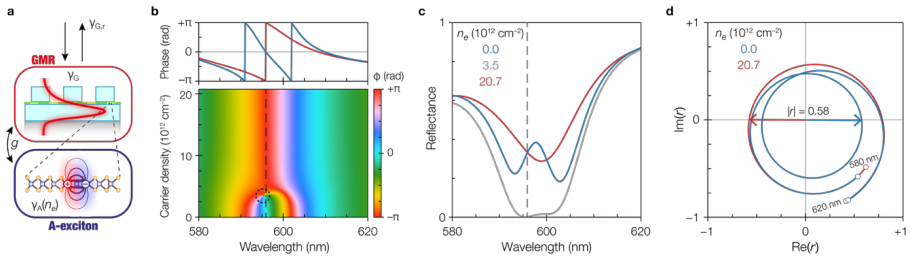
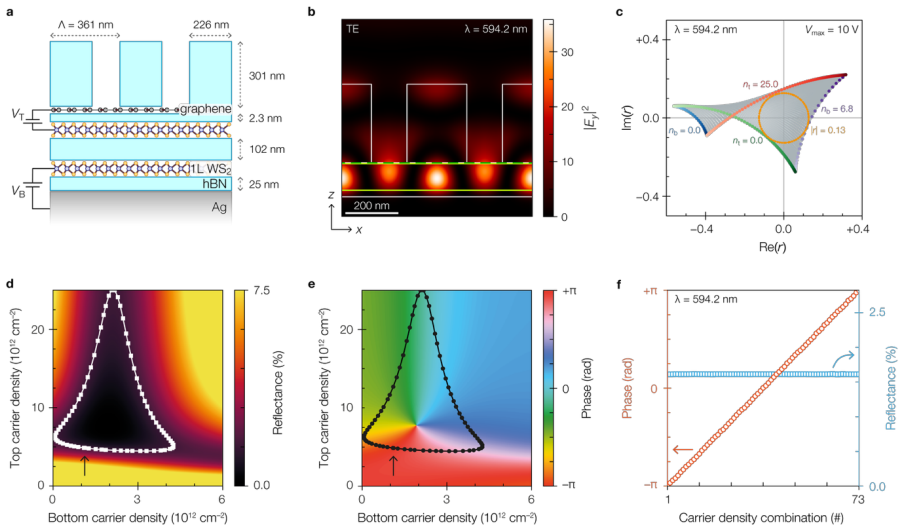
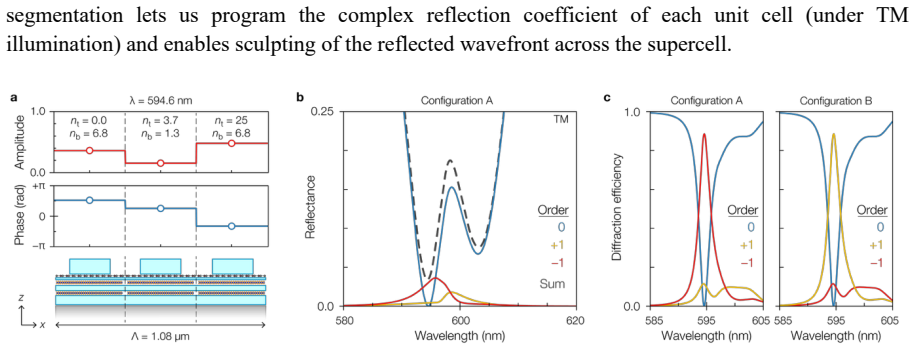
The authors claim that the gate-tunable excitonic response of monolayer WS2, when integrated into an inverse-designed hybrid-2D metasurface, supplies enough degrees of freedom to decouple amplitude and phase modulation. A single monolayer yields a pi-phase shifter with constant scattering amplitude. A second independently gated monolayer extends this to full independent control over amplitude and the entire 0-2pi phase interval, which is then applied to produce an electrically reconfigurable beam-steering device.
What carries the argument
The gate-tunable excitonic resonance of monolayer WS2 placed inside an inverse-designed dielectric metasurface geometry that converts voltage-induced changes in the material response into independent amplitude and phase shifts of the scattered light.
If this is right
- A single-monolayer design functions as a uniform-amplitude pi-phase modulator.
- Two monolayers together permit arbitrary complex modulation (any amplitude paired with any phase between 0 and 2pi).
- The same platform produces an electrically addressable beam-steering device without amplitude crosstalk.
- All modulation occurs in the visible spectrum using only electrical gating.
Where Pith is reading between the lines
- The same inverse-design approach could be repeated with other gate-tunable 2D excitonic materials to shift the operating band into the near-infrared or ultraviolet.
- Because the control is purely electrical and local, the architecture may be tiled into larger arrays for dynamic holography or adaptive-optics correctors.
- If the monolayers remain stable under repeated gating, the device could operate at video rates without mechanical parts.
- Stacking additional monolayers might add polarization or spectral degrees of freedom, though this extension lies outside the present work.
Load-bearing premise
The experimentally measured gate-tunable excitonic response of free-standing WS2 remains accurate once the monolayer is embedded in the metasurface stack and subjected to fabrication variations.
What would settle it
Fabricate the proposed two-monolayer metasurface, sweep the two gate voltages independently, and record the transmitted or reflected field; the measurement would falsify the claim if amplitude and phase cannot be set independently across the full 0-2pi phase range while staying within the modeled amplitude window.
Figures
read the original abstract
Dynamic control of visible light is crucial for technologies such as holographic displays and adaptive optics. Passive metasurfaces can shape wavefronts at the subwavelength scale and active metasurfaces promise to extend this functionality into the temporal domain. However, existing metasurfaces for dynamic phase manipulation typically cannot deliver phase modulation across a broad range without causing variations in the scattering amplitude. Here, we use an inverse-design pipeline to numerically demonstrate a hybrid-2D excitonic metasurface platform offering independent amplitude and phase control in the visible regime. Harnessing the gate-tunable excitonic response of monolayer WS2 retrieved from experiments, we design a pi-phase modulator with a uniform amplitude profile. Adding a second tunable monolayer, we achieve independent control of the amplitude and phase over the full 0-2pi phase range, which we leverage for a reconfigurable beam-steering metadevice. Our results demonstrate how hybrid-2D excitonic metasurfaces enable electrically tunable wavefront shaping in the visible regime.
Editorial analysis
A structured set of objections, weighed in public.
Referee Report
Summary. The paper numerically demonstrates, via inverse design, a hybrid-2D excitonic metasurface platform that uses the gate-tunable excitonic response of monolayer WS2 (imported from experiment) to achieve independent amplitude and phase control of visible light. It first shows a uniform-amplitude π-phase modulator and then, with a second independently tunable monolayer, full 0–2π phase range with decoupled amplitude, which is applied to a reconfigurable beam-steering device.
Significance. If the modeling assumptions hold, the work offers a concrete route to complex-amplitude modulation in the visible regime using electrically tunable 2D materials, addressing a key limitation of existing active metasurfaces. The combination of experimental material data with inverse design is a positive feature; however, the absence of experimental validation or sensitivity analysis to integration effects limits immediate impact.
major comments (2)
- [Results (inverse-design demonstrations)] The strongest claim (independent 0–2π amplitude-phase control and the beam-steering application) rests on direct insertion of the measured WS2 gate-dependent permittivity into the electromagnetic solver. No section quantifies or bounds the expected shifts in exciton resonance position, linewidth, or oscillator strength arising from the modified local dielectric environment, possible strain, or near-field coupling between the two monolayers and the supporting structure. A sensitivity study or effective-medium correction would be required to confirm that the inverse-design solution remains valid.
- [Methods / Numerical modeling] The pi-phase modulator with uniform amplitude (first numerical result) and the subsequent two-monolayer extension both assume that the experimental monolayer response remains representative inside the metasurface geometry. If even modest broadening or detuning occurs, the reported decoupling of amplitude and phase would degrade; the manuscript provides no error bars or robustness checks on this transfer.
minor comments (2)
- [Figures] Figure captions should explicitly state the wavelength range and the exact WS2 permittivity model (real/imaginary parts) used in each panel.
- [Device application] Notation for the two independent gate voltages (V_g1, V_g2) should be introduced once and used consistently in the beam-steering section.
Simulated Author's Rebuttal
We thank the referee for the constructive feedback and positive assessment of the potential impact of our work. We address each major comment below. We agree that additional robustness analysis strengthens the numerical demonstration and have incorporated a sensitivity study into the revised manuscript.
read point-by-point responses
-
Referee: [Results (inverse-design demonstrations)] The strongest claim (independent 0–2π amplitude-phase control and the beam-steering application) rests on direct insertion of the measured WS2 gate-dependent permittivity into the electromagnetic solver. No section quantifies or bounds the expected shifts in exciton resonance position, linewidth, or oscillator strength arising from the modified local dielectric environment, possible strain, or near-field coupling between the two monolayers and the supporting structure. A sensitivity study or effective-medium correction would be required to confirm that the inverse-design solution remains valid.
Authors: We agree that a quantitative sensitivity analysis was missing from the original submission. In the revised manuscript we have added a dedicated subsection (Section 3.3) that perturbs the excitonic parameters (resonance energy, linewidth, and oscillator strength) over ranges reported in the literature for environmental, strain, and near-field effects in WS2 monolayers. The inverse-designed structures are re-evaluated under these perturbations; the independent amplitude-phase control and beam-steering functionality remain functional within the tolerances required for the targeted applications. These results are presented in new Figure 5 and Supplementary Note 4, confirming that the reported performance is robust to realistic variations in the material response. revision: yes
-
Referee: [Methods / Numerical modeling] The pi-phase modulator with uniform amplitude (first numerical result) and the subsequent two-monolayer extension both assume that the experimental monolayer response remains representative inside the metasurface geometry. If even modest broadening or detuning occurs, the reported decoupling of amplitude and phase would degrade; the manuscript provides no error bars or robustness checks on this transfer.
Authors: We acknowledge that the original manuscript did not provide explicit robustness checks or error bars on the transfer of the experimental permittivity into the metasurface geometry. We have revised the Methods section to clarify the baseline use of the measured data and have added error bands to the performance metrics of both the uniform-amplitude π-phase modulator and the two-monolayer complex-amplitude modulator. These bands are derived directly from the sensitivity study described above. The decoupling of amplitude and phase is shown to persist across the considered parameter variations, with the beam-steering efficiency remaining above the threshold needed for practical operation. revision: yes
Circularity Check
No significant circularity; derivation uses external experimental inputs and numerical optimization
full rationale
The paper's claims rest on an inverse-design pipeline that imports gate-tunable excitonic response data for monolayer WS2 directly from external experiments as a fixed input. This data drives numerical optimization of metasurface geometries to achieve uniform-amplitude pi-phase modulation and, with a second monolayer, independent 0-2pi amplitude-phase control. No equations or steps reduce by construction to self-defined quantities, fitted parameters renamed as predictions, or load-bearing self-citations. The central results are simulation outputs from an optimization process whose inputs are independent of the target performance metrics, rendering the derivation self-contained against the cited experimental benchmarks.
Axiom & Free-Parameter Ledger
axioms (1)
- domain assumption Gate-tunable excitonic response of monolayer WS2 from experiments can be directly used in numerical design without major deviations
Reference graph
Works this paper leans on
-
[1]
Hu, Y . et al. Electrically Tunable Multifunctional Polarization-Dependent Metasurfaces Integrated with Liquid Crystals in the Visible Region. Nano Lett. 21, 4554–4562 (2021). 17. Lynch, J. et al. Full 2π phase modulation using exciton-polaritons in a two-dimensional superlattice. Device 3, (2025). 18. Li, Q. et al. A Purcell-enabled monolayer semiconduct...
work page 2021
-
[2]
Guarneri, L. et al. Dynamic Excitonic Beam Switching with Atomically‐Thin Binary Blazed Gratings. Adv. Opt. Mater. 2403257 (2025) doi:10.1002/adom.202403257. 33. Guarneri, L. et al. Temperature-Dependent Excitonic Light Manipulation with Atomically Thin Optical Elements. Nano Lett. 24, 6240–6246 (2024). 34. Epstein, I. et al. Near-unity light absorption i...
-
[3]
Wilson, J. A. & Yoffe, A. D. The transition metal dichalcogenides discussion and interpretation of the observed optical, electrical and structural properties. Adv. Phys. 18, 193–335 (1969). 49. Van de Groep, J., Li, Q., Song, J.-H., Kik, P. G. & Brongersma, M. L. Impact of substrates and quantum effects on exciton line shapes of 2D semiconductors at room ...
-
[4]
Thureja, P. et al. Array-level inverse design of beam steering active metasurfaces. ACS Nano 14, 15042–15055 (2020). 63. Das, S., Wang, Y ., Dai, Y ., Li, S. & Sun, Z. Ultrafast transient sub-bandgap absorption of monolayer MoS2. Light Sci. Appl. 10, 27 (2021). 64. Mohammadi Estakhri, N. & Alù, A. Wave-front Transformation with Gradient Metasurfaces. Phys...
work page 2020
discussion (0)
Sign in with ORCID, Apple, or X to comment. Anyone can read and Pith papers without signing in.