Continuous Wavefront Design via Virtual Point Sources: A Holographic Paradigm for Near-Field XL-MIMO
Pith reviewed 2026-05-10 17:52 UTC · model grok-4.3
The pith
The optimal virtual point source can be located geometrically without iteration to approximate the continuous wavefront in near-field XL-MIMO.
A machine-rendered reading of the paper's core claim, the machinery that carries it, and where it could break.
Core claim
The optimal location of the virtual point source can be determined in a fully non-iterative manner through rigorous geometric-optical analysis, which decouples the coupled dual near-field beamforming problem in XL-MIMO systems by approximating the ideal continuous wave function with a single analytically tractable spherical wave.
What carries the argument
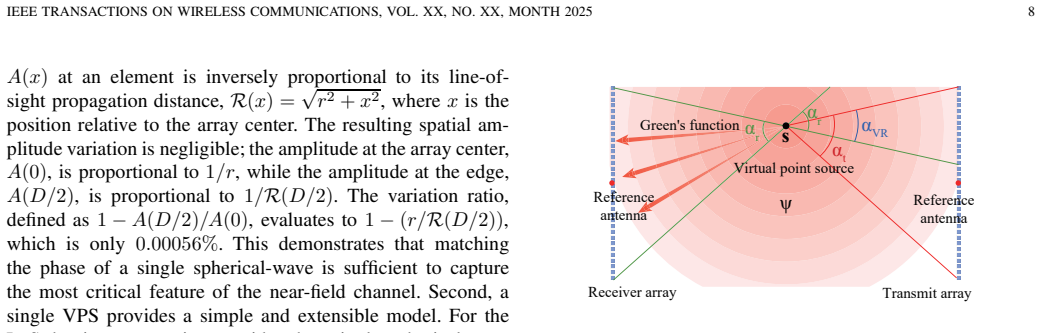
The Virtual Point Source (VPS), defined as the origin of a spherical wave that approximates the target continuous wavefront over the array aperture; it enables non-iterative location calculation via geometric optics to replace coupled iterative optimization.
Load-bearing premise
The desired continuous wave function over the array aperture is accurately approximated by the spherical wave originating from a single virtual point source whose optimal position is correctly identified by the geometric-optical analysis.
What would settle it
A numerical experiment that optimizes the beamforming directly without the VPS approximation and shows that the resulting performance gain over the geometrically located VPS is large, or that the geometrically predicted location deviates substantially from the numerically optimal location for the spherical-wave parameters.
Figures






read the original abstract
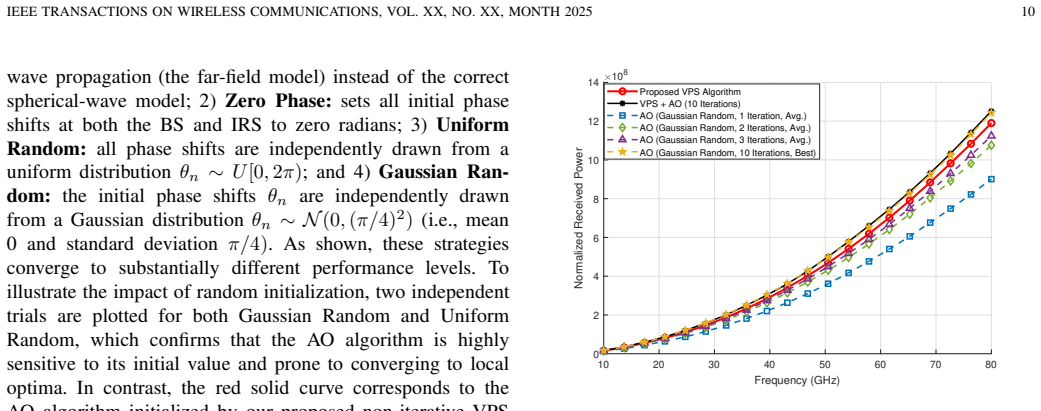
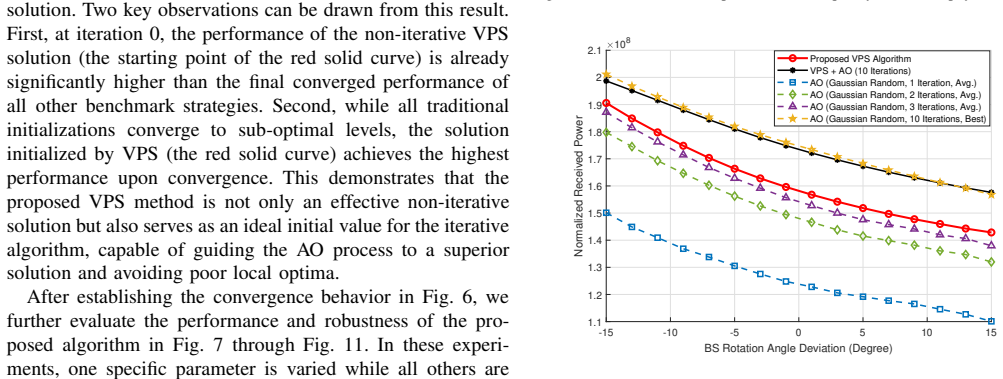
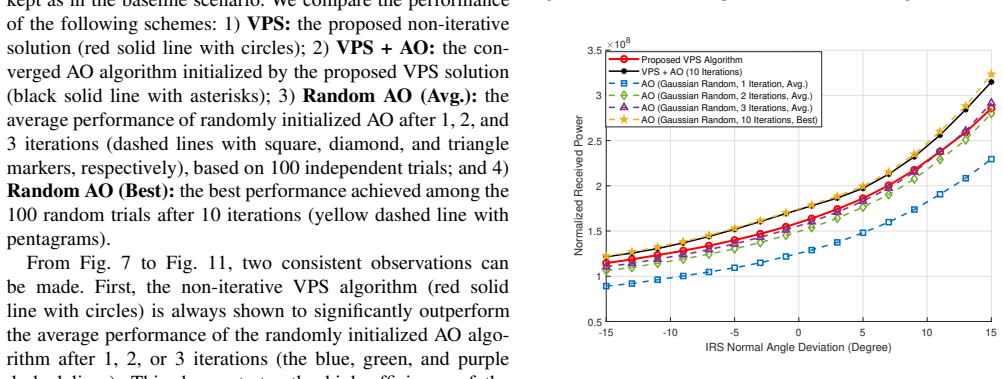
Beamforming design for extremely large-scale multiple-input multiple-output (XL-MIMO) systems is challenging due to prohibitive computational complexity and complex near-field propagation effects. To address this, this paper introduces a holographic beamforming paradigm that reformulates the design from optimizing variables at spatially discrete antenna locations to shaping a continuous electromagnetic wave function over the array aperture, effectively mitigating the growth of algorithmic complexity as the array scale increases. We apply this paradigm to the challenging dual near-field (DNF) scenario, where strong transceiver coupling severely degrades conventional iterative algorithms. In this case, we propose a novel Virtual Point Source (VPS) method, which approximates the ideal wave function with a single and analytically tractable spherical-wave. A rigorous geometric-optical analysis is provided to show that the optimal VPS location can be determined in a fully non-iterative manner, thus decoupling the coupled DNF problem. The proposed method is demonstrated in an intelligent reflecting surfaces (IRS)-assisted system, where simulation results show that our non-iterative approach achieves performance comparable to converged alternating-optimization (AO) algorithms, while incurring significantly lower complexity and avoiding convergence uncertainty. This work offers a new theoretical framework for holographic beamforming design in XL-MIMO systems.
Editorial analysis
A structured set of objections, weighed in public.
Referee Report
Summary. The paper introduces a holographic beamforming paradigm for XL-MIMO that shifts design from discrete antenna variables to shaping a continuous wavefront over the aperture. For the dual near-field (DNF) case, it approximates the ideal wave function by a single spherical wave from a virtual point source (VPS) whose location is found non-iteratively via geometric-optical analysis, thereby decoupling the coupled problem. Simulations in an IRS-assisted system indicate that this non-iterative VPS method achieves performance comparable to converged alternating optimization (AO) while reducing complexity and avoiding convergence issues.
Significance. If the geometric-optical analysis is shown to identify the VPS location that truly minimizes wavefront approximation error, the work would supply a scalable, non-iterative framework for near-field XL-MIMO beamforming that sidesteps the complexity growth of discrete optimization. The explicit non-iterative derivation and the reported parity with AO constitute concrete strengths that could influence practical holographic designs, provided the approximation's accuracy is rigorously established.
major comments (1)
- [VPS method and geometric-optical analysis] Geometric-optical analysis for VPS location (central to the DNF decoupling claim): the manuscript asserts that this analysis rigorously locates the optimal VPS without iteration or data fitting. However, geometric optics relies on ray or stationary-phase approximations that are typically asymptotic and may omit evanescent components or fail to guarantee the global L2-optimal spherical-wave fit to the ideal continuous aperture function. A direct verification—e.g., by comparing the derived location against the minimizer of the actual wavefront error metric or by bounding the approximation error—is required to confirm that the non-iterative solution is optimal rather than merely stationary under the geometric model.
minor comments (2)
- [Simulation results] Simulation results section: the abstract and results claim performance comparable to AO but supply no quantitative metrics (e.g., achievable rate values, gap to AO), error bars, number of Monte-Carlo trials, or specific parameter settings, which weakens the empirical support for the non-iterative claim.
- [VPS derivation] The paper would benefit from an explicit statement of the wavefront error metric (L2 norm or similar) used to define optimality of the VPS location, together with a brief comparison to the location obtained by numerical minimization of that metric.
Simulated Author's Rebuttal
We thank the referee for the constructive and insightful review of our manuscript. We have carefully considered the major comment and provide a point-by-point response below. We propose revisions that directly address the concern while preserving the core contributions of the work.
read point-by-point responses
-
Referee: Geometric-optical analysis for VPS location (central to the DNF decoupling claim): the manuscript asserts that this analysis rigorously locates the optimal VPS without iteration or data fitting. However, geometric optics relies on ray or stationary-phase approximations that are typically asymptotic and may omit evanescent components or fail to guarantee the global L2-optimal spherical-wave fit to the ideal continuous aperture function. A direct verification—e.g., by comparing the derived location against the minimizer of the actual wavefront error metric or by bounding the approximation error—is required to confirm that the non-iterative solution is optimal rather than merely stationary under the geometric model.
Authors: We appreciate the referee's precise identification of this subtlety. Our geometric-optical analysis derives the VPS location via stationary-phase and ray-path phase-matching conditions, which is a standard rigorous approach within the radiating near-field regime and yields a closed-form non-iterative solution. We acknowledge, however, that this does not automatically constitute a proof of global L2 optimality over all possible spherical-wave fits, nor does it explicitly bound the contribution of evanescent components. To strengthen the claim, we will revise the manuscript by adding a new subsection (and corresponding appendix) that numerically compares the analytically derived VPS coordinates against the location obtained by direct minimization of the L2 wavefront error metric (via dense grid search over candidate source positions). We will also include a brief discussion of the validity range of the ray-optics approximation and the negligible impact of evanescent waves for the aperture sizes and distances considered. These additions will clarify that the solution is optimal under the geometric model and empirically near-optimal in the L2 sense. revision: yes
Circularity Check
No significant circularity; geometric-optical derivation is independent of fitted inputs or self-citation chains.
full rationale
The central claim rests on a geometric-optical analysis that derives the VPS location non-iteratively from ray-phase or stationary-phase principles applied to the continuous aperture wave function. This step is presented as an original derivation rather than a fit to data, a renaming of known results, or a load-bearing self-citation. The ideal spherical-wave approximation is stated explicitly as an ansatz, and performance is checked externally via simulation against AO baselines. No equation reduces by construction to its own inputs, and the decoupling of the DNF problem follows from the analysis rather than being presupposed. The derivation chain remains self-contained against external benchmarks.
Axiom & Free-Parameter Ledger
axioms (1)
- domain assumption Geometric-optical analysis assumptions hold for determining optimal VPS location in dual near-field propagation
invented entities (1)
-
Virtual Point Source (VPS)
no independent evidence
Lean theorems connected to this paper
-
IndisputableMonolith/Cost/FunctionalEquation.leanwashburn_uniqueness_aczel unclear?
unclearRelation between the paper passage and the cited Recognition theorem.
holographic methodology... shaping a CWF over the array aperture
What do these tags mean?
- matches
- The paper's claim is directly supported by a theorem in the formal canon.
- supports
- The theorem supports part of the paper's argument, but the paper may add assumptions or extra steps.
- extends
- The paper goes beyond the formal theorem; the theorem is a base layer rather than the whole result.
- uses
- The paper appears to rely on the theorem as machinery.
- contradicts
- The paper's claim conflicts with a theorem or certificate in the canon.
- unclear
- Pith found a possible connection, but the passage is too broad, indirect, or ambiguous to say the theorem truly supports the claim.
Reference graph
Works this paper leans on
-
[1]
S. Dang, O. Amin, B. Shihada, and M.-S. Alouini, “What sho uld 6G be?” Nature Electron., vol. 3, no. 1, pp. 20–29, Jan. 2020
work page 2020
-
[2]
A vision of 6G wireless sy stems: Applications, trends, technologies, and open research pro blems,
W. Saad, M. Bennis, and M. Chen, “A vision of 6G wireless sy stems: Applications, trends, technologies, and open research pro blems,” IEEE Netw., vol. 34, no. 3, pp. 134–142, May/Jun. 2020
work page 2020
-
[3]
Millimeter-wa ve cellular wireless networks: Potentials and challenges,
S. Rangan, T. S. Rappaport, and E. Erkip, “Millimeter-wa ve cellular wireless networks: Potentials and challenges,” Proc. IEEE , vol. 102, no. 3, pp. 366–385, Feb. 2014
work page 2014
-
[4]
Near-field MIMO communications for 6G: Fundamentals, challenges, potenti als, and future directions,
M. Cui, Z. Wu, Y . Lu, X. Wei, and L. Dai, “Near-field MIMO communications for 6G: Fundamentals, challenges, potenti als, and future directions,” IEEE Commun. Mag. , vol. 61, no. 1, pp. 40–46, Sep. 2023
work page 2023
-
[5]
Millimeter wave communications for future mobile networks,
M. Xiao et al. , “Millimeter wave communications for future mobile networks,” IEEE J. Sel. Areas Commun. , vol. 35, no. 9, pp. 1909–1935, Sep. 2017
work page 1909
-
[6]
T. S. Rappaport et al., “Wireless communications and applications above 100 GHz: Opportunities and challenges for 6G and beyond,” IEEE Access, vol. 7, pp. 78 729–78 757, 2019
work page 2019
-
[7]
Space division multiple access SDMA applic able for mobile satellite communications,
S. D. Ilcev, “Space division multiple access SDMA applic able for mobile satellite communications,” in Proc. 10th Int. Conf. Telecommun. Modern Satell. Cable Broadcast. Services (TELSIKS) , 2011
work page 2011
-
[8]
Millimeter-wa ve cellular wireless networks: Potentials and challenges,
S. Rangan, T. S. Rappaport, and E. Erkip, “Millimeter-wa ve cellular wireless networks: Potentials and challenges,” Proc. IEEE , vol. 102, no. 3, pp. 366–385, Mar. 2014
work page 2014
-
[9]
Millimeter wave MIMO with lens ante nna array: A new path division multiplexing paradigm,
Y . Zeng and R. Zhang, “Millimeter wave MIMO with lens ante nna array: A new path division multiplexing paradigm,” IEEE Trans. Inf. Theory , vol. 64, no. 4, pp. 1557–1571, Jul. 2016
work page 2016
-
[10]
Design of energy- and cost-efficient massive MIMO arrays,
A. Puglielli et al., “Design of energy- and cost-efficient massive MIMO arrays,” Proc. IEEE , vol. 104, no. 3, pp. 586–606, Dec. 2016
work page 2016
-
[11]
H. Du, J. Zhang, J. Cheng, and B. Ai, “Millimeter wave com munica- tions with reconfigurable intelligent surfaces: Performan ce analysis and optimization,” IEEE Trans. Commun. , vol. 69, no. 4, pp. 2752–2768, Apr. 2021
work page 2021
-
[12]
Non-stationarities in extra-large-scale massive MIMO,
E. De Carvalho, A. Ali, A. Amiri, M. Angjelichinoski, an d R. W. Heath, “Non-stationarities in extra-large-scale massive MIMO,” IEEE Wireless Commun., vol. 27, no. 4, pp. 74–80, Aug. 2020
work page 2020
-
[13]
Spatially sparse precoding in millimeter wave MIMO system s,
O. El Ayach, S. Rajagopal, S. Abu-Surra, Z. Pi, and R. W. H eath, “Spatially sparse precoding in millimeter wave MIMO system s,” IEEE Trans. Wireless Commun. , vol. 13, no. 3, pp. 1499–1513, Mar. 2014
work page 2014
-
[14]
Communicating with extremely large- scale ar- ray/surface: Unified modeling and performance analysis,
H. Lu and Y . Zeng, “Communicating with extremely large- scale ar- ray/surface: Unified modeling and performance analysis,” IEEE Trans. Wireless Commun., vol. 21, no. 6, pp. 4039–4053, Jun. 2022
work page 2022
-
[15]
C. A. Balanis, Antenna Theory: Analysis and Design . Hoboken, NJ, USA: Wiley, 2015
work page 2015
-
[16]
6G wireless communications: From far-field beam steering to ne ar-field beam focusing,
H. Zhang, N. Shlezinger, F. Guidi, D. Dardari, and Y . C. E ldar, “6G wireless communications: From far-field beam steering to ne ar-field beam focusing,” IEEE Commun. Mag. , vol. 61, no. 4, pp. 72–77, Apr. 2023
work page 2023
-
[17]
Fraunhofer and Fresnel d istances: Unified derivation for aperture antennas,
K. T. Selvan and R. Janaswamy, “Fraunhofer and Fresnel d istances: Unified derivation for aperture antennas,” IEEE Antennas Propag. Mag. , vol. 59, no. 4, pp. 12–15, Aug. 2017
work page 2017
-
[18]
Spat ial non- stationary near-field channel modeling and validation for m assive MIMO systems,
Z. Y uan, J. Zhang, Y . Ji, G. F. Pedersen, and W. Fan, “Spat ial non- stationary near-field channel modeling and validation for m assive MIMO systems,” IEEE Trans. Antennas Propag. , vol. 71, no. 1, pp. 921–933, Jan. 2023
work page 2023
-
[19]
N ear- field communications: A tutorial review,
Y . Liu, Z. Wang, J. Xu, C. Ouyang, X. Mu, and R. Schober, “N ear- field communications: A tutorial review,” IEEE Open J. Commun. Soc. , vol. 4, pp. 1999–2049, 2023. IEEE TRANSACTIONS ON WIRELESS COMMUNICA TIONS, VOL. XX, NO. XX, MONTH 2025 12
work page 1999
-
[20]
How to dif ferentiate between near field and far field: Revisiting the Rayleigh dist ance,
S. Sun, R. Li, C. Han, X. Liu, L. Xue, and M. Tao, “How to dif ferentiate between near field and far field: Revisiting the Rayleigh dist ance,” IEEE Commun. Mag. , vol. 63, no. 1, pp. 22–28, Jan. 2025
work page 2025
-
[21]
Millimeter wave mobile communications for 5G cellular: It will work!
T. S. Rappaport et al., “Millimeter wave mobile communications for 5G cellular: It will work!” IEEE Access , vol. 1, pp. 335–349, 2013
work page 2013
-
[22]
Power scaling laws and near-field behaviors of massive MIMO and intelligent reflecting surfac es,
E. Björnson and L. Sanguinetti, “Power scaling laws and near-field behaviors of massive MIMO and intelligent reflecting surfac es,” IEEE Open J. Commun. Soc. , vol. 1, pp. 1306–1324, 2020
work page 2020
-
[23]
Beyond near-field: Far-Field location division multiple access in downlink MIMO systems,
Z. Wang, X. Mu, and Y . Liu, “Beyond near-field: Far-Field location division multiple access in downlink MIMO systems,” IEEE J. Sel. Areas Commun., vol. 41, no. 6, pp. 1918–1935, May. 2023
work page 1918
-
[24]
F. G’omez-Cuba, G. Feijoo-Rodr’ıguez, and N. Gonz’ale z-Prelcic, “Clock and orientation-robust simultaneous radio localiz ation and map- ping at millimeter wave bands,” in Proc. IEEE Wireless Commun. Netw. Conf. (WCNC) , 2023
work page 2023
-
[25]
Channel estimation for hybrid architecture-based wideba nd millimeter wave systems,
K. V enugopal, A. Alkhateeb, N. González Prelcic, and R. W. Heath, “Channel estimation for hybrid architecture-based wideba nd millimeter wave systems,” IEEE J. Sel. Areas Commun. , vol. 35, no. 9, pp. 1996– 2009, Jun. 2017
work page 1996
-
[26]
H. Lei, J. Zhang, Z. Wang, B. Ai, and E. Björnson, “Near-fi eld user localization and channel estimation for XL-MIMO systems: F undamen- tals, recent advances, and outlooks,” IEEE Wireless Commun. , vol. 32, no. 4, pp. 190–198, Aug. 2025
work page 2025
-
[27]
Near-field channel estimation in mixed LoS/NLOS environments for extremely large-scale MIMO systems,
Y . Lu and L. Dai, “Near-field channel estimation in mixed LoS/NLOS environments for extremely large-scale MIMO systems,” IEEE Trans. Commun., vol. 71, no. 6, pp. 3694–3707, Jun. 2023
work page 2023
-
[28]
P . Wang, J. Fang, X. Y uan, Z. Chen, and H. Li, “Intelligen t reflecting surface-assisted millimeter wave communications: Joint a ctive and pas- sive precoding design,” IEEE Trans. V eh. Technol., vol. 69, no. 12, pp. 14 960–14 973, Oct. 2020
work page 2020
-
[29]
Blockage correlation in IRS- assisted millimeter wave communication systems,
F. Y u, C. Zhang, and T. Q. S. Quek, “Blockage correlation in IRS- assisted millimeter wave communication systems,” IEEE Trans. V eh. Technol., vol. 23, no. 6, pp. 5786–5800, Nov. 2024
work page 2024
-
[30]
Intellig ent reflecting surface-aided wireless communications: A tutor ial,
Q. Wu, S. Zhang, B. Zheng, C. Y ou, and R. Zhang, “Intellig ent reflecting surface-aided wireless communications: A tutor ial,” IEEE Trans. Commun., vol. 23, no. 5, pp. 3313–3351, Jan. 2021
work page 2021
-
[31]
Reconfigurable intelligent surfaces: Principles and opp or- tunities,
Y . Liu et al., “Reconfigurable intelligent surfaces: Principles and opp or- tunities,” IEEE Commun. Surveys Tuts. , vol. 23, no. 3, pp. 1546–1577, May. 2021
work page 2021
-
[32]
Wireless communications through reconfigurable intelligent surfaces,
E. Basar, M. Di Renzo, J. De Rosny, M. Debbah, M. Alouini, and R. Zhang, “Wireless communications through reconfigurable intelligent surfaces,” IEEE Access , vol. 7, pp. 116 753–116 773, 2019
work page 2019
-
[33]
Intelligent reflecting surface enha nced wireless network via joint active and passive beamforming,
Q. Wu and R. Zhang, “Intelligent reflecting surface enha nced wireless network via joint active and passive beamforming,” IEEE Trans. Wireless Commun., vol. 18, no. 11, pp. 5394–5409, Nov. 2019
work page 2019
-
[34]
Smart radio environments empowered by recon- figurable AI meta-surfaces: An idea whose time has come,
M. Di Renzo et al. , “Smart radio environments empowered by recon- figurable AI meta-surfaces: An idea whose time has come,” EURASIP J. Wireless Commun. Netw. , vol. 2019, no. 1, pp. 1–20, 2019
work page 2019
-
[35]
Towards smart and reconfigurable env ironment: Intelligent reflecting surface aided wireless network,
Q. Wu and R. Zhang, “Towards smart and reconfigurable env ironment: Intelligent reflecting surface aided wireless network,” IEEE Commun. Mag., vol. 58, no. 1, pp. 106–112, Jan. 2020
work page 2020
-
[36]
Intelligent reflecting surface a ided multiple access: Capacity region and deployment strategy,
S. Zhang and R. Zhang, “Intelligent reflecting surface a ided multiple access: Capacity region and deployment strategy,” in Proc. IEEE 21st Int. W orkshop Signal Process. Adv. Wireless Commun. (SPAWC ), 2020
work page 2020
-
[37]
Joint beamfo rming for STAR-RIS in near-field communications,
H. Li, Y . Liu, X. Mu, Y . Chen, and P . Zhiwen, “Joint beamfo rming for STAR-RIS in near-field communications,” in Proc. IEEE Global Commun. Conf. (GLOBECOM) , 2024
work page 2024
-
[38]
Fast iterative configur ation of recon- figurable intelligent surfaces in mmwave systems,
A. V . Guglielmi and S. Tomasin, “Fast iterative configur ation of recon- figurable intelligent surfaces in mmwave systems,” in Proc. IEEE Global Commun. Conf. (GLOBECOM) , 2023
work page 2023
-
[39]
Joint beamformi ng design and power splitting optimization in IRS-assisted SW IPT NOMA networks,
Z. Li, W. Chen, Q. Wu, K. Wang, and J. Li, “Joint beamformi ng design and power splitting optimization in IRS-assisted SW IPT NOMA networks,” IEEE Trans. Wireless Commun. , vol. 21, no. 3, pp. 2019– 2033, Sep. 2022
work page 2019
-
[40]
Multiuser MIMO with large intelligent surfaces: Communic ation model and transmit design,
R. J. Williams, P . Ramírez-Espinosa, E. de Carvalho, an d T. L. Marzetta, “Multiuser MIMO with large intelligent surfaces: Communic ation model and transmit design,” in Proc. IEEE Int. Conf. Commun. (ICC) , 2021
work page 2021
-
[41]
A com munication model for large intelligent surfaces,
R. J. Williams, E. De Carvalho, and T. L. Marzetta, “A com munication model for large intelligent surfaces,” in Proc. 54th Asilomar Conf. Signals, Syst., Comput. , 2020
work page 2020
-
[42]
Beam focusing for near-field multiuser MIMO communi cations,
H. Zhang, N. Shlezinger, F. Guidi, D. Dardari, M. F. Iman i, and Y . C. Eldar, “Beam focusing for near-field multiuser MIMO communi cations,” IEEE Trans. Wireless Commun. , vol. 21, no. 9, pp. 7476–7490, Sep. 2022
work page 2022
-
[43]
Spatial c haracterization of electromagnetic random channels,
A. Pizzo, L. Sanguinetti, and T. L. Marzetta, “Spatial c haracterization of electromagnetic random channels,” IEEE Open J. Commun. Soc. , vol. 3, pp. 847–866, Apr. 2022
work page 2022
-
[44]
Nyquist sampling and degrees of freedom of electromagnetic fields,
A. Pizzo, A. de Jesus Torres, L. Sanguinetti, and T. L. Ma rzetta, “Nyquist sampling and degrees of freedom of electromagnetic fields,” IEEE Trans. Signal Process. , vol. 70, pp. 3935–3947, 2022
work page 2022
discussion (0)
Sign in with ORCID, Apple, or X to comment. Anyone can read and Pith papers without signing in.