Spectra of laser diodes
Pith reviewed 2026-05-10 18:04 UTC · model grok-4.3
The pith
Noise properties govern the spectra of semiconductor laser diodes in standard rate equation models.
A machine-rendered reading of the paper's core claim, the machinery that carries it, and where it could break.
Core claim
The authors supply a focused theoretical treatment of semiconductor laser diode spectra by examining how noise enters the rate-equation description, referring readers to the derivations already given in the referenced textbook and extending the discussion to the resulting spectral lineshapes and linewidths.
What carries the argument
Noise properties analyzed through the semiconductor laser rate equations referenced from the textbook.
If this is right
- Spectral linewidth can be calculated once the dominant noise sources and their strengths are known from the rate equations.
- Design choices that reduce particular noise terms will produce correspondingly narrower spectra and higher coherence.
- Performance limits in optical communication systems follow directly from the noise-induced spectral broadening described by the model.
Where Pith is reading between the lines
- Without the referenced textbook the derivations remain incomplete, so the paper functions best as a companion rather than a standalone text.
- The same noise framework can be used to interpret spectra of more recent laser structures that still obey similar rate-equation dynamics.
Load-bearing premise
The reader already possesses and understands the equations and context supplied by the referenced textbook that this paper builds upon.
What would settle it
A direct experimental spectrum or linewidth measurement from a semiconductor laser diode that deviates systematically from the lineshape and width predicted by the noise-inclusive rate-equation model presented in the paper.
Figures

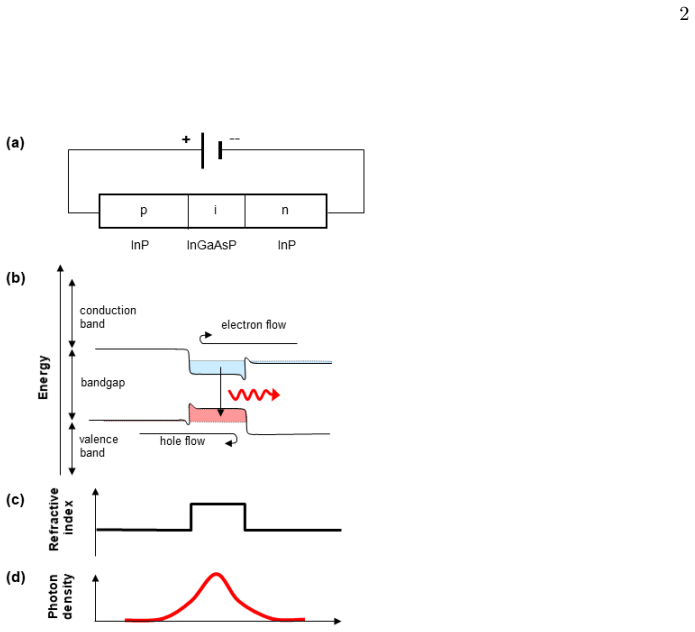
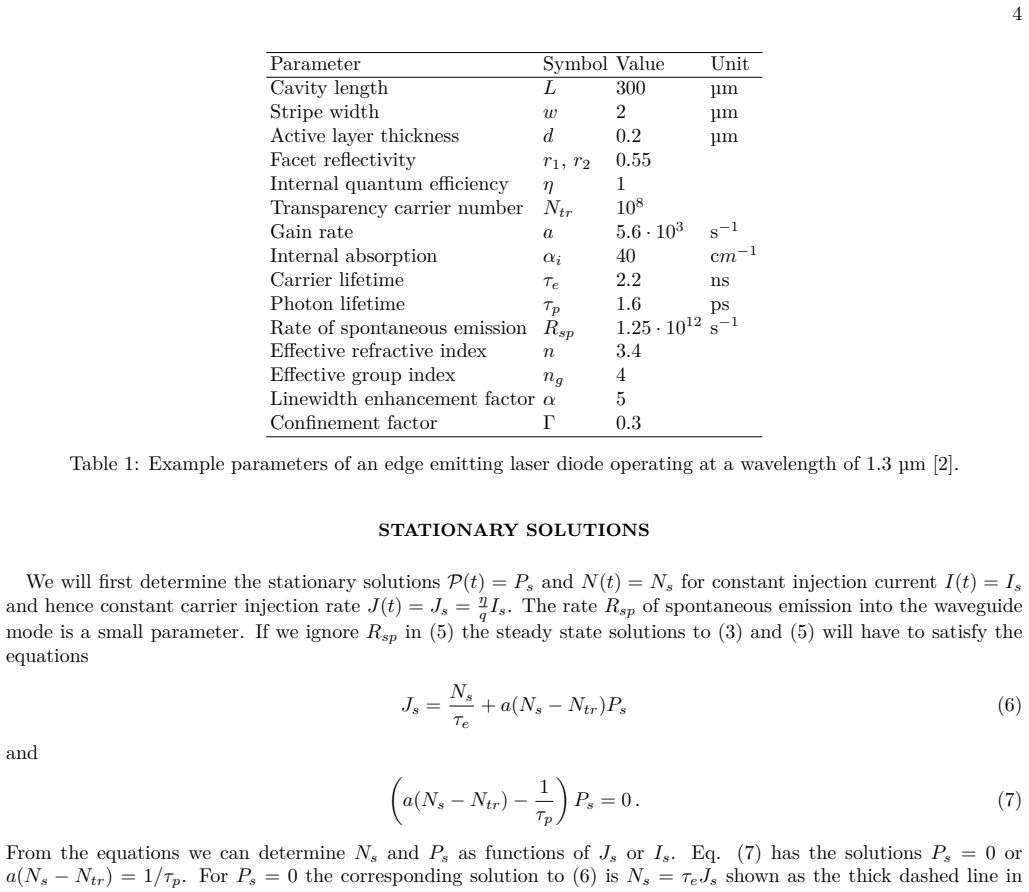
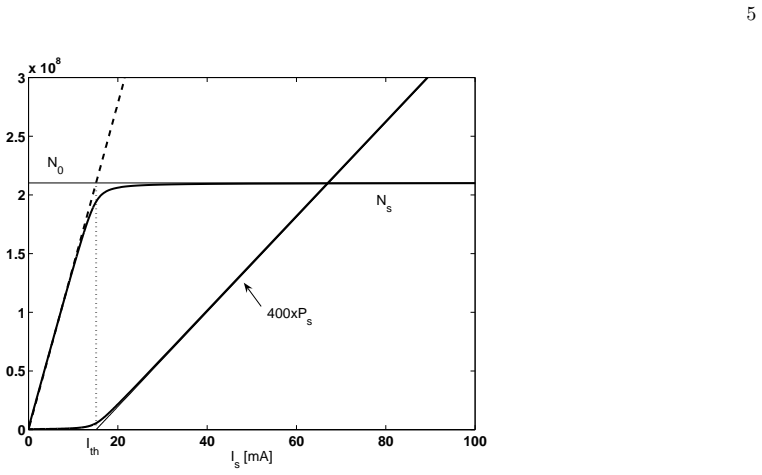
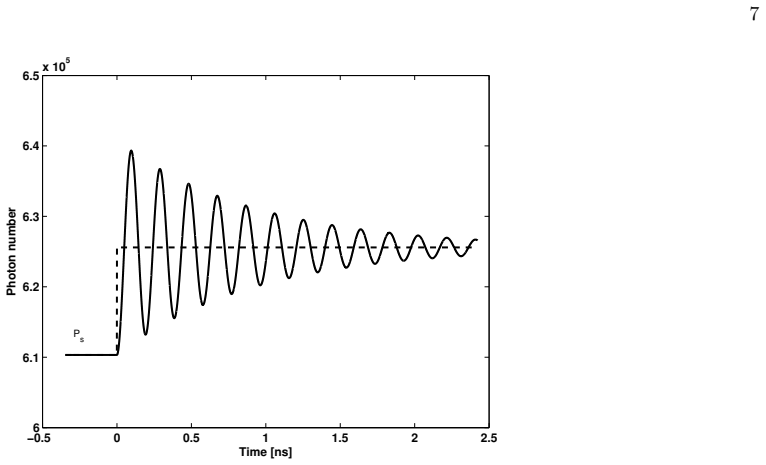


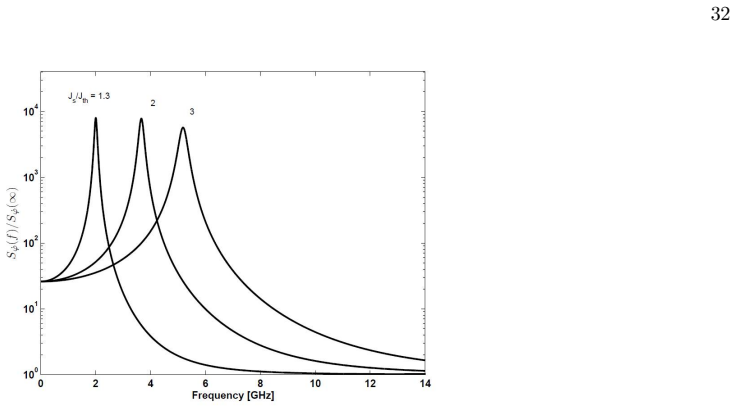
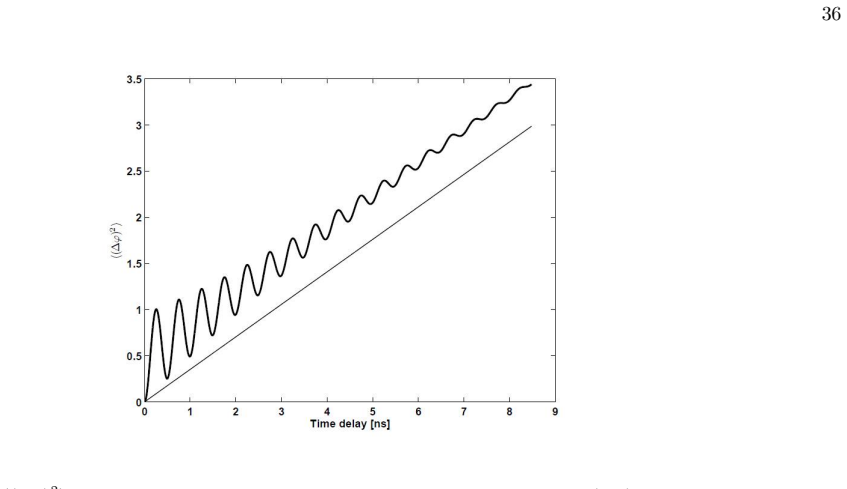


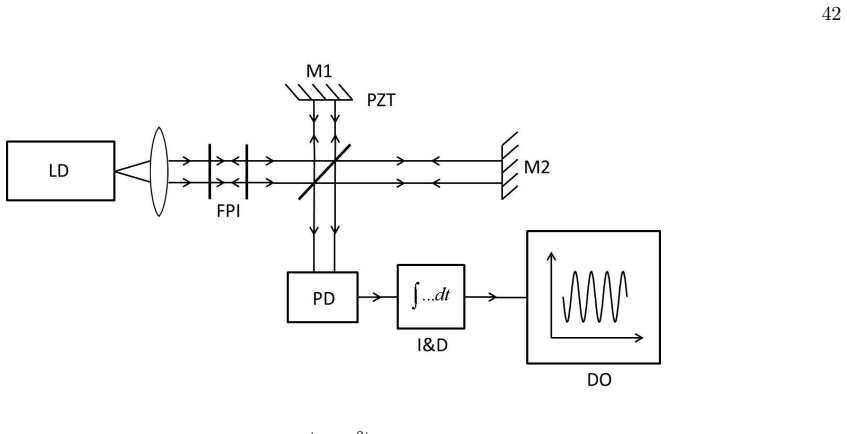
read the original abstract
This paper provides an introduction to the theory of semiconductor laser diodes, with special focus on their noise properties. It may be considered an additional chapter to the textbook [1]. As such, it will also refer to equations in that book.
Editorial analysis
A structured set of objections, weighed in public.
Referee Report
Summary. The manuscript provides an introduction to the theory of semiconductor laser diodes with a focus on their noise properties. It explicitly frames itself as an additional chapter to the referenced textbook [1] and refers to equations from that source rather than deriving new results.
Significance. If the exposition is accurate and clearly cross-referenced, the work could function as a useful pedagogical supplement for readers already familiar with the primary textbook. However, it introduces no original derivations, data, empirical tests, or falsifiable predictions, so its significance is confined to synthesis and accessibility within the existing literature on laser diode noise.
minor comments (2)
- The title 'Spectra of laser diodes' implies a primary emphasis on spectral characteristics, yet the abstract and framing center on noise properties; a brief explicit statement linking noise to spectral linewidth or broadening (e.g., via the Schawlow-Townes relation) would resolve the apparent mismatch.
- Because the manuscript defers to equations in [1], readers without immediate access to that textbook may find the exposition difficult to follow; adding one or two sentences of context for each key referenced equation would improve standalone readability.
Simulated Author's Rebuttal
We thank the referee for their review. We appreciate the recognition that the manuscript could serve as a useful pedagogical supplement to the referenced textbook when the exposition is accurate and clearly cross-referenced. We respond to the observations below.
read point-by-point responses
-
Referee: The manuscript provides an introduction to the theory of semiconductor laser diodes with a focus on their noise properties. It explicitly frames itself as an additional chapter to the referenced textbook [1] and refers to equations from that source rather than deriving new results.
Authors: This description matches the intended scope of the work. The manuscript is explicitly presented as an additional chapter to [1], with emphasis on noise properties, and deliberately cross-references existing equations from the textbook instead of re-deriving them. This structure supports its role as a concise, accessible supplement for readers already familiar with the primary text. revision: no
-
Referee: If the exposition is accurate and clearly cross-referenced, the work could function as a useful pedagogical supplement for readers already familiar with the primary textbook. However, it introduces no original derivations, data, empirical tests, or falsifiable predictions, so its significance is confined to synthesis and accessibility within the existing literature on laser diode noise.
Authors: We agree with this characterization. The manuscript makes no claim to original derivations, data, or predictions; its purpose is synthesis and improved accessibility of the noise properties of semiconductor laser diodes as a supplement to [1]. We have prioritized clear cross-referencing to ensure accuracy for the target audience. revision: no
Circularity Check
No significant circularity; expository extension of external textbook
full rationale
The paper explicitly frames itself as an additional chapter to textbook [1] and states that it will refer to equations in that book. No independent derivations, predictions, or parameter fits are introduced within the paper that could reduce to its own inputs by construction. All load-bearing content defers to the external reference, rendering the work self-contained against external benchmarks with no self-citation chains, self-definitional steps, or fitted-input predictions present.
Axiom & Free-Parameter Ledger
Lean theorems connected to this paper
-
IndisputableMonolith/Foundation/RealityFromDistinction.leanreality_from_one_distinction unclear?
unclearRelation between the paper passage and the cited Recognition theorem.
This paper provides an introduction to the theory of semiconductor laser diodes, with special focus on their noise properties. It may be considered an additional chapter to the textbook [1].
-
IndisputableMonolith/Cost/FunctionalEquation.leanwashburn_uniqueness_aczel unclear?
unclearRelation between the paper passage and the cited Recognition theorem.
The rate equation for the carrier number is then dN/dt = J − N/τe − a(N − Ntr)P (Eq. 3); photon rate equation (Eq. 5).
What do these tags mean?
- matches
- The paper's claim is directly supported by a theorem in the formal canon.
- supports
- The theorem supports part of the paper's argument, but the paper may add assumptions or extra steps.
- extends
- The paper goes beyond the formal theorem; the theorem is a base layer rather than the whole result.
- uses
- The paper appears to rely on the theorem as machinery.
- contradicts
- The paper's claim conflicts with a theorem or certificate in the canon.
- unclear
- Pith found a possible connection, but the passage is too broad, indirect, or ambiguous to say the theorem truly supports the claim.
Reference graph
Works this paper leans on
-
[1]
and [3]. The rate equations (169) and (103) allow calculation of the carrier and photon numbers as a function of time. From the field equation (97) we can also get an equation for the phase ϕ(t) of the electric field envelope E(t) = |E(t)|ejϕ(t). Multiplying (97) by E∗(t) and subtracting the complex conjugate gives E∗(t) d dt E(t) − E(t) d dt E∗(t) = 2 j|...
work page 2025
-
[2]
P. Jeppesen and B. Tromborg, Optical Communications from a Fourier Perspective: Fourier Theory and Optical Fiber Devices and Systems . Elsevier, 2024
work page 2024
-
[3]
G. P. Agrawal and N. K. Dutta, Semiconductor Lasers. Van Nostrand Reinhold, 2 ed., 1993
work page 1993
-
[4]
L. A. Coldren and S. W. Corzine, Diode Lasers and Photonic Integrated Circuits . John Wiley & Sons, 1995
work page 1995
-
[5]
Yariv, Optical Electronics in Modern Communications
A. Yariv, Optical Electronics in Modern Communications . Oxford University Press, 5 ed., 1997
work page 1997
-
[6]
P. S. Z. Jr., ed., Quantum Well Lasers . Academic Press, 1993
work page 1993
-
[7]
Ohtsubo, Semiconductor Lasers: Stability, Instability and Chaos
J. Ohtsubo, Semiconductor Lasers: Stability, Instability and Chaos . Springer, 2010
work page 2010
-
[8]
Nonlinear dynamics and spectral behaviour for an external cavity laser,
H. Olesen, J. H. Osmundsen, and B. Tromborg, “Nonlinear dynamics and spectral behaviour for an external cavity laser,” IEEE Journal of Quantum Electronics , vol. 22, no. 6, pp. 762–773, 1986
work page 1986
-
[9]
B. Tromborg, H. Olesen, X. Pan, and S. Saito, “Transmission line description of optical feedback and injection locking for fabry–perot and dfb lasers,” IEEE Journal of Quantum Electronics , vol. 23, no. 11, pp. 1875–1889, 1987
work page 1987
-
[10]
Chaos in semiconductor lasers with optical feedback: Theory and experiment,
J. Mørk, B. Tromborg, and J. Mark, “Chaos in semiconductor lasers with optical feedback: Theory and experiment,” IEEE Journal of Quantum Electronics , vol. 28, no. 1, pp. 93–108, 1992
work page 1992
-
[11]
B. Tromborg, H. E. Lassen, and H. Olesen, “Travelling wave analysis of semiconductor lasers: Modulation responses, stability and quantum mechanical treatment of noise spectra,” IEEE Journal of Quantum Electronics , vol. 30, pp. 939– 956, 1994
work page 1994
-
[12]
E. Detoma, B. Tromborg, and I. Montrosset, “The complex way to laser diode spectra: Example of an external cavity laser with strong optical feedback,” IEEE Journal of Quantum Electronics , vol. 41, pp. 171–182, Feb. 2005
work page 2005
-
[13]
Y. Yamamoto and N. Imoto, “Internal and external field fluctuations of a laser oscillator: Part i – quantum mechanical langevin treatment,” IEEE Journal of Quantum Electronics , vol. 22, pp. 2032–2042, 1986
work page 2032
-
[14]
Phase noise in semiconductor lasers,
C. H. Henry, “Phase noise in semiconductor lasers,” IEEE Journal of Lightwave Technology , vol. 4, no. 3, pp. 298–311, 1986
work page 1986
-
[15]
Observation of relaxation resonance effects in the field spectrum of semiconductor lasers,
K. Vahala, C. Harder, and A. Yariv, “Observation of relaxation resonance effects in the field spectrum of semiconductor lasers,” Applied Physics Letters , vol. 42, pp. 211–213, 1983
work page 1983
-
[16]
Amplitude squeezing in a semiconductor laser using nondemolition measurement and negative feedback,
Y. Yamamoto, N. Imoto, and S. Machida, “Amplitude squeezing in a semiconductor laser using nondemolition measurement and negative feedback,” Physical Review A , vol. 33, no. 5, pp. 3243–3261, 1986
work page 1986
-
[17]
H. A. Haus, Electromagnetic Noise and Quantum Optical Measurements . Springer, 2000
work page 2000
-
[18]
K. Kikuchi and T. Okoshi, “Dependence of semiconductor laser linewidth on measurement time: Evidence of predominance of 1/f noise,” Electronics Letters, vol. 21, pp. 1011–1012, 1985
work page 1985
-
[19]
T. Okoshi and K. Kikuchi, Coherent Optical Fiber Communications . Kluwer Academic Publishers, 1988
work page 1988
-
[20]
Petermann, Laser Diode Modulation and Noise
K. Petermann, Laser Diode Modulation and Noise . Kluwer Academic Publishers, 1991
work page 1991
-
[21]
K. Kikuchi, “Characterization of semiconductor-laser phase noise and estimation of bit-error rate performance with low- speed offline digital coherent receivers,” Optics Express , vol. 20, no. 5, pp. 5291–5302, 2012
work page 2012
-
[22]
Phase noise and spectral line shape in semiconductor lasers,
B. Daino, P. Spano, M. Tamburrini, and S. Piazzolla, “Phase noise and spectral line shape in semiconductor lasers,” IEEE Journal of Quantum Electronics , vol. 19, pp. 266–270, 1983
work page 1983
-
[23]
Semiconductor laser lineshape and parameter determination from fringe visibility measure- ments,
E. Eichen and P. Melman, “Semiconductor laser lineshape and parameter determination from fringe visibility measure- ments,” Electronics Letters, vol. 20, no. 20, pp. 826–828, 1984
work page 1984
-
[24]
The ∆β in (106) does not satisfy a Kramers-Kronig relations as required by causality
discussion (0)
Sign in with ORCID, Apple, or X to comment. Anyone can read and Pith papers without signing in.