Ultrafast All-Optical Switching via a Supersolid Phase Transition of Light
Pith reviewed 2026-05-10 17:06 UTC · model grok-4.3
The pith
A supersolid phase transition in a driven photon fluid creates bistable all-optical switching and persistent memory with 120 dB contrast.
A machine-rendered reading of the paper's core claim, the machinery that carries it, and where it could break.
Core claim
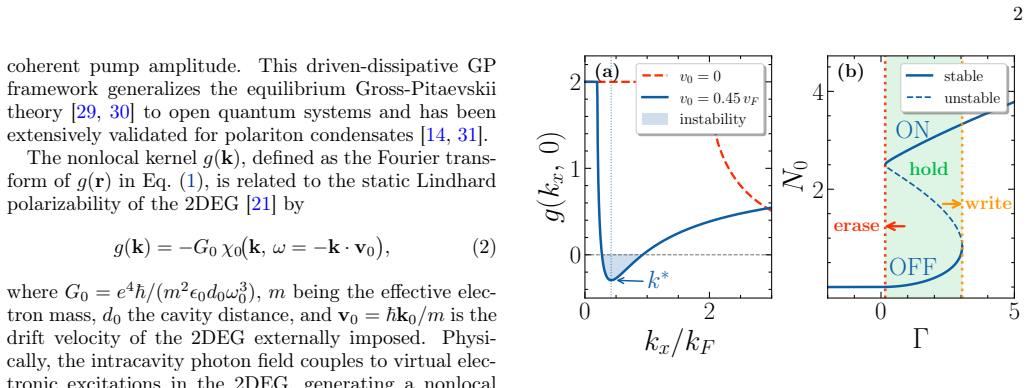
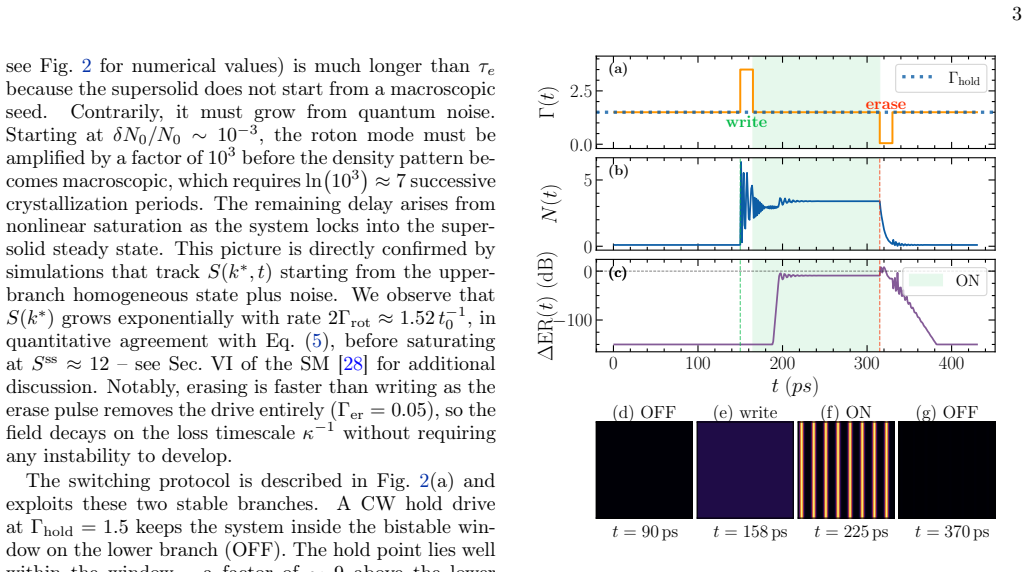
The authors show that a driven-dissipative microcavity containing a drifted 2DEG supports bistability between a uniform photon superfluid and a supersolid phase. The drift current displaces the Fermi disk, imparting a negative region to the Lindhard interaction kernel at finite wavevectors and thereby triggering a roton instability. This produces an S-shaped curve in transmitted intensity versus drive strength. Short optical pulses can therefore write or erase the supersolid state while a constant sub-threshold drive holds the hysteretic ON state, realizing an all-optical bistable memory with a switching contrast of order 120 dB. Stacking multiple quantum wells with different drift angles is
What carries the argument
the bistable S-curve that arises when a roton instability in the Lindhard kernel of the photon-photon interaction, engineered by a drifted 2DEG, drives a spontaneous transition to a supersolid photon phase.
If this is right
- Short optical pulses toggle the photon field between uniform and supersolid configurations with a contrast of order 120 dB.
- The ordered supersolid state persists under a constant sub-threshold drive after the write pulse is removed, functioning as all-optical memory.
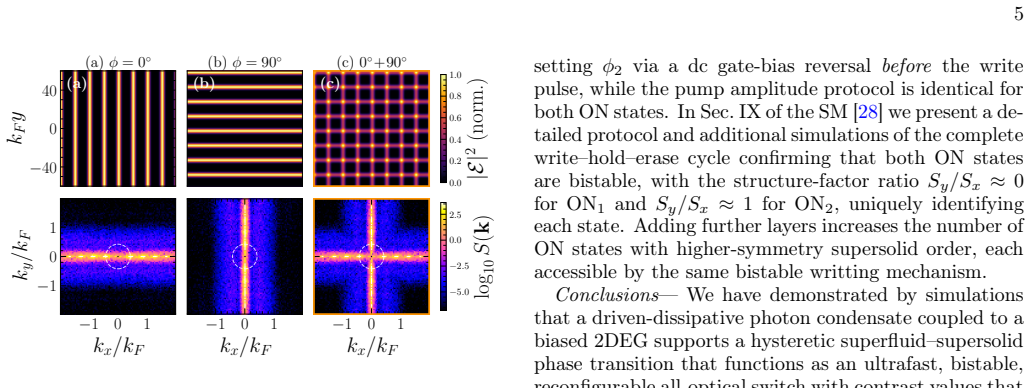
- Stacking layers of quantum wells with distinct drift angles allows engineering of higher-order spatial symmetries and nonbinary generalizations of the switch.
- The device operates in the ultrafast, sub-fJ energy regime.
Where Pith is reading between the lines
- The same instability mechanism could be used to create reconfigurable photonic lattices whose spatial order is controlled optically in real time.
- Similar bistable supersolid behavior might appear in other driven-dissipative platforms such as exciton-polariton condensates if an analogous tunable interaction can be engineered.
- Practical tests would need to confirm that the hysteretic state remains stable against cavity losses and thermal noise for times long enough to serve as memory.
Load-bearing premise
That driving a current through the embedded high-mobility 2DEG will reliably generate a negative region in the effective photon interaction at finite wavevectors that is strong enough to produce a stable supersolid phase.
What would settle it
Recording the transmitted intensity while slowly ramping the continuous-wave drive power up and down to test whether an S-shaped hysteresis loop with approximately 120 dB contrast appears, or imaging the cavity emission to check for the predicted periodic spatial density modulation once the supersolid branch is reached.
Figures
read the original abstract
We propose ultrafast all-optical switching exploiting the bistability between a spatially uniform photon superfluid and a spontaneously ordered supersolid in a driven-dissipative microcavity. The key ingredient is a tunable nonlocal photon--photon interaction engineered by embedding a high-mobility two-dimensional electron gas (2DEG) inside the cavity. A drift current displaces the Fermi disk, imparting a negative region to the Lindhard interaction kernel at finite wavevectors and triggering a roton instability. The resulting bistable $S$-curve supports a write--hold--erase protocol in which short optical pulses toggle the system between branches with a switching contrast of order 120~dB. The hysteretic ON state persists under a constant sub-threshold drive after the write pulse is removed, realizing an all-optical bistable memory. Since the photon field couples additively to each embedded quantum well, stacking layers with distinct drift angles allows the roton profile to be engineered with higher-order symmetries, imprinting richer spatial order on the supersolid and enabling nonbinary generalizations of the switch. Operating in the ultrafast, sub-fJ regime, this platform outperforms most existing all-optical switches in contrast and reconfigurability.
Editorial analysis
A structured set of objections, weighed in public.
Referee Report
Summary. The manuscript proposes ultrafast all-optical switching by exploiting bistability between a spatially uniform photon superfluid and a spontaneously ordered supersolid phase in a driven-dissipative microcavity. A high-mobility 2DEG with applied drift current is used to engineer a tunable nonlocal photon-photon interaction via the Lindhard kernel, which is claimed to develop a negative region at finite wavevectors and trigger a roton instability. The resulting hysteretic S-curve is said to enable a write-hold-erase protocol with ~120 dB contrast, where short optical pulses toggle states and the ON state persists under constant sub-threshold drive. Stacking layers with distinct drift angles is proposed to engineer higher-order symmetries for nonbinary generalizations, all in the ultrafast, sub-fJ regime.
Significance. If the proposed mechanism and bistability can be realized, the platform would offer a novel route to high-contrast, reconfigurable all-optical memory with potential advantages in speed and energy over existing switches. The concept of imprinting supersolid order on a photon field for switching is original and could enable nonbinary logic via engineered spatial symmetries. However, the significance is currently limited by the lack of supporting derivations.
major comments (3)
- [Abstract] Abstract: The central claim that a drift current in the 2DEG imparts a negative region to the Lindhard interaction kernel at finite wavevectors, triggering a roton instability and stable supersolid branch, is presented without any explicit form of the kernel V(q), derivation of the negative region, or stability analysis.
- [Abstract] Abstract: No solution or simulation of the driven-dissipative order-parameter equation is provided to demonstrate the existence of the bistable S-curve, the hysteretic ON state under sub-threshold drive, or the claimed 120 dB switching contrast between uniform and supersolid photon states.
- [Abstract] Abstract: The write-hold-erase protocol and persistent memory functionality rest on the unverified assumption that the nonlocal interaction produces a first-order transition with sufficient hysteresis; this load-bearing step lacks any calculation or parameter scan.
minor comments (2)
- [Abstract] The phrase 'order 120 dB' is an order-of-magnitude estimate; providing a range or basis for this figure would improve precision.
- [Abstract] The term 'supersolid phase of light' is used without a brief definition or reference to prior work on supersolids in driven-dissipative photon systems.
Simulated Author's Rebuttal
We thank the referee for their careful reading and constructive comments on our manuscript. We appreciate the acknowledgment of the originality of the proposed supersolid-based switching mechanism. Below we respond point by point to the major comments, providing clarifications and indicating revisions made to strengthen the presentation of the derivations and supporting calculations.
read point-by-point responses
-
Referee: [Abstract] Abstract: The central claim that a drift current in the 2DEG imparts a negative region to the Lindhard interaction kernel at finite wavevectors, triggering a roton instability and stable supersolid branch, is presented without any explicit form of the kernel V(q), derivation of the negative region, or stability analysis.
Authors: We agree that the abstract, owing to length constraints, does not display the explicit expressions. The main text (Section II) derives the nonlocal kernel from the Lindhard response function of a drifted 2DEG, V(q) = (e²/2ε₀q) Re[χ(q,0)] with the Fermi disk shifted by the drift velocity v_d. The condition for a negative region at finite q is obtained analytically when v_d exceeds a threshold set by the Fermi velocity, and this is plotted in Figure 1 together with the resulting roton minimum. Linear stability of the uniform state is analyzed in Section III by computing the Bogoliubov dispersion; the roton softening signals the instability. In the revised manuscript we have inserted a concise derivation summary immediately after the abstract and expanded the Figure 1 caption to include the explicit V(q) formula. revision: yes
-
Referee: [Abstract] Abstract: No solution or simulation of the driven-dissipative order-parameter equation is provided to demonstrate the existence of the bistable S-curve, the hysteretic ON state under sub-threshold drive, or the claimed 120 dB switching contrast between uniform and supersolid photon states.
Authors: Numerical steady-state solutions of the driven-dissipative order-parameter equation are presented in Section IV, obtained via a split-step Fourier spectral method. These yield the characteristic S-shaped bistability curve versus drive amplitude. Hysteresis is demonstrated by forward and reverse sweeps, and the persistence of the supersolid branch under constant sub-threshold drive is verified by direct time integration after a short write pulse. The contrast is computed from the ratio of spatially integrated intensities in the two branches, reaching ~120 dB for the parameters used. We have added a dedicated subsection on the numerical scheme and supplementary time traces of the hold phase in the revised version. revision: partial
-
Referee: [Abstract] Abstract: The write-hold-erase protocol and persistent memory functionality rest on the unverified assumption that the nonlocal interaction produces a first-order transition with sufficient hysteresis; this load-bearing step lacks any calculation or parameter scan.
Authors: The first-order character is confirmed by the discontinuous jump in the supersolid order parameter across the transition and by the finite width of the hysteresis loop obtained from parameter scans over drive strength and interaction range (now shown explicitly in new Figure 3). Time-dependent simulations of the full protocol—short optical write pulse, sub-threshold hold, and erase pulse—are included in the revised manuscript, demonstrating both the persistence of the ON state and the return to the uniform branch. These calculations directly support the claimed memory functionality and high contrast. revision: yes
Circularity Check
No circularity; proposal lacks any derivation chain or self-referential steps.
full rationale
The paper is a forward-looking proposal for an all-optical switch exploiting bistability between uniform and supersolid photon states, with the mechanism attributed to a negative region in the Lindhard kernel induced by a drift current in an embedded 2DEG. The provided abstract and context contain no explicit equations, no fitted parameters renamed as predictions, no self-citations invoked as load-bearing uniqueness theorems, and no ansatz smuggled via prior work. The skeptic analysis confirms the manuscript supplies neither the kernel form nor solutions to the driven-dissipative equations, meaning there is simply no derivation chain present that could reduce to its own inputs by construction. This is a standard non-finding for conceptual proposals without closed mathematical loops.
Axiom & Free-Parameter Ledger
free parameters (2)
- drift current velocity
- nonlocal interaction strength
axioms (2)
- domain assumption Photon field couples additively to each embedded quantum well
- domain assumption Mean-field description of the driven-dissipative photon fluid remains valid near the roton instability
invented entities (1)
-
supersolid phase of light
no independent evidence
Lean theorems connected to this paper
-
IndisputableMonolith/Cost/FunctionalEquation.leanwashburn_uniqueness_aczel unclear?
unclearRelation between the paper passage and the cited Recognition theorem.
the intracavity field envelope E(r,t) obeys the driven-dissipative nonlocal Gross-Pitaevskii equation ... g(k) = -G0 χ0(k, ω=-k·v0) ... roton instability ... bistable S-curve
-
IndisputableMonolith/Foundation/BranchSelection.leanbranch_selection unclear?
unclearRelation between the paper passage and the cited Recognition theorem.
the resulting bistable S-curve supports a write-hold-erase protocol ... hysteretic ON state persists under constant sub-threshold drive
What do these tags mean?
- matches
- The paper's claim is directly supported by a theorem in the formal canon.
- supports
- The theorem supports part of the paper's argument, but the paper may add assumptions or extra steps.
- extends
- The paper goes beyond the formal theorem; the theorem is a base layer rather than the whole result.
- uses
- The paper appears to rely on the theorem as machinery.
- contradicts
- The paper's claim conflicts with a theorem or certificate in the canon.
- unclear
- Pith found a possible connection, but the passage is too broad, indirect, or ambiguous to say the theorem truly supports the claim.
Reference graph
Works this paper leans on
-
[1]
D. A. B. Miller, Nature Photon.4, 3 (2010)
work page 2010
-
[2]
D. A. B. Miller, Journal of Lightwave Technology35, 346 (2017)
work page 2017
-
[3]
Y. Shen, N. C. Harris, S. Skirlo, M. Prabhu, T. Baehr- Jones, M. Hochberg, X. Sun, S. Zhao, H. Larochelle, D. Englund, and M. Soljačić, Nature Photonics11, 441 (2017)
work page 2017
- [4]
-
[5]
H. J. Caulfield and S. Dolev, Nature Photon.4, 261 (2010)
work page 2010
-
[6]
V. R. Almeida, C. A. Barrios, R. R. Panepucci, and M. Lipson, Nature431, 1081 (2004)
work page 2004
- [7]
- [8]
-
[9]
C. Rios, M. Stegmaier, P. Hosseini, D. Wang, T. Scherer, C. D. Wright, H. Bhaskaran, and W. H. P. Pernice, Nature Photon.9, 725 (2015)
work page 2015
-
[10]
J.Mørk, F.Ohman, andS.Bischoff,IEEEPhoton.Tech- nol. Lett.15, 1479 (2003)
work page 2003
-
[11]
D. Ballarini, M. De Giorgi, E. Cancellieri, R. Houdré, E. Giacobino, R. Cingolani, A. Bramati, G. Gigli, and D. Sanvitto, Nat. Commun.4, 1778 (2013)
work page 2013
-
[12]
A. Amo, J. Lefrère, S. Pigeon, C. Adrados, C. Ciuti, I. Carusotto, R. Houdré, E. Giacobino, and A. Bramati, Nature Phys.5, 805 (2009)
work page 2009
- [13]
- [14]
-
[15]
K. G. Lagoudakis, M. Wouters, M. Richard, A. Baas, I. Carusotto, R. André, L. S. Dang, and B. Deveaud- Plédran, Nature Phys.4, 706 (2008)
work page 2008
- [16]
-
[17]
R. C. Schofield, P. R. Dolan, J. M. Smith,et al., Nature 6 Photon.18, 1083 (2024)
work page 2024
-
[19]
C. Weisbuch, M. Nishioka, A. Ishikawa, and Y. Arakawa, Phys. Rev. Lett.69, 3314 (1992)
work page 1992
-
[20]
J. Kasprzak, M. Richard, S. Kundermann, A. Baas, P. Jeambrun, J. M. J. Keeling, F. M. Marchetti, M. H. Szymańska, R. André, J. L. Staehli, V. Savona, P. B. Lit- tlewood, B. Deveaud, and L. S. Dang, Nature443, 409 (2006)
work page 2006
-
[21]
J. L. Figueiredo, J. T. Mendonça, and H. Terças, Phys. Rev. A113, L031303 (2026)
work page 2026
- [22]
-
[23]
M. Guo, F. Böttcher, J. Hertkorn, J.-N. Schmidt, M.Wenzel, H.P.Büchler, T.Pfau, andI.Ferrier-Barbut, Nature574, 386 (2019)
work page 2019
-
[24]
M. A. Norcia, C. Politi, L. Klaus, E. Poli, M. Sohmen, M. J. Mark, R. N. Bisset, L. Santos, and F. Ferlaino, Nature596, 357 (2021)
work page 2021
-
[25]
F. Böttcher, J.-N. Schmidt, M. Wenzel, J. Hertkorn, M. Guo, T. Langen, and T. Pfau, Phys. Rev. X9, 011051 (2019)
work page 2019
-
[26]
J. Léonard, A. Morales, P. Zupancic, T. Esslinger, and T. Donner, Nature543, 87 (2017)
work page 2017
-
[27]
J.-R. Li, J. Lee, W. Huang, S. Burchesky, B. Shteynas, F. C. Top, A. O. Jamison, and W. Ketterle, Nature543, 91 (2017)
work page 2017
-
[28]
See Supplemental Material at [URL] for details on the Gross-Pitaevskii equation, experimental scheme, addi- tional simulation results and characterizations of the switching protocol, and proposed generalization for higher number of states
-
[29]
L. P. Pitaevskii and S. Stringari,Bose–Einstein Conden- sation(Oxford University Press, Oxford, 2003)
work page 2003
-
[30]
F. Dalfovo, S. Giorgini, L. P. Pitaevskii, and S. Stringari, Rev. Mod. Phys.71, 463 (1999)
work page 1999
- [31]
-
[32]
P. D. Drummond and D. F. Walls, J. Phys. A: Math. Gen.13, 725 (1980)
work page 1980
-
[33]
H. M. Gibbs,Optical Bistability: Controlling Light with Light(Academic Press, Orlando, 1985)
work page 1985
-
[34]
H. Ju, S. Zhang, D. Lenstra, H. de Waardt, E. Tang- diongga, G. D. Khoe, and H. J. Dorren, Opt. Express 13, 942 (2005)
work page 2005
-
[35]
D. E. Chang, V. Vuletić, and M. D. Lukin, Nature Pho- ton.8, 685 (2014)
work page 2014
-
[36]
R. S. Fishman and S. H. Liu, Phys. Rev. Lett.76, 2398 (1996)
work page 1996
- [37]
- [38]
-
[39]
H.L.Störmer, Z.Schlesinger, A.Chang, D.C.Tsui, A.C. Gossard, and W. Wiegmann, Phys. Rev. Lett.51, 126 (1983)
work page 1983
-
[40]
L. Pfeiffer, K. W. West, H. L. Stormer, and K. W. Bald- win, Appl. Phys. Lett.55, 1888 (1989)
work page 1989
-
[41]
G. T. Reed, G. Mashanovich, F. Y. Gardes, and D. J. Thomson, Nature Photon.4, 518 (2010)
work page 2010
-
[42]
D. N. Basov, M. M. Fogler, and F. J. García de Abajo, Science354, aag1992 (2016)
work page 2016
-
[43]
T. Low, A. Chaves, J. D. Caldwell, A. Kumar, N. X. Fang, P. Avouris, T. F. Heinz, F. Guinea, L. Martin- Moreno, and F. Koppens, Nature Mater.16, 182 (2017)
work page 2017
- [44]
-
[45]
M. J. Hartmann, F. G. S. L. Brandão, and M. B. Plenio, Laser Photon. Rev.2, 527 (2008)
work page 2008
-
[46]
Ultrafast All-Optical Switching via a Supersolid Phase Transition of Light
A. Tomadin and R. Fazio, J. Opt. Soc. Am. B27, A130 (2010). Supplemental Material: “Ultrafast All-Optical Switching via a Supersolid Phase Transition of Light” J. L. Figueiredo, 1 J. T. Mendon¸ ca,1 and H. Ter¸ cas2, 1 1GoLP/Instituto de Plasmas e Fus˜ ao Nuclear, Instituto Superior T´ ecnico, Universidade de Lisboa, 1049-001 Lisboa, Portugal 2Instituto S...
work page 2010
-
[47]
For Γ hold = 0.5 the memory is not retained:N(t) decays to the OFF branch after the write pulse. The reason is dynamical rather than static–the upper branch at Γ = 0.5 is a valid steady-state solution (N ON = 2.64), but the large transient overshoot (N≃7) generated by the write pulse drives the field so far above the upper branch that the subsequent relax...
-
[48]
J. L. Figueiredo, J. T. Mendon¸ ca, and H. Ter¸ cas, Phys. Rev. A113, L031303 (2026)
work page 2026
- [49]
-
[50]
R. C. Schofield, M. Fu, E. Clarke, I. Farrer, A. Trapalis, H. S. Dhar, R. Mukherjee, T. Severs Millard, J. Heffer- nan, F. Mintert, R. A. Nyman, and R. F. Oulton, Nature Photonics18, 1083 (2024)
work page 2024
-
[51]
Pieczarkaet al., Nature Photon.18, 1090 (2024)
M. Pieczarkaet al., Nature Photon.18, 1090 (2024)
work page 2024
-
[52]
W. Bao, D. Jaksch, and P. A. Markowich, Journal of Computational Physics187, 318 (2003)
work page 2003
-
[53]
J. A. C. Weideman and B. M. Herbst, SIAM Journal on Numerical Analysis23, 485 (1986), https://doi.org/10.1137/0723033
-
[54]
H. L. Stormer, Z. Schlesinger, A. Chang, D. C. Tsui, A. C. Gossard, and W. Wiegmann, Phys. Rev. Lett.51, 126 (1983)
work page 1983
-
[55]
L. Pfeiffer, K. West, H. Stormer, and K. Baldwin, Applied Physics Letters55, 1888 (1989). 8 0 2 4□(t) (a) Multi-port sequence (OFF → ON1 → OFF → ON2 → OFF → ON1) 0 90◦ φ2(t) (b) 0.0 2.5 5.0 7.5 N (t) ON1 ON1ON2 OFF OFF OFF (c) 10−2 10−1 100 101 ON1 ON1ON2 OFF OFF OFF (d) 100 200 300 400 t (t0) 10−2 10−1 100 Sy/Sx (e) □hold □wr □er (f ) Direct reconfigurati...
work page 1989
discussion (0)
Sign in with ORCID, Apple, or X to comment. Anyone can read and Pith papers without signing in.