Heterogeneous Molecular Signatures of Human Odor Perception
Pith reviewed 2026-05-10 17:31 UTC · model grok-4.3
The pith
Different odors depend on distinct molecular properties rather than any single universal set of features.
A machine-rendered reading of the paper's core claim, the machinery that carries it, and where it could break.
Core claim
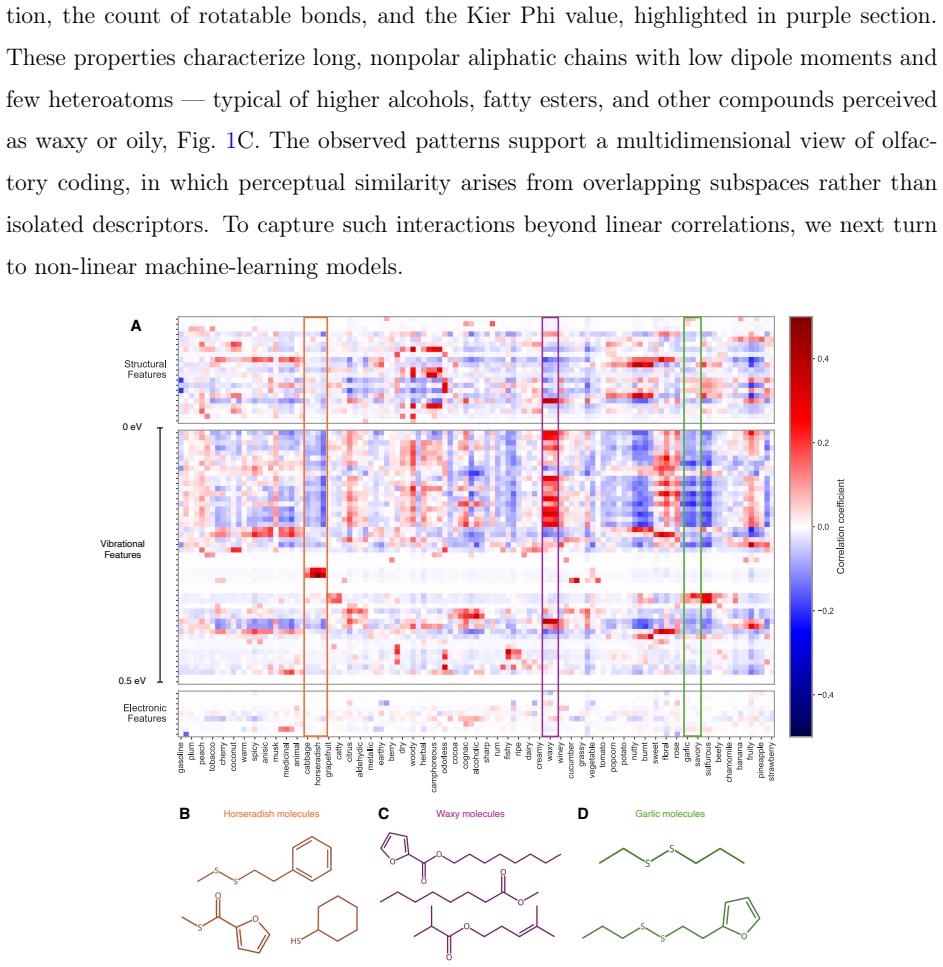
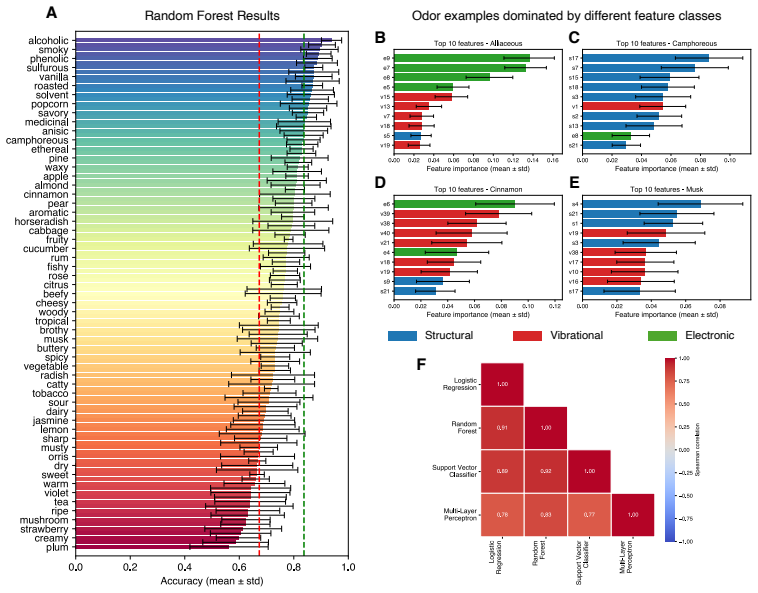
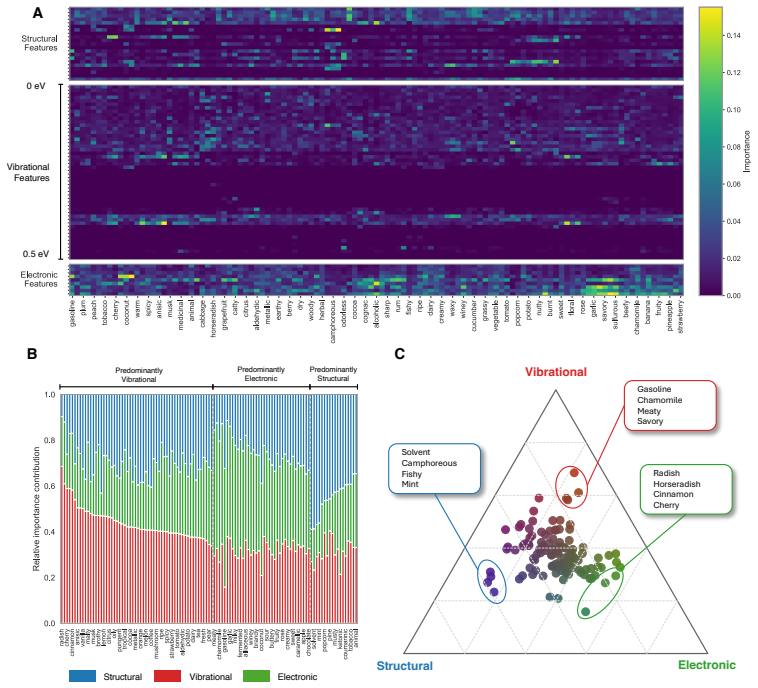
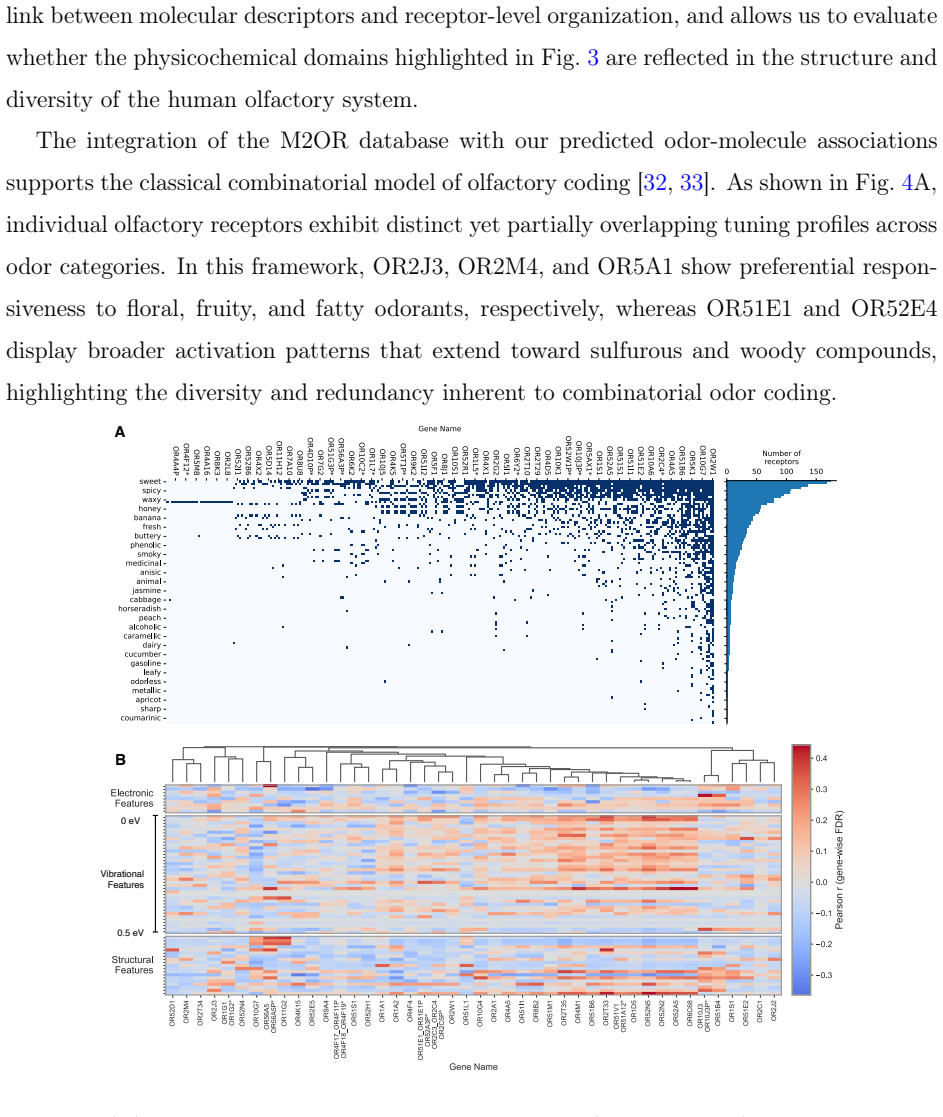
Using interpretable machine-learning models trained on molecular descriptors derived from first-principles calculations that span electronic, vibrational, and structural properties, the analysis shows that no single descriptor class universally dominates odor prediction. Different odors exhibit strongly odor-specific patterns of feature importance, with substantial variability across physicochemical domains. This heterogeneity is consistent across different models, suggesting that a universal encoding scheme does not capture odor perception but reflects receptor- and odor-dependent structure-odor relationships. The results provide statistical constraints on competing olfactory theories and a
What carries the argument
Interpretable machine-learning models that extract and compare feature-importance rankings from first-principles molecular descriptors across electronic, vibrational, and structural domains for different odor categories and receptors.
If this is right
- Odor space can be organized according to data-driven signatures of which molecular properties matter for each smell.
- Competing theories of olfaction are limited to those consistent with receptor- and odor-dependent feature use.
- Universal models that assume one encoding scheme for all odors are unlikely to succeed.
- Structure-odor relationships must be treated as context-specific rather than fixed across perception.
- Predictions for new molecules require accounting for the particular odor and receptor involved.
Where Pith is reading between the lines
- Models of olfaction may need receptor-expression profiles to improve accuracy for individuals.
- Applications such as fragrance design or treatment of smell disorders could target specific feature classes per odor.
- The observed heterogeneity offers a route to test how different receptor subtypes select distinct molecular cues.
Load-bearing premise
Feature-importance rankings from the machine-learning models accurately reflect the biologically relevant contributions of those molecular properties at actual olfactory receptors.
What would settle it
A dataset or biological assay in which one descriptor class predicts human odor ratings or receptor activation with comparable accuracy and dominance across many chemically diverse odorants.
Figures
read the original abstract
Understanding how molecular structure gives rise to odor perception remains a long-standing challenge, with ongoing debate over whether olfaction is primarily governed by molecular shape, vibrational properties, or their interplay at the level of olfactory receptors. Here, we ask whether different odors rely on common molecular determinants or instead emerge from distinct physicochemical regimes. Using interpretable machine-learning models trained on molecular descriptors derived from first-principles calculations that span electronic, vibrational, and structural properties, we analyze feature contributions for odor categories and their associated receptors. We find that no single descriptor class universally dominates odor prediction; instead, different odors exhibit strongly odor-specific patterns of feature importance, with substantial variability across physicochemical domains. This heterogeneity is consistent across different models, suggesting that a universal encoding scheme does not capture odor perception but reflects receptor- and odor-dependent structure-odor relationships. Our results provide statistical constraints on competing olfactory theories and offer a data-driven framework for organizing odor space.
Editorial analysis
A structured set of objections, weighed in public.
Referee Report
Summary. The paper uses interpretable machine-learning models trained on first-principles molecular descriptors (electronic, vibrational, and structural) to analyze feature contributions across odor categories. It reports that no single descriptor class universally dominates odor prediction; instead, odors exhibit strongly odor-specific patterns of feature importance with substantial variability across physicochemical domains. This heterogeneity persists across model variants, supporting the conclusion that structure-odor relationships are receptor- and odor-dependent rather than governed by a universal encoding scheme, thereby providing statistical constraints on olfactory theories.
Significance. If the central observation holds, the work offers a data-driven framework for organizing odor space and statistical constraints on competing theories of olfaction (shape vs. vibration vs. interplay). Credit is due for employing first-principles descriptors rather than empirical fingerprints and for demonstrating consistency of heterogeneity across multiple models, which strengthens the claim against a single universal scheme.
major comments (2)
- [Methods] Methods: The manuscript does not provide sufficient detail on cross-validation procedures, data exclusion rules, or error bars associated with feature-importance rankings (e.g., permutation or SHAP values). These omissions make it difficult to evaluate the robustness of the reported odor-specific patterns and their consistency across models.
- [Discussion] Results/Discussion: The interpretive step linking feature-importance heterogeneity to receptor-dependent biology is presented as a suggestion, but the weakest assumption—that these rankings accurately reflect biologically relevant contributions at olfactory receptors—lacks any direct comparison to receptor-binding or activation data, which is load-bearing for the claim that the patterns reflect receptor- and odor-dependent relationships.
minor comments (2)
- [Figures] Figure captions and axis labels should explicitly state the number of odors or samples per category and the exact importance metric used (permutation vs. SHAP).
- [Methods] Notation for descriptor classes (electronic, vibrational, structural) is introduced without a clear table summarizing their definitions and computation methods from first principles.
Simulated Author's Rebuttal
We thank the referee for their constructive review and recommendation for minor revision. We address each major comment point by point below, indicating revisions where they have been made to strengthen the manuscript.
read point-by-point responses
-
Referee: [Methods] Methods: The manuscript does not provide sufficient detail on cross-validation procedures, data exclusion rules, or error bars associated with feature-importance rankings (e.g., permutation or SHAP values). These omissions make it difficult to evaluate the robustness of the reported odor-specific patterns and their consistency across models.
Authors: We agree that additional methodological transparency is warranted. In the revised manuscript we have added a new subsection to Methods that specifies: (1) the stratified 5-fold cross-validation scheme with odor-category balancing to prevent leakage; (2) explicit exclusion criteria (molecules with missing first-principles descriptors or unphysical values); and (3) bootstrap (n=1000) and permutation-based error bars on SHAP and permutation-importance rankings. These additions confirm that the reported odor-specific heterogeneity remains stable across resamples and model families. revision: yes
-
Referee: [Discussion] Results/Discussion: The interpretive step linking feature-importance heterogeneity to receptor-dependent biology is presented as a suggestion, but the weakest assumption—that these rankings accurately reflect biologically relevant contributions at olfactory receptors—lacks any direct comparison to receptor-binding or activation data, which is load-bearing for the claim that the patterns reflect receptor- and odor-dependent relationships.
Authors: We appreciate the referee’s distinction. The original text already frames the receptor link as an interpretation rather than a mechanistic claim, noting consistency with known receptor diversity. We acknowledge that direct receptor-activation or binding data would constitute stronger validation; such comprehensive, feature-resolved datasets do not yet exist at the scale of our odor panel. Our primary contribution remains the statistical demonstration that no single descriptor class suffices across odors, thereby constraining universal-encoding theories. We have revised the Discussion to sharpen this interpretive boundary and to state explicitly that the work supplies statistical constraints rather than direct biological proof. revision: partial
Circularity Check
No significant circularity identified
full rationale
The paper derives its central claim—that odor perception exhibits heterogeneous, odor-specific patterns of molecular feature importance rather than a universal encoding—from standard application of interpretable ML models (permutation importance or SHAP-style attribution) to independently generated first-principles descriptors spanning electronic, vibrational, and structural properties. This heterogeneity is quantified directly from the trained models' outputs on odor-category labels and persists across model variants, without any equation or derivation reducing the reported patterns back to fitted parameters, self-defined quantities, or self-citation chains. Descriptor computation, model training, and importance extraction are described as external to the interpretive conclusion, which is framed as a data-driven statistical constraint rather than a deductive necessity. No load-bearing step collapses the result to its inputs by construction.
Axiom & Free-Parameter Ledger
free parameters (2)
- machine-learning hyperparameters
- feature-importance threshold
axioms (1)
- domain assumption Feature importance rankings in the trained models reflect biologically causal contributions to odor perception at receptors
Reference graph
Works this paper leans on
-
[1]
Heterogeneous Molecular Signatures of Human Odor Perception
Heterogeneous Molecular Signatures of Human Odor Perception P. Zanineli ,1, 2 E. V. C. Lopes ,3 G. R. Schleder ,1, 2 L. N. Lemos ,3 F. Crasto de Lima ,3,∗ and A. Fazzio 3, 2,† 1Brazilian Nanotechnology National Laboratory (LNNano), Brazilian Center for Research in Energy and Materials (CNPEM), Campinas, SP, Brazil. 2Center for Natural and Human Sciences, ...
work page internal anchor Pith review Pith/arXiv arXiv 2026
-
[2]
Olfactory perception: receptors, cells, and circuits,
descriptors. These patterns reinforce the view that subsets of receptors may exhibit preferential sensitivity to distinct physicochemical regimes rather than sharing a uniform selectivity profile. Although these clusters resemble those obtained in our feature-importance analyses, it remains uncertain to what extent receptor selectivity truly aligns with t...
discussion (0)
Sign in with ORCID, Apple, or X to comment. Anyone can read and Pith papers without signing in.