Interference Limited Absorption in Dense Molecular Nanolayers Near Reflecting Surfaces
Pith reviewed 2026-05-10 17:03 UTC · model grok-4.3
The pith
Reflecting surfaces enable unity absorption in dense molecular nanolayers by balancing radiative and intrinsic losses through interference.
A machine-rendered reading of the paper's core claim, the machinery that carries it, and where it could break.
Core claim
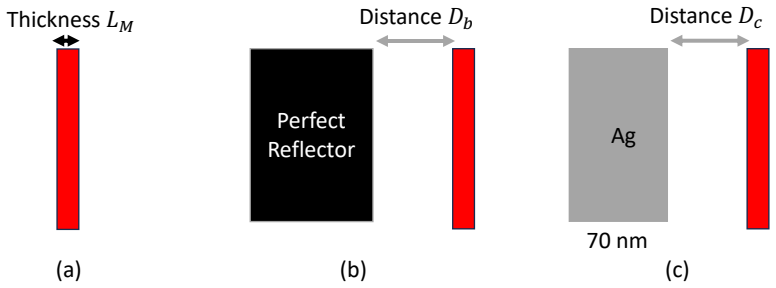
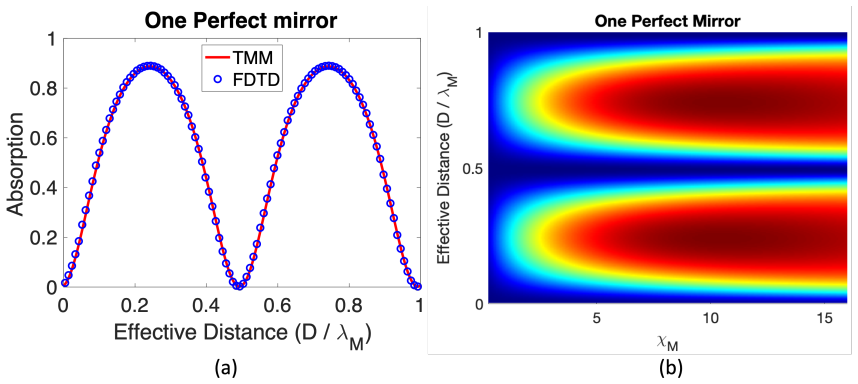
In the mirror-backed geometry, interference can cancel reflection and unity absorption is obtained at critical coupling, when radiative leakage is balanced by intrinsic molecular loss. The isolated film is a symmetric two-port system that bounds single-sided resonant absorption to 50 percent in the ultrathin limit, while the mirror converts the structure into an effectively one-port absorber.
What carries the argument
The scattering/port picture treating the film as a symmetric two-port system (free-standing) or one-port absorber (mirror-backed), with critical coupling defined by the balance between radiative leakage and intrinsic molecular loss.
If this is right
- Single-sided absorption in free-standing ultrathin films is capped at 50 percent due to unavoidable reflection and transmission.
- Mirror-backed films reach 100 percent absorption at the specific density or oscillator strength where radiative and intrinsic losses balance.
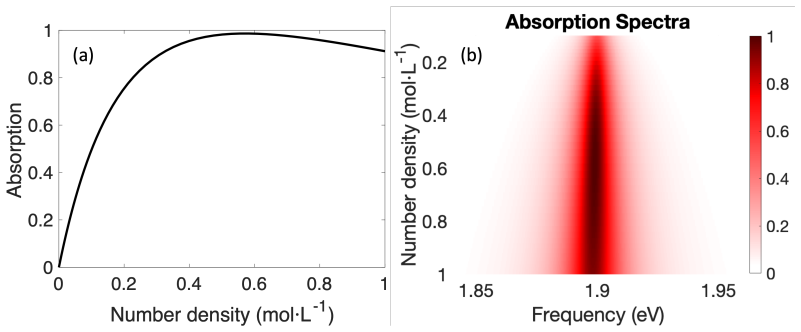
- Absorption exhibits a non-monotonic dependence on molecular density, peaking at an optimum before declining as the layer becomes too reflective.
- Quantitative agreement between FDTD simulations and analytical transfer-matrix results gives compact conditions for the absorption maximum.
- The results supply design rules for collective absorption in dense molecular layers placed near dielectric or metallic boundaries.
Where Pith is reading between the lines
- The same critical-coupling balance could be used to optimize absorption in other thin-film systems such as organic solar cells or sensors by tuning mirror distance.
- Varying the separation between the molecular layer and the mirror should shift the absorption peak, providing a direct experimental test of the interference mechanism.
- The one-port picture may apply to collective resonances in other dense ensembles, such as atomic or excitonic layers, without requiring strong-coupling regimes.
- The non-monotonic trend suggests that simply increasing molecular density will eventually reduce net absorption, a limit that must be respected in device design.
Load-bearing premise
The molecular layer can be modeled as a uniform continuous medium with an effective oscillator strength in the linear regime, without significant local-field corrections or spatial inhomogeneities at high densities.
What would settle it
Measuring absorption well above 50 percent in a free-standing dense molecular film or observing failure to reach near-unity absorption in a mirror-backed layer at the predicted critical-coupling density and distance would disprove the central claims.
Figures


read the original abstract
We investigate linear resonant absorption by a dense ensemble of molecules confined to a subwavelength layer in two geometries: (i) a free-standing film in homogeneous space and (ii) the same film placed at a controlled distance from a reflecting surface. In both cases, increasing the effective light-matter coupling (via molecular density/oscillator strength) produces a non-monotonic response: absorption rises to an optimum and then decreases as the film becomes increasingly radiatively bright and reflective. Finite-difference time-domain simulations and analytical transfer-matrix calculations agree quantitatively and yield compact ridge conditions for the optimum. We interpret the trends using a scattering/port picture: the isolated film is a symmetric two-port system (reflection and transmission), which bounds single-sided resonant absorption to 50% in the ultrathin limit (reflecting transition saturation), whereas adding a mirror suppresses transmission and converts the structure into an effectively one-port absorber. In the mirror-backed geometry, interference can cancel reflection and unity absorption is obtained at critical coupling, when radiative leakage is balanced by intrinsic molecular loss. These results clarify fundamental limits and design rules for collective absorption in dense molecular layers near dielectric or metallic boundaries.
Editorial analysis
A structured set of objections, weighed in public.
Referee Report
Summary. The manuscript investigates linear resonant absorption by dense molecular nanolayers in two geometries: a free-standing subwavelength film and the same film placed near a reflecting surface. Increasing the effective light-matter coupling (via density or oscillator strength) produces non-monotonic absorption that rises to an optimum then falls as the layer becomes radiatively bright. FDTD simulations and transfer-matrix analytics agree quantitatively, yielding compact ridge conditions for the optimum. The free-standing case is interpreted as a symmetric two-port system whose ultrathin resonant absorption is bounded at 50%; the mirror-backed geometry converts the system to an effective one-port absorber where interference can null reflection, enabling unity absorption at critical coupling (radiative leakage balanced by intrinsic molecular loss).
Significance. If the homogeneous effective-medium description remains valid, the work supplies clear design rules and fundamental limits for collective absorption in dense molecular layers near boundaries, with direct relevance to molecular optoelectronics and thin-film sensors. The quantitative agreement between independent numerical and analytical methods, together with the explicit ridge conditions, constitutes a reproducible and falsifiable set of predictions that strengthens the central claims.
major comments (2)
- [Abstract / model section] Abstract and model description: the claim of unity absorption at critical coupling in the mirror-backed geometry rests on exact balance between radiative leakage and intrinsic loss inside a homogeneous slab whose susceptibility is scaled linearly by density. No section provides a bound on when local-field corrections (Lorentz or Clausius-Mossotti) or discrete positional effects remain negligible at the densities required to reach this balance; both the transfer-matrix and FDTD implementations employ the same mean-field susceptibility, so their agreement only verifies internal consistency of that approximation.
- [Results / ridge conditions] Results on non-monotonic absorption: the reported optimum and subsequent decline are derived under the continuous-medium assumption. If local-field renormalization shifts the resonance frequency or alters the effective radiative rate by even a few percent, the ridge conditions for optimum absorption would move and the peak value would fall below the predicted maximum; the manuscript contains no microscopic calculation or density-dependent error estimate to quantify this risk.
minor comments (2)
- [Methods] Notation for the effective oscillator strength and the definition of the critical-coupling condition should be collected in a single equation block for clarity.
- [Figures] Figure captions for the FDTD vs. transfer-matrix comparisons should explicitly state the range of densities (or coupling strengths) over which quantitative agreement holds.
Simulated Author's Rebuttal
We thank the referee for the careful and constructive review of our manuscript. The comments correctly identify that our analysis relies on a homogeneous effective-medium description. We address each major point below, propose targeted revisions to clarify assumptions and limitations, and note where further microscopic analysis lies beyond the present scope.
read point-by-point responses
-
Referee: [Abstract / model section] Abstract and model description: the claim of unity absorption at critical coupling in the mirror-backed geometry rests on exact balance between radiative leakage and intrinsic loss inside a homogeneous slab whose susceptibility is scaled linearly by density. No section provides a bound on when local-field corrections (Lorentz or Clausius-Mossotti) or discrete positional effects remain negligible at the densities required to reach this balance; both the transfer-matrix and FDTD implementations employ the same mean-field susceptibility, so their agreement only verifies internal consistency of that approximation.
Authors: We agree that the reported unity absorption at critical coupling is obtained strictly within the homogeneous effective-medium model with linearly scaled susceptibility. The quantitative match between transfer-matrix analytics and FDTD simulations demonstrates consistency inside that framework but does not test its validity against local-field or discrete-molecular corrections. In the revised manuscript we will insert a concise discussion in the model section that (i) recalls the standard range of validity for the mean-field susceptibility at typical molecular densities and oscillator strengths and (ii) explicitly states that Lorentz or Clausius-Mossotti corrections, as well as positional disorder, are neglected and would require separate atomistic treatments. revision: partial
-
Referee: [Results / ridge conditions] Results on non-monotonic absorption: the reported optimum and subsequent decline are derived under the continuous-medium assumption. If local-field renormalization shifts the resonance frequency or alters the effective radiative rate by even a few percent, the ridge conditions for optimum absorption would move and the peak value would fall below the predicted maximum; the manuscript contains no microscopic calculation or density-dependent error estimate to quantify this risk.
Authors: The non-monotonic absorption curves and the compact ridge conditions for the absorption optimum are derived under the continuous-medium approximation. Local-field renormalization could indeed shift the resonance or modify the radiative decay rate, thereby displacing the ridge and lowering the peak value. The present work does not contain a microscopic calculation or density-dependent error estimate for these corrections, as such an analysis would necessitate a distinct study employing discrete-dipole or quantum-chemical methods. We will add an explicit caveat in the results section stating that the reported optima and ridge conditions apply within the effective-medium model and may be quantitatively modified by local-field effects. revision: partial
- A microscopic calculation or density-dependent error estimate that quantifies the magnitude of local-field corrections on the ridge conditions and peak absorption values.
Circularity Check
No significant circularity; derivation uses standard EM methods self-contained within the model
full rationale
The paper derives absorption limits via transfer-matrix analytics and FDTD simulations applied to a homogeneous effective-medium slab with linear susceptibility. The 50% bound for the free-standing film and the critical-coupling condition for unity absorption in the mirror-backed case follow directly from port scattering theory and interference cancellation, without any fitted parameters renamed as predictions or self-citations invoked as uniqueness theorems. Quantitative agreement between analytics and simulation confirms internal consistency of the chosen model but does not constitute circularity, as both methods implement the same Maxwell equations and boundary conditions independently. The homogeneous-layer assumption is stated explicitly as an approximation whose validity range is not claimed to be proven within the derivation itself.
Axiom & Free-Parameter Ledger
free parameters (1)
- effective light-matter coupling (density/oscillator strength)
axioms (2)
- domain assumption Linear resonant absorption regime
- domain assumption Subwavelength layer confinement
Reference graph
Works this paper leans on
-
[1]
(1) Haynes, C. L.; McFarland, A. D.; Van Duyne, R. P. Surface-Enhanced Raman Spectroscopy.Analytical Chemistry2005,77, 338 A–346 A. (2) Stiles, P. L.; Dieringer, J. A.; Shah, N. C.; Van Duyne, R. P. Surface-enhanced Raman spectroscopy. Annu. Rev. Anal. Chem.2008,1, 601–626. (3) Frontiera, R. R.; Henry, A.-I.; Gruenke, N. L.; Van Duyne, R. P. Surface-enhan...
work page 2008
-
[2]
A.; Schwartz, T.; Genet, C.; Devaux, E.; Ebbesen, T
(8) Hutchison, J. A.; Schwartz, T.; Genet, C.; Devaux, E.; Ebbesen, T. W. Modifying chemical landscapes by coupling to vacuum fields.Angewandte Chemie International Edition2012,51, 1592–1596. (9) Ebbesen, T. W. Hybrid light–matter states in a molecular and material science perspective.Accounts of chemical research2016,49, 2403–2412. (10) Kavokin, A. V.; B...
work page 2017
-
[3]
(19) Teixeira, F. L. FDTD/FETD methods: a review on some recent advances and selected applications. Journal of Microwaves, Optoelectronics and Electromagnetic Applications (JMOe)2007,6, 83–95. (20) McMahon, J. M.; Henzie, J.; Odom, T. W.; Schatz, G. C.; Gray, S. K. Tailoring the sensing capabilities of nanohole arrays in gold films with Rayleigh anomaly-s...
work page 2007
-
[4]
(31) Landy, N. I.; Sajuyigbe, S.; Mock, J. J.; Smith, D. R.; Padilla, W. J. Perfect metamaterial absorber. Physical review letters2008,100, 207402. (32) Watts, C. M.; Liu, X.; Padilla, W. J. Metamaterial electromagnetic wave absorbers.Advanced materials 2012,24, OP98–OP120. (33) Thongrattanasiri,S.; Koppens,F.H.; GarcíadeAbajo,F.J.Completeopticalabsorptio...
work page 2012
discussion (0)
Sign in with ORCID, Apple, or X to comment. Anyone can read and Pith papers without signing in.