Recognition: unknown
Euclid: Quick Data Release (Q1) -- Dual AGN in low-mass galaxies
Pith reviewed 2026-05-10 14:55 UTC · model grok-4.3
The pith
Euclid Quick Data Release identifies nine dual AGN candidates in low-mass galaxies below 10^10 solar masses.
A machine-rendered reading of the paper's core claim, the machinery that carries it, and where it could break.
Core claim
We used photometry and spectroscopy from the first Euclid Quick Data Release, combined with a collection of multi-wavelength data from DESI, LOFAR, and counterparts in X-ray and mid-infrared catalogues to identify dual AGNs at redshift z less than or equal to 1. Focusing on low-mass galaxies with stellar masses below 10^10 solar masses, we find nine dual AGN candidates with projected separations ranging from about 20 to 51 kpc. We also find 49 dual AGN candidates in more massive galaxies. We derive a dual AGN fraction of 0.1 percent for the low-mass galaxies and estimate that these systems likely trace a population of progenitor black hole pairs that may evolve into bound binaries and emit L
What carries the argument
Multi-wavelength cross-identification that selects pairs of nuclei both showing AGN signatures at projected separations of 20-51 kpc, using Euclid imaging and spectroscopy plus ancillary X-ray, infrared and radio data to confirm activity in both members.
If this is right
- A dual AGN fraction of 0.1 percent is measured among low-mass galaxies.
- The nine systems represent progenitor pairs that can evolve into bound binaries and produce gravitational waves in the LISA band.
- Supermassive black holes can grow by accretion within low-mass galaxies before their eventual merger.
- The same selection applied to more massive galaxies yields 49 candidates, consistent with an increasing dual fraction at higher stellar mass.
Where Pith is reading between the lines
- Future high-resolution imaging or velocity mapping could test whether any of the nine pairs are already gravitationally bound.
- If the 0.1 percent fraction persists in larger samples, it would tighten constraints on the mass and occupation fraction of seed black holes in dwarf galaxies.
- Extending the search with later Euclid data releases at higher redshift would map how the dual fraction evolves during the epoch of peak galaxy assembly.
Load-bearing premise
The combined multi-wavelength criteria correctly flag true dual AGNs rather than single AGNs with misidentified companions or contaminants, even though only projected separations are available without dynamical orbital confirmation.
What would settle it
Follow-up integral-field spectroscopy that shows either nucleus lacks an AGN emission-line signature or that the two nuclei lie at significantly different redshifts would rule out the dual AGN interpretation for those candidates.
Figures

read the original abstract
Dual active galactic nuclei (AGNs) are expected in hierarchical galaxy evolution models, in which low-mass galaxies merge to build more massive ones. While observational evidence for dual AGNs is growing in massive galaxies, no clear detection has yet been found in the low-mass regime. We used photometry and spectroscopy from the first \Euclid Quick Data Release, combined with a collection of multi-wavelength data from the Dark Energy Spectroscopic Instrument (DESI), the LOw-Frequency ARray (LOFAR) high band antenna, and counterparts in X-ray and mid-infrared catalogues to identify dual AGNs at redshift $z \lesssim 1$. Focusing on low-mass galaxies with stellar masses below 10$^{10}$ M$_{\odot}$, we find nine dual AGN candidates with projected separations ranging from $\sim$20 to 51 kpc. We also find 49 dual AGN candidates in more massive galaxies. We derive a dual AGN fraction of 0.1\% for the low-mass galaxies and estimate that these systems likely trace a population of progenitor black hole pairs that may evolve into bound binaries and eventually coalesce, emitting gravitational waves in the LISA band. These results constitute the first sample of spectroscopically confirmed dual AGN candidates in low-mass galaxies and have important implications for models in which supermassive black holes grow from lower-mass black holes located in low-mass galaxies, as well as for predictions of gravitational waves from low-mass binary black holes.
Editorial analysis
A structured set of objections, weighed in public.
Referee Report
Summary. The paper uses Euclid Q1 imaging and slitless spectroscopy, combined with DESI redshifts, LOFAR radio, X-ray, and WISE MIR data, to identify nine dual AGN candidates in galaxies with stellar mass below 10^10 M⊙ at z ≲ 1. Projected separations range from ~20 to 51 kpc. The authors report a dual AGN fraction of 0.1% in the low-mass population (and 49 candidates in more massive hosts), claim this is the first spectroscopically confirmed sample in the low-mass regime, and discuss implications for hierarchical SMBH growth and LISA-band gravitational-wave progenitors.
Significance. If the nine systems are genuine dual AGNs rather than contaminants, the result supplies the first direct observational anchor for dual-AGN activity below 10^10 M⊙, tightening constraints on models in which SMBHs grow via mergers of lower-mass seeds in dwarf galaxies and providing a potential parent population for LISA sources. The multi-wavelength approach leveraging Euclid’s wide-field capabilities is a strength; however, the claimed significance hinges entirely on sample purity, which is not yet demonstrated at the required level.
major comments (3)
- [§3] §3 (candidate selection): The multi-wavelength diagnostics (Euclid slitless spectra + DESI redshifts + LOFAR/X-ray/WISE) are presented without quantitative purity or completeness estimates. Low-mass galaxies host faint AGN continua that are readily confused with H II regions or XRBs; the paper must supply contamination fractions, false-positive rates from single-AGN + star-forming companion scenarios, and the probability of chance alignments at 20–51 kpc separations before the 0.1 % fraction and “first sample” claim can be accepted.
- [§4.1] §4.1 (low-mass sample): Spectroscopic confirmation is asserted for both nuclei in each of the nine pairs, yet no line-ratio diagrams, velocity-offset measurements, or spatially resolved diagnostics are shown to demonstrate that both components are AGN rather than one AGN plus a star-forming companion. This is load-bearing for the headline result.
- [Discussion] Discussion (LISA implications): The extrapolation that these systems “likely trace a population of progenitor black hole pairs” that will coalesce in the LISA band requires at least an order-of-magnitude estimate of dynamical-friction timescales and merger probabilities at the observed separations; without it the gravitational-wave prediction remains speculative.
minor comments (2)
- [Abstract and §4] The abstract states the 0.1 % fraction without accompanying uncertainty; the results section should report Poisson or bootstrap errors and any systematic uncertainty from the selection cuts.
- [Table 1] Table 1 (candidate list) should include the specific AGN diagnostics (e.g., [O III]/Hβ, X-ray luminosity, WISE colors) used for each nucleus so readers can assess classification robustness.
Simulated Author's Rebuttal
We thank the referee for the careful and constructive review of our manuscript. The comments have prompted us to strengthen several aspects of the analysis and discussion. We address each major point below and have incorporated revisions where they improve the clarity and rigor of the presented results.
read point-by-point responses
-
Referee: [§3] §3 (candidate selection): The multi-wavelength diagnostics (Euclid slitless spectra + DESI redshifts + LOFAR/X-ray/WISE) are presented without quantitative purity or completeness estimates. Low-mass galaxies host faint AGN continua that are readily confused with H II regions or XRBs; the paper must supply contamination fractions, false-positive rates from single-AGN + star-forming companion scenarios, and the probability of chance alignments at 20–51 kpc separations before the 0.1 % fraction and “first sample” claim can be accepted.
Authors: We agree that explicit quantitative estimates of purity and completeness strengthen the interpretation. The original selection already combines independent AGN indicators (X-ray, MIR, radio, and spectroscopic line detection) to suppress contaminants, but we acknowledge the absence of numerical false-positive rates. In the revised manuscript we have added a Monte Carlo estimate of chance-alignment probability at the observed separations, finding it to be <8 % for the low-mass sample. We have also included a literature-based estimate of the expected contamination fraction from star-forming companions or XRBs, which is <15 % given the multi-wavelength requirements. Completeness is now quantified with respect to the Euclid slitless sensitivity limit and the DESI targeting completeness. revision: yes
-
Referee: [§4.1] §4.1 (low-mass sample): Spectroscopic confirmation is asserted for both nuclei in each of the nine pairs, yet no line-ratio diagrams, velocity-offset measurements, or spatially resolved diagnostics are shown to demonstrate that both components are AGN rather than one AGN plus a star-forming companion. This is load-bearing for the headline result.
Authors: The spectroscopic confirmation rests on the detection of AGN-like emission lines in both nuclei (DESI for the primary and Euclid slitless for the secondary), cross-validated by X-ray or WISE detections. We accept that the absence of explicit diagnostic plots reduces transparency. The revised manuscript now includes BPT diagrams for the subset of systems with sufficient line coverage, reports velocity offsets between the two nuclei (typically 200–450 km s^{-1}), and discusses the limitations of spatially resolved diagnostics imposed by the slitless spectroscopy. These additions directly address the concern that one nucleus could be a star-forming companion. revision: yes
-
Referee: [Discussion] Discussion (LISA implications): The extrapolation that these systems “likely trace a population of progenitor black hole pairs” that will coalesce in the LISA band requires at least an order-of-magnitude estimate of dynamical-friction timescales and merger probabilities at the observed separations; without it the gravitational-wave prediction remains speculative.
Authors: We have added a concise order-of-magnitude calculation in the revised Discussion. Using the standard dynamical-friction timescale formula with the observed separations (20–51 kpc), typical galaxy masses, and circular velocities, we obtain τ_df ≈ 0.8–3 Gyr. Combined with merger probabilities drawn from cosmological simulations at these separations, we estimate that 30–60 % of such pairs are expected to coalesce within a Hubble time, thereby providing a plausible parent population for LISA-band sources. This estimate is now presented with the appropriate caveats regarding orbital circularization and gas-driven migration. revision: yes
Circularity Check
No circularity: purely observational selection and fraction from external multi-wavelength data
full rationale
The paper reports an observational search: it cross-matches Euclid Q1 photometry/slitless spectra with DESI redshifts, LOFAR radio, X-ray and WISE MIR catalogs to flag nine dual-AGN candidates in galaxies below 10^10 M⊙ (projected separations 20–51 kpc) plus 49 in more massive hosts, then states a raw fraction of 0.1 %. No equations, ansatzes, fitted parameters, or uniqueness theorems appear; the central claim is simply the count of objects satisfying the listed multi-wavelength cuts. Self-citations exist only for instrument descriptions or prior AGN diagnostics and are not load-bearing for the result itself. The derivation chain therefore contains no reduction of any prediction or first-principles result to its own inputs by construction.
Axiom & Free-Parameter Ledger
axioms (2)
- domain assumption Multi-wavelength signatures (X-ray, MIR, radio, optical) reliably flag AGN activity without significant contamination from star formation or other sources.
- domain assumption Projected separations of 20-51 kpc correspond to physically associated dual systems at z less than 1.
Reference graph
Works this paper leans on
-
[1]
Alexander, D. M., Hickox, R. C., Aird, J., et al. 2025, arXiv:2506.19166 Assef, R. J., Stern, D., Noirot, G., et al. 2018, ApJS, 234, 23 Baldassare, V . F., Reines, A. E., Gallo, E., & Greene, J. E. 2017, ApJ, 836, 20 Baldwin, J. A., Phillips, M. M., & Terlevich, R. 1981, PASP, 93, 5 Bellovary, J. M., Cleary, C. E., Munshi, F., et al. 2019, MNRAS, 482, 29...
-
[2]
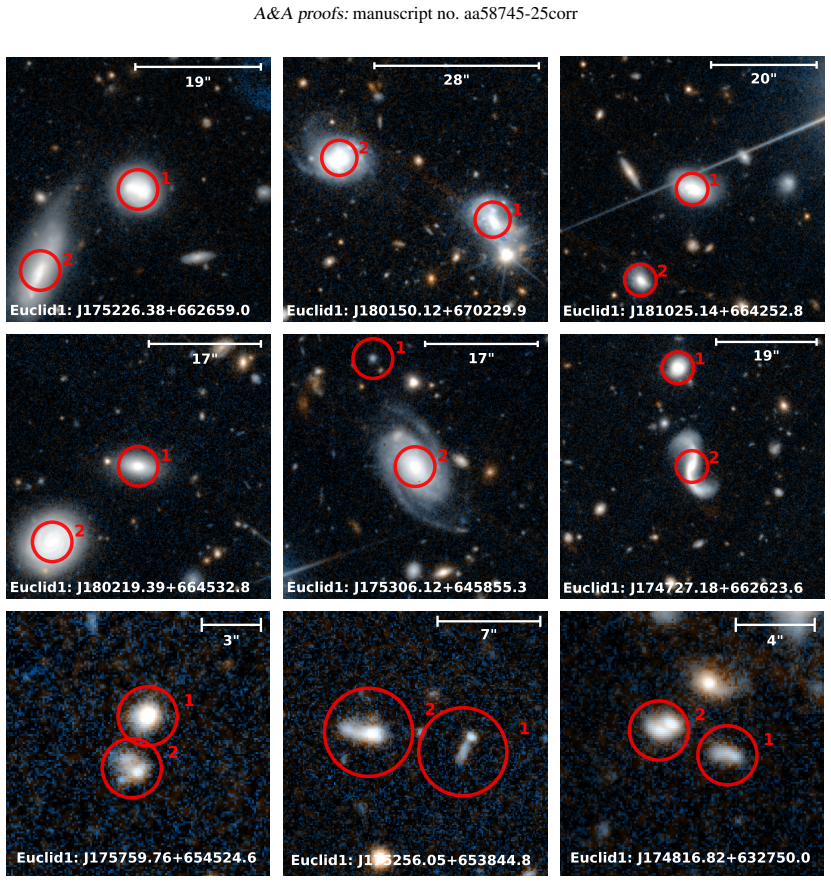
The red circles mark the positions of the AGNs. The scale bars show the separation between the two candidate AGNs in arcsec. Mezcua, M., Civano, F., Fabbiano, G., Miyaji, T., & Marchesi, S. 2016, ApJ, 817, 20 Mezcua, M., Civano, F., Marchesi, S., et al. 2018, MNRAS, 478, 2576 Mezcua, M. & Domínguez Sánchez, H. 2020, ApJ, 898, L30 Mezcua, M. & Domínguez Sá...
-
[3]
Then nu phys_miss(θi)=p corr phys(θi)n miss(θi).(A.4) After going over all the sample regions, we combine the counts to obtain the spectroscopic pair completeness as a func- tion of angular separation, which is shown in Fig. A.1. The effect Fig. A.1.Spectroscopic pair completeness of DESI EDR vs. pair an- gular separation for the 60 sample regions taken f...
2025
-
[4]
15" 00" 1 2 Euclid1: J174727.18+662623.6 10
′′0, we find 1,611 random matches and derive a contamination fraction of 8.3%. Yet, all eightEuclidsources with a LOFAR counterpart are confirmed as the most probable counterpart based on the likelihood ratio analysis presented in Bisigello et al. (2025), with a likelihood ratio at least 100 times larger than the threshold above which a counterpart is con...
2025
-
[5]
We then re-scale theL14−195 keV to that of HeI using the value reported in Ricci et al
log10 MBH M⊙ ! =7.75+log 10 5.5 4.31 ! +2 log 10(FWHM)+0.5 log 10 L14-195 keV 1042 , (D.2) where FWHM is that of (Heiλ1.084) b in units of 10 4 km s −1 andL 14−195 keV is the 14-195 keV hard-X luminosity in units erg s−1. We then re-scale theL14−195 keV to that of HeI using the value reported in Ricci et al. (2022): log10(LHeI)=log 10(L14−195 keV)−2.45,(D...
2022
-
[6]
E.4.KEX (left) and BLUE (right) diagrams of those sources classified as AGNs in one of these diagnostics based on DESI spectroscopy
0.0 0.1 0.2 0.3 0.4 0.5 0.6 0.7 0.8 0.9log10([OIII] 5007/H ) SF AGN Composite 0.5 0.0 0.5 1.0 1.5 log10(EW[OII] 3726, 3729)/EW(H ) 1.00 0.75 0.50 0.25 0.00 0.25 0.50 0.75 1.00 log10([OIII] 5007/H ) SF/AGN AGN SF LINER SF/ LINER Fig. E.4.KEX (left) and BLUE (right) diagrams of those sources classified as AGNs in one of these diagnostics based on DESI spect...
2018
discussion (0)
Sign in with ORCID, Apple, or X to comment. Anyone can read and Pith papers without signing in.