ReSS: Learning Reasoning Models for Tabular Data Prediction via Symbolic Scaffold
Pith reviewed 2026-05-21 00:55 UTC · model grok-4.3
The pith
ReSS trains LLMs on decision-tree paths to gain up to 10 percent accuracy on tabular data while keeping reasoning faithful to the tree logic.
A machine-rendered reading of the paper's core claim, the machinery that carries it, and where it could break.
Core claim
The central claim is that decision-tree paths can serve as reliable scaffolds to generate grounded natural-language reasoning from an LLM; the resulting dataset, when used for fine-tuning together with scaffold-invariant augmentation, produces models that achieve higher predictive accuracy on tabular tasks and satisfy quantitative faithfulness criteria defined by hallucination, necessity, and sufficiency scores.
What carries the argument
Instance-level decision paths extracted from a decision tree, used as symbolic scaffolds that constrain and ground the LLM's natural-language reasoning generation.
If this is right
- ReSS-trained models deliver both higher accuracy and measurable faithfulness on tabular prediction in healthcare and finance.
- The scaffold-guided dataset creation reduces the need for manual reasoning annotations while preserving logical consistency.
- Scaffold-invariant augmentation improves generalization without altering the core decision structure.
- The three quantitative metrics provide an objective way to audit whether explanations remain faithful to the underlying logic.
Where Pith is reading between the lines
- Similar scaffolding could be built from other symbolic structures such as rule sets or logic programs to handle a wider range of reasoning tasks.
- The same pipeline might be applied to larger or streaming tabular datasets where manual explanation curation is impractical.
- Hybrid systems could route simple cases to the tree and complex cases to the fine-tuned LLM while using the scaffold for consistency checks.
Load-bearing premise
The LLM-generated reasoning will strictly follow the decision logic in the scaffold without adding contradictions or extraneous inferences that the hallucination, necessity, and sufficiency metrics will reliably detect.
What would settle it
A controlled test in which a substantial fraction of generated explanations on held-out data either contradict the corresponding tree path or receive low scores on the necessity or sufficiency metrics.
Figures







read the original abstract
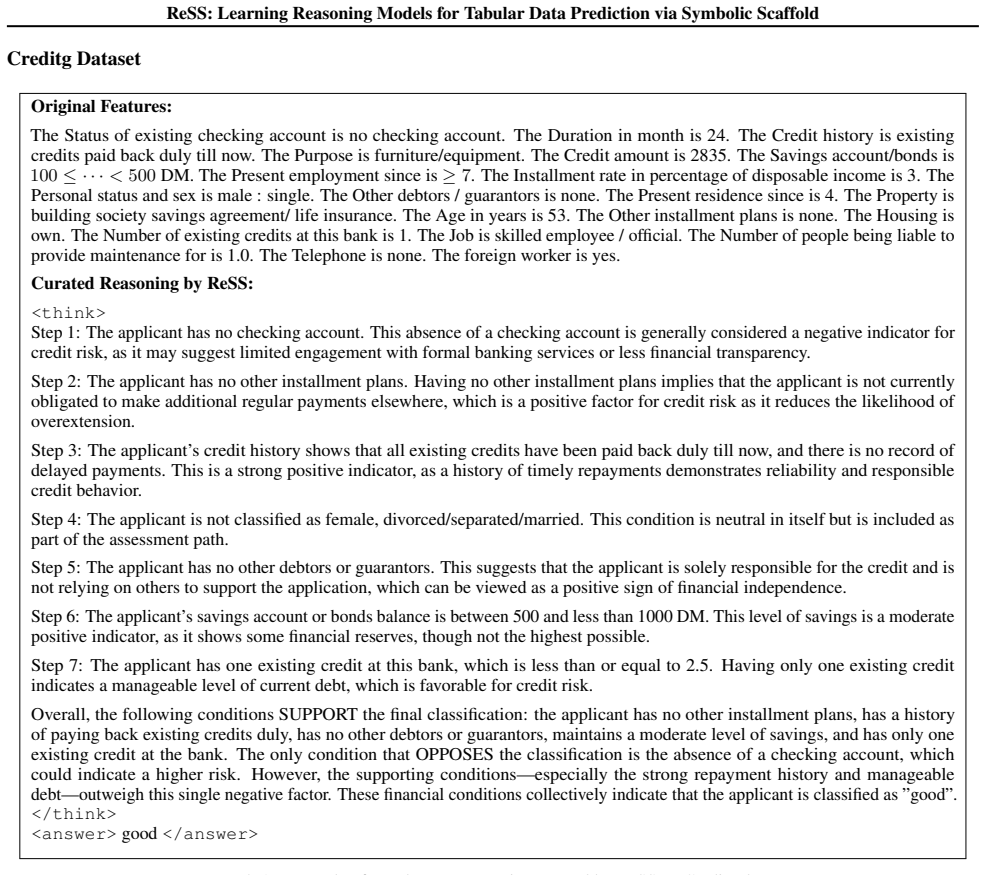
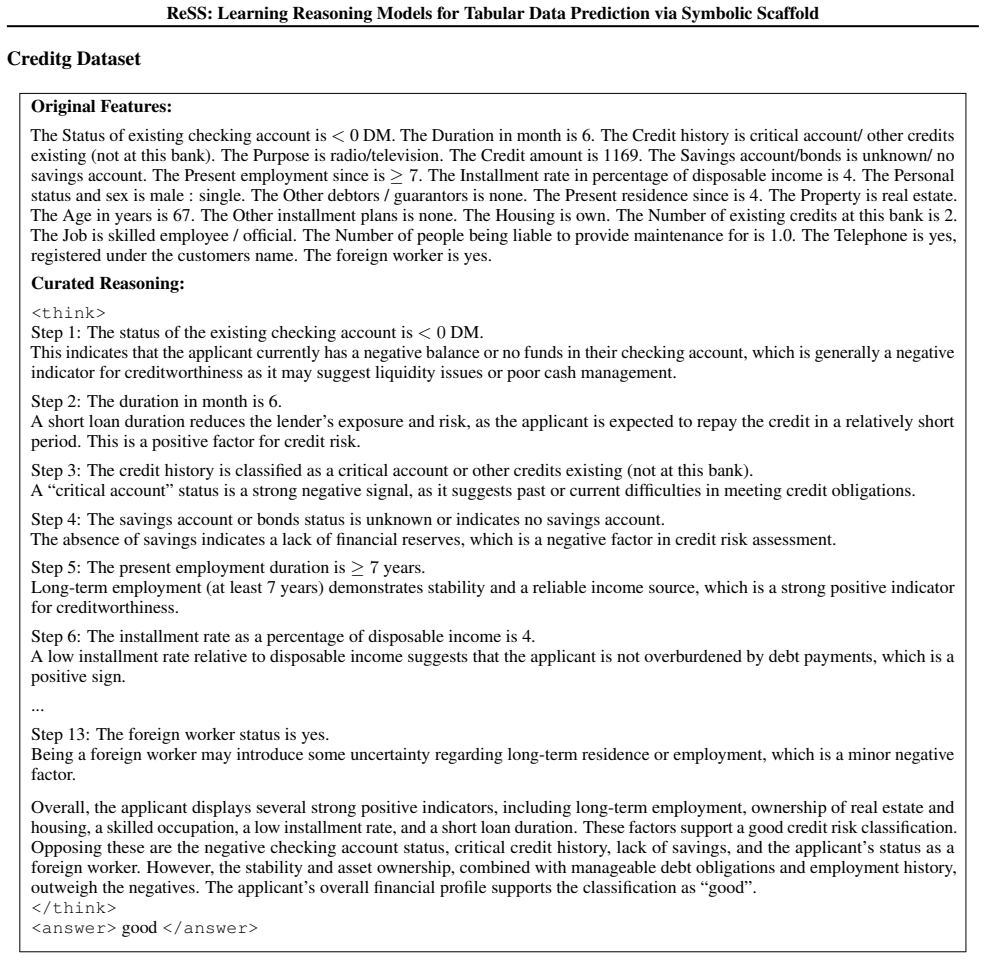
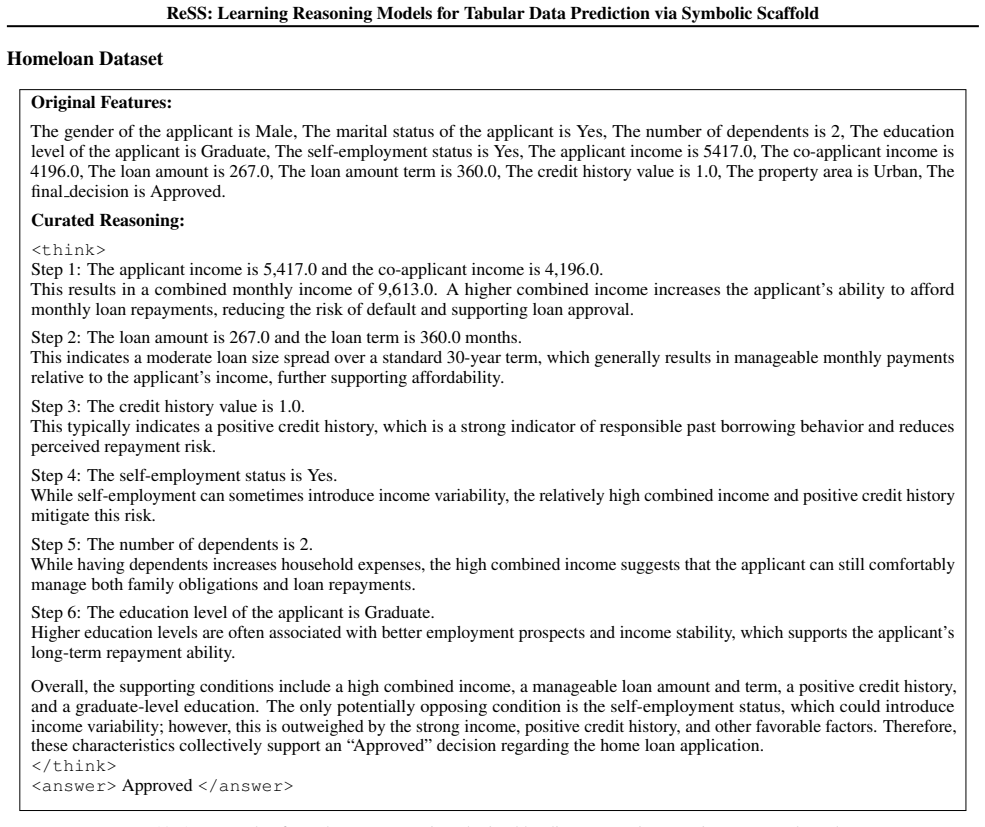
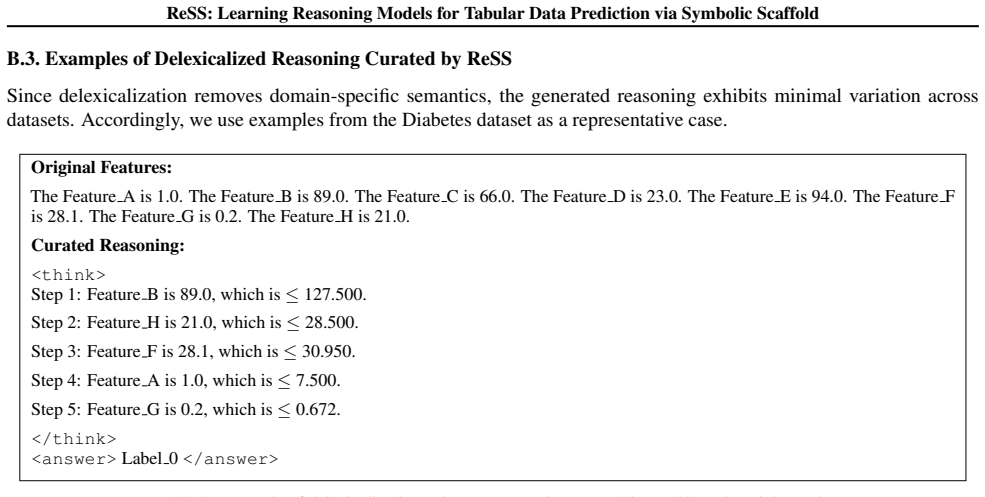
Tabular data remains prevalent in high-stakes domains such as healthcare and finance, where predictive models are expected to provide both high accuracy and faithful, human-understandable reasoning. While symbolic models offer verifiable logic, they lack semantic expressiveness. Meanwhile, general-purpose LLMs often require specialized fine-tuning to master domain-specific tabular reasoning. To address the dual challenges of scalable data curation and reasoning consistency, we propose ReSS, a systematic framework that bridges symbolic and neural reasoning models. ReSS leverages a decision-tree model to extract instance-level decision paths as symbolic scaffolds. These scaffolds, alongside input features and labels, guide an LLM to generate grounded natural-language reasoning that strictly adheres to the underlying decision logic. The resulting high-quality dataset is used to fine-tune a pretrained LLM into a specialized tabular reasoning model, further enhanced by a scaffold-invariant data augmentation strategy to improve generalization and explainability. To rigorously assess faithfulness, we introduce quantitative metrics including hallucination rate, explanation necessity, and explanation sufficiency. Experimental results on medical and financial benchmarks demonstrate that ReSS-trained models improve traditional decision trees and standard fine-tuning approaches up to $10\%$ while producing faithful and consistent reasoning
Editorial analysis
A structured set of objections, weighed in public.
Referee Report
Summary. The paper presents ReSS, a framework for tabular data prediction that uses decision trees to generate symbolic scaffolds for guiding LLMs to produce natural-language reasoning. The scaffolds are used to create training data for fine-tuning LLMs, with an additional scaffold-invariant data augmentation. New metrics for faithfulness are proposed, and the method is claimed to achieve up to 10% better performance on medical and financial benchmarks compared to decision trees and standard fine-tuning while maintaining faithful reasoning.
Significance. This work addresses an important problem in explainable AI for tabular data in high-stakes applications. If the results hold, it offers a promising way to integrate symbolic reasoning with neural models for better accuracy and interpretability. The quantitative faithfulness metrics are a notable contribution for evaluating such hybrid systems.
major comments (2)
- The abstract states that ReSS-trained models improve upon traditional decision trees and standard fine-tuning approaches up to 10%, but does not specify the exact experimental protocol, baseline details, statistical tests, or ablation results. This leaves the central performance and faithfulness claims without verifiable support.
- The hallucination rate, explanation necessity, and explanation sufficiency metrics are introduced to measure adherence to the decision logic in the scaffolds. However, without an independent verification such as human evaluation to confirm they capture deviations or contradictions, the metrics risk being circular and not guaranteeing the strict adherence assumed in the central claim.
minor comments (1)
- Consider adding the names of the specific medical and financial benchmarks used in the experiments for better context.
Simulated Author's Rebuttal
We thank the referee for the detailed and constructive report. We address the major comments point by point below, providing clarifications and indicating planned revisions to enhance the manuscript's transparency and rigor.
read point-by-point responses
-
Referee: The abstract states that ReSS-trained models improve upon traditional decision trees and standard fine-tuning approaches up to 10%, but does not specify the exact experimental protocol, baseline details, statistical tests, or ablation results. This leaves the central performance and faithfulness claims without verifiable support.
Authors: The abstract is intentionally concise to highlight the main contributions. Detailed descriptions of the experimental protocol, including the specific medical and financial benchmarks, baseline models (decision trees and vanilla LLM fine-tuning), statistical significance testing, and ablation studies on scaffold and augmentation components, are provided in Section 4 of the manuscript with results in the tables. We will update the abstract to include a brief reference to the evaluation setup and cross-references to the experimental section to improve immediate verifiability. revision: yes
-
Referee: The hallucination rate, explanation necessity, and explanation sufficiency metrics are introduced to measure adherence to the decision logic in the scaffolds. However, without an independent verification such as human evaluation to confirm they capture deviations or contradictions, the metrics risk being circular and not guaranteeing the strict adherence assumed in the central claim.
Authors: We appreciate the concern regarding potential circularity. The metrics are defined through direct, objective computations: hallucination rate detects logical contradictions via entailment against the scaffold, necessity quantifies performance drop upon explanation removal, and sufficiency checks predictive power of the explanation in isolation. These are rule-based and independent of the LLM generation process itself. To further strengthen validation, we will incorporate a human evaluation on a sample subset in the revised manuscript to demonstrate correlation with the automated scores. revision: yes
Circularity Check
Independent decision-tree scaffolds generated prior to LLM involvement keep derivation self-contained
full rationale
The paper first fits a decision-tree model to extract instance-level decision paths as symbolic scaffolds from the tabular data. These scaffolds are then used to prompt an LLM for natural-language reasoning generation, followed by fine-tuning and evaluation via hallucination rate, necessity, and sufficiency metrics. Because the tree-derived scaffolds are produced by an independent symbolic model before any LLM step and the metrics operate on the generated outputs rather than re-using the same fitted parameters, no load-bearing step reduces by construction to its own inputs. The central claims rest on experimental comparisons rather than definitional equivalence.
Axiom & Free-Parameter Ledger
axioms (1)
- domain assumption A decision-tree model trained on tabular data yields instance-level decision paths that accurately encode the logic used to reach each prediction.
Lean theorems connected to this paper
-
IndisputableMonolith/Foundation/Cost/FunctionalEquation.leanwashburn_uniqueness_aczel unclear?
unclearRelation between the paper passage and the cited Recognition theorem.
ReSS leverages a decision-tree model to extract instance-level decision paths as symbolic scaffolds. These scaffolds, alongside input features and labels, guide an LLM to generate grounded natural-language reasoning that strictly adheres to the underlying decision logic.
-
IndisputableMonolith/Foundation/AlphaCoordinateFixation.leanJ_uniquely_calibrated_via_higher_derivative unclear?
unclearRelation between the paper passage and the cited Recognition theorem.
We introduce quantitative metrics including hallucination rate, explanation necessity, and explanation sufficiency.
What do these tags mean?
- matches
- The paper's claim is directly supported by a theorem in the formal canon.
- supports
- The theorem supports part of the paper's argument, but the paper may add assumptions or extra steps.
- extends
- The paper goes beyond the formal theorem; the theorem is a base layer rather than the whole result.
- uses
- The paper appears to rely on the theorem as machinery.
- contradicts
- The paper's claim conflicts with a theorem or certificate in the canon.
- unclear
- Pith found a possible connection, but the passage is too broad, indirect, or ambiguous to say the theorem truly supports the claim.
Reference graph
Works this paper leans on
-
[1]
" write newline "" before.all 'output.state := FUNCTION n.dashify 't := "" t empty not t #1 #1 substring "-" = t #1 #2 substring "--" = not "--" * t #2 global.max substring 't := t #1 #1 substring "-" = "-" * t #2 global.max substring 't := while if t #1 #1 substring * t #2 global.max substring 't := if while FUNCTION format.date year duplicate empty "emp...
-
[2]
Dnf-net: A neural architecture for tabular data, 2020
Abutbul, A., Elidan, G., Katzir, L., and El-Yaniv, R. Dnf-net: A neural architecture for tabular data, 2020. URL https://arxiv.org/abs/2006.06465
-
[3]
Chain-of-thought reasoning in the wild is not always faithful.arXiv preprint:2503.08679, 2025
Arcuschin, I., Janiak, J., Krzyzanowski, R., Rajamanoharan, S., Nanda, N., and Conmy, A. Chain-of-thought reasoning in the wild is not always faithful, 2025. URL https://arxiv. org/abs/2503.08679, 2025
- [4]
-
[5]
Atanasova, P., Camburu, O.-M., Lioma, C., Lukasiewicz, T., Simonsen, J. G., and Augenstein, I. Faithfulness tests for natural language explanations. arXiv preprint arXiv:2305.18029, 2023
-
[6]
Chain-of-thought is not explainability
Barez, F., Wu, T.-Y., Arcuschin, I., Lan, M., Wang, V., Siegel, N., Collignon, N., Neo, C., Lee, I., Paren, A., et al. Chain-of-thought is not explainability. Preprint, alphaXiv, pp.\ v1, 2025
work page 2025
-
[7]
GPT-NeoX-20B: An Open-Source Autoregressive Language Model
Black, S., Biderman, S., Hallahan, E., Anthony, Q., Gao, L., Golding, L., He, H., Leahy, C., McDonell, K., Phang, J., Pieler, M., Prashanth, U. S., Purohit, S., Reynolds, L., Tow, J., Wang, B., and Weinbach, S. Gpt-neox-20b: An open-source autoregressive language model, 2022. URL https://arxiv.org/abs/2204.06745
work page internal anchor Pith review Pith/arXiv arXiv 2022
-
[8]
Machine Learning 45(1), 5–32 (Oct 2001)
Breiman, L. Random forests. Mach. Learn., 45 0 (1): 0 5–32, October 2001. ISSN 0885-6125. doi:10.1023/A:1010933404324. URL https://doi.org/10.1023/A:1010933404324
-
[9]
Breiman, L., Friedman, J. H., Olshen, R. A., and Stone, C. J. Classification and Regression Trees. Wadsworth, 1984. ISBN 0-534-98053-8
work page 1984
-
[10]
Tabr1: Taming grpo for tabular reasoning llms
Cai, P., Gao, Z., and Chen, J. Tabr1: Taming grpo for tabular reasoning llms. arXiv preprint arXiv:2510.17385, 2025
-
[11]
Chen, Tianqi, Guestrin, and Carlos. Xgboost: A scalable tree boosting system. In Proceedings of the 22nd ACM SIGKDD International Conference on Knowledge Discovery and Data Mining, KDD ’16, pp.\ 785–794. ACM, August 2016. doi:10.1145/2939672.2939785. URL http://dx.doi.org/10.1145/2939672.2939785
-
[12]
Scaling Instruction-Finetuned Language Models
Chung, H. W., Hou, L., Longpre, S., Zoph, B., Tay, Y., Fedus, W., Li, Y., Wang, X., Dehghani, M., Brahma, S., Webson, A., Gu, S. S., Dai, Z., Suzgun, M., Chen, X., Chowdhery, A., Castro-Ros, A., Pellat, M., Robinson, K., Valter, D., Narang, S., Mishra, G., Yu, A., Zhao, V., Huang, Y., Dai, A., Yu, H., Petrov, S., Chi, E. H., Dean, J., Devlin, J., Roberts,...
work page internal anchor Pith review Pith/arXiv arXiv 2022
-
[13]
Diabetes 130-US Hospitals for Years 1999-2008
Clore, J., Cios, K., DeShazo, J., and Strack, B. Diabetes 130-US Hospitals for Years 1999-2008 . UCI Machine Learning Repository, 2014. DOI : 10.24432/C5230J
-
[14]
Lift: Language-interfaced fine-tuning for non-language machine learning tasks, 2022
Dinh, T., Zeng, Y., Zhang, R., Lin, Z., Gira, M., Rajput, S., yong Sohn, J., Papailiopoulos, D., and Lee, K. Lift: Language-interfaced fine-tuning for non-language machine learning tasks, 2022. URL https://arxiv.org/abs/2206.06565
-
[15]
DeepSeek-R1: Incentivizing Reasoning Capability in LLMs via Reinforcement Learning
Guo, D., Yang, D., Zhang, H., Song, J., Zhang, R., Xu, R., Zhu, Q., Ma, S., Wang, P., Bi, X., et al. Deepseek-r1: Incentivizing reasoning capability in llms via reinforcement learning. arXiv preprint arXiv:2501.12948, 2025
work page internal anchor Pith review Pith/arXiv arXiv 2025
-
[16]
Tabllm: Few-shot classification of tabular data with large language models, 2023
Hegselmann, S., Buendia, A., Lang, H., Agrawal, M., Jiang, X., and Sontag, D. Tabllm: Few-shot classification of tabular data with large language models, 2023. URL https://arxiv.org/abs/2210.10723
-
[17]
TabPFN: A Transformer That Solves Small Tabular Classification Problems in a Second
Hollmann, N., Müller, S., Eggensperger, K., and Hutter, F. Tabpfn: A transformer that solves small tabular classification problems in a second, 2023. URL https://arxiv.org/abs/2207.01848
work page internal anchor Pith review Pith/arXiv arXiv 2023
-
[18]
REINFORCE++: Stabilizing Critic-Free Policy Optimization with Global Advantage Normalization
Hu, J., Liu, J. K., Xu, H., and Shen, W. Reinforce++: Stabilizing critic-free policy optimization with global advantage normalization, 2025. URL https://arxiv.org/abs/2501.03262
work page internal anchor Pith review Pith/arXiv arXiv 2025
-
[19]
TabTransformer: Tabular Data Modeling Using Contextual Embeddings
Huang, X., Khetan, A., Cvitkovic, M., and Karnin, Z. Tabtransformer: Tabular data modeling using contextual embeddings, 2020. URL https://arxiv.org/abs/2012.06678
work page internal anchor Pith review Pith/arXiv arXiv 2020
-
[20]
Kambhampati, S., Stechly, K., and Valmeekam, K. (how) do reasoning models reason? Annals of the New York Academy of Sciences, 1547 0 (1): 0 33--40, 2025. doi:https://doi.org/10.1111/nyas.15339. URL https://nyaspubs.onlinelibrary.wiley.com/doi/abs/10.1111/nyas.15339
-
[21]
Lightgbm: A highly efficient gradient boosting decision tree
Ke, G., Meng, Q., Finley, T., Wang, T., Chen, W., Ma, W., Ye, Q., and Liu, T.-Y. Lightgbm: A highly efficient gradient boosting decision tree. In Guyon, I., Luxburg, U. V., Bengio, S., Wallach, H., Fergus, R., Vishwanathan, S., and Garnett, R. (eds.), Advances in Neural Information Processing Systems, volume 30. Curran Associates, Inc., 2017. URL https://...
work page 2017
-
[22]
T., Kang, D., Moon, S., Lee, J
Kwon, T., iunn Ong, K. T., Kang, D., Moon, S., Lee, J. R., Hwang, D., Sim, Y., Sohn, B., Lee, D., and Yeo, J. Large language models are clinical reasoners: Reasoning-aware diagnosis framework with prompt-generated rationales, 2024. URL https://arxiv.org/abs/2312.07399
-
[23]
Crafting papers on machine learning
Langley, P. Crafting papers on machine learning. In Langley, P. (ed.), Proceedings of the 17th International Conference on Machine Learning (ICML 2000), pp.\ 1207--1216, Stanford, CA, 2000. Morgan Kaufmann
work page 2000
-
[24]
Li, G., Lin, M., Galanti, T., Tu, Z., and Yang, T. Disco: Reinforcing large reasoning models with discriminative constrained optimization. arXiv preprint arXiv:2505.12366, 2025
-
[25]
Moro, S., Rita, P., and Cortez, P. Bank Marketing . UCI Machine Learning Repository, 2014. DOI : 10.24432/C5K306
-
[26]
Making reasoning matter: Measuring and improving faithfulness of chain-of-thought reasoning
Paul, D., West, R., Bosselut, A., and Faltings, B. Making reasoning matter: Measuring and improving faithfulness of chain-of-thought reasoning. arXiv preprint arXiv:2402.13950, 2024
-
[27]
Y., Cooper, M., and Krishnan, R
Si, J., Cheng, W. Y., Cooper, M., and Krishnan, R. G. Interpretabnet: Distilling predictive signals from tabular data by salient feature interpretation. arXiv preprint arXiv:2406.00426, 2024
-
[28]
Slack, D. and Singh, S. Tablet: Learning from instructions for tabular data, 2023. URL https://arxiv.org/abs/2304.13188
-
[29]
Team, K., Du, A., Gao, B., Xing, B., Jiang, C., Chen, C., Li, C., Xiao, C., Du, C., Liao, C., et al. Kimi k1. 5: Scaling reinforcement learning with llms. arXiv preprint arXiv:2501.12599, 2025
work page internal anchor Pith review Pith/arXiv arXiv 2025
-
[30]
Turpin, M., Michael, J., Perez, E., and Bowman, S. Language models don't always say what they think: Unfaithful explanations in chain-of-thought prompting. Advances in Neural Information Processing Systems, 36: 0 74952--74965, 2023
work page 2023
-
[31]
Trl: Transformer reinforcement learning
von Werra, L., Belkada, Y., Tunstall, L., Beeching, E., Thrush, T., Lambert, N., Huang, S., Rasul, K., and Gallouédec, Q. Trl: Transformer reinforcement learning. https://github.com/huggingface/trl, 2020
work page 2020
- [32]
-
[33]
Wei, J., Wang, X., Schuurmans, D., Bosma, M., brian ichter, Xia, F., Chi, E. H., Le, Q. V., and Zhou, D. Chain of thought prompting elicits reasoning in large language models. In Oh, A. H., Agarwal, A., Belgrave, D., and Cho, K. (eds.), Advances in Neural Information Processing Systems, 2022. URL https://openreview.net/forum?id=_VjQlMeSB_J
work page 2022
-
[34]
U., van der Schaar, M., and Agius, R
Werling, M., Seedat, N., Liu, J., Gr nlykke, L., Niemann, C. U., van der Schaar, M., and Agius, R. Tables2traces: Distilling tabular data to improve llm reasoning in healthcare. In EurIPS 2025 Workshop: AI for Tabular Data, 2025
work page 2025
-
[35]
Sub-task decomposition enables learning in sequence to sequence tasks
Wies, N., Levine, Y., and Shashua, A. Sub-task decomposition enables learning in sequence to sequence tasks. In International Conference on Learning Representations, 2023. URL https://openreview.net/pdf?id=BrJATVZDWEH
work page 2023
-
[36]
K., Hajimirsadeghi, H., and Mori, G
Xu, T., Zhang, Z., Sun, X., Zung, L. K., Hajimirsadeghi, H., and Mori, G. Tabreason: A reinforcement learning-enhanced reasoning llm for explainable tabular data prediction. arXiv preprint arXiv:2505.21807, 2025
discussion (0)
Sign in with ORCID, Apple, or X to comment. Anyone can read and Pith papers without signing in.