Recognition: unknown
Distributed Resilient Fixed-Time Control for Cooperative Output Regulation of MASs over Directed Graphs under DoS Attacks
Pith reviewed 2026-05-10 13:26 UTC · model grok-4.3
The pith
A distributed resilient controller drives regulated outputs of linear multi-agent systems to zero in fixed time over directed graphs despite denial-of-service attacks.
A machine-rendered reading of the paper's core claim, the machinery that carries it, and where it could break.
Core claim
The paper proposes a distributed resilient fixed-time controller comprising a distributed resilient fixed-time observer and a distributed resilient fixed-time control law for each agent. This controller enables the regulated outputs of linear multi-agent systems over directed graphs to converge to zero in a fixed time whose upper bound does not depend on initial states, even under DoS attacks. The design avoids assumptions of Laplacian symmetry, strong connectivity, or detail-balanced graphs required by prior methods.
What carries the argument
The distributed resilient fixed-time observer combined with the per-agent control law, which estimates system states and enforces output regulation resiliently to DoS interruptions without requiring graph symmetry.
If this is right
- Regulated outputs reach zero within a time determined solely by design parameters, independent of initial conditions.
- The controller applies to arbitrary directed graphs without symmetry or strong-connectivity requirements.
- Agents tolerate temporary link failures as long as sufficient attack-free intervals remain for convergence.
- A simulation example confirms that the outputs converge as predicted under the attack model.
Where Pith is reading between the lines
- The fixed-time guarantee could support real-time certification of performance in networks where attack durations are bounded but unknown in advance.
- Relaxing the linearity assumption to Lipschitz nonlinear dynamics would require only local modifications to the observer gain design.
- The same resilience structure might transfer to event-triggered implementations that further reduce communication load during attack-free periods.
- Similar recovery-interval arguments could be tested on other attack classes such as jamming or replay that also produce intermittent connectivity loss.
Load-bearing premise
The multi-agent system must be linear with known dynamics, and denial-of-service attacks must leave enough recovery intervals for the observer and controller to complete their fixed-time tasks.
What would settle it
Run the closed-loop system with the stated observer and controller under a sequence of DoS attacks whose total active duration exceeds the recovery intervals assumed in the stability analysis; if the regulated outputs fail to reach and stay at zero by the predicted fixed-time bound, the claim is falsified.
Figures

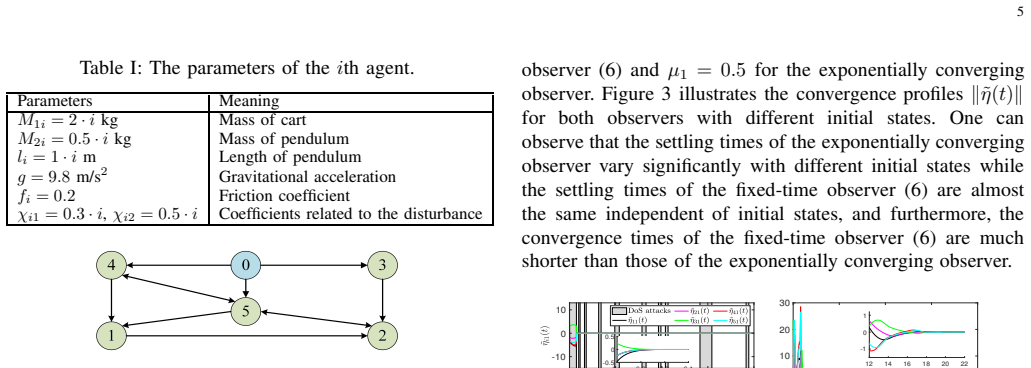

read the original abstract
This paper addresses the problem of fixed-time cooperative output regulation for linear multi-agent systems over directed graphs under denial-of-service attacks. A novel distributed resilient fixed-time controller is developed that comprises a distributed resilient fixed-time observer taking general directed graphs into consideration, and a distributed resilient fixed-time control law for each agent. The proposed controller neither depends on Laplacian symmetry nor requires strong connectivity and detail-balanced condition, in contrast to existing distributed resilient fixed-time controllers. Under the proposed controller, the regulated outputs converge to zero in a fixed time with its upper bound independent of the initial states of the multi-agent system. Ultimately, the efficacy of the proposed controller is demonstrated via a simulation example.
Editorial analysis
A structured set of objections, weighed in public.
Referee Report
Summary. The paper develops a distributed resilient fixed-time observer and controller for linear multi-agent systems over directed graphs under DoS attacks to achieve cooperative output regulation. The design avoids Laplacian symmetry, strong connectivity, and detail-balance assumptions. It claims that regulated outputs converge to zero in a fixed time whose upper bound is independent of initial states, with efficacy shown via simulation.
Significance. If the fixed-time stability analysis holds with the claimed independence from initial conditions, the result strengthens resilient MAS control by extending fixed-time methods to general directed graphs and intermittent DoS without strong connectivity, providing a priori bounded convergence times useful for safety-critical applications.
major comments (1)
- [Stability analysis / Theorem on fixed-time convergence] The central fixed-time claim requires that the convergence-time bound T_max derived from the piecewise Lyapunov analysis (during attack-free and recovery intervals) is independent of x(0). The manuscript must explicitly show how attack frequency and duration parameters are absorbed into gain-dependent terms only, without residual dependence that would make the practical bound vary with attack statistics (see skeptic note on decay rates dominating growth).
minor comments (2)
- [Problem formulation] Clarify the precise DoS attack model (e.g., bounds on frequency and duration) and how the resilient observer recovers during communication intervals.
- [Simulation] In the simulation example, provide quantitative comparison of convergence times across different initial conditions to illustrate independence from x(0).
Simulated Author's Rebuttal
We thank the referee for the detailed and constructive review. We have revised the manuscript to explicitly strengthen the fixed-time stability analysis as requested.
read point-by-point responses
-
Referee: [Stability analysis / Theorem on fixed-time convergence] The central fixed-time claim requires that the convergence-time bound T_max derived from the piecewise Lyapunov analysis (during attack-free and recovery intervals) is independent of x(0). The manuscript must explicitly show how attack frequency and duration parameters are absorbed into gain-dependent terms only, without residual dependence that would make the practical bound vary with attack statistics (see skeptic note on decay rates dominating growth).
Authors: We agree that an explicit derivation is needed to confirm independence from initial conditions. In the revised proof of Theorem 3, we start from the piecewise Lyapunov derivative: during attack-free intervals, we have V̇ ≤ −k1 V^α − k2 V^β (0<α<1<β) which yields the standard fixed-time bound T1 = (1/(k1(1−α))) + (1/(k2(β−1))) after integration; during DoS intervals, V̇ ≤ k3 V with k3 depending on the attack-induced perturbation. Under the standard DoS assumption that the total attack duration up to time t satisfies ∫_0^t χ(τ)dτ ≤ ηt + Td (with known bounds η<1, Td), the number and length of attack intervals within any finite window are bounded a priori. Substituting these bounds into the integrated inequality produces an overall upper bound T_max that is a function solely of the controller gains k1,k2,k3 and the fixed DoS parameters η,Td; the initial value V(0) cancels out because of the fractional powers. The gain-selection conditions are then stated explicitly so that k1,k2 are chosen sufficiently large relative to k3(η,Td) to guarantee that the net decay dominates any growth, thereby absorbing the attack statistics into the gain terms. Once the gains are fixed, T_max is a numerical constant independent of x(0) and of any particular realization of the attack sequence (provided the sequence obeys the assumed bounds). We have added the full chain of inequalities and the resulting closed-form expression for T_max in the revised manuscript. revision: yes
Circularity Check
No circularity in derivation chain; fixed-time bound derived from standard Lyapunov analysis.
full rationale
The paper designs a distributed resilient fixed-time observer and controller for linear MASs over directed graphs under DoS attacks, claiming regulated outputs converge in fixed time independent of initial states. This follows from piecewise Lyapunov analysis between attack intervals using standard fixed-time stability lemmas (not self-cited as load-bearing). No self-definitional steps, fitted parameters renamed as predictions, or ansatz smuggled via self-citation appear in the abstract or described derivation. The bound depends on gains, system matrices, and attack frequency/duration bounds as external parameters, without reducing to its own inputs by construction. The result is self-contained against external benchmarks.
Axiom & Free-Parameter Ledger
axioms (1)
- domain assumption The multi-agent system dynamics are linear and the communication graph is directed.
Reference graph
Works this paper leans on
-
[1]
Coordination of gr oups of mobile autonomous agents using nearest neighbor rules,
A. Jadbabaie, J. Lin, and A. S. Morse, “Coordination of gr oups of mobile autonomous agents using nearest neighbor rules,” IEEE Transactions on Automatic Control, vol. 48, no. 6, pp. 988–1001, 2003
2003
-
[2]
A multi-agent approach to power system restoration,
T. Nagata and H. Sasaki, “A multi-agent approach to power system restoration,” IEEE Transactions on Power Systems , vol. 17, no. 2, pp. 457–462, 2002
2002
-
[3]
Ren and R
W. Ren and R. W. Beard, Distributed Consensus in Multi-vehicle Cooperative Control. London, U.K.: Springer-V erlag, 2008
2008
-
[4]
Ren and Y
W. Ren and Y . Cao, Distributed Coordination of Multi-Agent Networks: Emerge nt Problems, Models, and Issues . London, U.K.: Springer-V erlag, 2011
2011
-
[5]
An overview of recent advanc es in distributed coordination of multi-agent systems,
R. Y ang, L. Liu, and G. Feng, “An overview of recent advanc es in distributed coordination of multi-agent systems,” Unmanned Systems, vol. 10, no. 03, pp. 307– 325, 2022
2022
-
[6]
Cooperative output regulation of lin ear multi-agent systems,
Y . Su and J. Huang, “Cooperative output regulation of lin ear multi-agent systems,” IEEE Transactions on Automatic Control , vol. 57, no. 4, pp. 1062–1066, 2011. 9
2011
-
[7]
A general result on the robus t cooperative output regulation for linear uncertain multi-agent system s,
Y . Su, Y . Hong, and J. Huang, “A general result on the robus t cooperative output regulation for linear uncertain multi-agent system s,” IEEE Transactions on Automatic Control, vol. 58, no. 5, pp. 1275–1279, 2012
2012
-
[8]
Adaptive consensus output regulation of a clas s of nonlinear systems with unknown high-frequency gain,
Z. Ding, “Adaptive consensus output regulation of a clas s of nonlinear systems with unknown high-frequency gain,” Automatica, vol. 51, pp. 348–355, 2015
2015
-
[9]
Robust cooperat ive output regulation of uncertain linear multi-agent systems not det ectable by regulated output,
L. Wang, C. Wen, F. Guo, H. Cai, and H. Su, “Robust cooperat ive output regulation of uncertain linear multi-agent systems not det ectable by regulated output,” Automatica, vol. 101, pp. 309–317, 2019
2019
-
[10]
Distributed fault-toler ant cooperative output regulation for multi-agent networks via fixed-time observe r and adaptive control,
G. Song, P . Shi, and C. P . Lim, “Distributed fault-toler ant cooperative output regulation for multi-agent networks via fixed-time observe r and adaptive control,” IEEE Transactions on Control of Network Systems , vol. 9, no. 2, pp. 845–855, 2021
2021
-
[11]
A Lyapunov approach t o robust cooperative output regulation of multia-gent systems under infinite com munication delays,
Q. Zhou, X. Xu, L. Liu, and G. Feng, “A Lyapunov approach t o robust cooperative output regulation of multia-gent systems under infinite com munication delays,” IEEE Transactions on Automatic Control , vol. 67, no. 11, pp. 6271–6278, 2022
2022
-
[12]
Input-to-state stabilizing c ontrol under denial-of-service,
C. De Persis and P . Tesi, “Input-to-state stabilizing c ontrol under denial-of-service,” IEEE Transactions on Automatic Control , vol. 60, no. 11, pp. 2930–2944, 2015
2015
-
[13]
Distributed consensus contro l for multi-agent systems under denial-of-service,
A.-Y . Lu and G.-H. Y ang, “Distributed consensus contro l for multi-agent systems under denial-of-service,” Information Sciences , vol. 439, pp. 95–107, 2018
2018
-
[14]
HMM-based secure control of multi- agent systems under DoS attacks,
P . Cheng, S. He, G. Xiao, and W. Zhang, “HMM-based secure control of multi- agent systems under DoS attacks,” IEEE Transactions on Automatic Control , vol. 71, no. 2, pp. 1199–1206, 2026
2026
-
[15]
Distributed consensus track ing for multi-agent systems under two types of attacks,
Z. Feng, G. Hu, and G. Wen, “Distributed consensus track ing for multi-agent systems under two types of attacks,” International Journal of Robust and Nonlinear Control, vol. 26, no. 5, pp. 896–918, 2016
2016
-
[16]
Secure cooperative event-triggered control of linear multi- agent systems under DoS attacks,
Z. Feng and G. Hu, “Secure cooperative event-triggered control of linear multi- agent systems under DoS attacks,” IEEE Transactions on Control Systems Tech- nology, vol. 28, no. 3, pp. 741–752, 2019
2019
-
[17]
Consensus of heterogeneo us linear multi-agent systems subject to aperiodic sampled-data and DoS attack,
D. Zhang, L. Liu, and G. Feng, “Consensus of heterogeneo us linear multi-agent systems subject to aperiodic sampled-data and DoS attack,” IEEE Transactions on Cybernetics, vol. 49, no. 4, pp. 1501–1511, 2019
2019
-
[18]
Adaptive event-trigge red resilient control of heterogeneous multi-agent under DoS attacks and link fault s on directed graphs,
C. Y an, L. Y an, Y . Lv, and Y . Xia, “Adaptive event-trigge red resilient control of heterogeneous multi-agent under DoS attacks and link fault s on directed graphs,” IEEE Transactions on Network Science and Engineering , vol. 11, no. 1, pp. 834– 847, 2024
2024
-
[19]
Resilient practical coo perative output regulation for MASs with unknown switching exosystem dynamics under Do S attacks,
C. Deng, D. Zhang, and G. Feng, “Resilient practical coo perative output regulation for MASs with unknown switching exosystem dynamics under Do S attacks,” Automatica, vol. 139, p. 110172, 2022
2022
-
[20]
Distributed resilient observer-ba sed fault-tolerant control for heterogeneous multi-agent systems under actuator faults a nd DoS attacks,
C. Deng and C. Wen, “Distributed resilient observer-ba sed fault-tolerant control for heterogeneous multi-agent systems under actuator faults a nd DoS attacks,” IEEE Transactions on Control of Network Systems , vol. 7, no. 3, pp. 1308–1318, 2020
2020
-
[21]
Resilient cooperative o utput regulation for nonlinear multi-agent systems under DoS attacks,
D. Zhang, C. Deng, and G. Feng, “Resilient cooperative o utput regulation for nonlinear multi-agent systems under DoS attacks,” IEEE Transactions on Automatic Control, vol. 68, pp. 2521–2528, 2023
2023
-
[22]
Asynchronous resilient collision-free formation control for nonlinear MASs under DoS attacks,
J. Zhang, J. Ning, and S. Tong, “Asynchronous resilient collision-free formation control for nonlinear MASs under DoS attacks,” Automatica, vol. 183, p. 112619, 2026
2026
-
[23]
Event-b ased formation control for nonlinear multi-agent systems under DoS attacks,
Y . Tang, D. Zhang, P . Shi, W. Zhang, and F. Qian, “Event-b ased formation control for nonlinear multi-agent systems under DoS attacks,” IEEE Transactions on Automatic Control, vol. 66, no. 1, pp. 452–459, 2020
2020
-
[24]
Finite-time consensus problems fo r networks of dynamic agents,
L. Wang and F. Xiao, “Finite-time consensus problems fo r networks of dynamic agents,” IEEE Transactions on Automatic Control , vol. 55, no. 4, pp. 950–955, 2010
2010
-
[25]
Finite-time conse nsus for high-order multi- agent systems under directed communication topologies,
X.-R. Zhang, Z.-L. Zhao, and T. Liu, “Finite-time conse nsus for high-order multi- agent systems under directed communication topologies,” IEEE Transactions on Automatic Control, vol. 7, no. 12, pp. 8430–8437, 2025
2025
-
[26]
A finite -time distributed dynamic consensus protocol for tracking maximum (minimum) reference signals,
A. Furchì, M. Lippi, A. Marino, and A. Gasparri, “A finite -time distributed dynamic consensus protocol for tracking maximum (minimum) reference signals,” Automatica, vol. 179, p. 112390, 2025
2025
-
[27]
Resi lient finite-time consensus tracking for nonholonomic high-order chained-form system s against DoS attacks,
N. Sarrafan, J. Zarei, R. Razavi-Far, and M. Saif, “Resi lient finite-time consensus tracking for nonholonomic high-order chained-form system s against DoS attacks,” IEEE Transactions on Cybernetics , vol. 54, no. 2, pp. 739–751, 2024
2024
-
[28]
Resilient semi-global fin ite-time cooperative output regulation of heterogeneous linear multi-agent sys tems subject to denial-of- service attacks,
W. Cao, D. Zhang, and G. Feng, “Resilient semi-global fin ite-time cooperative output regulation of heterogeneous linear multi-agent sys tems subject to denial-of- service attacks,” Automatica, vol. 173, p. 112099, 2025
2025
-
[29]
Finite-ti me cooperative output regulation of heterogeneous nonlinear multi-agent system s under switching DoS attacks,
D. Zhang, H. Chen, Q. Lu, C. Deng, and G. Feng, “Finite-ti me cooperative output regulation of heterogeneous nonlinear multi-agent system s under switching DoS attacks,” Automatica, vol. 173, p. 112062, 2025
2025
-
[30]
Fixed-time consensus control of general linear multi-agent systems,
Y . Liu, Z. Zuo, J. Song, and W. Li, “Fixed-time consensus control of general linear multi-agent systems,” IEEE Transactions on Automatic Control , vol. 69, no. 8, pp. 5516–5523, 2024
2024
-
[31]
Nonsingular fixed-time consensus tracking for second-order multi-agent networks,
Z. Zuo, “Nonsingular fixed-time consensus tracking for second-order multi-agent networks,” Automatica, vol. 54, pp. 305–309, 2015
2015
-
[32]
Distributed fixe d-time consensus for nonlinear heterogeneous multi-agent systems,
H. Du, G. Wen, D. Wu, Y . Cheng, and J. Lü, “Distributed fixe d-time consensus for nonlinear heterogeneous multi-agent systems,” Automatica, vol. 113, p. 108797, 2020
2020
-
[33]
Distrib uted fixed-time output regulation for a class of nonlinear multi-agent syst ems with unity relative degree,
Q. Liang, D. Huang, L. Ma, J. Hu, Y . Wu, and S. Wu, “Distrib uted fixed-time output regulation for a class of nonlinear multi-agent syst ems with unity relative degree,” IEEE Transactions on Control of Network Systems , vol. 11, no. 4, pp. 1962–1974, 2024
1962
-
[34]
Observer-based fixed-time secure tra cking consensus for networked high-order multi-agent systems against dos atta cks,
H. Y ang and D. Y e, “Observer-based fixed-time secure tra cking consensus for networked high-order multi-agent systems against dos atta cks,” IEEE Transactions on Cybernetics , vol. 52, no. 4, pp. 2018–2031, 2020
2018
-
[35]
Fixed-time fuzzy resilient consensus tracking of nonlinear MASs under DoS attacks and actuator faults,
B. Xu, Y .-X. Li, and Z. Hou, “Fixed-time fuzzy resilient consensus tracking of nonlinear MASs under DoS attacks and actuator faults,” IEEE Transactions on Automation Science and Engineering , vol. 22, pp. 2923–2934, 2024
2024
-
[36]
Resilient gl obal practical fixed-time cooperative output regulation of uncertain nonlinear mult i-agent systems subject to denial-of-service attacks,
W. Cao, L. Liu, Z. Y e, D. Zhang, and G. Feng, “Resilient gl obal practical fixed-time cooperative output regulation of uncertain nonlinear mult i-agent systems subject to denial-of-service attacks,” IEEE Transactions on Automatic Control , vol. 71, no. 2, pp. 1247–1254, 2026
2026
-
[37]
Resilient fixed-ti me cooperative output regulation of heterogeneous linear multi-agent systems un der denial-of-service attacks over detail-balanced directed graphs,
W. Cao, L. Liu, D. Zhang, and G. Feng, “Resilient fixed-ti me cooperative output regulation of heterogeneous linear multi-agent systems un der denial-of-service attacks over detail-balanced directed graphs,” Automatica, vol. 185, p. 112836, 2026
2026
-
[38]
Geometric homogeneity w ith applications to finite- time stability,
S. P . Bhat and D. S. Bernstein, “Geometric homogeneity w ith applications to finite- time stability,” Mathematics of Control, Signals and Systems , vol. 17, no. 2, pp. 101–127, 2005
2005
-
[39]
Finite-time stability o f continuous autonomous systems,
S. P . Bhat and D. S. Bernstein, “Finite-time stability o f continuous autonomous systems,” SIAM Journal on Control and Optimization , vol. 38, no. 3, pp. 751–766, 2000
2000
-
[40]
Nonlinear feedback design for fixed-time stabilization of linear control systems,
A. Polyakov, “Nonlinear feedback design for fixed-time stabilization of linear control systems,” IEEE Transactions on Automatic Control , vol. 57, no. 8, pp. 2106–2110, 2012
2012
-
[41]
A. F. Filippov, Differential Equations with Discontinuous Righthand Side s: Control Systems. New Y ork: Kluwer Academic, 1988
1988
-
[42]
Distributed containment cont rol for Lagrangian networks with parametric uncertainties under a directed gr aph,
J. Mei, W. Ren, and G. Ma, “Distributed containment cont rol for Lagrangian networks with parametric uncertainties under a directed gr aph,” Automatica, vol. 48, no. 4, pp. 653–659, 2012
2012
-
[43]
Fixed-time synchronization of net worked uncertain Euler–Lagrange systems,
Y . Dong and Z. Chen, “Fixed-time synchronization of net worked uncertain Euler–Lagrange systems,” Automatica, vol. 146, p. 110571, 2022
2022
-
[44]
Normal form for linear systems with respec t to its vector relative degree,
M. Mueller, “Normal form for linear systems with respec t to its vector relative degree,” Linear Algebra and its Applications , vol. 430, no. 4, pp. 1292–1312, 2009
2009
-
[45]
Canonical forms for linear multivaria ble systems,
D. Luenberger, “Canonical forms for linear multivaria ble systems,” IEEE Transac- tions on Automatic Control , vol. 12, no. 3, pp. 290–293, 1967
1967
-
[46]
Continuous fini te- and fixed-time high- order regulators,
M. Basin, Y . Shtessel, and F. Aldukali, “Continuous fini te- and fixed-time high- order regulators,” Journal of the Franklin Institute , vol. 353, no. 18, pp. 5001–5012, 2016
2016
-
[47]
Hardy and J
G. Hardy and J. Littlewood, Inequalities. Cambridge: Cambridge University Press, 1952
1952
discussion (0)
Sign in with ORCID, Apple, or X to comment. Anyone can read and Pith papers without signing in.