Semidefinite relaxations for nonlinear elasticity with energies convex in the Cauchy-Green strain tensor
Pith reviewed 2026-05-10 12:44 UTC · model grok-4.3
The pith
For energies convex in the Cauchy-Green strain, the non-convex elasticity problem has no relaxation gap when cast as a linear moment problem.
A machine-rendered reading of the paper's core claim, the machinery that carries it, and where it could break.
Core claim
In the case where the energy function is non-convex but frame indifferent and convex with respect to the Cauchy-Green strain tensor, we use the standard Le Dret-Raoult semidefinite projection formula for the quasiconvex envelope of the energy function to prove that there is no relaxation gap between the original non-convex calculus of variations problem and its linear moment formulation based on occupation measures. This implies convergence of the Lasserre moment-sum-of-squares hierarchy and provides a computationally efficient, mesh-free numerical method. Under the additional condition that the boundary condition is linear and the function is SOS convex in the strain tensor, the first level
What carries the argument
The linear moment formulation based on occupation measures, which converts the non-convex variational problem into an equivalent linear problem whose successive semidefinite relaxations converge to the quasiconvex envelope.
If this is right
- The Lasserre hierarchy converges to the solution of the original non-convex problem.
- The quasiconvex envelope at any point can be computed by solving a convex semidefinite program when the boundary condition is linear and the energy is SOS-convex.
- The resulting numerical scheme is mesh-free and therefore free of the orientation-dependent artifacts typical of finite-element discretizations.
- Microstructure formation can be recovered from the moment measures without explicit construction of oscillations.
Where Pith is reading between the lines
- The same occupation-measure approach may apply to other variational problems whose quasiconvex envelopes admit an explicit semidefinite representation.
- Numerical tests on benchmark wrinkling problems could confirm that the hierarchy produces physically realistic fine-scale patterns without mesh alignment bias.
- The exactness result at the first level suggests that low-order moment relaxations may suffice for many practical elasticity computations.
Load-bearing premise
The energy satisfies frame indifference together with convexity in the Cauchy-Green strain tensor, and the Le Dret-Raoult semidefinite projection formula gives the correct quasiconvex envelope.
What would settle it
A concrete stored-energy function satisfying the convexity and frame-indifference conditions for which the value of the first or second Lasserre relaxation lies strictly below the true minimum energy obtained by direct minimization or by an independent numerical method.
Figures



read the original abstract
In nonlinear elasticity, finding the deformation of a material which minimizes a given stored energy density is a challenging calculus of variations problem which may fail to have minimizers: the energy optimal material forms infinitely fine microstructures (wrinkles) rather than deforming smoothly. In the case where the energy function is non-convex but frame indifferent and convex with respect to the Cauchy-Green strain tensor, we use the standard Le Dret-Raoult semidefinite projection formula for the quasiconvex envelope of the energy function to prove that there is no relaxation gap between the original non-convex calculus of variations problem and its linear moment formulation based on occupation measures. This implies convergence of the Lasserre moment-sum-of-squares (SOS) hierarchy and provides a computationally efficient, mesh-free numerical method that, unlike the finite element method, avoids undesirable mesh-dependent artifacts. Under the additional condition that the boundary condition is linear and the function is SOS convex in the strain tensor, we show that the first relaxation of the Lasserre hierarchy is exact. In other words, computing the quasiconvex envelope at a point boils down to solving a small convex semidefinite optimization problem.
Editorial analysis
A structured set of objections, weighed in public.
Referee Report
Summary. The manuscript establishes that, for frame-indifferent stored-energy densities that are convex in the Cauchy-Green tensor C, the Le Dret-Raoult semidefinite projection formula yields the quasiconvex envelope and coincides exactly with the value of the linear occupation-measure relaxation; this implies absence of a relaxation gap, convergence of the Lasserre moment-SOS hierarchy, and, under affine boundary data together with SOS-convexity in C, exactness of the first-order relaxation (reducing pointwise envelope evaluation to a small SDP).
Significance. If the central claims hold, the work supplies a rigorous justification for applying polynomial-optimization relaxations to a broad and physically relevant class of non-convex variational problems in nonlinear elasticity. It furnishes both a convergence guarantee for the hierarchy and an exact low-order SDP for the envelope under standard additional hypotheses, thereby offering a mesh-free computational route that sidesteps the mesh-dependent artifacts typical of finite-element discretizations. The argument rests on standard external ingredients (Le Dret-Raoult projection and occupation-measure theory) but assembles them into a clean, falsifiable numerical method.
minor comments (3)
- [§2.2] §2.2, after Eq. (2.4): the precise statement of the algebraic constraint C = FᵀF inside the moment formulation should be written explicitly as a linear matrix equality on the first-moment matrix rather than left implicit.
- [Theorem 3.3] Theorem 3.3: the proof sketch invokes compactness of the occupation-measure set; a one-sentence reference to the relevant Archimedean or moment-compactness hypothesis (standard in the Lasserre literature) would make the argument self-contained.
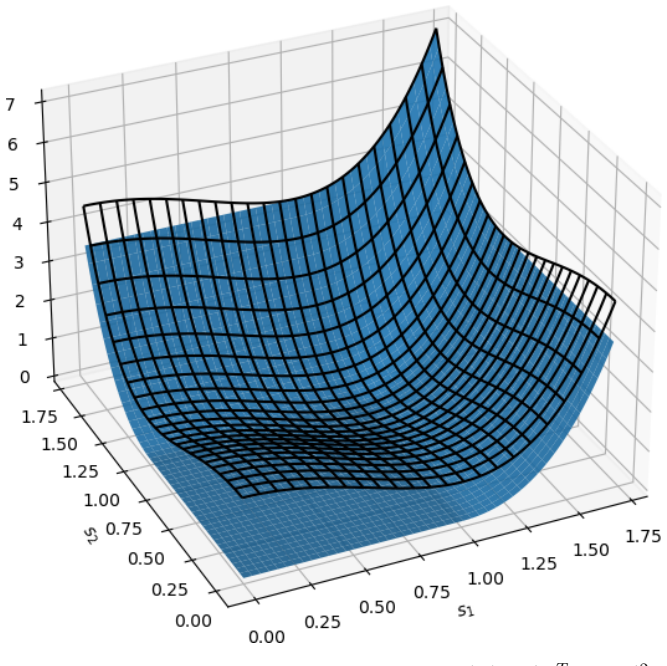
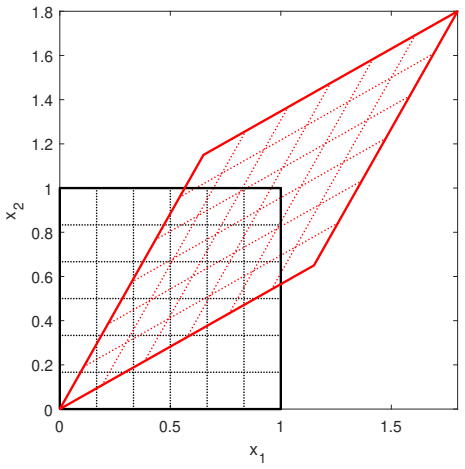
- [Figure 1] Figure 1 caption: the color scale for the computed envelope should be labeled with the same units and range as the analytic Le Dret-Raoult expression plotted in the same panel.
Simulated Author's Rebuttal
We thank the referee for the positive assessment of our manuscript, including the summary of our main results on the absence of a relaxation gap for frame-indifferent energies convex in the Cauchy-Green tensor, the convergence of the Lasserre hierarchy, and the exactness of the first-order relaxation under affine boundary conditions and SOS-convexity. We are pleased with the recommendation for minor revision.
Circularity Check
No significant circularity; derivation relies on external standard results
full rationale
The paper's central claim of no relaxation gap between the non-convex variational problem and the occupation-measure LP is obtained by invoking the known Le Dret-Raoult semidefinite projection formula for the quasiconvex envelope (explicitly called 'standard' in the abstract) together with standard facts from occupation-measure theory and the Lasserre hierarchy. These are external, independently established results not derived inside the paper. The exactness statement at the first relaxation order under affine boundary data and SOS-convexity in C follows directly from the algebraic moment constraints C = F^T F and the convexity assumption; it does not reduce any claimed value to a fitted parameter or self-referential definition. No self-citation is load-bearing for the envelope or convergence statements, and no ansatz or renaming of a known empirical pattern occurs. The derivation chain is therefore self-contained against external benchmarks.
Axiom & Free-Parameter Ledger
axioms (2)
- domain assumption Energy function is frame indifferent and convex with respect to the Cauchy-Green strain tensor
- standard math Le Dret-Raoult semidefinite projection formula computes the quasiconvex envelope
Reference graph
Works this paper leans on
-
[1]
A. A. Ahmadi, P. A. Parrilo, A convex polynomial that is not SOS-convex. Math. Prog. 135(1–2):275–292, 2012
work page 2012
- [2]
-
[3]
A. Ben-Tal, A. Nemirovski. Lectures on modern convex optimization. SIAM, 2001
work page 2001
-
[4]
P. G. Ciarlet. Mathematical elasticity, Volume I: Three-dimensional elasticity. North-Holland, 1988
work page 1988
- [5]
- [6]
-
[7]
G. Fantuzzi, F. Fuentes, Global minimization of polynomial integral functionals. SIAM J. Sci. Comp. 46(4), 2024
work page 2024
-
[8]
G. Fantuzzi, I. Tobasco. Sharpness and non-sharpness of occupation measure bounds for integral variational problems. arXiv:2207.13570, 2022
-
[9]
J. W. Helton, J. Nie. Semidefinite representation of convex sets. Math. Prog. 122(1):21–64, 2010
work page 2010
-
[10]
D. Henrion, M. Korda, J. B. Lasserre. The moment-SOS hierarchy. World Scientific, 2020
work page 2020
-
[11]
D. Henrion, M. Korda, M. Kruˇ z´ ık, R. R´ ıos-Zertuche. Occupation measure relaxations in variational problems: the role of convexity. SIAM J. Optim. 34(2):1708-1731, 2024
work page 2024
-
[12]
D. Henrion, J. B. Lasserre, J. L¨ ofberg. GloptiPoly 3: moments, optimization and semidefinite programming. Optimization Methods and Software 24(4):761–779, 2009
work page 2009
-
[13]
The gap between a variational problem and its occupation measure relaxation
M. Korda and R. R´ ıos-Zertuche. The gap between a variational problem and its occupation measure relaxation. Accepted in ESAIM: Control, Optimisation and Calculus of Variations, arXiv:2205.14132
work page internal anchor Pith review Pith/arXiv arXiv
-
[14]
D. Henrion, J. B. Lasserre, M. Mevissen. Mean squared error minimization for inverse moment problems. Applied Mathematics and Optimization 70(1):83–110, 2014
work page 2014
-
[15]
M. Hor´ ak, M. Kruˇ z´ ık. Gradient polyconvex material models and their numerical treatment. Int. J. Solids and Structures 195:57–65, 2020
work page 2020
- [16]
-
[17]
M. Kruˇ z´ ık, T. Roub´ ıˇ cek. Mathematical methods in continuum mechanics of solids. Springer, 2019. 21
work page 2019
-
[18]
J. B. Lasserre. Global optimization with polynomials and the problem of moments. SIAM J. Opt. 11(3):796–817, 2001
work page 2001
-
[19]
J. B. Lasserre. Convexity in semialgebraic geometry and polynomial optimization. SIAM J. Optim. 19(4):1995–2014, 2009
work page 1995
-
[20]
H. Le Dret, A. Raoult. Quasiconvex envelopes of stored energy densities that are convex with respect to the strain tensor. In Calculus of Variations, Applications and Computations, 138–146. Pitman Research Notes in Mathematics, 1995
work page 1995
-
[21]
H. Le Dret, A. Raoult. The quasiconvex envelope of the Saint Venant-Kirchhoff stored energy function. Proc. Roy. Soc. Edinburgh A 125:1179–1192, 1995
work page 1995
-
[22]
The MOSEK Optimization Toolbox for Matlab
MOSEK ApS. The MOSEK Optimization Toolbox for Matlab. Version 11.1, 2025
work page 2025
-
[23]
J. Nie. Moment and polynomial optimization. SIAM, 2023
work page 2023
- [24]
-
[25]
Roub´ ıˇ cek, Relaxation in optimization theory and variational calculus
T. Roub´ ıˇ cek, Relaxation in optimization theory and variational calculus. 2nd edition, De Gruyter, 2020
work page 2020
-
[26]
D. Yang Gao, P. Neff, I. Roventa, C. Thiel. On the convexity of nonlinear elastic energies in the right Cauchy-Green tensor. J. Elast. 127:303–308, 2017. 22
work page 2017
discussion (0)
Sign in with ORCID, Apple, or X to comment. Anyone can read and Pith papers without signing in.