Massive star clusters and clumps in the collisional ring galaxy Arp 147
Pith reviewed 2026-05-10 13:03 UTC · model grok-4.3
The pith
Arp 147's ring-forming collision produced 211 young massive star knots with a truncated mass function and only mild later disruption.
A machine-rendered reading of the paper's core claim, the machinery that carries it, and where it could break.
Core claim
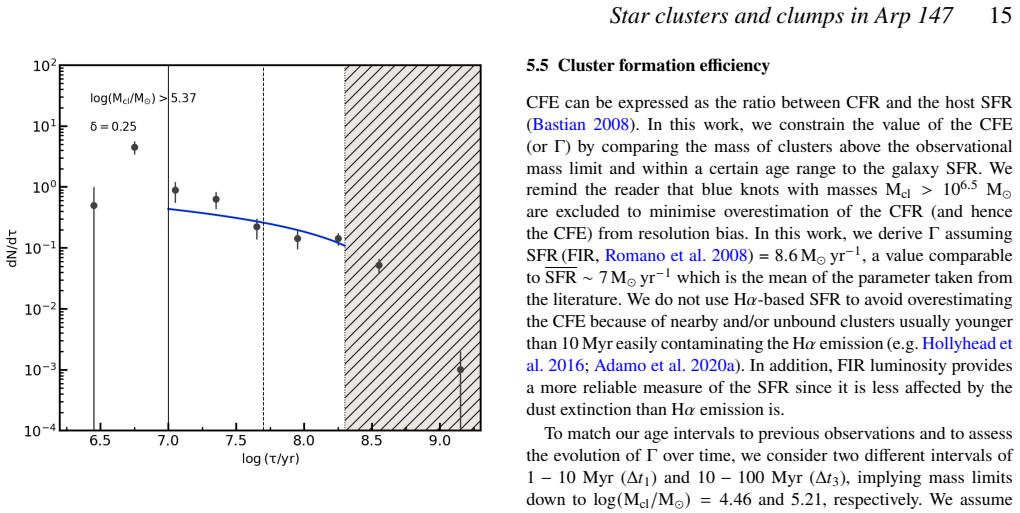
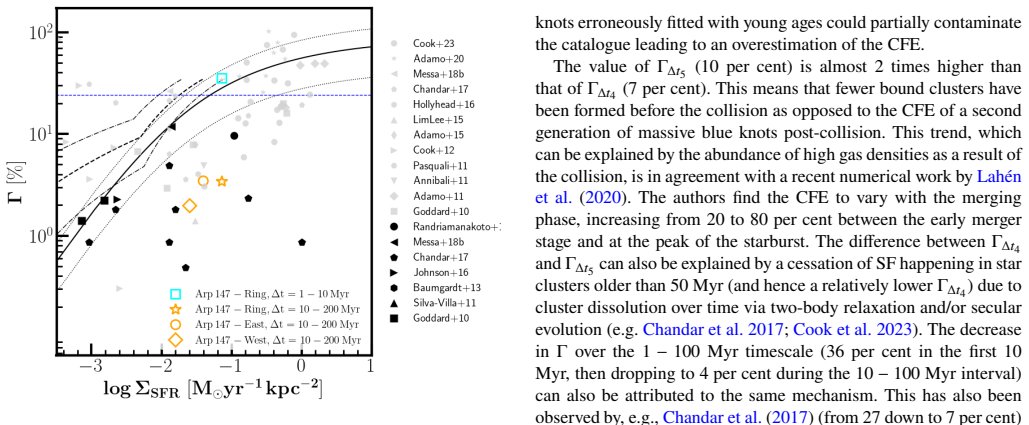
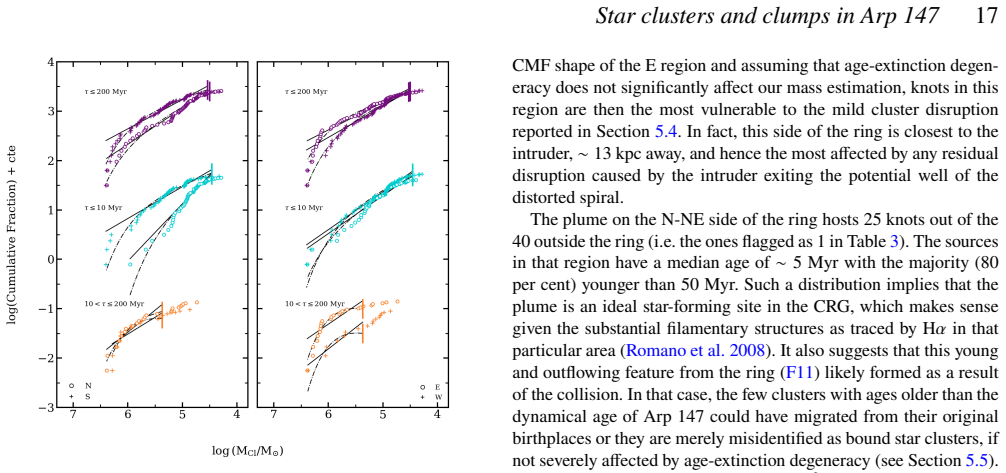
Arp 147 hosts 211 knots and six kpc-size clumps, nearly sixty percent younger than 10 Myr and two thirds above 10^5 solar masses. The cluster mass function for knots aged 10-200 Myr follows a Schechter function truncated at 6.2 times 10^5 solar masses, most clearly in the eastern ring segment. Over that interval the disruption parameter is 0.25 and cluster formation efficiency is 3 percent, while efficiency rises to nearly 40 percent for knots 1-10 Myr old, demonstrating that the drop-through collision created conditions for abundant young cluster formation and only mild subsequent disruption.
What carries the argument
Age and mass estimates derived from three-band HST photometry of the 211 knots, followed by construction of the cluster mass function and cluster age function to measure truncation, disruption rate, and formation efficiency.
If this is right
- Galaxy collisions that produce rings can drive a second generation of young blue clusters in large numbers.
- The cluster mass function in these environments is truncated rather than extending indefinitely as a power law.
- Disruption proceeds slowly enough that many clusters formed in the ring survive for hundreds of millions of years.
- Cluster formation efficiency is highest immediately after the collision and drops sharply within the first ten million years.
Where Pith is reading between the lines
- Ring galaxies may provide cleaner laboratories than merging systems for isolating the effects of triggered star formation because the interaction is a single passage rather than a full merger.
- The characteristic truncation mass in the cluster mass function could be set by the maximum density reached in the expanding gaseous ring.
- Repeating the same analysis on other collisional ring galaxies would test whether high young-cluster formation efficiency and low disruption are general outcomes of this type of encounter.
Load-bearing premise
Optical colors alone can separate the ages of dusty young clusters from older clusters with little dust despite the known degeneracy between age and reddening.
What would settle it
Ultraviolet or H-alpha imaging that assigns substantially older ages to many of the currently identified young knots or that yields a disruption rate much higher than 0.25.
Figures




read the original abstract
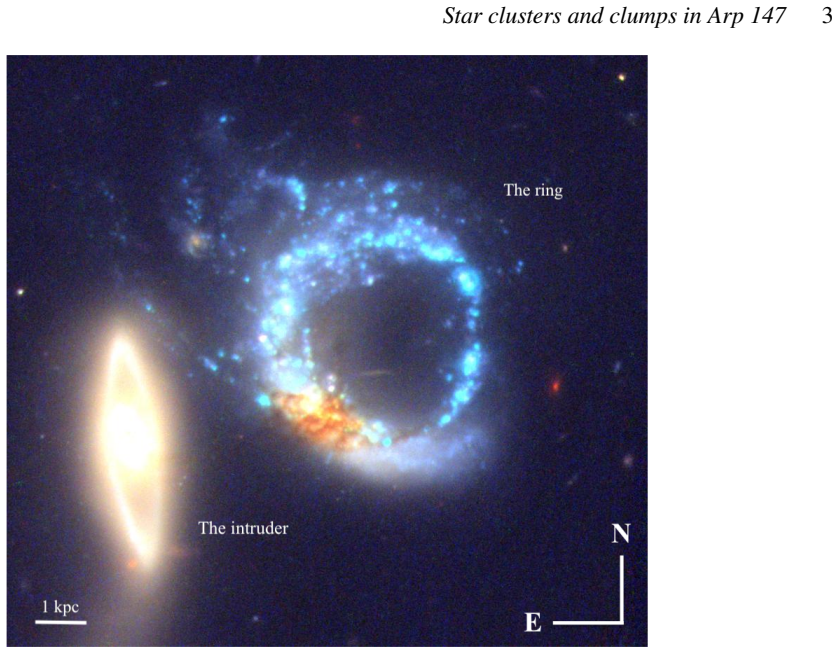
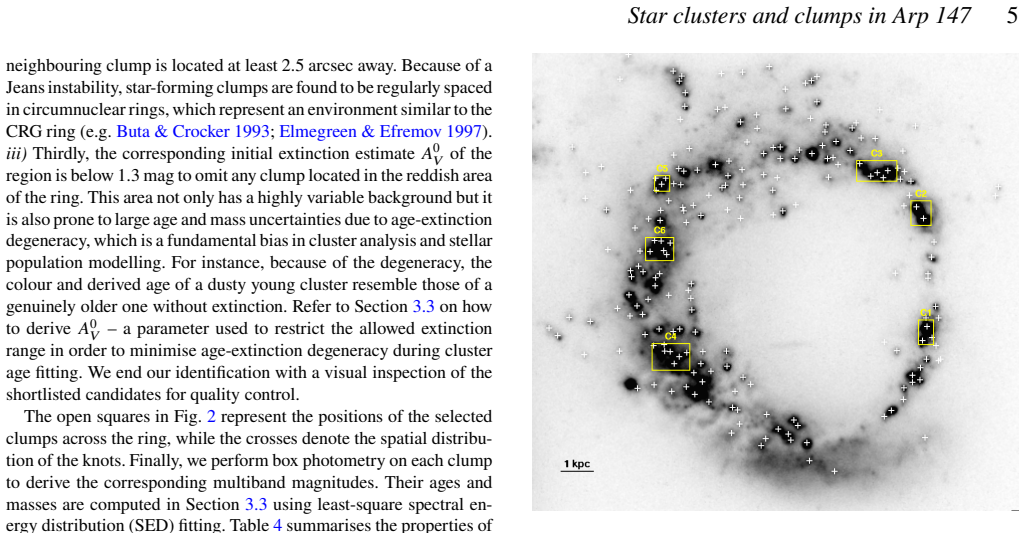
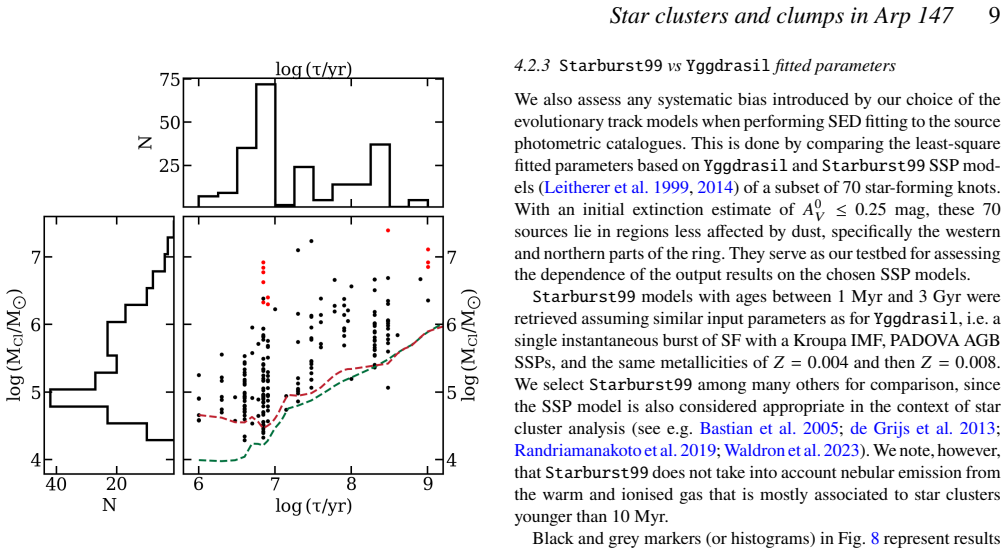
We conduct a photometric study of star clusters (or knots) in the collisional ring galaxy (CRG) Arp 147 to trace the star formation history across its empty ring. Using HST F450W, F606W and F814W images, we find that Arp 147 hosts 211 knots and six kpc-size clumps, nearly 60 per cent of which have ages below 10 Myr, and two thirds have masses above $\rm 10^{5}\,M_{\odot}$. The cluster mass function (CMF) of knots with ages between $10 - 200$ Myr deviates from a power-law and follows a Schechter function with a characteristic truncation mass of ${\rm M}_{c} = 6.2 \times 10^{5} \, {\rm M}_{\odot}$. This shape of the CMF is more prominent for a subsample of knots in the eastern region of the ring. Over the same age interval, we derive a low rate of disruption ($\delta \sim 0.25$) from the cluster age function and a cluster formation efficiency (CFE) of $\sim$ 3 per cent. In contrast, the CFE in the $1 - 10$ Myr age range is nearly 40 per cent. We note the lack of high-resolution UV and H$\alpha$ observations to help break age-extinction degeneracy which affects the derived ages for dusty young clusters and old ones with low reddening. Nevertheless, this study has shown, at least to a first-order approximation, that collision-triggered starburst events happening across the CRG offer an ideal environment for a second generation of young blue knots to form in abundance. It also suggests that the drop-through collision between the two galaxies can fuel at least mild cluster disruption over time.
Editorial analysis
A structured set of objections, weighed in public.
Referee Report
Summary. The paper performs a photometric study of 211 star clusters/knots and six kpc-scale clumps in the collisional ring galaxy Arp 147 using HST F450W/F606W/F814W imaging. It reports that ~60% of knots are younger than 10 Myr with two-thirds above 10^5 M⊙, derives a Schechter CMF with truncation mass Mc = 6.2 × 10^5 M⊙ for the 10–200 Myr subsample (more prominent in the eastern ring), a disruption parameter δ ≈ 0.25 from the age function, and CFE values of ~3% (10–200 Myr) versus ~40% (1–10 Myr). The work concludes that the collision-driven starburst provides an environment for abundant young cluster formation and at least mild disruption, while noting the age-extinction degeneracy limitation from the available photometry.
Significance. If the photometric ages and masses prove robust, the results add a useful case study of cluster populations in a collisional ring galaxy, quantifying how interactions can drive elevated young-cluster formation efficiency and a Schechter-shaped CMF. The contrast in CFE between age bins and the low disruption rate provide testable numbers for models of cluster evolution in starburst environments triggered by galaxy collisions.
major comments (3)
- [Abstract and age/mass derivation sections] Abstract and results on age-binned statistics: The headline numbers (~60% of knots <10 Myr, Mc = 6.2 × 10^5 M⊙, δ ~ 0.25, CFE ~3% vs ~40%) are derived from ages and masses obtained solely from three-band optical photometry. The abstract itself flags the age-extinction degeneracy for dusty young clusters versus old low-reddening ones, yet no quantitative propagation of this uncertainty into the reported fractions, CMF shape, or derived parameters is provided. This directly affects the reliability of all age-binned conclusions.
- [CMF fitting and age function sections] CMF and disruption analysis: The claim that the 10–200 Myr CMF follows a Schechter function with a specific truncation mass, and the derivation of δ ~ 0.25 from the age function, rest on the accuracy of the age assignments and the selection of that subsample. Without error bars on Mc, details of the fitting procedure, or tests of how misclassified ages would alter the functional form, it is unclear whether the deviation from a power law is robust.
- [CFE derivation] CFE calculation: The reported factor-of-ten difference in cluster formation efficiency between the 1–10 Myr and 10–200 Myr intervals depends on the same age estimates. A systematic shift of even a modest fraction of objects across the 10 Myr boundary due to the degeneracy would change the CFE contrast and the interpretation of collision-triggered formation.
minor comments (2)
- [Data and sample selection] The manuscript would benefit from explicit statements of the selection criteria used to identify the 211 knots and the six clumps, including any magnitude or color cuts applied to the HST catalog.
- [Figures and tables] Figure captions and text should clarify whether the reported masses and ages include formal uncertainties or only best-fit values from the SED fitting.
Simulated Author's Rebuttal
We thank the referee for the constructive comments on our manuscript. We appreciate the positive assessment of the significance of our work on star clusters in the collisional ring galaxy Arp 147. We address each major comment below, providing clarifications and outlining revisions to strengthen the analysis of uncertainties.
read point-by-point responses
-
Referee: [Abstract and age/mass derivation sections] Abstract and results on age-binned statistics: The headline numbers (~60% of knots <10 Myr, Mc = 6.2 × 10^5 M⊙, δ ~ 0.25, CFE ~3% vs ~40%) are derived from ages and masses obtained solely from three-band optical photometry. The abstract itself flags the age-extinction degeneracy for dusty young clusters versus old low-reddening ones, yet no quantitative propagation of this uncertainty into the reported fractions, CMF shape, or derived parameters is provided. This directly affects the reliability of all age-binned conclusions.
Authors: We agree that a quantitative propagation of the age-extinction degeneracy uncertainties is important for assessing the robustness of our results. Although the manuscript notes this limitation, we will revise the text to include a dedicated analysis of the uncertainties. Using the photometric errors from the three-band data, we will implement Monte Carlo simulations to resample the SED fits and derive distributions for ages and masses. From these, we will compute the impact on the young cluster fraction, the CMF parameters including Mc with uncertainties, the disruption parameter δ, and the CFE values in both age bins. This will be added to the methods and results sections. revision: yes
-
Referee: [CMF fitting and age function sections] CMF and disruption analysis: The claim that the 10–200 Myr CMF follows a Schechter function with a specific truncation mass, and the derivation of δ ~ 0.25 from the age function, rest on the accuracy of the age assignments and the selection of that subsample. Without error bars on Mc, details of the fitting procedure, or tests of how misclassified ages would alter the functional form, it is unclear whether the deviation from a power law is robust.
Authors: We acknowledge the need for more details on the fitting and robustness checks. In the revised manuscript, we will expand the CMF section to describe the fitting procedure in full, including the likelihood maximization method used to fit the Schechter function and how the truncation mass Mc was obtained. We will report uncertainties on Mc derived from the fit covariance or bootstrap resampling. Additionally, we will perform tests by randomly shifting ages within estimated uncertainties (accounting for degeneracy) and re-fitting the CMF to evaluate whether the Schechter form remains preferred over a power law. Similar robustness tests will be applied to the age function analysis for δ. revision: yes
-
Referee: [CFE derivation] CFE calculation: The reported factor-of-ten difference in cluster formation efficiency between the 1–10 Myr and 10–200 Myr intervals depends on the same age estimates. A systematic shift of even a modest fraction of objects across the 10 Myr boundary due to the degeneracy would change the CFE contrast and the interpretation of collision-triggered formation.
Authors: This point is well taken, as the CFE values are directly tied to the age binning. To address potential misclassifications, the revision will include a sensitivity analysis where we vary the boundary and extinction assumptions to see how the CFE contrast changes. We will report the nominal values along with ranges under different degeneracy scenarios (e.g., assuming young clusters have higher extinction). If the order-of-magnitude difference holds, it bolsters the conclusion regarding collision-triggered formation; we will qualify the interpretation if it does not. This analysis will be incorporated into the CFE section. revision: partial
- The complete resolution of the age-extinction degeneracy would require additional UV and Hα observations, which are not available in the current dataset. While we can perform sensitivity tests, a full quantitative propagation without new data remains limited.
Circularity Check
No circularity; standard observational fits with independent derivations
full rationale
The paper derives cluster ages, masses, CMF shape, disruption rate δ, and CFE directly from HST three-band photometry of 211 knots using established methods (e.g., fitting Schechter function to the 10-200 Myr subsample yielding Mc = 6.2e5 Msun, and extracting δ ~0.25 and CFE values from the age and mass distributions). No equations reduce any reported quantity to its inputs by construction, no fitted parameter is relabeled as a prediction, and no self-citation or ansatz chain is load-bearing. The age-extinction degeneracy is explicitly flagged as a limitation but does not create circularity in the reported steps. The chain remains self-contained against external benchmarks such as standard cluster population synthesis and CMF analysis techniques.
Axiom & Free-Parameter Ledger
free parameters (1)
- Schechter truncation mass Mc =
6.2e5 Msun
axioms (1)
- domain assumption Stellar population synthesis models accurately convert HST F450W/F606W/F814W colors into ages and masses for clusters younger than a few hundred Myr
Reference graph
Works this paper leans on
-
[1]
& Bastian, N.\ 2018, The Birth of Star Clusters, The Lifecycle of Clusters in Galaxies, 424, 91
Adamo, A. & Bastian, N.\ 2018, The Birth of Star Clusters, The Lifecycle of Clusters in Galaxies, 424, 91
work page 2018
-
[2]
Adamo, A., Hollyhead, K., Messa, M., et al.\ 2020a, , 499, 3267
-
[3]
Adamo, A., Kruijssen, J. M. D., Bastian, N., et al.\ 2015, , 452, 246
work page 2015
-
[4]
Adamo, A., \"O stlin, G., & Zackrisson, E.\ 2011, , 417, 3, 1904
work page 2011
-
[5]
Adamo, A., Zeidler, P., Kruijssen, J. M. D., et al.\ 2020b, , 216, 69
-
[6]
C., Fedotov, K., et al.\ 2025, , arXiv:2509.22800
Aromal, P., Gallagher, S. C., Fedotov, K., et al.\ 2025, , arXiv:2509.22800
-
[7]
C., Fedotov, K., et al.\ 2025, , 994, 1, 90
Aromal, P., Gallagher, S. C., Fedotov, K., et al.\ 2025, , 994, 1, 90
work page 2025
- [8]
-
[9]
Alvensleben, U., et al.\ 2004, , 347, 196
Anders, P., Bissantz, N., Fritze-v. Alvensleben, U., et al.\ 2004, , 347, 196
work page 2004
-
[10]
Appleton, P. N. & Marston, A. P.\ 1997, , 113, 201
work page 1997
-
[11]
Appleton, P. N. & Struck-Marcell, C.\ 1987, , 312, 566
work page 1987
-
[12]
Appleton, P. N. & Struck-Marcell, C.\ 1996, , 16, 111
work page 1996
-
[13]
Bastian, N.\ 2008, , 390, 759
work page 2008
-
[14]
Bastian, N., Adamo, A., Gieles, M., et al.\ 2012, , 419, 2606
work page 2012
-
[15]
Bastian, N., Gieles, M., Lamers, H. J. G. L. M., et al.\ 2005, , 431, 905
work page 2005
-
[16]
Beir \ a o, P., Appleton, P. N., Brandl, B. R., et al.\ 2009, , 693, 1650
work page 2009
- [17]
-
[18]
Bigiel, F., Leroy, A., Walter, F., et al.\ 2008, , 136, 2846
work page 2008
-
[19]
Bik, A., Lamers, H. J. G. L. M., Bastian, N., et al.\ 2003, , 397, 473
work page 2003
-
[20]
Bransford, M. A., Appleton, P. N., Marston, A. P., et al.\ 1998, , 116, 2757
work page 1998
-
[21]
Boutloukos, S. G. & Lamers, H. J. G. L. M.\ 2003, , 338, 717
work page 2003
-
[22]
Burkert, A., Brodie, J., & Larsen, S.\ 2005, , 628, 231
work page 2005
- [23]
-
[24]
Calzetti, D., Armus, L., Bohlin, R. C., et al.\ 2000, , 533, 682
work page 2000
-
[25]
C., Sabbi, E., et al.\ 2015, , 149, 51
Calzetti, D., Lee, J. C., Sabbi, E., et al.\ 2015, , 149, 51
work page 2015
-
[26]
Caputo, M., Chandar, R., Mok, A., et al.\ 2024, , 168, 6, 259
work page 2024
- [27]
-
[28]
Chandar, R., Caputo, M., Mok, A., et al.\ 2023, , 949, 116
work page 2023
- [29]
- [30]
-
[31]
Davies, B., Kudritzki, R.-P., Lardo, C., et al.\ 2017, , 847, 2, 112
work page 2017
-
[32]
de Grijs, R., Anders, P., Bastian, N., et al.\ 2003, , 343, 1285
work page 2003
-
[33]
de Grijs, R., Anders, P., Zackrisson, E., et al.\ 2013, , 431, 2917
work page 2013
-
[34]
G., et al.\ 1991, Sky Telesc., 82, 621
de Vaucouleurs, G., de Vaucouleurs, A., Corwin, H. G., et al.\ 1991, Sky Telesc., 82, 621
work page 1991
-
[35]
R., Longhetti, M., Fossati, M., et al.\ 2024, , 688, A89
Ditrani, F. R., Longhetti, M., Fossati, M., et al.\ 2024, , 688, A89
work page 2024
-
[36]
D'Onghia, E., Mapelli, M., & Moore, B.\ 2008, , 389, 1275
work page 2008
-
[37]
Egorov, O. V., Kreckel, K., Sandstrom, K. M., et al.\ 2023, , 944, 2, L16
work page 2023
-
[38]
Elagali, A., Lagos, C. D. P., Wong, O. I., et al.\ 2018, , 481, 2951
work page 2018
- [39]
-
[40]
Elmegreen, B. G. & Efremov, Y. N.\ 1997, , 480, 235
work page 1997
-
[41]
Elmegreen, B. G. & Elmegreen, D. M.\ 2005a, , 627, 632
-
[42]
Elmegreen, D. M. & Elmegreen, B. G.\ 2006, , 651, 676
work page 2006
-
[43]
Elmegreen, D. M., Elmegreen, B. G., Lang, C., et al.\ 1994, , 425, 57
work page 1994
-
[44]
Elmegreen, D. M., Elmegreen, B. G., Rubin, D. S., et al.\ 2005b, , 631, 85
-
[45]
Fabbiano, G.\ 1989, , 27, 87
work page 1989
-
[46]
M., Chandar, R., & Whitmore, B
Fall, S. M., Chandar, R., & Whitmore, B. C.\ 2005, , 631, L133
work page 2005
-
[47]
Fa \'u ndez-Abans, M., da Rocha-Poppe, P. C., Fernandes-Martin, V. A., et al.\ 2013, , 559, A8
work page 2013
-
[48]
Fogarty, L., Thatte, N., Tecza, M., et al.\ 2011, , 417, 835 (F11)
work page 2011
- [49]
- [50]
-
[51]
Gallagher, S. C., Durrell, P. R., Elmegreen, D. M., et al.\ 2010, , 139, 545
work page 2010
- [52]
-
[53]
Z., Davies, B., Bastian, N., et al.\ 2014, , 787, 2, 142
Gazak, J. Z., Davies, B., Bastian, N., et al.\ 2014, , 787, 2, 142
work page 2014
-
[54]
Georgakakis, A., Georgantopoulos, I., Vallb \'e , M., et al.\ 2004, , 349, 1, 135
work page 2004
- [55]
- [56]
-
[57]
S., Bastian, N., et al.\ 2006, , 450, 129
Gieles, M., Larsen, S. S., Bastian, N., et al.\ 2006, , 450, 129
work page 2006
-
[58]
Ghosh, K. K. & Mapelli, M.\ 2008, , 386, L38
work page 2008
-
[59]
E., Bastian, N., & Kennicutt, R
Goddard, Q. E., Bastian, N., & Kennicutt, R. C.\ 2010, , 405, 857
work page 2010
-
[60]
G \'o mez-Gonz \'a lez, V. M. A., Mayya, Y. D., Zaragoza-Cardiel, J., et al.\ 2024, , 529, 4, 4369
work page 2024
- [61]
- [62]
- [63]
-
[64]
Hollyhead, K., Adamo, A., Bastian, N., et al.\ 2016, , 460, 2087
work page 2016
-
[65]
Inoue, S., Yoshida, N., & Hernquist, L.\ 2021, , 507, 6140
work page 2021
- [66]
-
[67]
Kaaret, P., Alonso-Herrero, A., Gallagher, J. S., et al.\ 2004, , 348, L28
work page 2004
- [68]
- [69]
-
[70]
Kruijssen, J. M. D.\ 2012, , 426, 3008
work page 2012
-
[71]
Lada, C. J. & Lada, E. A.\ 2003, , 41, 57
work page 2003
-
[72]
Lah \'e n, N., Naab, T., Johansson, P. H., et al.\ 2020, , 891, 2
work page 2020
- [73]
-
[74]
Larsen, S. S. & Richtler, T.\ 2000, , 354, 836
work page 2000
-
[75]
J., Remijan, A., Charmandaris, V., et al.\ 2004, , 612, 679
Lavery, R. J., Remijan, A., Charmandaris, V., et al.\ 2004, , 612, 679
work page 2004
-
[76]
Leitherer, C., Ekstr \"o m, S., Meynet, G., et al.\ 2014, , 212, 14
work page 2014
-
[77]
Leitherer, C., Schaerer, D., Goldader, J. D., et al.\ 1999, , 123, 3
work page 1999
-
[78]
Li, S., de Grijs, R., Anders, P., et al.\ 2015, , 216, 1, 6
work page 2015
- [79]
- [80]
discussion (0)
Sign in with ORCID, Apple, or X to comment. Anyone can read and Pith papers without signing in.