Recognition: unknown
Towards Autonomous Driving with Short-Packet Rate Splitting: Age of Information Analysis and Optimization
Pith reviewed 2026-05-10 12:28 UTC · model grok-4.3
The pith
Rate splitting with short packets lowers average age of information in vehicle networks by managing interference through common and private streams.
A machine-rendered reading of the paper's core claim, the machinery that carries it, and where it could break.
Core claim
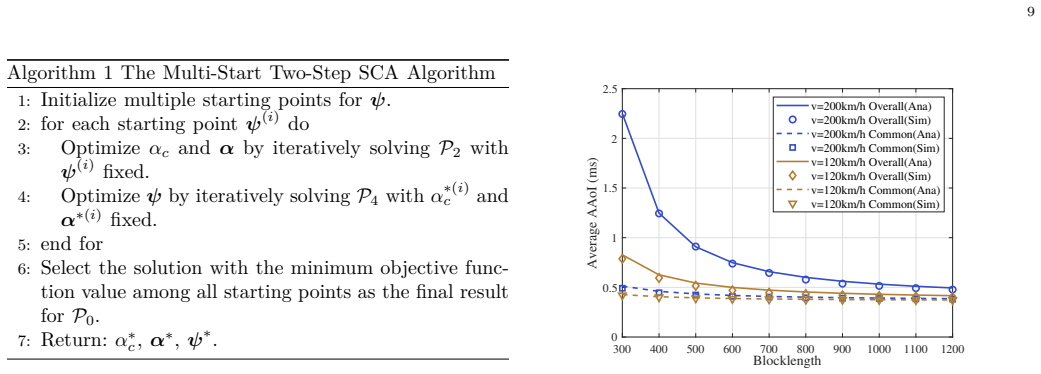
By splitting the unicast messages into common and private parts, encoding all common parts together with the multicast message into a common stream, and encoding each private part into a private stream, RSMA effectively manages interference and enables achieving lower AoI. Closed-form expressions for the average AoI of the common stream under partial decoding and the overall AAoI under complete decoding are derived, with a multi-start two-step successive convex approximation algorithm optimizing power and rates under QoS trade-off constraints.
What carries the argument
The rate-splitting scheme that encodes common unicast parts plus multicast data into one common stream and each private unicast part into its own stream, enabling interference control and separate decoding levels that directly affect packet error rates and transmission delays in short blocks.
If this is right
- The common stream reaches ultra-low average AoI independently of the private streams.
- Power allocation followed by rate splitting can be jointly optimized via the multi-start two-step SCA algorithm while satisfying QoS trade-offs.
- Overall system average AoI improves while preserving fairness across users.
- A performance trade-off appears between the common stream and the aggregate system, allowing further overall gains without losing common-stream benefits.
Where Pith is reading between the lines
- The same splitting structure could guide blocklength selection in other high-mobility URLLC settings where freshness and reliability must be balanced.
- If the closed forms remain accurate under time-varying velocities, they could serve as a quick design tool for choosing power splits without repeated Monte-Carlo runs.
- Extending the model to include hardware impairments or imperfect channel state information would test whether the reported AoI reductions survive real-vehicle conditions.
Load-bearing premise
The closed-form average AoI expressions rest on finite-blocklength error-rate approximations and standard fading models holding accurately for the vehicle velocities and blocklengths considered.
What would settle it
Field or simulation measurements of average age of information that deviate substantially from the derived closed-form values at identical transmit power, blocklength, velocity, and antenna count would falsify the expressions.
Figures




read the original abstract
To address the high mobility impacts and the ultra-reliable and low-latency communication (URLLC) requirements in autonomous driving scenarios, rate-splitting multiple access (RSMA) combined with short-packet communication (SPC) emerges as a promising solution.Autonomous vehicles rely on real-time information exchange to ensure safety and coordination, making information freshness essential.By jointly capturing transmission delays and packet errors, age of information (AoI) serves as a comprehensive metric for freshness.In this paper, we investigate short-packet rate splitting to enhance information freshness measured by the AoI.By splitting the unicast messages into common and private parts, encoding all common parts together with the multicast message into a common stream, and encoding each private part into a private stream, RSMA effectively manages interference and enables achieving lower AoI.By considering critical factors such as transmit power, vehicle velocity, blocklength, and the number of transmit antennas, we derive closed-form expressions for the average AoI (AAoI) of the common stream under partial decoding and the overall AAoI under complete decoding.To enhance the AAoI performance, we propose the multi-start two-step successive convex approximation (SCA) algorithm.This algorithm first optimizes the power allocation and subsequently optimizes the rate splitting under the quality of service (QoS) trade-off constraint.Simulation results demonstrate that our short-packet rate-splitting scheme significantly improves the AAoI performance while ensuring system fairness and enabling ultra-low AAoI through the common stream, meeting the requirements of autonomous driving applications.Moreover, the trade-off between the common and overall performance is revealed, indicating that the overall performance can be further enhanced while maintaining the advantages of the common stream.
Editorial analysis
A structured set of objections, weighed in public.
Referee Report
Summary. The paper proposes a short-packet rate-splitting multiple access (RSMA) scheme for autonomous driving scenarios to reduce Age of Information (AoI) under URLLC constraints. Unicasts are split into common and private parts, with common parts plus the multicast encoded into a common stream and privates into private streams. Closed-form expressions are derived for the average AoI (AAoI) of the common stream under partial decoding and the overall AAoI under complete decoding. A multi-start two-step successive convex approximation (SCA) algorithm is proposed to jointly optimize power allocation and rate splitting subject to QoS trade-off constraints. Simulations claim significant AAoI gains while preserving fairness.
Significance. If the closed-form AAoI derivations hold, the work supplies analytical expressions and an optimization procedure for managing interference and achieving ultra-low AoI in high-mobility settings, which is directly relevant to autonomous-vehicle coordination. The explicit treatment of the common-stream versus overall-performance trade-off and the incorporation of vehicle velocity, blocklength, and antenna count as parameters are practical strengths.
major comments (2)
- [AAoI derivations] The section deriving the AAoI expressions: the closed-form AAoI for the common stream (partial decoding) and overall system (complete decoding) is obtained by substituting the normal approximation for short-packet error probability (involving channel dispersion V and the Q-function) into the standard AoI renewal process. This step assumes that the post-decoding SINRs remain constant over each block and that fading realizations are independent across blocks. When vehicle velocity renders coherence time comparable to the blocklength, the approximation error becomes first-order and the claimed closed forms lose accuracy; the manuscript provides no verification of the approximation error in the target mobility and blocklength regime.
- [Optimization algorithm] The optimization section: the multi-start two-step SCA algorithm first optimizes power allocation factors and then rate splitting under the QoS trade-off constraint. The paper does not report convergence rates, the number of random starts required for reliable global behavior, or the sensitivity of the final AAoI to initialization, all of which are load-bearing for the claim that the algorithm reliably achieves the reported performance gains.
minor comments (2)
- [Abstract and conclusion] The abstract states that 'the trade-off between the common and overall performance is revealed' but does not specify whether this trade-off is expressed as a Pareto front, a weighted sum, or a constraint; the same phrasing appears in the conclusion without a precise mathematical statement.
- [Numerical results] Simulation figures should include error bars or confidence intervals on the AAoI curves and explicitly list the exact parameter values (vehicle speeds, blocklengths, antenna counts, and baseline schemes) used to generate each plot.
Simulated Author's Rebuttal
We thank the referee for the constructive and detailed comments, which have identified valuable opportunities to improve the rigor and clarity of our manuscript. We address each major comment point by point below, providing honest responses and indicating the revisions we will make.
read point-by-point responses
-
Referee: [AAoI derivations] The section deriving the AAoI expressions: the closed-form AAoI for the common stream (partial decoding) and overall system (complete decoding) is obtained by substituting the normal approximation for short-packet error probability (involving channel dispersion V and the Q-function) into the standard AoI renewal process. This step assumes that the post-decoding SINRs remain constant over each block and that fading realizations are independent across blocks. When vehicle velocity renders coherence time comparable to the blocklength, the approximation error becomes first-order and the claimed closed forms lose accuracy; the manuscript provides no verification of the approximation error in the target mobility and blocklength regime.
Authors: We appreciate the referee's careful scrutiny of the modeling assumptions underlying our closed-form AAoI derivations. Our analysis employs the standard block-fading model, which is prevalent in short-packet URLLC literature and assumes constant post-decoding SINR within each block with independent realizations across blocks. This is appropriate when blocklength is shorter than coherence time. We acknowledge that the manuscript does not explicitly verify the approximation error for the specific mobility and blocklength regimes considered. In the revised version, we will add a discussion quantifying coherence time via Jakes' model for the vehicle velocities in our simulations and compare it to the blocklengths used. We will also include Monte Carlo validation results comparing analytical AAoI to empirical values across mobility levels to bound the error, thereby clarifying the regime where the closed forms remain accurate. revision: partial
-
Referee: [Optimization algorithm] The optimization section: the multi-start two-step SCA algorithm first optimizes power allocation factors and then rate splitting under the QoS trade-off constraint. The paper does not report convergence rates, the number of random starts required for reliable global behavior, or the sensitivity of the final AAoI to initialization, all of which are load-bearing for the claim that the algorithm reliably achieves the reported performance gains.
Authors: We agree that additional empirical details on the multi-start two-step SCA algorithm are needed to substantiate its reliability. In the revised manuscript, we will expand the optimization section (and add an appendix if necessary) to report convergence behavior, including typical iteration counts required for convergence (observed to be under 30 iterations in our experiments). We will specify the use of 20 random initializations and include statistics on the resulting AAoI values (mean and variance) to demonstrate consistent achievement of the reported gains. We will further add sensitivity analysis plots or tables showing AAoI variation across different initializations, confirming low sensitivity and reliable global performance. revision: yes
Circularity Check
No circularity: AAoI closed forms and optimization rest on independent standard formulas.
full rationale
The paper derives closed-form AAoI expressions by substituting standard finite-blocklength normal approximations (involving channel dispersion and Q-function) and Rayleigh fading statistics into the conventional AoI renewal-process formula for average age under geometric retransmissions. These building blocks are external to the paper and do not reference its own results or fitted parameters. The subsequent multi-start SCA optimization operates on explicitly stated power-allocation and rate-splitting constraints with QoS trade-offs; no step reduces a claimed prediction back to a fitted input or self-citation by construction. Self-citations, if present, are not load-bearing for the central claims.
Axiom & Free-Parameter Ledger
free parameters (2)
- power allocation factors
- blocklength
axioms (2)
- domain assumption Finite-blocklength rate approximations hold for the considered packet sizes and error probabilities
- domain assumption Channel state information is available at transmitters for rate and power allocation
Reference graph
Works this paper leans on
-
[1]
Milestones in autonomous driving and intelligent vehicles—Part I: Control, computing system design, communication, HD map, testing, and human behaviors,
L. Chen, Y. Li, C. Huang, Y. Xing, D. Tian, L. Li, Z. Hu, S. Teng, C. Lv, J. Wang et al., “Milestones in autonomous driving and intelligent vehicles—Part I: Control, computing system design, communication, HD map, testing, and human behaviors,” IEEE Trans. Syst., Man, Cybern., Syst., vol. 53, no. 9, pp. 5831–5847, 2023
2023
-
[2]
6G for vehicle-to-everything (V2X) communications: Enabling tech- nologies, challenges, and opportunities,
M. Noor-A-Rahim, Z. Liu, H. Lee, M. O. Khyam, J. He, D. Pesch, K. Moessner, W. Saad, and H. V. Poor, “6G for vehicle-to-everything (V2X) communications: Enabling tech- nologies, challenges, and opportunities,” Proc. IEEE, vol. 110, no. 6, pp. 712–734, 2022
2022
-
[3]
Enhancement of 3GPP support for V2X scenarios,
3GPP, “Enhancement of 3GPP support for V2X scenarios,” 3GPP TS 22.186 V19.0.0, Oct. 2025
2025
-
[4]
Age of information in SWIPT-enabled wireless communication system for 5GB,
T. D. P. Perera, D. N. K. Jayakody, I. Pitas, and S. Garg, “Age of information in SWIPT-enabled wireless communication system for 5GB,” IEEE Wireless Commun., vol. 27, no. 5, pp. 162–167, 2020
2020
-
[5]
Real-time status: How often should one update?
S. Kaul, R. Yates, and M. Gruteser, “Real-time status: How often should one update?” in Proc. IEEE INFOCOM, Mar. 2012, pp. 2731–2735
2012
-
[6]
Age of information for the cellular Internet of Things: Challenges, key techniques, and future trends,
B. Yu, X. Chen, and Y. Cai, “Age of information for the cellular Internet of Things: Challenges, key techniques, and future trends,” IEEE Commun. Mag., vol. 60, no. 12, pp. 20–26, 2022. 14
2022
-
[7]
Adaptive packet length adjustment for minimizing age of information over fading channels,
B. Yu, Y. Cai, X. Diao, and K. Cheng, “Adaptive packet length adjustment for minimizing age of information over fading channels,” IEEE Trans. Wireless Commun., vol. 22, no. 10, pp. 6641–6653, 2023
2023
-
[8]
Efficient decoders for short block length codes in 6G URLLC,
C. Yue, V. Miloslavskaya, M. Shirvanimoghaddam, B. Vucetic, and Y. Li, “Efficient decoders for short block length codes in 6G URLLC,” IEEE Commun. Mag., vol. 61, no. 4, pp. 84–90, 2023
2023
-
[9]
Transformer-based channel prediction for rate-splitting multiple access-enabled vehicle-to-everything communication,
S. Zhang, S. Zhang, Y. Mao, L. K. Yeung, B. Clerckx, and T. Q. Quek, “Transformer-based channel prediction for rate-splitting multiple access-enabled vehicle-to-everything communication,” IEEE Trans. Wireless Commun., vol. 23, no. 10, pp. 12 717– 12 730, 2024
2024
-
[10]
A rate-splitting approach to the gaussian multiple-access channel,
B. Rimoldi and R. Urbanke, “A rate-splitting approach to the gaussian multiple-access channel,” IEEE Trans. Inf. Theory, vol. 42, no. 2, pp. 364–375, 1996
1996
-
[11]
Rate-splitting multiple access to mitigate the curse of mobility in (massive) MIMO networks,
O. Dizdar, Y. Mao, and B. Clerckx, “Rate-splitting multiple access to mitigate the curse of mobility in (massive) MIMO networks,” IEEE Trans. Commun., vol. 69, no. 10, pp. 6765– 6780, 2021
2021
-
[12]
Rate-splitting multiple access for downlink communication systems: Bridging, gener- alizing, and outperforming SDMA and NOMA,
Y. Mao, B. Clerckx, and V. O. Li, “Rate-splitting multiple access for downlink communication systems: Bridging, gener- alizing, and outperforming SDMA and NOMA,” EURASIP J. Wireless Commun. Netw., vol. 2018, no. 1, p. 133, 2018
2018
-
[13]
Rate-splitting multiple access: Fundamentals, survey, and future research trends,
Y. Mao, O. Dizdar, B. Clerckx, R. Schober, P. Popovski, and H. V. Poor, “Rate-splitting multiple access: Fundamentals, survey, and future research trends,” IEEE Commun. Surv. Tutor., vol. 24, no. 4, pp. 2073–2126, 2022
2073
-
[14]
Beyond dirty paper coding for multi- antenna broadcast channel with partial CSIT: A rate-splitting approach,
Y. Mao and B. Clerckx, “Beyond dirty paper coding for multi- antenna broadcast channel with partial CSIT: A rate-splitting approach,” IEEE Trans. Commun., vol. 68, no. 11, pp. 6775– 6791, 2020
2020
-
[15]
Rate-splitting multiple access with finite blocklength for short-packet and low- latency downlink communications,
Y. Xu, Y. Mao, O. Dizdar, and B. Clerckx, “Rate-splitting multiple access with finite blocklength for short-packet and low- latency downlink communications,” IEEE Trans. Veh. Technol., vol. 71, no. 11, pp. 12 333–12 337, 2022
2022
-
[16]
Rate-splitting multiple access with finite blocklength and high mobility for URLLC transmissions,
J. Zhu, Y. Chen, X. Pei, T. Pei, X. Li, and T. A. Tsiftsis, “Rate-splitting multiple access with finite blocklength and high mobility for URLLC transmissions,” IEEE Wireless Commun. Lett., vol. 13, no. 5, pp. 1518–1522, 2024
2024
-
[17]
Autonomous driving with RSMA-enabled finite blocklength transmissions: Ergodic performance analysis and optimization,
Y. Wang, Y. Chen, L. Wang, D. Cai, X. Li, and P. Fan, “Autonomous driving with RSMA-enabled finite blocklength transmissions: Ergodic performance analysis and optimization,” IEEE Trans. Wireless Commun., vol. 25, pp. 2954–2969, 2026
2026
-
[18]
Resource allocation in MU- MISO rate-splitting multiple access with SIC errors for URLLC services,
X. Ou, X. Xie, H. Lu, and H. Yang, “Resource allocation in MU- MISO rate-splitting multiple access with SIC errors for URLLC services,” IEEE Trans. Commun., vol. 71, no. 1, pp. 229–243, 2022
2022
-
[19]
Flexible rate-splitting multiple access with finite blocklength,
Y. Wang, V. W. Wong, and J. Wang, “Flexible rate-splitting multiple access with finite blocklength,” IEEE J. Sel. Areas Commun., vol. 41, no. 5, pp. 1398–1412, 2023
2023
-
[20]
Fairness-aware reliability maximization of a novel RSMA framework for URLLC,
S. Seyedmasoumian, Y. Zhu, Y. Hu, and A. Schmeink, “Fairness-aware reliability maximization of a novel RSMA framework for URLLC,” in Proc. IEEE GLOBECOM, 2023, pp. 1517–1522
2023
-
[21]
Max-min fairness for uplink rate-splitting multiple access with finite blocklength,
J. Xu and Y. Mao, “Max-min fairness for uplink rate-splitting multiple access with finite blocklength,” IEEE Trans. Veh. Technol., vol. 74, no. 5, pp. 8437–8441, 2025
2025
-
[22]
Max-min fairness of rate-splitting multiple access with finite blocklength com- munications,
Y. Xu, Y. Mao, O. Dizdar, and B. Clerckx, “Max-min fairness of rate-splitting multiple access with finite blocklength com- munications,” IEEE Trans. Veh. Technol., vol. 72, no. 5, pp. 6816–6821, 2022
2022
-
[23]
Balancing AoI and rate for mission- critical and eMBB coexistence with puncturing, NOMA, and RSMA in cellular uplink,
F. Khodakhah, A. Mahmood, Č. Stefanović, H. Farag, P. Öster- berg, and M. Gidlund, “Balancing AoI and rate for mission- critical and eMBB coexistence with puncturing, NOMA, and RSMA in cellular uplink,” IEEE Trans. Veh. Technol., vol. 74, no. 1, pp. 1475–1488, 2024
2024
-
[24]
RSMA- aided iterative max-age scheduling for multi-source systems,
E. J. dos Santos, R. D. Souza, and J. L. Rebelatto, “RSMA- aided iterative max-age scheduling for multi-source systems,” in Proc. Int. Symp. Wireless Commun. Syst. (ISWCS), 2024, pp. 1–6
2024
-
[25]
Rate-splitting multiple access for semantic-aware networks: An age of incorrect information per- spective,
O. Dizdar and S. Wang, “Rate-splitting multiple access for semantic-aware networks: An age of incorrect information per- spective,” IEEE Wireless Commun. Lett., vol. 13, no. 4, pp. 1168–1172, 2024
2024
-
[26]
A joint framework of HARQ and RSMA for AoI minimization,
S. R. Ali, S. Abidrabbu, H. Furqan, and H. Arslan, “A joint framework of HARQ and RSMA for AoI minimization,” IEEE Internet Things J., vol. 12, no. 18, pp. 37 500–37 511, 2025
2025
-
[27]
Age of information minimization for short-packet communications RSMA in satellite-based IoT,
Q. Yan, J. Jiao, Y. Wang, L. An, R. Lu, and Q. Zhang, “Age of information minimization for short-packet communications RSMA in satellite-based IoT,” in Proc. IEEE VTC-Fall, 2023, pp. 1–5
2023
-
[28]
Age of incorrect information minimization for timely status updates in satellite-based IoT,
Q. Yan, J. Jiao, T. Yang, L. An, Y. Wang, and Q. Zhang, “Age of incorrect information minimization for timely status updates in satellite-based IoT,” in Proc. IEEE/CIC ICCC, 2024, pp. 433–438
2024
-
[29]
Efficient rate-splitting multiple access for the Internet of Vehicles: Fed- erated edge learning and latency minimization,
S. Zhang, S. Zhang, W. Yuan, Y. Li, and L. Hanzo, “Efficient rate-splitting multiple access for the Internet of Vehicles: Fed- erated edge learning and latency minimization,” IEEE J. Sel. Areas Commun., vol. 41, no. 5, pp. 1468–1483, 2023
2023
-
[30]
Optimizing re- source allocation with high-reliability constraint for multicasting automotive messages in 5G NR C-V2X networks,
K.-L. Chen, W.-Y. Chen, and R.-H. Hwang, “Optimizing re- source allocation with high-reliability constraint for multicasting automotive messages in 5G NR C-V2X networks,” IEEE Trans. Veh. Technol., vol. 72, no. 4, pp. 4792–4804, 2022
2022
-
[31]
IRS-assisted joint broadcast/multicast resource allocation and cooperative perception optimization for 6G V2X networks,
F. Qi, Q. Huang, Y. Wang, P. Lin, C. Hu, and X. Shi, “IRS-assisted joint broadcast/multicast resource allocation and cooperative perception optimization for 6G V2X networks,” IEEE Trans. Broadcast., vol. 72, no. 1, pp. 106–116, 2026
2026
-
[32]
Model-assisted learning for adaptive cooperative perception of connected au- tonomous vehicles,
K. Qu, W. Zhuang, Q. Ye, W. Wu, and X. Shen, “Model-assisted learning for adaptive cooperative perception of connected au- tonomous vehicles,” IEEE Trans. Wireless Commun., vol. 23, no. 8, pp. 8820–8835, 2024
2024
-
[33]
Rate-splitting for multi- antenna non-orthogonal unicast and multicast transmission: Spectral and energy efficiency analysis,
Y. Mao, B. Clerckx, and V. O. Li, “Rate-splitting for multi- antenna non-orthogonal unicast and multicast transmission: Spectral and energy efficiency analysis,” IEEE Trans. Commun., vol. 67, no. 12, pp. 8754–8770, 2019
2019
-
[34]
MIMO systems with limited rate differential feedback in slowly varying channels,
T. Kim, D. J. Love, and B. Clerckx, “MIMO systems with limited rate differential feedback in slowly varying channels,” IEEE Trans. Commun., vol. 59, no. 4, pp. 1175–1189, 2011
2011
-
[35]
J. G. Proakis and M. Salehi, Digital communications, 4th ed. New York, NY, USA: McGraw-Hill, 2001
2001
-
[36]
Study on channel model for frequencies from 0.5 to 100 GHz,
3GPP, “Study on channel model for frequencies from 0.5 to 100 GHz,” 3GPP TR 38.901 V18.0.0, Mar. 2025
2025
-
[37]
Coor- dinated multi-point transmission with imperfect CSI and other- cell interference,
D. Jaramillo-Ramirez, M. Kountouris, and E. Hardouin, “Coor- dinated multi-point transmission with imperfect CSI and other- cell interference,” IEEE Trans. Wireless Commun., vol. 14, no. 4, pp. 1882–1896, 2014
2014
-
[38]
Rate analysis of two-receiver MISO broadcast channel with finite rate feedback: A rate- splitting approach,
C. Hao, Y. Wu, and B. Clerckx, “Rate analysis of two-receiver MISO broadcast channel with finite rate feedback: A rate- splitting approach,” IEEE Trans. Commun., vol. 63, no. 9, pp. 3232–3246, 2015
2015
-
[39]
Channel coding rate in the finite blocklength regime,
Y. Polyanskiy, H. V. Poor, and S. Verdú, “Channel coding rate in the finite blocklength regime,” IEEE Trans. Inf. Theory, vol. 56, no. 5, pp. 2307–2359, 2010
2010
-
[40]
Finite block-length analysis of the incremental redundancy HARQ,
B. Makki, T. Svensson, and M. Zorzi, “Finite block-length analysis of the incremental redundancy HARQ,” IEEE Wireless Commun. Lett., vol. 3, no. 5, pp. 529–532, 2014
2014
-
[41]
Age of information: An introduction and survey,
R. D. Yates, Y. Sun, D. R. Brown, S. K. Kaul, E. Modiano, and S. Ulukus, “Age of information: An introduction and survey,” IEEE J. Sel. Areas Commun., vol. 39, no. 5, pp. 1183–1210, 2021
2021
-
[42]
Some bounds for the logarithmic function,
F. TOPSØE, “Some bounds for the logarithmic function,” Inequality Theory and Applications, vol. 4, p. 137, 2007
2007
-
[43]
G. H. Hardy, J. E. Littlewood, and G. Pólya, Inequalities. Cambridge University Press, 1952
1952
-
[44]
Study on evaluation methodology of new Vehicle-to- Everything (V2X) use cases for LTE and NR,
3GPP, “Study on evaluation methodology of new Vehicle-to- Everything (V2X) use cases for LTE and NR,” 3GPP TR 37.885 V15.3.0, Jun. 2019
2019
-
[45]
Use of the 5.850-5.925 GHz band,
Federal Communications Commission, “Use of the 5.850-5.925 GHz band,” Federal Register, vol. 86, pp. 23 281–23 299, May 2021
2021
-
[46]
Toward massive, ul- trareliable, and low-latency wireless communication with short packets,
G. Durisi, T. Koch, and P. Popovski, “Toward massive, ul- trareliable, and low-latency wireless communication with short packets,” Proc. IEEE, vol. 104, no. 9, pp. 1711–1726, 2016
2016
-
[47]
On the optimality of multiantenna broadcast scheduling using zero-forcing beamforming,
T. Yoo and A. Goldsmith, “On the optimality of multiantenna broadcast scheduling using zero-forcing beamforming,” IEEE J. Sel. Areas Commun., vol. 24, no. 3, pp. 528–541, 2006
2006
-
[48]
Exploit- ing multiple-antenna techniques for non-orthogonal multiple access,
X. Chen, Z. Zhang, C. Zhong, and D. W. K. Ng, “Exploit- ing multiple-antenna techniques for non-orthogonal multiple access,” IEEE J. Sel. Areas Commun., vol. 35, no. 10, pp. 2207– 2220, 2017
2017
discussion (0)
Sign in with ORCID, Apple, or X to comment. Anyone can read and Pith papers without signing in.