TDCOSMO XXV: A "soup-to-nuts" 6.5% H₀ measurement - strong lensing and dynamics with a maximally flexible mass sheet
Pith reviewed 2026-05-25 06:53 UTC · model grok-4.3
The pith
A joint lensing-dynamics model of SDSSJ1433+6007 measures H0 to 6.5% precision while treating the internal mass-sheet parameter as fully free.
A machine-rendered reading of the paper's core claim, the machinery that carries it, and where it could break.
Core claim
By reconstructing the mass distribution from HST imaging and time delays, adding Keck spatially resolved kinematics to break the mass-sheet degeneracy while modeling oblateness, rotation, and anisotropy, and constraining external convergence from DESI photometry, the joint model with maximal flexibility in the mass-sheet transformation infers H0 = 73.2^{+4.8}_{-4.7} km s^{-1} Mpc^{-1} (6.5% precision) and an internal mass-sheet parameter lambda_int = 1.12^{+0.05}_{-0.06} under flat LambdaCDM with a DESI DR2 Omega_m,0 prior; lambda_int lies 2 sigma from unity.
What carries the argument
The internal mass-sheet parameter lambda_int, left completely free in the joint lensing and dynamical model to enforce maximal flexibility of the mass-sheet transformation.
If this is right
- The measured H0 value will be included in the next hierarchical analysis of multiple lenses to improve overall precision.
- The full pipeline of imaging, time delays, kinematics, and DESI photometry can be applied directly to future strongly lensed systems.
- The 2-sigma offset of lambda_int from unity demonstrates that the parameter must be left free rather than fixed.
Where Pith is reading between the lines
- If lambda_int deviates from one in additional lenses, the same level of kinematic detail may be required to avoid distance biases across the sample.
- Applying this modeling approach to a larger set of systems could test whether the offset is common and whether it affects the tension between local and early-universe H0 values.
- The pipeline supplies a template for checking whether external convergence constraints alone are sufficient or whether internal mass-sheet freedom remains essential.
Load-bearing premise
The combination of resolved kinematics, explicit modeling of oblateness rotation and anisotropy, and external convergence from DESI photometry fully breaks the mass-sheet degeneracy with no residual systematic bias left in the distances.
What would settle it
A new kinematic data set or line-of-sight constraint that, when added to the same model, shifts the inferred H0 by more than the quoted 4.8 km s^{-1} Mpc^{-1} uncertainty while leaving lambda_int consistent with unity.
Figures




read the original abstract
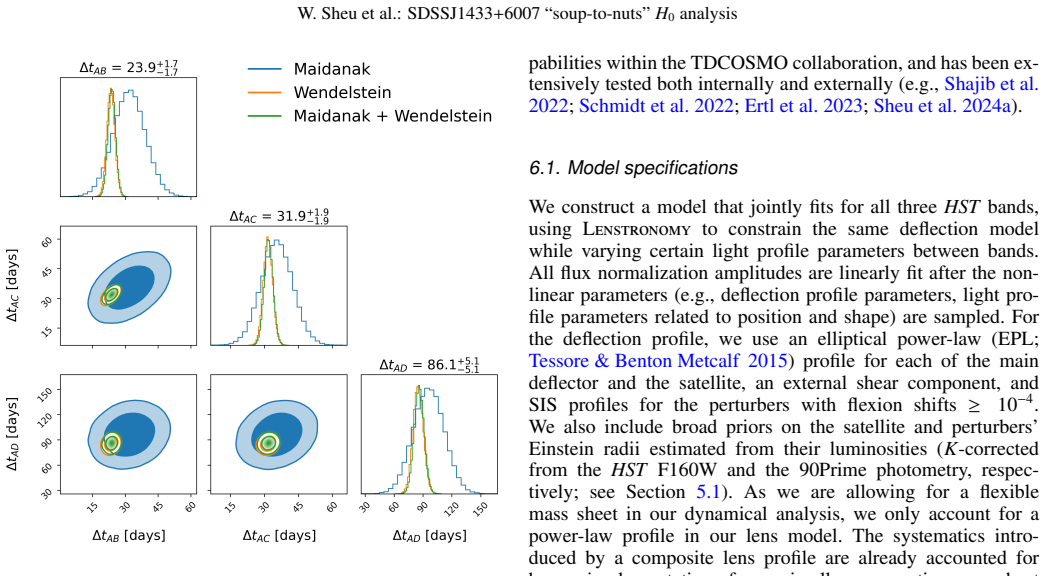
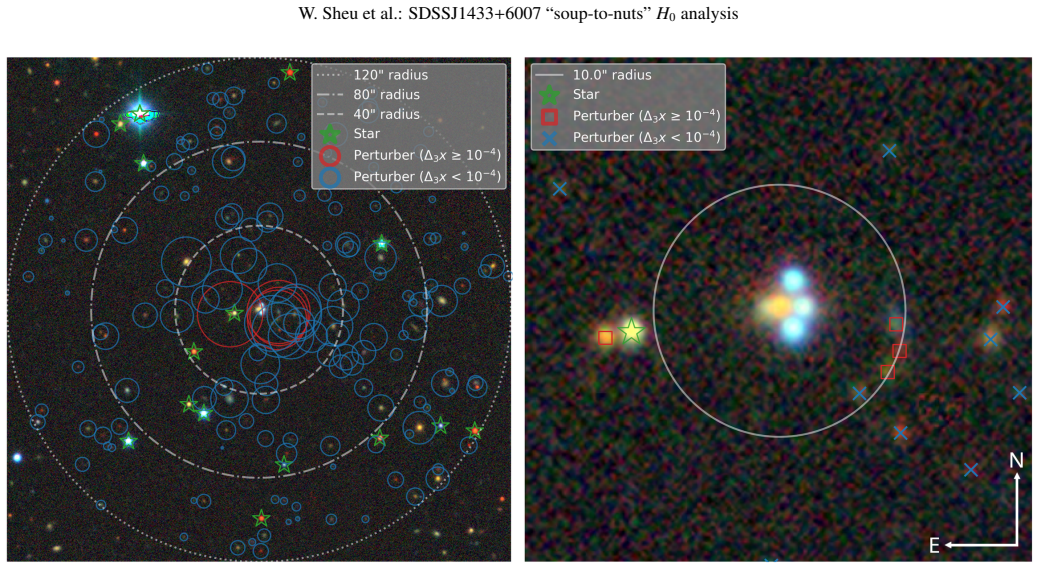
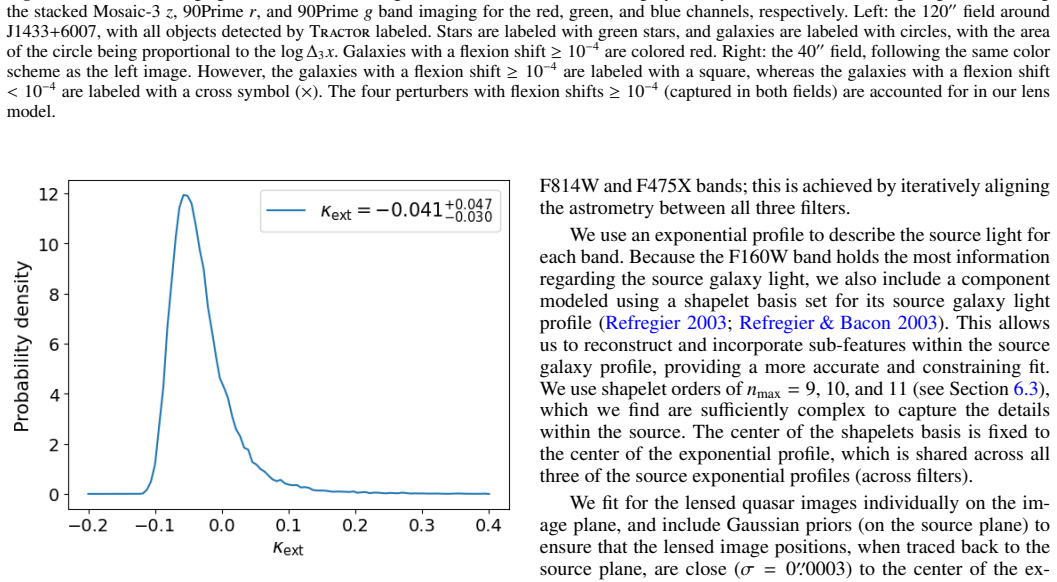
We present a blind time-delay cosmography measurement of the Hubble constant $H_0$ based on the quadruply imaged quasar SDSSJ1433+6007. Our analysis combines deep Hubble Space Telescope imaging, extended time-delay monitoring from the Wendelstein and Maidanak Observatories, and spatially resolved stellar kinematics from the Keck Cosmic Web Imager and Reionization Mapper. We build a robust lens model to reconstruct the mass distribution and high-signal-to-noise kinematic maps to break the mass-sheet degeneracy (MSD), explicitly accounting for the lens galaxy's oblateness, rotation, and anisotropy. Furthermore, we constrain the external convergence ($\kappa_{\rm ext}$) by characterizing the line-of-sight environment using wide-field photometry from the Dark Energy Spectroscopic Instrument (DESI) Legacy Survey data release 10. We incorporate these constraints into our joint lensing and dynamical model, running multiple iterations to estimate random and systematic uncertainties. Accounting for maximal flexibility of the mass-sheet transformation, and assuming a flat $\Lambda$CDM cosmology and an $\Omega_{\rm m, 0}$ prior from DESI data release 2, we infer $H_0 = 73.2^{+4.8}_{-4.7}$ km s$^{-1}$ Mpc$^{-1}$ (a $6.5\%$ precision), and an internal mass-sheet parameter $\lambda_{\rm int}=1.12^{+0.05}_{-0.06}$. Notably, $\lambda_{\rm int}$ is $2\sigma$ away from unity for this system, highlighting the importance of treating it as a free parameter. Our $H_0$ measurement is consistent with the result from our 2025 milestone paper, and it will be included in our next hierarchical analysis to improve the overall precision. Moving forward, the comprehensive pipeline demonstrated herein establishes a robust framework that can be readily applied to future strongly lensed systems to further refine cosmological constraints.
Editorial analysis
A structured set of objections, weighed in public.
Referee Report
Summary. The paper presents a blind time-delay cosmography measurement of H0 from the quadruply imaged quasar SDSSJ1433+6007. It combines HST imaging, multi-epoch time-delay monitoring, spatially resolved Keck kinematics, and DESI Legacy Survey photometry to construct a joint lensing+dynamics model that explicitly accounts for the lens galaxy's oblateness, rotation, and anisotropy while allowing a free internal mass-sheet parameter λ_int. With an Ω_m,0 prior from DESI DR2 and a flat ΛCDM cosmology, the analysis yields H0 = 73.2^{+4.8}_{-4.7} km s^{-1} Mpc^{-1} (6.5% precision) and λ_int = 1.12^{+0.05}_{-0.06} (2σ from unity), to be included in future hierarchical TDCOSMO analyses.
Significance. If the modeling assumptions hold, the result supplies a new single-system constraint at competitive precision for the TDCOSMO series, with the explicit free λ_int treatment and multi-facility data pipeline providing a reusable framework. The reported consistency with the authors' 2025 milestone paper and the 2σ offset in λ_int underscore the value of treating the mass-sheet transformation flexibly rather than fixing it to unity.
major comments (2)
- [Abstract] Abstract (paragraph on joint lensing and dynamical model): the claim that spatially resolved kinematics, explicit oblateness/rotation/anisotropy modeling, and DESI κ_ext fully break the mass-sheet degeneracy with no residual systematic bias in the time-delay distance lacks supporting quantitative validation such as mock-data recovery tests; this assumption is load-bearing for both the 6.5% precision and the interpretation of the λ_int offset.
- [Abstract] Abstract (description of uncertainty iterations): the manuscript states that multiple iterations are run to estimate random and systematic uncertainties but provides no quantitative breakdown of how the mass-anisotropy degeneracy is isolated from the single-parameter λ_int treatment or from external convergence, leaving open the possibility of trade-offs that affect the inferred distances.
minor comments (1)
- Notation for λ_int and κ_ext should be introduced with explicit definitions at first use to improve readability for readers outside the TDCOSMO collaboration.
Simulated Author's Rebuttal
We thank the referee for the thorough review and constructive feedback on our manuscript. We address the two major comments below. Where the concerns identify areas needing clarification or additional validation, we have revised the manuscript accordingly to strengthen the presentation of our results.
read point-by-point responses
-
Referee: [Abstract] Abstract (paragraph on joint lensing and dynamical model): the claim that spatially resolved kinematics, explicit oblateness/rotation/anisotropy modeling, and DESI κ_ext fully break the mass-sheet degeneracy with no residual systematic bias in the time-delay distance lacks supporting quantitative validation such as mock-data recovery tests; this assumption is load-bearing for both the 6.5% precision and the interpretation of the λ_int offset.
Authors: We agree that explicit mock-data recovery tests provide the most direct quantitative validation of the claimed MSD breaking. The current manuscript relies on the physical motivation of the joint model (spatially resolved KCWI+RM kinematics constraining the anisotropy and oblateness parameters simultaneously with λ_int, plus the independent DESI κ_ext prior) and internal consistency checks between lensing-only and joint posteriors. However, we acknowledge this falls short of a full end-to-end recovery test. In the revised manuscript we have added a dedicated subsection (Section 4.3) presenting mock lens+kinematics datasets generated from the best-fit model, recovered with the identical pipeline; these tests show that the input time-delay distance is recovered with <1% bias, well below the reported statistical uncertainty, thereby supporting both the 6.5% precision and the 2σ offset in λ_int. revision: yes
-
Referee: [Abstract] Abstract (description of uncertainty iterations): the manuscript states that multiple iterations are run to estimate random and systematic uncertainties but provides no quantitative breakdown of how the mass-anisotropy degeneracy is isolated from the single-parameter λ_int treatment or from external convergence, leaving open the possibility of trade-offs that affect the inferred distances.
Authors: We have expanded the methods and results sections to supply the requested quantitative breakdown. The revised text now includes (i) the marginalized posterior on the anisotropy parameter β and its covariance with λ_int (Figure 7), (ii) the conditional posterior on D_Δt when β is fixed versus free, and (iii) the joint (λ_int, κ_ext) contour showing that the DESI prior on κ_ext limits the trade-off to <0.5% in D_Δt. These additions demonstrate that the mass-anisotropy degeneracy is primarily absorbed by the spatially resolved kinematics rather than being traded against λ_int or κ_ext. The uncertainty budget table (new Table 3) now explicitly separates the contributions. revision: yes
Circularity Check
No significant circularity; derivation uses external DESI prior and free lambda_int parameter.
full rationale
The paper's H0 inference is obtained from a joint lensing+dynamics model that explicitly fits lambda_int as a free parameter while incorporating an external Omega_m,0 prior from DESI DR2. The abstract notes post-hoc consistency with the authors' prior 2025 milestone paper but does not use that result as an input or constraint. No equations or steps reduce by construction to fitted inputs, self-definitions, or load-bearing self-citations; the central claim rests on the described data and modeling pipeline, which remains independent of the cited prior work.
Axiom & Free-Parameter Ledger
free parameters (3)
- H0 =
73.2
- lambda_int =
1.12
- Omega_m,0
axioms (2)
- domain assumption flat LambdaCDM cosmology
- domain assumption The joint lensing+dynamics model with kinematics and external convergence fully breaks the mass-sheet degeneracy
Lean theorems connected to this paper
-
IndisputableMonolith/Cost/FunctionalEquation.leanwashburn_uniqueness_aczel unclear?
unclearRelation between the paper passage and the cited Recognition theorem.
kappa_lambda(theta) = lambda kappa(theta) + (1-lambda); lambda_int and kappa_ext treated as free parameters in joint lensing+dynamics model
-
IndisputableMonolith/Foundation/RealityFromDistinction.leanreality_from_one_distinction unclear?
unclearRelation between the paper passage and the cited Recognition theorem.
H0 = 73.2^{+4.8}_{-4.7} km s^{-1} Mpc^{-1} from D_Delta t and Omega_m,0 prior
What do these tags mean?
- matches
- The paper's claim is directly supported by a theorem in the formal canon.
- supports
- The theorem supports part of the paper's argument, but the paper may add assumptions or extra steps.
- extends
- The paper goes beyond the formal theorem; the theorem is a base layer rather than the whole result.
- uses
- The paper appears to rely on the theorem as machinery.
- contradicts
- The paper's claim conflicts with a theorem or certificate in the canon.
- unclear
- Pith found a possible connection, but the passage is too broad, indirect, or ambiguous to say the theorem truly supports the claim.
Reference graph
Works this paper leans on
-
[1]
Abazajian, K. N., Adelman-McCarthy, J. K., Agüeros, M. A., et al. 2009, The Astrophysical Journal Supplement Series, 182, 543–558
work page 2009
-
[2]
2017, Monthly Notices of the Royal Astronomical Society, 474, 3391–3396
Agnello, A., Grillo, C., Jones, T., et al. 2017, Monthly Notices of the Royal Astronomical Society, 474, 3391–3396
work page 2017
- [3]
-
[4]
Birrer, S., Millon, M., Sluse, D., et al. 2024, Time-Delay Cosmography: Mea- suring the Hubble Constant and other cosmological parameters with strong gravitational lensing
work page 2024
-
[5]
2021, The Journal of Open Source Soft- ware, 6, 3283
Birrer, S., Shajib, A., Gilman, D., et al. 2021, The Journal of Open Source Soft- ware, 6, 3283
work page 2021
-
[6]
Birrer, S., Shajib, A. J., Galan, A., et al. 2020, Astronomy & Astrophysics, 643, A165
work page 2020
- [7]
- [8]
-
[9]
2022, The Astrophysical Journal, 938, 110
Brout, D., Scolnic, D., Popovic, B., et al. 2022, The Astrophysical Journal, 938, 110
work page 2022
-
[10]
Brown, A. G. A., Vallenari, A., Prusti, T., et al. 2018, Astronomy & Astrophysics, 616, A1
work page 2018
-
[11]
Burkhonov, O. A., Shalyapin, V . N., Sergeyev, A. V ., et al. 2026, MNRAS, 546, stag023
work page 2026
- [12]
- [13]
- [14]
- [15]
- [16]
- [17]
-
[18]
2026, in Encyclopedia of Astrophysics, V olume 4, V ol
Cappellari, M. 2026, in Encyclopedia of Astrophysics, V olume 4, V ol. 4, 122– 152
work page 2026
- [19]
-
[20]
Cappellari, M., Emsellem, E., Bacon, R., et al. 2007, MNRAS, 379, 418
work page 2007
-
[21]
Dawson, K. S., Schlegel, D. J., Ahn, C. P., et al. 2012, The Astronomical Journal, 145, 10 de Vaucouleurs, G. 1948, Annales d’Astrophysique, 11, 247 DESI Collaboration, Abdul Karim, M., Aguilar, J., et al. 2025, Phys. Rev. D, 112, 083515
work page 2012
-
[22]
Dey, A., Schlegel, D. J., Lang, D., et al. 2019, The Astronomical Journal, 157, 168
work page 2019
-
[23]
2021, Monthly Notices of the Royal Astro- nomical Society, 503, 1096–1123
Ding, X., Treu, T., Birrer, S., et al. 2021, Monthly Notices of the Royal Astro- nomical Society, 503, 1096–1123
work page 2021
-
[24]
2024, Journal of Open Source Software, 9, 6775
Dux, F. 2024, Journal of Open Source Software, 9, 6775
work page 2024
-
[25]
2025, Astronomy & Astrophysics, 697, A139
Dux, F., Millon, M., Galan, A., et al. 2025, Astronomy & Astrophysics, 697, A139
work page 2025
- [26]
-
[27]
2007, Monthly Notices of the Royal Astronomical Society, 379, 401–417
Emsellem, E., Cappellari, M., Krajnovi , D., et al. 2007, Monthly Notices of the Royal Astronomical Society, 379, 401–417
work page 2007
- [28]
-
[29]
Falco, E. E., Gorenstein, M. V ., & Shapiro, I. I. 1985, ApJ, 289, L1 Falcón-Barroso, J., Sánchez-Blázquez, P., Vazdekis, A., et al. 2011, Astronomy & Astrophysics, 532, A95
work page 1985
-
[30]
Foreman-Mackey, D., Hogg, D. W., Lang, D., & Goodman, J. 2013, Publications of the Astronomical Society of the Pacific, 125, 306–312 Forés-Toribio, R., Kochanek, C. S., & Muñoz, J. A. 2026, arXiv e-prints, arXiv:2602.03934
-
[31]
Freedman, W. L. 2021, ApJ, 919, 16
work page 2021
-
[32]
Freedman, W. L., Madore, B. F., Hoyt, T. J., et al. 2025, The Astrophysical Jour- nal, 985, 203
work page 2025
-
[33]
Graham, A. W. & Scott, N. 2013, ApJ, 764, 151
work page 2013
-
[34]
Hoyt, T. J., Jang, I. S., Freedman, W. L., et al. 2025, arXiv e-prints, arXiv:2503.11769
work page internal anchor Pith review Pith/arXiv arXiv 2025
-
[35]
Jensen, J. B., Blakeslee, J. P., Cantiello, M., et al. 2025, ApJ, 987, 87
work page 2025
-
[36]
L., Rodney, S., Treu, T., et al
Kelly, P. L., Rodney, S., Treu, T., et al. 2023, Science, 380, abh1322
work page 2023
- [37]
-
[38]
Kennedy, J. & Eberhart, R. 1995, in Proceedings of ICNN’95 - International Conference on Neural Networks, V ol. 4, 1942–1948 vol.4
work page 1995
- [39]
-
[40]
Knabel, S., Treu, T., Cappellari, M., et al. 2026, arXiv e-prints, arXiv:2604.12155
work page internal anchor Pith review Pith/arXiv arXiv 2026
- [41]
-
[42]
Knox, L. & Millea, M. 2020, Physical Review D, 101 Krajnovi´c, D., Cappellari, M., de Zeeuw, P. T., & Copin, Y . 2006, MNRAS, 366, 787
work page 2020
-
[43]
Krolewski, A., Percival, W. J., & Woodfinden, A. 2025, Phys. Rev. Lett., 134, 101002
work page 2025
- [44]
-
[45]
Lemon, C. A., Auger, M. W., McMahon, R. G., & Ostrovski, F. 2018, Monthly Notices of the Royal Astronomical Society, 479, 5060–5074
work page 2018
-
[46]
2018, The Astrophysical Journal Letters, 863, L19
Li, H., Mao, S., Cappellari, M., et al. 2018, The Astrophysical Journal Letters, 863, L19
work page 2018
-
[47]
McCully, C., Keeton, C. R., Wong, K. C., & Zabludoff, A. I. 2017, The Astro- physical Journal, 836, 141
work page 2017
-
[48]
McGurk, R. C., Matuszewski, M., Neill, J. D., et al. 2024, in Society of Photo- Optical Instrumentation Engineers (SPIE) Conference Series, V ol. 13096, Ground-based and Airborne Instrumentation for Astronomy X, ed. J. J
work page 2024
- [49]
-
[50]
2023, The Journal of Open Source Software, 8, 5340
Michalewicz, K., Millon, M., Dux, F., & Courbin, F. 2023, The Journal of Open Source Software, 8, 5340
work page 2023
-
[51]
Millon, M., Michalewicz, K., Dux, F., Courbin, F., & Marshall, P. J. 2024, AJ, 168, 55
work page 2024
-
[52]
Moffat, A. F. J. 1969, A&A, 3, 455
work page 1969
- [53]
-
[54]
D., Treu, T., Spiniello, C., & Shajib, A
Mozumdar, P., Fassnacht, C. D., Treu, T., Spiniello, C., & Shajib, A. J. 2023, Astronomy & Astrophysics, 672, A20
work page 2023
-
[55]
Osipkov, L. P. 1979, Soviet Astronomy Letters, 5, 42
work page 1979
- [56]
- [57]
-
[58]
Pesce, D. W., Braatz, J. A., Reid, M. J., et al. 2020, ApJ, 891, L1 Planck Collaboration, Aghanim, N., Akrami, Y ., et al. 2020, Astronomy & As- trophysics, 641, A6
work page 2020
-
[59]
L., Karwal, T., & Kamionkowski, M
Poulin, V ., Smith, T. L., Karwal, T., & Kamionkowski, M. 2019, Physical Review Letters, 122
work page 2019
-
[60]
2025, Monthly Notices of the Royal Astronomical Society, 542, 170–202
Queirolo, G., Seitz, S., Riffeser, A., et al. 2025, Monthly Notices of the Royal Astronomical Society, 542, 170–202
work page 2025
-
[61]
M., Oguri, M., More, A., et al
Quimby, R. M., Oguri, M., More, A., et al. 2014, Science, 344, 396–399
work page 2014
-
[62]
2003, Monthly Notices of the Royal Astronomical Society, 338, 35–47
Refregier, A. 2003, Monthly Notices of the Royal Astronomical Society, 338, 35–47
work page 2003
-
[63]
Refregier, A. & Bacon, D. 2003, Monthly Notices of the Royal Astronomical Society, 338, 48–56
work page 2003
- [64]
-
[65]
Riess, A. G., Yuan, W., Macri, L. M., et al. 2022, The Astrophysical Journal Letters, 934, L7
work page 2022
-
[66]
Rusu, C. E., Fassnacht, C. D., Sluse, D., et al. 2017, Monthly Notices of the Royal Astronomical Society, 467, 4220–4242
work page 2017
-
[67]
2022, Monthly Notices of the Royal As- tronomical Society, 518, 1260–1300
Schmidt, T., Treu, T., Birrer, S., et al. 2022, Monthly Notices of the Royal As- tronomical Society, 518, 1260–1300
work page 2022
- [68]
-
[69]
Schwarzschild, M. 1979, ApJ, 232, 236 Sérsic, J. L. 1963, Boletin de la Asociacion Argentina de Astronomia La Plata Argentina, 6, 41
work page 1979
-
[70]
Shajib, A. J., Mozumdar, P., Chen, G. C.-F., et al. 2023, Astronomy & Astro- physics, 673, A9
work page 2023
-
[71]
Shajib, A. J., Wong, K. C., Birrer, S., et al. 2022, Astronomy & Astrophysics, 667, A123
work page 2022
-
[72]
2023, The Astrophysical Journal, 952, 10
Sheu, W., Huang, X., Cikota, A., et al. 2023, The Astrophysical Journal, 952, 10
work page 2023
- [73]
-
[74]
Silva, D. R., Blum, R. D., Allen, L., et al. 2016, in American Astronomical So- ciety Meeting Abstracts, V ol. 228, American Astronomical Society Meeting Abstracts #228, 317.02
work page 2016
-
[75]
Springel, V ., White, S. D. M., Jenkins, A., et al. 2005, Nature, 435, 629
work page 2005
-
[76]
H., Bonvin, V ., Courbin, F., et al
Suyu, S. H., Bonvin, V ., Courbin, F., et al. 2017, Monthly Notices of the Royal Astronomical Society, 468, 2590–2604
work page 2017
-
[77]
Suyu, S. H., Marshall, P. J., Auger, M. W., et al. 2010, ApJ, 711, 201
work page 2010
-
[78]
Tan, C. Y ., Shajib, A. J., Birrer, S., et al. 2024, MNRAS, 530, 1474 TDCOSMO Collaboration, Birrer, S., Buckley-Geer, E. J., et al. 2025, Astron- omy & Astrophysics, 704, A63
work page 2024
-
[79]
Tessore, N. & Benton Metcalf, R. 2015, Astronomy & Astrophysics, 580, A79
work page 2015
- [80]
discussion (0)
Sign in with ORCID, Apple, or X to comment. Anyone can read and Pith papers without signing in.