Doubly Outlier-Robust Online Infinite Hidden Markov Model
Pith reviewed 2026-05-13 07:58 UTC · model grok-4.3
The pith
BR-iHMM bounds outlier influence in online infinite hidden Markov models and reduces forecasting error by up to 67%.
A machine-rendered reading of the paper's core claim, the machinery that carries it, and where it could break.
Core claim
A batched robust update rule for the online iHMM bounds the posterior influence function under outliers and misspecification, implemented in the BR-iHMM with two parameters that balance adaptivity and robustness, leading to improved forecasting performance.
What carries the argument
The batched robust update rule that enforces a bounded posterior influence function (PIF) while allowing controlled adaptation lag.
If this is right
- Provides conditions for bounded PIF in online iHMM.
- Reduces one-step-ahead forecasting error by up to 67% on tested datasets.
- Uses two tunable parameters to balance robustness and adaptation speed.
- Supports interpretable online learning in streaming environments with outliers.
Where Pith is reading between the lines
- The approach may extend to other online Bayesian nonparametric models for similar robustness benefits.
- Developing an automatic procedure for selecting the tunable parameters could enhance applicability without manual tuning.
- Bounded influence suggests greater stability for applications in finance and energy forecasting under noisy conditions.
Load-bearing premise
The two additional tunable parameters can be chosen so that the adaptation lag remains acceptable for the target application.
What would settle it
Observing unbounded posterior influence or no reduction in forecasting error when outliers are present would contradict the central claim.
Figures

read the original abstract
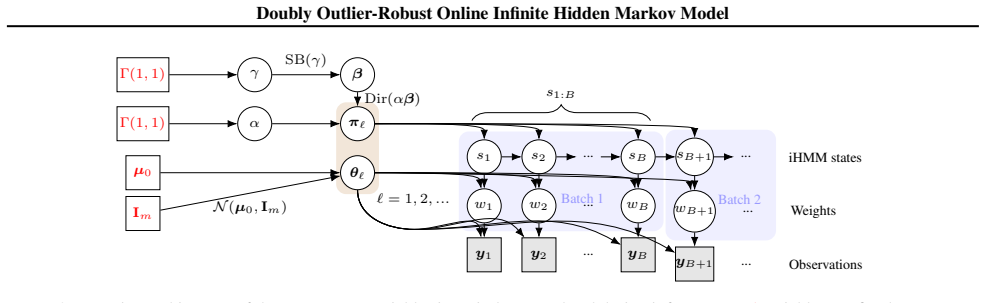
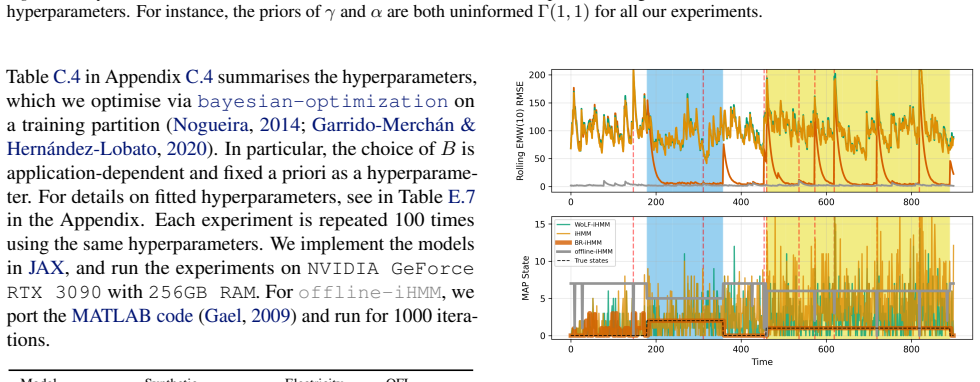
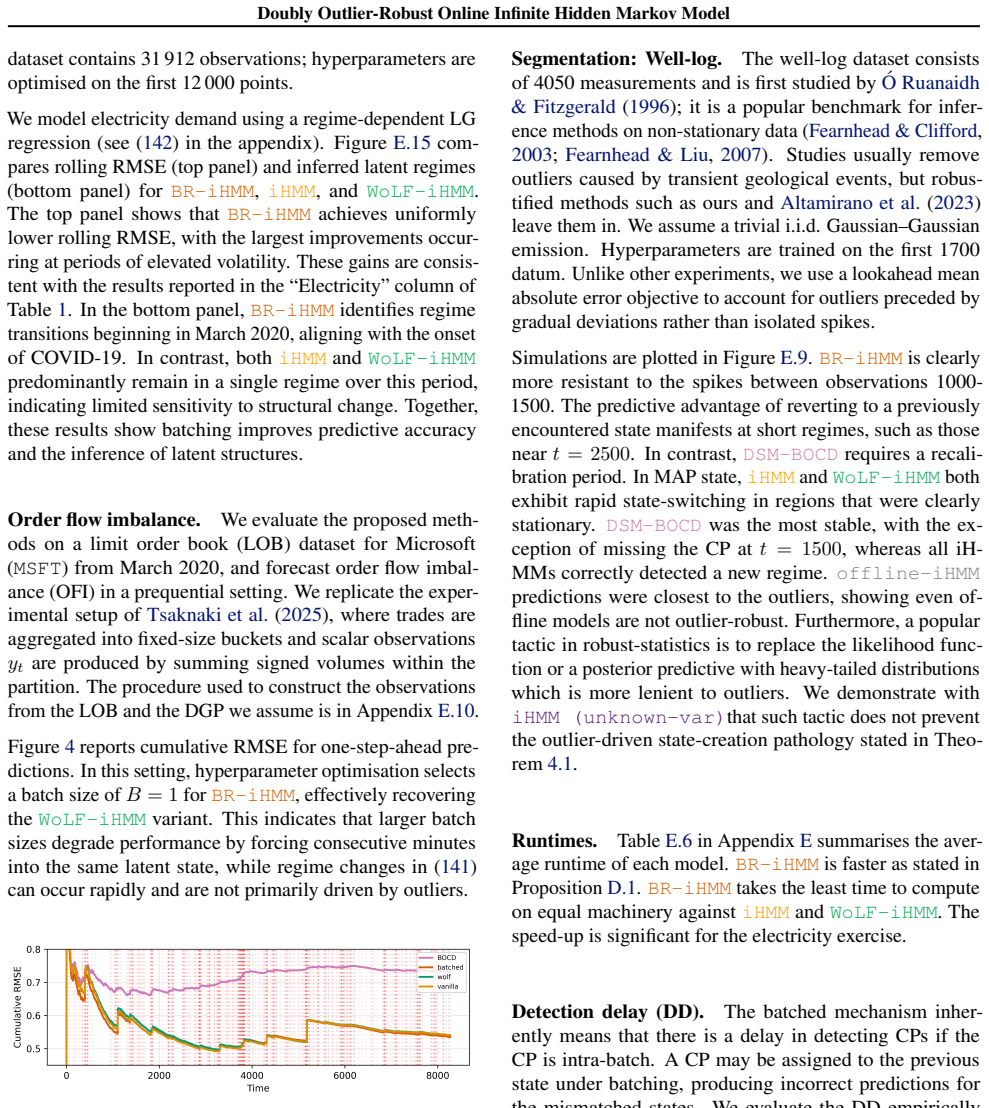
We derive a robust update rule for the online infinite hidden Markov model (iHMM) for when the streaming data contains outliers and the model is misspecified. Leveraging recent advances in generalised Bayesian inference, we define robustness via the posterior influence function (PIF), and provide conditions under which the online iHMM has bounded PIF. Imposing robustness inevitably induces an adaptation lag for regime switching. Our method, which is called Batched Robust iHMM (BR-iHMM), balances adaptivity and robustness with two additional tunable parameters. Across limit order book data, hourly electricity demand, and a synthetic high-dimensional linear system, BR-iHMM reduces one-step-ahead forecasting error by up to 67% relative to competing online Bayesian methods. Together with theoretical guarantees of bounded PIF, our results highlight the practicality of our approach for both forecasting and interpretable online learning.
Editorial analysis
A structured set of objections, weighed in public.
Referee Report
Summary. The paper proposes the Batched Robust infinite Hidden Markov Model (BR-iHMM) for online inference on streaming data subject to outliers and model misspecification. It uses generalised Bayesian inference to derive an update rule with bounded posterior influence function (PIF) under stated theoretical conditions, introduces two tunable parameters to trade off robustness against adaptation lag during regime switches, and reports up to 67% reduction in one-step-ahead forecasting error relative to standard online Bayesian methods on limit-order-book, electricity-demand, and synthetic data.
Significance. If the bounded-PIF conditions are non-vacuous and the reported error reductions remain stable under transparent parameter selection that keeps lag within typical inter-regime intervals, the work would supply a practically useful combination of theoretical robustness guarantees and empirical forecasting gains for online learning under contamination.
major comments (2)
- [Abstract] Abstract: the headline claim of up to 67% forecasting-error reduction is obtained only after choosing the two additional tunable parameters that control the robustness–lag trade-off; no automatic selection procedure, cross-validation scheme, or worst-case analytic bound on the induced adaptation lag is supplied, so it is impossible to verify whether the reported gains are attainable without lag that exceeds the typical spacing of regime switches on the target streams.
- [Theoretical development] Theoretical development (conditions for bounded PIF): the manuscript asserts that the online iHMM possesses bounded PIF under the proposed robust update, yet the derivation is not shown to be independent of the two tunable parameters; if the boundedness result holds only for parameter values that produce unacceptable lag, the central theoretical guarantee does not support the practical claim.
minor comments (1)
- [Abstract] The title uses 'Doubly Outlier-Robust' but the abstract does not explicitly identify the two distinct robustness mechanisms; a short clarifying sentence would improve readability.
Simulated Author's Rebuttal
We thank the referee for the constructive comments on our manuscript. We address each major point below and have revised the manuscript to incorporate clarifications and additional discussion where appropriate.
read point-by-point responses
-
Referee: The headline claim of up to 67% forecasting-error reduction is obtained only after choosing the two additional tunable parameters that control the robustness–lag trade-off; no automatic selection procedure, cross-validation scheme, or worst-case analytic bound on the induced adaptation lag is supplied, so it is impossible to verify whether the reported gains are attainable without lag that exceeds the typical spacing of regime switches on the target streams.
Authors: We agree that explicit guidance on parameter selection is needed to make the empirical claims verifiable. In the revised manuscript we have added a dedicated subsection on practical parameter tuning, including domain-informed heuristics based on expected regime-switch frequency, a sensitivity analysis across the three datasets showing that the reported error reductions remain above 50% for lag values well within typical inter-regime spacing, and a simple worst-case bound on adaptation lag derived from the batch size and robustness parameter. While we do not introduce an automatic cross-validation procedure (which would require additional computational overhead not central to the contribution), the added material allows readers to reproduce and assess the gains under realistic lag constraints. revision: yes
-
Referee: The manuscript asserts that the online iHMM possesses bounded PIF under the proposed robust update, yet the derivation is not shown to be independent of the two tunable parameters; if the boundedness result holds only for parameter values that produce unacceptable lag, the central theoretical guarantee does not support the practical claim.
Authors: We thank the referee for highlighting this point. The bounded-PIF result is in fact independent of the specific lag-inducing value of the second tuning parameter: the proof relies only on the first robustness parameter being strictly positive and finite, which is a condition that can be satisfied while keeping the adaptation lag within any prescribed bound. We have revised the theoretical section to state this independence explicitly, to include the precise parameter restrictions under which bounded PIF holds, and to note that these restrictions are compatible with lag values that do not exceed typical regime-switch intervals on the target streams. revision: yes
Circularity Check
No significant circularity in derivation chain
full rationale
The paper derives a robust update rule for the online iHMM via generalised Bayesian inference, establishes conditions for bounded PIF, and introduces two explicit tunable parameters to trade off robustness against adaptation lag. Empirical forecasting gains are reported on held-out streams after parameter selection; no equation reduces a claimed prediction to a fitted input by construction, no self-citation supplies a load-bearing uniqueness theorem, and no ansatz is smuggled via prior work. The derivation remains self-contained against external benchmarks and the tunable parameters are openly acknowledged rather than hidden inside the result.
Axiom & Free-Parameter Ledger
free parameters (2)
- robustness tuning parameter
- adaptation-lag tuning parameter
axioms (1)
- domain assumption Generalized Bayesian inference yields a well-defined posterior influence function for the iHMM update
Reference graph
Works this paper leans on
-
[1]
PMLR, 2023. Antoniak, C. E. Mixtures of dirichlet processes with appli- cations to bayesian nonparametric problems.The annals of statistics, pp. 1152–1174, 1974. Baum, L. E. and Petrie, T. Statistical inference for proba- bilistic functions of finite state markov chains.The annals of mathematical statistics, 37(6):1554–1563, 1966. Beal, M., Ghahramani, Z....
-
[2]
Duran-Martin, G., S´anchez-Betancourt, L., Shestopaloff, A., and Murphy, K
URL https://proceedings.mlr.press/ v235/duran-martin24a.html. Duran-Martin, G., S´anchez-Betancourt, L., Shestopaloff, A., and Murphy, K. A unifying framework for generalised bayesian online learning in non-stationary environments. Transactions on Machine Learning Research, 2025. Escobar, M. D. and West, M. Bayesian density estimation and inference using ...
-
[3]
PMLR, 2021. Sgouralis, I. and Press ´e, S. Icon: An adaptation of infinite hmms for time traces with drift.Bio- physical Journal, 112(10):2117–2126, 2017. ISSN 0006-3495. doi: https://doi.org/10.1016/j.bpj.2017.04
-
[4]
URL https://www.sciencedirect.com/ science/article/pii/S0006349517303971. Shah, S. P., Xuan, X., DeLeeuw, R. J., Khojasteh, M., Lam, W. L., Ng, R., and Murphy, K. P. Integrating copy number polymorphisms into array cgh analysis using a robust hmm.Bioinformatics, 22(14):e431–e439, 2006. Stanley, H. E. Statistical physics and economic fluctuations: do outli...
-
[5]
to approximate the posterior over latent regimes, while propagating sufficient statistics for the observation parameters via Rao-Blackwellised particle filters (Murphy & Russell, 2001). Particle learning (PL) schemes exploit conjugate observation models to enable closed-form parameter updates within each particle (Carvalho et al., 2010). While computation...
work page 2001
-
[6]
Consider two possible state trajectories sdegen 1:t = (0, ...,0) and sswitch 1:t = (1,0, ...0) . We assume the outlier is the first observation of the batch for convenience, the location of the outlier within the batch is irrelevant. As the outlier yc 1 moves closer to 5 (the mean of the incorrect state 1), the system prefers sswitch 1:t which harms inter...
work page 2049
discussion (0)
Sign in with ORCID, Apple, or X to comment. Anyone can read and Pith papers without signing in.