Recognition: unknown
A fast X-ray transient with chromatic flares: signatures of violent collisions induced by late-time central engine reactivation
Pith reviewed 2026-05-10 11:58 UTC · model grok-4.3
The pith
A fast X-ray transient shows late-time shell collisions that point to central engine reactivation.
A machine-rendered reading of the paper's core claim, the machinery that carries it, and where it could break.
Core claim
The distinct X-ray and optical behaviors constitute the first observed instance of late-time violent collision of two relativistic shells in an EFXT. Drawing on insights from GRB studies, such a collision process strongly indicates the reactivation of a central engine, making EP250302a-like transients a unique laboratory for probing the late-time activity and jet physics of EFXT central engines.
What carries the argument
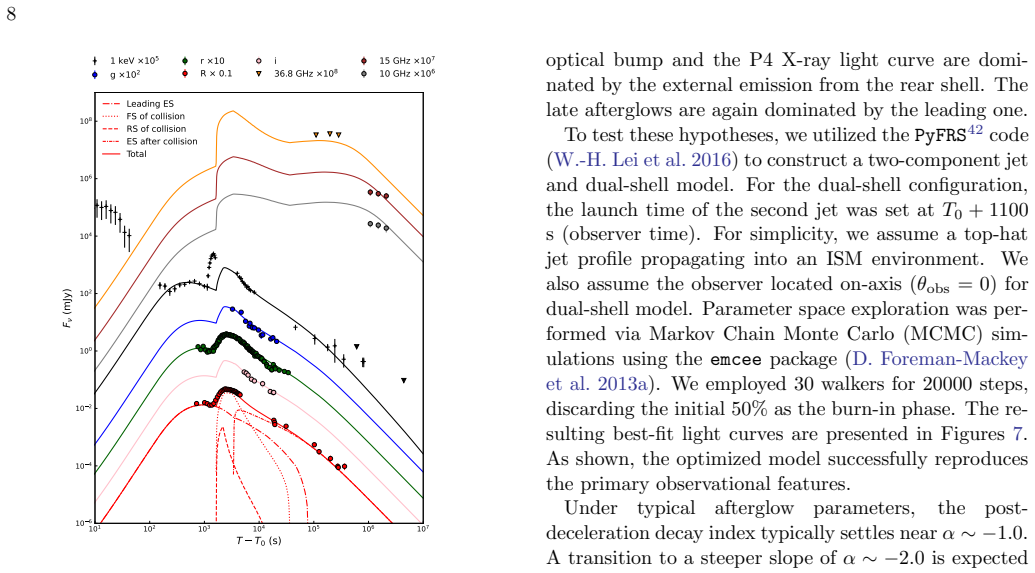
Late-time violent collision between two relativistic shells, which produces the observed needle-like X-ray flare and optical rebrightening through internal dissipation.
If this is right
- EP250302a-like events can serve as direct probes of late-time central-engine activity in fast X-ray transients.
- The same collision mechanism may operate in other EFXTs whose origins have remained unclear.
- Multi-wavelength chromatic flares become a diagnostic for distinguishing internal versus external emission processes.
- Jet physics models for these transients must now incorporate the possibility of engine restart at late epochs.
Where Pith is reading between the lines
- Future wide-field X-ray monitors could identify more such events by searching for needle-like flares paired with optical rebrightenings.
- The reactivation scenario may link some EFXTs to other transients that show prolonged high-energy activity.
- Detailed modeling of shell collision timing could constrain the outflow structure and engine lifetime in these systems.
Load-bearing premise
The needle-like X-ray flare and optical rebrightening are produced by internal shell collisions powered by late central-engine reactivation rather than external shocks, refreshed shocks, or other emission mechanisms.
What would settle it
Spectral or timing data showing that the flare and rebrightening arise from external shock interaction instead of internal shell collision, or absence of any engine-reactivation signature in similar future events.
Figures




read the original abstract
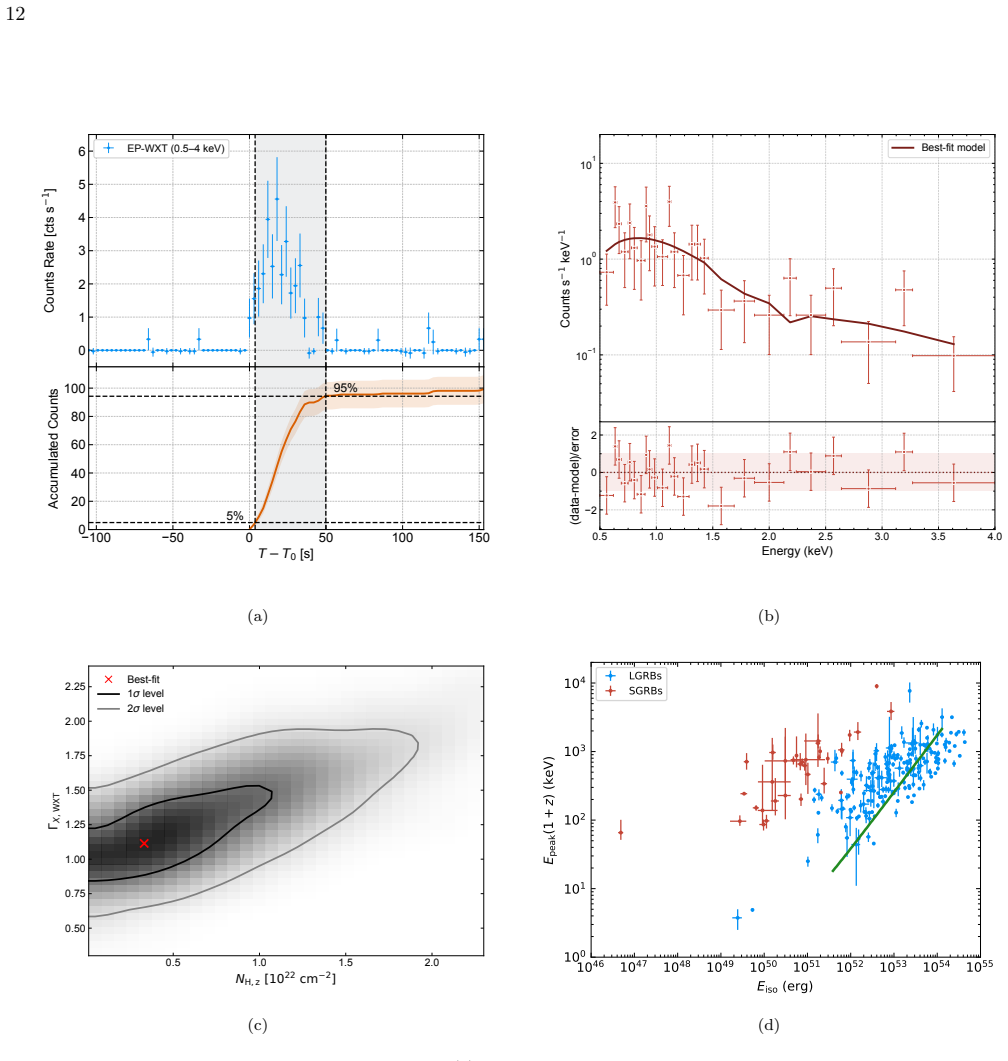
Extragalactic Fast X-ray Transients (EFXTs) represent an emerging class of high-energy phenomena characterized by X-ray outbursts lasting from tens to hundreds of seconds. However, for more than half of the EFXTs, their physical origins remain elusive. In this Letter, we report the discovery of EP250302a, a luminous EFXT detected by the Einstein Probe (EP) at a redshift of $z = 1.131$. The multi-wavelength light curves of EP250302a reveal remarkable temporal features that distinguish it from the previously known EP-detected EFXT population, most notably a needle-like X-ray flare accompanied by smooth optical rebrightening during the afterglow phase. We suggest that the distinct X-ray and optical behaviors constitute the first observed instance of late-time violent collision of two relativistic shells in an EFXT. Drawing on insights from GRB studies, such a collision process strongly indicates the reactivation of a central engine, making EP250302a-like transients a unique laboratory for probing the late-time activity and jet physics of EFXT central engines.
Editorial analysis
A structured set of objections, weighed in public.
Referee Report
Summary. The paper reports the discovery of EP250302a, a luminous EFXT at redshift z=1.131 detected by the Einstein Probe. Its multi-wavelength light curves show a distinctive needle-like X-ray flare accompanied by smooth optical rebrightening during the afterglow phase. The authors interpret these chromatic features as the first observed instance of late-time violent collisions between two relativistic shells in an EFXT, which they argue indicates reactivation of the central engine, drawing analogies to established GRB shell-collision phenomenology.
Significance. If substantiated through further modeling, this would be a notable contribution to the emerging EFXT field by providing observational evidence for late-time central-engine activity and extending GRB-inspired shell-collision models to this class of transients. It underscores the value of rapid multi-wavelength follow-up in constraining jet physics and engine reactivation timescales, potentially guiding targeted searches in future EP and similar surveys.
major comments (1)
- [Physical interpretation / discussion of flare origin] The central interpretive claim—that the needle-like X-ray flare plus optical rebrightening requires late-time internal shell collisions powered by central-engine reactivation, rather than refreshed external shocks, structured jets, or circumburst density variations—is load-bearing but unsupported by quantitative discrimination. The manuscript presents the light-curve morphology and GRB analogy but does not include afterglow modeling, predicted spectral evolution, or hydrodynamic fits that could rule out or favor alternatives (see the skeptic note on the weakest assumption).
Simulated Author's Rebuttal
We thank the referee for their constructive and insightful review of our manuscript. The feedback highlights a key area where the physical interpretation can be strengthened, and we address this point directly below while outlining planned revisions.
read point-by-point responses
-
Referee: The central interpretive claim—that the needle-like X-ray flare plus optical rebrightening requires late-time internal shell collisions powered by central-engine reactivation, rather than refreshed external shocks, structured jets, or circumburst density variations—is load-bearing but unsupported by quantitative discrimination. The manuscript presents the light-curve morphology and GRB analogy but does not include afterglow modeling, predicted spectral evolution, or hydrodynamic fits that could rule out or favor alternatives (see the skeptic note on the weakest assumption).
Authors: We agree that the manuscript lacks quantitative afterglow modeling, predicted spectral evolution, or hydrodynamic simulations that would formally discriminate the proposed late-time internal shell collision scenario from alternatives such as refreshed external shocks, structured jets, or circumburst density variations. This omission stems from the concise Letter format, which prioritizes timely reporting of the discovery, the distinctive chromatic light-curve features, and a qualitative interpretation grounded in GRB shell-collision phenomenology. The observed needle-like X-ray flare (with no sharp optical counterpart) accompanied by smooth optical rebrightening is difficult to explain via external mechanisms, which typically produce more correlated multi-band variability. We will revise the manuscript to expand the discussion section with an explicit comparison of why alternative models are less favored by the chromatic and temporal properties, while clearly stating the interpretive nature of the claim and identifying detailed numerical modeling as an important direction for future work. revision: partial
Circularity Check
No significant circularity; claim is interpretive analogy, not self-referential derivation
full rationale
The paper reports new multi-wavelength observations of EP250302a and proposes that the needle-like X-ray flare plus optical rebrightening represent late-time internal shell collisions powered by central-engine reactivation. This is framed as a suggestion drawing on established GRB shell-collision phenomenology applied to the distinct temporal features of this event. No equations, fitted parameters renamed as predictions, or load-bearing self-citations appear in the provided text that would reduce the central claim to its own inputs by construction. The interpretation remains one possible reading of the light-curve morphology rather than a forced mathematical outcome.
Axiom & Free-Parameter Ledger
axioms (1)
- domain assumption Relativistic shell collision and internal-shock models developed for GRBs apply directly to EFXT light curves
Reference graph
Works this paper leans on
-
[1]
, " * write output.state after.block = add.period write newline
ENTRY address archivePrefix author booktitle chapter doi edition editor eprint howpublished institution journal key month number organization pages publisher school series title misctitle type volume year version url label extra.label sort.label short.list INTEGERS output.state before.all mid.sentence after.sentence after.block FUNCTION init.state.consts ...
-
[2]
write newline
" write newline "" before.all 'output.state := FUNCTION format.url url empty "" new.block "" url * "" * if FUNCTION format.eprint eprint empty "" archivePrefix empty "" archivePrefix "arXiv" = new.block " " eprint * " " * new.block " " eprint * " " * if if if FUNCTION format.doi doi empty "" " " doi * " " * if FUNCTION format.pid doi empty eprint empty ur...
-
[3]
thebibliography [1] 20pt to REFERENCES 6pt =0pt \@twocolumntrue 12pt -12pt 10pt plus 3pt =0pt =0pt =1pt plus 1pt =0pt =0pt -12pt =13pt plus 1pt =20pt =13pt plus 1pt \@M =10000 =-1.0em =0pt =0pt 0pt =0pt =1.0em @enumiv\@empty 10000 10000 `\.\@m \@noitemerr \@latex@warning Empty `thebibliography' environment \@ifnextchar \@reference \@latexerr Missing key o...
discussion (0)
Sign in with ORCID, Apple, or X to comment. Anyone can read and Pith papers without signing in.