Nontrivial three-sublattice magnetization in the easy-axis spin-1/2 XXZ antiferromagnet on the triangular lattice
Pith reviewed 2026-05-10 10:28 UTC · model grok-4.3
The pith
Quantum fluctuations select a nontrivial three-sublattice state in the easy-axis XXZ antiferromagnet on the triangular lattice that persists even at infinite anisotropy.
A machine-rendered reading of the paper's core claim, the machinery that carries it, and where it could break.
Core claim
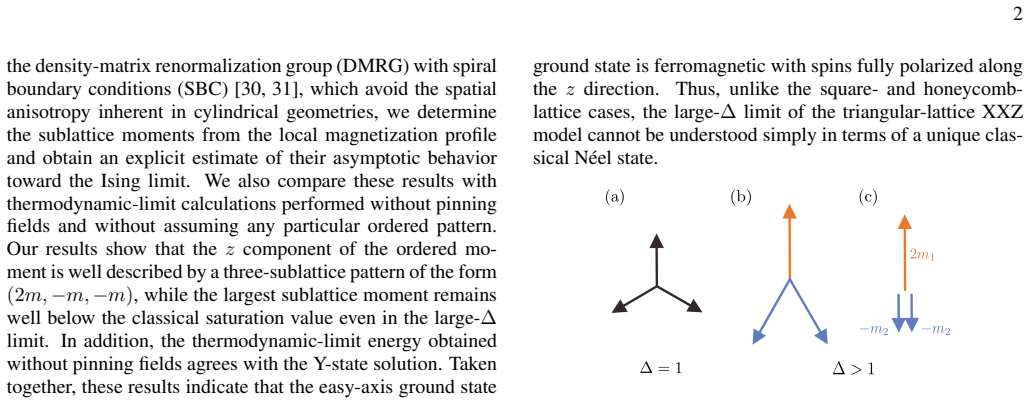
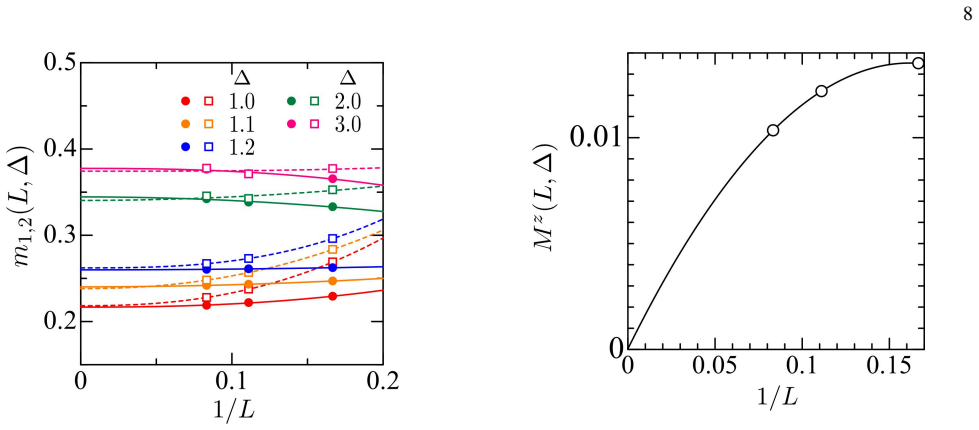
In the easy-axis regime, the ordered moments remain close to a zero-magnetization three-sublattice structure of the form (2m,-m,-m) over a broad range of Delta. Extrapolation in 1/Delta shows that the positive sublattice moment stays well below the classical saturation value 1/2, approaching 0.41873 as Delta to infinity, while the magnitude of the negative sublattice moment approaches 0.20832. The Y state is favored at zero field, and independent thermodynamic-limit energy calculations yield an energy consistent with the Y-state solution. These results show that the easy-axis ground state does not simply cross over to a trivially saturated collinear Ising state, but instead remains a trivial
What carries the argument
Three-sublattice moments extracted from symmetry-broken local magnetization profiles on spiral-boundary DMRG clusters, extrapolated in 1/Delta to the infinite-anisotropy limit.
Where Pith is reading between the lines
- This selection from the degenerate manifold may operate in other anisotropic frustrated spin systems.
- Neutron scattering or NMR in candidate materials could detect the specific (2m, -m, -m) moment imbalance.
- Finite-temperature or field-dependent extensions might show how the selected order evolves or melts.
Load-bearing premise
The extrapolation of sublattice moments in 1/Delta to the infinite-anisotropy limit accurately captures the thermodynamic-limit behavior without significant finite-size or boundary-condition artifacts.
What would settle it
A direct calculation or measurement of the sublattice moments reaching exactly the classical saturation values of 0.5 and 0 in the thermodynamic limit at very large anisotropy would falsify the nontrivial order claim.
Figures



read the original abstract
We investigate the ground-state magnetic structure of the spin-$1/2$ XXZ antiferromagnet on the triangular lattice in the easy-axis regime using the density-matrix renormalization group. By applying spiral boundary conditions, we exactly map finite $L\times L$ clusters onto one-dimensional chains while avoiding the spatial anisotropy inherent in cylindrical geometries. From symmetry-broken local magnetization profiles, we extract the three-sublattice moments and track their evolution with anisotropy. At the isotropic point, we obtain a positive sublattice moment of $0.21671$, consistent with previous numerical estimates. In the easy-axis regime, the ordered moments remain close to a zero-magnetization three-sublattice structure of the form $(2m,-m,-m)$ over a broad range of $\Delta$. Extrapolation in $1/\Delta$ shows that the positive sublattice moment stays well below the classical saturation value $1/2$, approaching $0.41873$ as $\Delta\to\infty$, while the magnitude of the negative sublattice moment approaches $0.20832$. We further compare the energies of the Y state and the up-down-down state and find that the Y state is favored at zero field. Independent thermodynamic-limit energy calculations, performed without assuming any particular ordered pattern, yield an energy consistent with the Y-state solution. These results show that the easy-axis ground state does not simply cross over to a trivially saturated collinear Ising state, but instead remains a nontrivial three-sublattice ordered state selected from the macroscopically degenerate Ising manifold by quantum fluctuations.
Editorial analysis
A structured set of objections, weighed in public.
Referee Report
Summary. The manuscript investigates the ground state of the spin-1/2 XXZ antiferromagnet on the triangular lattice in the easy-axis regime (Δ>1) via DMRG. Finite L×L clusters are mapped to 1D chains using spiral boundary conditions. From symmetry-broken local magnetization profiles the authors extract three-sublattice moments, extrapolate them linearly in 1/Δ, and report limiting values 0.41873 and 0.20832 (below classical saturation 0.5 and 0.25). They conclude that the ground state remains a nontrivial zero-magnetization Y-state selected by quantum fluctuations rather than crossing over to a saturated collinear Ising configuration. Supporting evidence includes energy comparisons between the Y-state and up-down-down state plus independent thermodynamic-limit energy calculations performed without assuming a particular ordered pattern.
Significance. If the reported extrapolations accurately represent the thermodynamic limit, the work clarifies the persistence of quantum order-by-disorder selection within the macroscopically degenerate Ising manifold on the triangular lattice. The spiral-boundary-condition mapping that enables controlled DMRG on 2D clusters and the independent energy calculations that do not presuppose order are methodological strengths that strengthen the numerical evidence.
major comments (2)
- [Abstract and extrapolation section] Abstract and the section describing the 1/Δ extrapolation: the sublattice moments are extrapolated only in 1/Δ on finite-L clusters; no prior L→∞ scaling at fixed large Δ is reported. Because the central claim that the moments remain below saturation (0.41873 and 0.20832) rests on these intercepts being the true thermodynamic-limit values, the absence of explicit finite-size analysis leaves open the possibility that L-dependent corrections alter the intercepts and weaken the evidence against a saturated collinear state.
- [Energy comparison and thermodynamic-limit calculations] Section on energy comparisons and independent thermodynamic-limit calculations: while the Y-state is shown to be lower in energy than the up-down-down state and independent calculations are stated to be consistent with the Y-state, the manuscript does not specify the range of system sizes, boundary conditions, or extrapolation procedure used for those thermodynamic-limit energies. This information is required to assess convergence and to confirm that the energy comparison is not itself affected by the same finite-size issues raised for the moments.
minor comments (2)
- [Abstract] The abstract provides no information on the DMRG bond dimensions, truncation errors, or convergence checks employed for the mapped 1D chains. These technical details should be added (or referenced to a methods section) so that readers can evaluate the numerical accuracy of the reported moments.
- Figures displaying local magnetization profiles should explicitly label the three sublattices and indicate the spiral boundary conditions used; this would improve clarity when readers compare the extracted moments to the classical (2m,−m,−m) structure.
Simulated Author's Rebuttal
We thank the referee for the careful reading of our manuscript and the constructive comments. We are pleased that the referee recognizes the significance of our results and the strengths of our approach. We respond to each major comment below, indicating the revisions we will make to address the concerns.
read point-by-point responses
-
Referee: [Abstract and extrapolation section] Abstract and the section describing the 1/Δ extrapolation: the sublattice moments are extrapolated only in 1/Δ on finite-L clusters; no prior L→∞ scaling at fixed large Δ is reported. Because the central claim that the moments remain below saturation (0.41873 and 0.20832) rests on these intercepts being the true thermodynamic-limit values, the absence of explicit finite-size analysis leaves open the possibility that L-dependent corrections alter the intercepts and weaken the evidence against a saturated collinear state.
Authors: We acknowledge the validity of this observation. Our primary extrapolation was performed in 1/Δ because the spiral boundary conditions provide excellent convergence for the local magnetizations even on moderate L. To strengthen our claim, we will add in the revised manuscript an analysis of the L-dependence at several fixed large values of Δ, including extrapolations to L→∞. This will demonstrate that finite-size corrections do not alter the conclusion that the moments remain below saturation in the thermodynamic limit. We will update the abstract and the relevant section to reflect this additional evidence. revision: yes
-
Referee: [Energy comparison and thermodynamic-limit calculations] Section on energy comparisons and independent thermodynamic-limit calculations: while the Y-state is shown to be lower in energy than the up-down-down state and independent calculations are stated to be consistent with the Y-state, the manuscript does not specify the range of system sizes, boundary conditions, or extrapolation procedure used for those thermodynamic-limit energies. This information is required to assess convergence and to confirm that the energy comparison is not itself affected by the same finite-size issues raised for the moments.
Authors: We agree that more details are needed for reproducibility and assessment. The thermodynamic-limit energy calculations were carried out using DMRG on cylindrical clusters with periodic boundary conditions along the short direction and open boundaries along the long direction, for widths L=4 to L=12 and lengths up to several times the width, with finite-size extrapolation in 1/L. We will include a detailed description of the system sizes, boundary conditions, and extrapolation procedure in the revised manuscript, along with the specific energy values obtained. revision: yes
Circularity Check
No significant circularity in numerical derivation chain
full rationale
The paper obtains its central results via direct DMRG simulations on finite L×L clusters mapped to 1D chains with spiral boundary conditions, extracts symmetry-broken local magnetization profiles to determine three-sublattice moments, and performs a linear extrapolation in 1/Δ to the infinite-anisotropy limit. These extrapolated values (0.41873 and 0.20832) are compared against classical saturation (0.5 and 0.25) as an independent benchmark, and an additional energy calculation without assuming any ordered pattern is shown to be consistent with the Y state. No step in the chain reduces by construction to its inputs, no parameters are fitted and then relabeled as predictions, and no load-bearing self-citations or imported uniqueness theorems are invoked. The procedure is a standard, externally falsifiable numerical workflow whose outputs are independent of the target claim.
Axiom & Free-Parameter Ledger
axioms (2)
- domain assumption DMRG truncation error is negligible for the system sizes employed
- domain assumption Spiral boundary conditions introduce no spurious anisotropy or topological effects that alter the bulk order
Reference graph
Works this paper leans on
-
[1]
Three-sublattice magnetization In contrast to bipartite lattices, where the magnetic order can be characterized by the staggered magnetization, as in our previous analyses of the square- and honeycomb-lattice cases [24, 25], the triangular-lattice XXZ model is expected to exhibit a three-sublattice magnetic structure. In the present analysis, we assume th...
-
[2]
Energy As discussed in Sec. III B, the DMRG calculations with pinning fields are performed in sectors of fixed total magne- tizationS z tot. Because the spin configuration near the system edges is directly constrained by the pinning fields, the total energy of a finite system is not always the most suitable quan- tity for characterizing the bulk magnetic ...
-
[3]
A. P. Ramirez, Strongly geometrically frustrated magnets, An- nual Review of Materials Research24, 453 (1994)
work page 1994
-
[4]
Balents, Spin liquids in frustrated magnets, Nature464, 199 (2010)
L. Balents, Spin liquids in frustrated magnets, Nature464, 199 (2010)
work page 2010
-
[5]
C. Lacroix, P. Mendels, and F. Mila,Introduction to frustrated magnetism: materials, experiments, theory(Springer Science & Business Media, 2011)
work page 2011
-
[6]
S. Miyashita and H. Kawamura, Phase transitions of anisotropic heisenberg antiferromagnets on the triangular lattice, Journal of the Physical Society of Japan54, 3385 (1985)
work page 1985
-
[7]
D. Sellmann, X.-F. Zhang, and S. Eggert, Phase diagram of the antiferromagnetic xxz model on the triangular lattice, Physical Review B91, 081104 (2015)
work page 2015
-
[8]
S. Wessel and M. Troyer, Supersolid hard-core bosons on the triangular lattice, Physical Review Letters95, 127205 (2005)
work page 2005
-
[9]
D. Heidarian and K. Damle, Persistent supersolid phase of hard- core bosons on the triangular lattice, Physical Review Letters 95, 127206 (2005)
work page 2005
-
[10]
M. Boninsegni and N. Prokof’ev, Supersolid phase of hard- core bosons on a triangular lattice, Phys. Rev. Lett.95, 237204 (2005)
work page 2005
-
[11]
R. G. Melko, A. Paramekanti, A. A. Burkov, A. Vishwanath, D. N. Sheng, and L. Balents, Supersolid order from disorder: Hard-core bosons on the triangular lattice, Phys. Rev. Lett.95, 127207 (2005)
work page 2005
-
[12]
D. A. Huse and V . Elser, Simple variational wave functions for two-dimensional heisenberg spin-1/2 antiferromagnets, Phys. Rev. Lett.60, 2531 (1988)
work page 1988
- [13]
- [14]
-
[15]
L. Capriotti, A. E. Trumper, and S. Sorella, Long-range n ´eel order in the triangular heisenberg model, Phys. Rev. Lett.82, 3899 (1999)
work page 1999
- [16]
-
[17]
S. R. White and A. L. Chernyshev, N´eel order in square and tri- angular lattice heisenberg models, Phys. Rev. Lett.99, 127004 (2007)
work page 2007
-
[18]
Q. Li, H. Li, J. Zhao, H.-G. Luo, and Z. Y . Xie, Magnetization of the spin-1/2 heisenberg antiferromagnet on the triangular lat- tice, Physical Review B105, 184418 (2022)
work page 2022
- [19]
- [20]
-
[21]
Y . Gao, Y .-C. Fan, H. Li, F. Yang, X.-T. Zeng, X.-L. Sheng, R. Zhong, Y . Qi, Y . Wan, and W. Li, Spin supersolidity in nearly ideal easy-axis triangular quantum antiferromagnet na2baco (po4) 2, npj Quantum Materials7, 89 (2022)
work page 2022
-
[22]
J. Sheng, L. Wang, A. Candini, W. Jiang, L. Huang, B. Xi, J. Zhao, H. Ge, N. Zhao, Y . Fu, J. Ren, J. Yang, P. Miao, X. Tong, D. Yu, S. Wang, Q. Liu, M. Kofu, R. Mole, G. Bi- asiol, D. Yu, I. A. Zaliznyak, J.-W. Mei, and L. Wu, Two- dimensional quantum universality in the spin-1/2 triangular- lattice quantum antiferromagnet na2baco(po4)2, Proceedings of t...
-
[23]
M. Zhu, L. M. Chinellato, V . Romerio, N. Murai, S. Ohira- Kawamura, C. Balz, Z. Yan, S. Gvasaliya, Y . Kato, C. D. Batista, and A. Zheludev, Wannier states and spin supersolid physics in the triangular antiferromagnet k2co(seo3)2, npj Quantum Materials10, 74 (2025)
work page 2025
-
[24]
P. W. Anderson, An approximate quantum theory of the antifer- romagnetic ground state, Phys. Rev.86, 694 (1952)
work page 1952
-
[25]
Sachdev,Quantum phases of matter(Cambridge University Press, 2023)
S. Sachdev,Quantum phases of matter(Cambridge University Press, 2023)
work page 2023
-
[26]
M. Kadosawa, M. Nakamura, Y . Ohta, and S. Nishimoto, Study of staggered magnetization in the spin-s square-lattice heisen- berg model using spiral boundary conditions, Journal of the Physical Society of Japan92, 023701 (2023)
work page 2023
-
[27]
M. Kadosawa, M. Nakamura, Y . Ohta, and S. Nishimoto, Comparing quantum fluctuations in the spin- 1 2 and spin-1 xxz heisenberg models on the square and honeycomb lattices, Phys. Rev. B110, 134418 (2024)
work page 2024
-
[28]
G. H. Wannier, Antiferromagnetism. the triangular ising net, Physical Review79, 357 (1950)
work page 1950
-
[29]
Villain, J., Bidaux, R., Carton, J.-P., and Conte, R., Order as an effect of disorder, J. Phys. France41, 1263 (1980). 11
work page 1980
-
[30]
E. Shender, Antiferromagnetic garnets with fluctuationally in- teracting sublattices, Soviet Journal of Experimental and Theo- retical Physics56, 178 (1982)
work page 1982
-
[31]
A. Sen, P. Dutt, K. Damle, and R. Moessner, Variational wave- function study of the triangular lattice supersolid, Phys. Rev. Lett.100, 147204 (2008)
work page 2008
-
[32]
M. Nakamura, S. Masuda, and S. Nishimoto, Characterization of topological insulators based on the electronic polarization with spiral boundary conditions, Phys. Rev. B104, L121114 (2021)
work page 2021
-
[33]
M. Kadosawa, M. Nakamura, Y . Ohta, and S. Nishimoto, One- dimensional projection of two-dimensional systems using spiral boundary conditions, Phys. Rev. B107, L081104 (2023)
work page 2023
-
[34]
S. R. White, Density matrix formulation for quantum renormal- ization groups, Phys. Rev. Lett.69, 2863 (1992)
work page 1992
- [35]
-
[36]
Y . Iqbal, W.-J. Hu, R. Thomale, D. Poilblanc, and F. Becca, Spin liquid nature in the heisenbergJ 1 −J 2 triangular antifer- romagnet, Phys. Rev. B93, 144411 (2016)
work page 2016
- [37]
-
[38]
A. V . Chubukov and D. I. Golosov, Quantum theory of an anti- ferromagnet on a triangular lattice in a magnetic field, Journal of Physics: Condensed Matter3, 69 (1991)
work page 1991
-
[39]
D. Yamamoto, G. Marmorini, and I. Danshita, Quantum phase diagram of the triangular-latticexxzmodel in a magnetic field, Phys. Rev. Lett.112, 127203 (2014)
work page 2014
-
[40]
S. Miyashita, Magnetic properties of ising-like heisenberg an- tiferromagnets on the triangular lattice, Journal of the Physical Society of Japan55, 3605 (1986)
work page 1986
- [41]
-
[42]
Q. Sheng and C. L. Henley, Ordering due to disorder in a tri- angular heisenberg antiferromagnet with exchange anisotropy, Journal of Physics: Condensed Matter4, 2937 (1992)
work page 1992
discussion (0)
Sign in with ORCID, Apple, or X to comment. Anyone can read and Pith papers without signing in.