Exploring and Testing Skill-Based Behavioral Profile Annotation: Human Operability and LLM Feasibility under Schema-Guided Execution
Pith reviewed 2026-05-10 11:19 UTC · model grok-4.3
The pith
Behavioral profile annotation breaks into heterogeneous skills where humans and GPT-5.4 can handle only a selective subset under a fixed schema.
A machine-rendered reading of the paper's core claim, the machinery that carries it, and where it could break.
Core claim
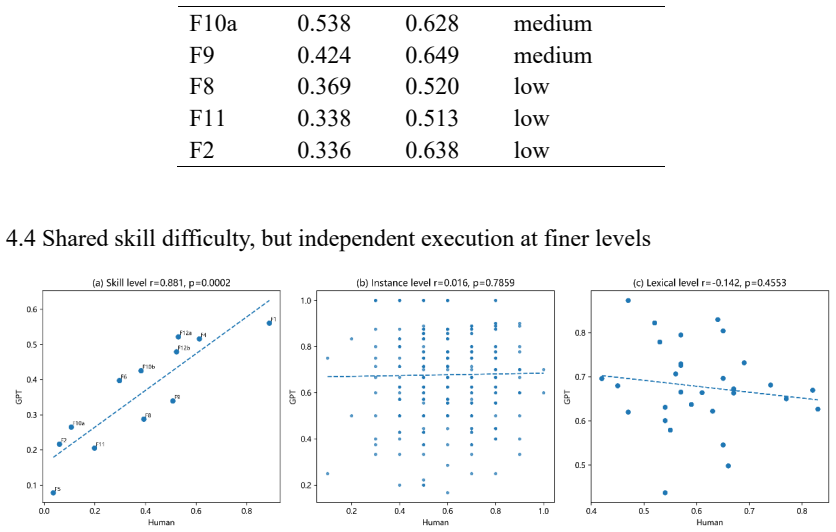
When behavioral profile annotation is recast as a bundle of independent skills executed via a skill-file-driven pipeline with schema files, decision rules, and examples for each of the fourteen features, five skills prove directly operable by humans, four become recoverable after targeted re-annotation, and five remain structurally underspecified. GPT-5.4 achieves substantial reliability on the retained skills (accuracy 0.678, kappa 0.665, weighted F1 0.695), and human-GPT difficulty profiles align strongly at the skill level (r = 0.881) but not at the instance level (r = 0.016) or lexical-item level (r = -0.142). Pairwise agreement patterns indicate GPT operates as an independent thirdannot
What carries the argument
The skill-file-driven pipeline that decomposes the 14-feature BP schema into independent skills, each governed by its own external schema file containing decision rules and examples.
If this is right
- Annotation automation should be measured and improved skill by skill rather than as a single task.
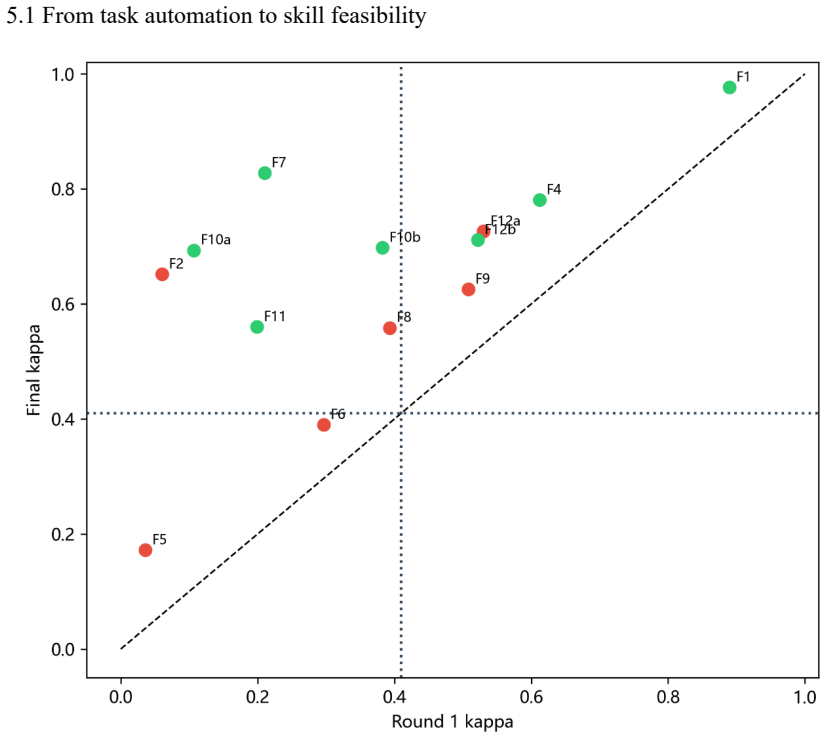
- Targeted re-annotation of the four recoverable skills can expand the usable skill set without redesigning the schema.
- LLMs can be deployed as a distinct third voice for the operable skills instead of as a direct replacement for human annotators.
- Focus on schema refinement should prioritize the five structurally underspecified skills to raise overall coverage.
- Open-source models fail mainly on schema-to-skill translation, pointing to a need for better prompt or file integration rather than model scale alone.
Where Pith is reading between the lines
- The skill-level alignment but instance-level independence pattern may appear in other multi-dimensional annotation tasks such as discourse or sentiment coding.
- Hybrid systems could route each skill to the human or model that performs it best once per-skill reliability is known.
- Underspecified skills likely require either schema expansion or new decision criteria rather than more training data alone.
- The same decomposition method could be tested on non-Chinese or non-metaphorical annotation projects to check whether heterogeneity is domain-specific.
Load-bearing premise
The 14-feature schema supplies a complete and unbiased breakdown of annotation requirements, and classifications made by two annotators on a 300-instance subset generalize to the full 3,134 lines without major bias.
What would settle it
Re-running the full pipeline on the entire 3,134 lines with at least four additional human annotators and measuring whether the counts of operable, recoverable, and underspecified skills shift by more than 20 percent.
Figures


read the original abstract
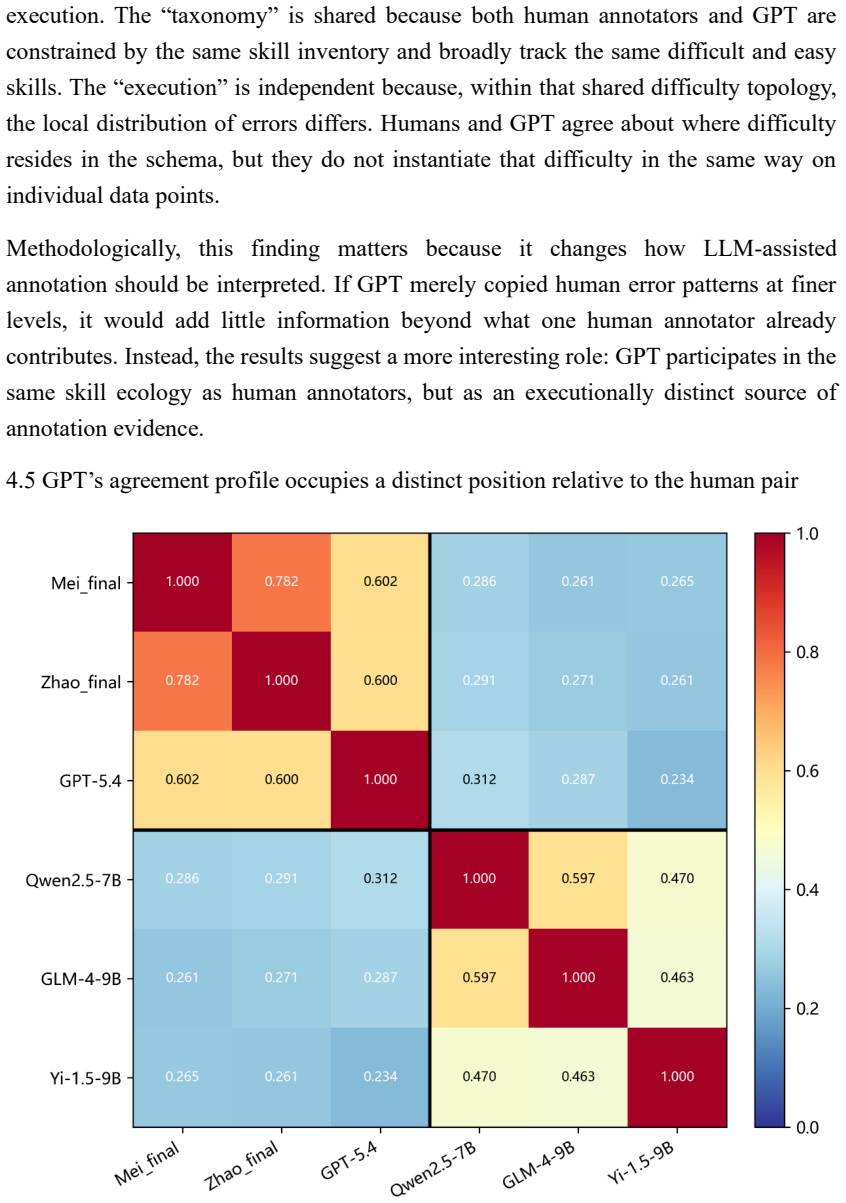
Behavioral Profile (BP) annotation is difficult to automate because it requires simultaneous coding across multiple linguistic dimensions. We treat BP annotation as a bundle of annotation skills rather than a single task and evaluate LLM-assisted BP annotation from this perspective. Using 3,134 concordance lines of 30 Chinese metaphorical color-term derivatives and a 14-feature BP schema, we implement a skill-file-driven pipeline in which each feature is externally defined through schema files, decision rules, and examples. Two human annotators completed a two-round schema-only protocol on a 300-instance validation subset, enabling BP skills to be classified as directly operable, recoverable under focused re-annotation, or structurally underspecified. GPT-5.4 and three locally deployable open-source models were then evaluated under the same setup. Results show that BP annotation is highly heterogeneous at the skill level: 5 skills are directly operable, 4 are recoverable after focused re-annotation, and 5 remain structurally underspecified. GPT-5.4 executes the retained skills with substantial reliability (accuracy = 0.678, \k{appa} = 0.665, weighted F1 = 0.695), but this feasibility is selective rather than global. Human and GPT difficulty profiles are strongly aligned at the skill level (r = 0.881), but not at the instance level (r = 0.016) or lexical-item level (r = -0.142), a pattern we describe as shared taxonomy, independent execution. Pairwise agreement further suggests that GPT is better understood as an independent third skill voice than as a direct human substitute. Open-source failures are concentrated in schema-to-skill execution problems. These findings suggest that automatic annotation should be evaluated in terms of skill feasibility rather than task-level automation.
Editorial analysis
A structured set of objections, weighed in public.
Referee Report
Summary. The paper treats behavioral profile (BP) annotation as a bundle of 14 distinct skills defined via external schema files rather than a monolithic task. On 3,134 Chinese metaphorical color-term concordance lines, two human annotators apply a two-round schema-only protocol to a 300-instance validation subset and partition the skills into 5 directly operable, 4 recoverable after focused re-annotation, and 5 structurally underspecified. GPT-5.4 and three open-source models are then evaluated on the retained skills; GPT-5.4 achieves accuracy 0.678, kappa 0.665, and weighted F1 0.695. Human and model difficulty profiles correlate strongly at the skill level (r = 0.881) but not at the instance (r = 0.016) or lexical-item (r = -0.142) levels, which the authors term “shared taxonomy, independent execution.”
Significance. If the skill-level heterogeneity and selective LLM feasibility findings hold, the work offers a practical framework for decomposing complex linguistic annotation tasks and evaluating automation at the skill rather than task level. The concrete metrics, the alignment pattern across granularity levels, and the schema-driven pipeline constitute reproducible empirical contributions that could inform future annotation pipelines in computational linguistics.
major comments (2)
- [Validation subset and skill classification (Methods)] The central claim that BP annotation is “highly heterogeneous at the skill level” (5 operable / 4 recoverable / 5 underspecified) rests entirely on the two annotators’ classifications performed on the 300-instance validation subset. No stratification, random-sampling justification, or statistical comparison of feature distributions between this subset and the remaining 2,834 lines is reported. Because the 5/4/5 partition is load-bearing for all subsequent claims about selective feasibility and human–GPT alignment, the absence of representativeness evidence directly weakens the generalizability of the heterogeneity result.
- [Skill classification protocol (Methods)] The “recoverable” category for four skills is defined by success after an unspecified “focused re-annotation” procedure. No formal success criteria, decision rules, or inter-annotator agreement thresholds for this second round are provided, rendering the recoverability classification non-replicable and therefore non-falsifiable.
minor comments (2)
- [Abstract] Abstract contains a LaTeX error: “accuracy = 0.678, kappa = 0.665” is rendered as “accuracy = 0.678, kappa = 0.665” with “k{appa}”; correct to proper kappa symbol.
- [Human annotation results] The manuscript does not report inter-annotator agreement statistics (e.g., Cohen’s kappa or percentage agreement) for the two human annotators on the 300-instance subset; these figures are standard for annotation studies and should be added.
Simulated Author's Rebuttal
We thank the referee for the constructive major comments on the methodological foundations of our skill classification. These points help clarify the generalizability and replicability of the 5/4/5 partition. We address each comment below and will incorporate revisions to strengthen the manuscript.
read point-by-point responses
-
Referee: [Validation subset and skill classification (Methods)] The central claim that BP annotation is “highly heterogeneous at the skill level” (5 operable / 4 recoverable / 5 underspecified) rests entirely on the two annotators’ classifications performed on the 300-instance validation subset. No stratification, random-sampling justification, or statistical comparison of feature distributions between this subset and the remaining 2,834 lines is reported. Because the 5/4/5 partition is load-bearing for all subsequent claims about selective feasibility and human–GPT alignment, the absence of representativeness evidence directly weakens the generalizability of the heterogeneity result.
Authors: We acknowledge that the original submission did not include an explicit justification or statistical comparison demonstrating that the 300-instance validation subset is representative of the full 3,134 lines. The subset was selected to enable feasible two-round human annotation under the schema-only protocol while covering all 30 color terms. In the revision we will add to the Methods section: (i) a clear description of the sampling procedure (random selection with stratification by color term to ensure proportional representation), and (ii) a supplementary table reporting distributional comparisons (e.g., chi-square tests on color-term frequencies and mean sentence length) between the validation subset and the remaining 2,834 lines. This will either support the generalizability of the skill classification or allow us to qualify the heterogeneity claim accordingly. revision: yes
-
Referee: [Skill classification protocol (Methods)] The “recoverable” category for four skills is defined by success after an unspecified “focused re-annotation” procedure. No formal success criteria, decision rules, or inter-annotator agreement thresholds for this second round are provided, rendering the recoverability classification non-replicable and therefore non-falsifiable.
Authors: We agree that the recoverability classification requires explicit documentation to be replicable. The focused re-annotation round consisted of the two annotators re-examining the relevant instances after the schema files were augmented with additional decision rules and examples targeting the observed disagreements. In the revised Methods we will specify: the exact decision rules added to the schema, the formal success criterion (post-reannotation Cohen’s kappa ≥ 0.65 on the four skills), and the resulting agreement values. This will render the 4-skill recoverable category fully operationalized, falsifiable, and replicable by future researchers. revision: yes
Circularity Check
No significant circularity: purely empirical measurements
full rationale
The paper is an empirical study that reports direct human annotation results on a 300-instance validation subset (classifying 14 skills into operable/recoverable/underspecified categories) followed by LLM performance metrics (accuracy, kappa, weighted F1, Pearson correlations) computed against those annotations on held-out data. No equations, derivations, fitted parameters, or predictions appear in the reported chain. Skill classifications and model evaluations are observational outcomes, not quantities defined by construction from inputs within the paper. No self-citations are invoked as load-bearing uniqueness theorems or ansatzes. The subset representativeness concern is a methodological limitation but does not reduce any result to a self-referential fit or definition.
Axiom & Free-Parameter Ledger
axioms (1)
- domain assumption The 14-feature BP schema accurately captures all necessary annotation dimensions for the chosen Chinese metaphorical color-term derivatives.
Reference graph
Works this paper leans on
-
[1]
Aroyo, L., & Welty, C. (2015). Truth is a lie: Crowd truth and the seven myths of human annotation. AI Magazine, 36(1), 15–24. https://doi.org/10.1609/aimag.v36i1.2564
-
[2]
Divjak, D., & Gries, S. T. (2009). Behavioral profiles: A corpus -based approach to cognitive semantic analysis. In V . Evans & S. Pourcel (Eds.), New directions in cognitive linguistics (V ol. 24, pp. 57 –75). John Benjamins. https://doi.org/10.1075/hcp.24.07gri
-
[3]
Fang, Q., Garcia -Bernardo, J., & van Kesteren, E. -J. (2025). Using large language models for text annotation in social science and humanities: A hands -on Python/R tutorial. SocArXiv. https://doi.org/10.31235/osf.io/v4eq6_v1
-
[4]
Gries, S. T. (2010). Behavioral profiles: A fine -grained and quantitative approach in corpus-based lexical semantics. The Mental Lexicon, 5 (3), 323 –346. https://doi.org/10.1075/ml.5.3.04gri
-
[5]
Landis, J. R., & Koch, G. G. (1977). The measurement of observer agreement for categorical data. Biometrics, 33(1), 159–174. https://doi.org/10.2307/2529310
-
[6]
Movva, R., Koh, P. W., & Pierson, E. (2024). Annotation alignment: Comparing LLM and human annotations of conversational safety. In Proceedings of the 2024 Conference on Empirical Methods in Natural Language Processing (pp. 9048–9062). Association for Computational Linguistics. https://doi.org/10.18653/v1/2024.emnlp-main.511
-
[7]
Plank, B. (2022). The “problem” of human label variation: On ground truth in data, modeling and evaluation. In Proceedings of the 2022 Conference on Empirical Methods in Natural Language Processing (pp. 10671–10682). Association for Computational Linguistics. https://doi.org/10.18653/v1/2022.emnlp-main.731
-
[8]
Schroeder, H., Roy, D., & Kabbara, J. (2025). Just put a human in the loop? Investigating LLM -assisted annotation for subjective tasks. In Findings of the Association for Computational Linguistics: ACL 2025 (pp. 25771–25795). Association for Computational Linguistics. https://aclanthology.org/2025.findings-acl.1323/ https://doi.org/10.18653/v1/2025.findi...
-
[9]
Zhang, X., Peng, B., Li, K., Zhou, J., & Meng, H. (2023). SGP -TOD: Building task bots effortlessly via schema-guided LLM prompting. In Findings of the Association for Computational Linguistics: EMNLP 2023 (pp. 13348 –13369). Association for Computational Linguistics. https://aclanthology.org/2023.findings-emnlp.891/ https://doi.org/10.18653/v1/2023.findi...
discussion (0)
Sign in with ORCID, Apple, or X to comment. Anyone can read and Pith papers without signing in.