The hydrodynamical response of cold circumgalactic clouds to quasar radiation
Pith reviewed 2026-05-10 07:29 UTC · model grok-4.3
The pith
An analytical framework identifies three evolutionary paths for cold circumgalactic clouds under quasar radiation, with ionization state depending on quasar brightness.
A machine-rendered reading of the paper's core claim, the machinery that carries it, and where it could break.
Core claim
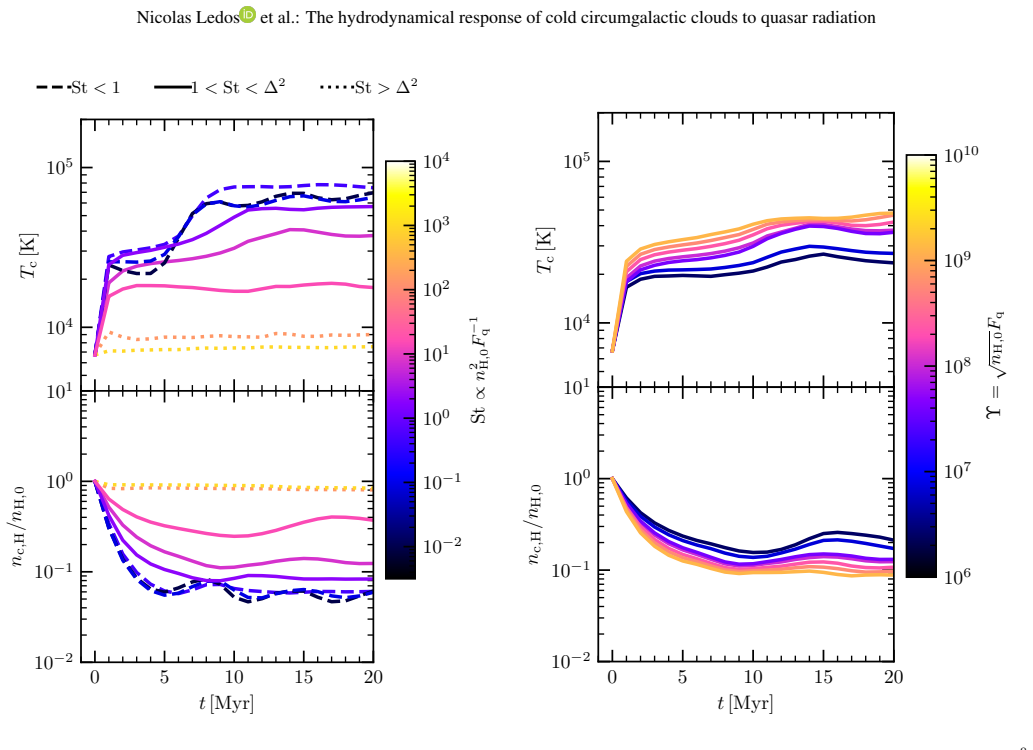
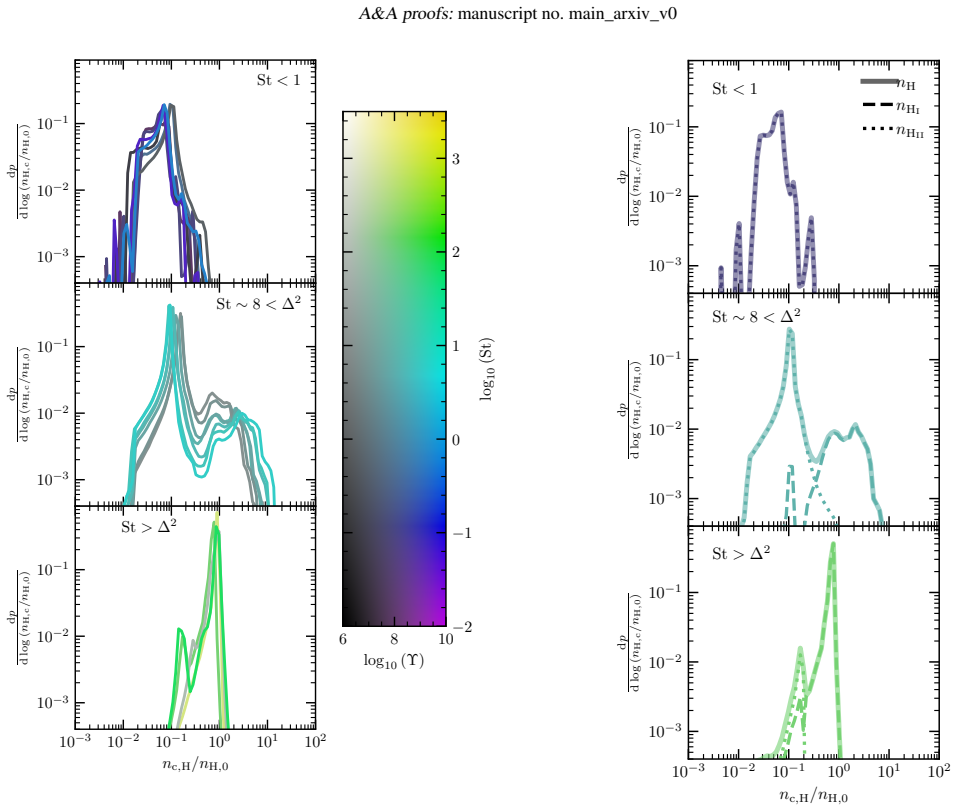
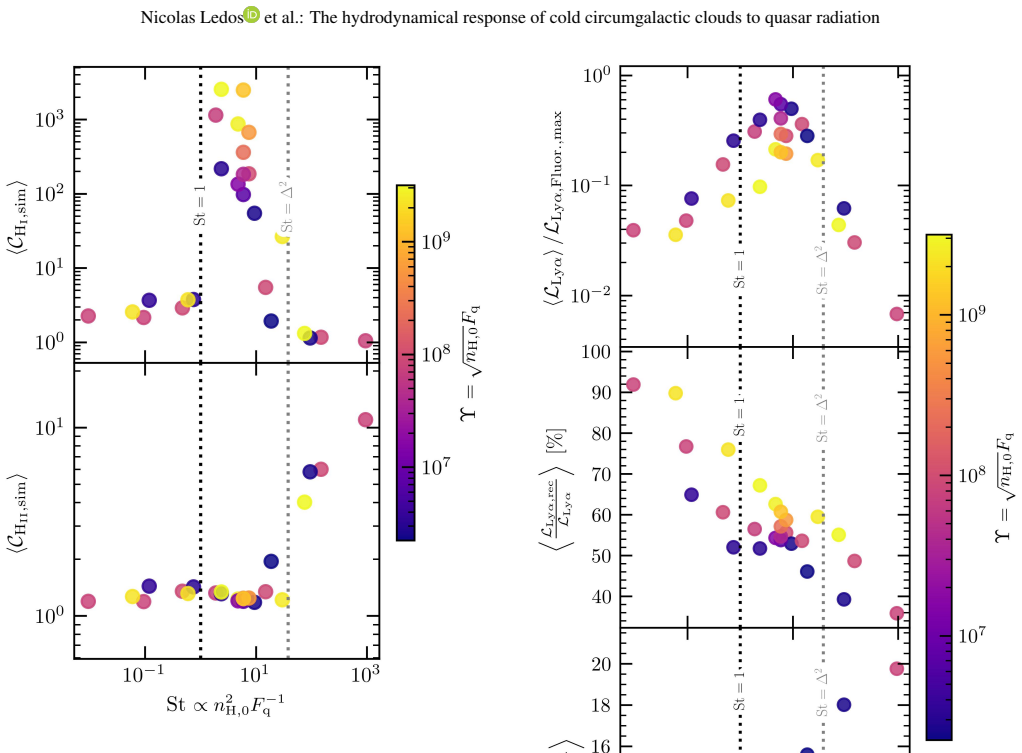
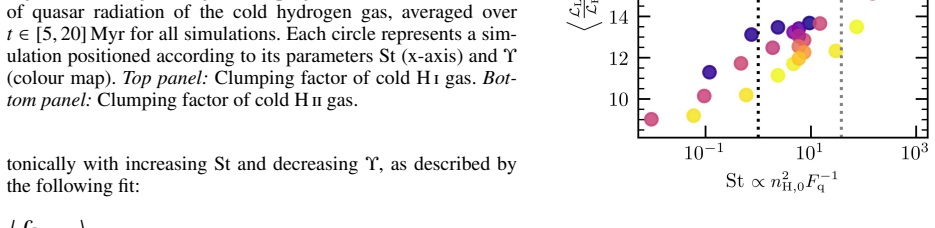
We introduce a new threshold defining when a cloud becomes radiation-shielded and use it to predict three evolutionary paths: an optically thin regime in which radiation uniformly ionises the cloud, a radiation-shielded regime where the cloud remains largely unaffected, and a rocket-effect regime in which the ionisation front ionises the illuminated side while compressing the opposite side and later accelerating the surviving cold clump. In the rocket-effect regime the cloud's Ly alpha luminosity can reach up to ten times the optically thin value and as much as 70 percent of the fluorescent value without hydrodynamical response. Unless shielded, at least 50-60 percent of the Ly alpha arises,
What carries the argument
The radiation-shielding threshold that partitions cold clouds into optically thin, shielded, or rocket-effect evolutionary regimes under quasar EUV radiation.
If this is right
- Bright quasars with L_nu,LL around 10^31.6 erg s^-1 Hz^-1 fully ionize the cold CGM.
- Faint quasars with L_nu,LL around 10^28.6 erg s^-1 Hz^-1 leave most cold gas in the rocket-effect regime with compressed, accelerated clumps.
- Rocket-effect clouds produce Ly alpha luminosities up to an order of magnitude higher than the optically thin case.
- At least 50-60 percent of Ly alpha emission comes from recombination unless the cloud is shielded.
- Physical properties of cold CGM must be derived with hydrodynamical response included, especially around faint quasars.
Where Pith is reading between the lines
- The predicted acceleration in the rocket-effect regime could produce observable high-velocity cold gas components in quasar fields.
- Extending the model to include turbulence or magnetic fields would test whether the three regimes remain distinct in more realistic CGM conditions.
- Ly alpha observations around faint quasars might reveal spatial offsets or velocity gradients matching the compressed far-side clumps.
- The ionization predictions could revise estimates of cold-gas accretion rates onto galaxies in quasar environments.
Load-bearing premise
Cold clouds are assumed to start as static, uniform spheres with no magnetic fields, external turbulence, or full 3D geometric effects on ionization-front propagation.
What would settle it
A radiation-hydrodynamic simulation or observation of a cold cloud around a faint quasar showing no far-side compression and acceleration after ionization-front passage would falsify the rocket-effect regime.
Figures



read the original abstract
Recent simulations increasingly resolve the small-scale structure of the circumgalactic medium (CGM), but the dynamical impact of ionising radiation on its cold $10^4$ K component remains poorly understood. We investigate the evolution of cold gas structures exposed to quasars' EUV radiation. We develop an analytical framework to describe the evolution of such clouds, introducing a new threshold that defines when a cloud becomes radiation-shielded. The framework is validated using radiation-hydrodynamic simulations of single static clouds. It predicts three evolutionary paths: (i) an optically thin regime, in which radiation uniformly ionises the cloud; (ii) a radiation-shielded regime, where the cloud remains largely unaffected; and (iii) a rocket-effect regime, in which the propagation of the ionisation front ionises the illuminated side while compressing the opposite side, later accelerating the surviving cold clump. In the latter regime, the cloud's Ly$\alpha$ luminosity can be up to one order of magnitude higher than the optically thin case. Such luminosities are as high as $70\%$ of the values obtained from a fluorescent regime without considering hydrodynamical response. Unless the cloud is shielded, at least $\sim 50$-$60\,\%$ of Ly$\alpha$ emission arises from recombination. Applying this framework to both a ray crossing a population of clouds, and a ray propagating inside a cold stream, we find that the cold CGM around bright quasars ($L_{\mathrm{\nu,LL}} \sim 10^{31.6} \, \mathrm{erg\, s^{-1}\, Hz^{-1}}$) is likely fully ionised, whereas the one around faint quasars ($L_{\mathrm{\nu,LL}} \sim 10^{28.6} \, \mathrm{erg\, s^{-1}\, Hz^{-1}}$) predominantly experiences a rocket-effect regime. These results imply that the hydrodynamical response of cold CGM structures to quasar radiation must be considered when deriving their physical properties, particularly for faint quasars.
Editorial analysis
A structured set of objections, weighed in public.
Referee Report
Summary. The manuscript develops an analytical framework for the hydrodynamical evolution of cold (10^4 K) circumgalactic clouds exposed to quasar EUV radiation, introducing a radiation-shielding threshold. The framework is validated against radiation-hydrodynamic simulations of single static, uniform clouds and predicts three regimes: (i) optically thin, with uniform ionization; (ii) radiation-shielded, with minimal effect; and (iii) rocket-effect, with ionization-front compression and acceleration of surviving clumps. In the rocket-effect regime, Lyα luminosity can increase by up to an order of magnitude relative to the optically thin case, with at least 50-60% arising from recombination unless shielded. Application to a ray through a cloud population or cold stream indicates that cold CGM around bright quasars (L_ν,LL ~ 10^31.6 erg s^{-1} Hz^{-1}) is likely fully ionized, while around faint quasars (L_ν,LL ~ 10^28.6 erg s^{-1} Hz^{-1}) the rocket-effect regime dominates.
Significance. If the idealized assumptions hold, the work supplies a parameter-free analytical framework (validated by RHD simulations) that cleanly delineates evolutionary regimes and quantifies the hydrodynamical boost to Lyα emission. This is a useful advance for interpreting quasar-CGM observations, particularly the previously under-considered dynamical response in faint-quasar environments. The direct mapping from single-cloud analytics to population/stream predictions is a strength.
major comments (1)
- [Application to populations and streams] Application to populations and streams (final paragraph of abstract and corresponding section): The central claim that bright quasars fully ionize cold CGM while faint quasars drive rocket-effect regimes rests on direct extrapolation of the radiation-shielding threshold and three regimes derived for initially static, uniform clouds. No robustness tests against subsonic turbulence or magnetic fields are reported; such effects could suppress ionization-front compression or alter cloud survival, shifting the luminosity thresholds that separate the regimes. This extrapolation is load-bearing for the observational conclusions.
minor comments (2)
- [Abstract / framework introduction] The abstract and framework section would benefit from an explicit statement of the radiation-shielding threshold (e.g., in terms of column density or optical depth) to make the regime boundaries immediately quantifiable.
- [Simulation validation] Simulation validation paragraph: provide the grid resolution, box size, and initial cloud density profile used in the RHD runs so readers can assess numerical convergence of the rocket-effect compression.
Simulated Author's Rebuttal
We thank the referee for their positive assessment of the manuscript and for the constructive comment on the application to populations and streams. We address this point below.
read point-by-point responses
-
Referee: Application to populations and streams (final paragraph of abstract and corresponding section): The central claim that bright quasars fully ionize cold CGM while faint quasars drive rocket-effect regimes rests on direct extrapolation of the radiation-shielding threshold and three regimes derived for initially static, uniform clouds. No robustness tests against subsonic turbulence or magnetic fields are reported; such effects could suppress ionization-front compression or alter cloud survival, shifting the luminosity thresholds that separate the regimes. This extrapolation is load-bearing for the observational conclusions.
Authors: We agree that the mapping from single static uniform clouds to populations and streams constitutes an extrapolation of the derived thresholds. The analytical framework and the three regimes are explicitly developed and validated under the idealized conditions stated in the manuscript (initially static, uniform clouds). The application in the final paragraph of the abstract and the corresponding section is presented as an illustrative estimate of which regime dominates for given quasar luminosities, rather than a definitive prediction for realistic, turbulent, magnetized clouds. We have not performed robustness tests including subsonic turbulence or magnetic fields, as these would require a separate suite of simulations beyond the scope of the current work. In the revised manuscript we will add a new paragraph in the discussion section that explicitly lists these assumptions, notes that turbulence and magnetic fields could modify ionization-front compression and cloud survival, and states that the reported luminosity thresholds separating the regimes should therefore be regarded as indicative. We maintain that the core hydrodynamical response (rocket effect and associated Lyα boost) remains a relevant physical effect that must be considered even in more complex environments. revision: partial
Circularity Check
No significant circularity; derivation from standard equations with independent validation
full rationale
The analytical framework is constructed from standard radiation-hydrodynamic equations for ionization-front propagation and cloud compression, then validated against separate RHD simulations of initially static uniform clouds. The three regimes (optically thin, shielded, rocket-effect) and the luminosity thresholds for bright vs. faint quasars are direct consequences of these equations and the shielding criterion, without any reduction to a fitted parameter renamed as prediction, self-citation load-bearing premise, or ansatz smuggled from prior author work. No load-bearing step equates output to input by construction.
Axiom & Free-Parameter Ledger
axioms (2)
- standard math Ionization equilibrium and optically thin/thick approximations hold for the EUV radiation propagation through the cloud.
- domain assumption Initial clouds are static, uniform, and isolated with no external pressure gradients or magnetic support.
invented entities (2)
-
Radiation-shielding threshold
no independent evidence
-
Rocket-effect regime
no independent evidence
Reference graph
Works this paper leans on
-
[1]
, " * write output.state after.block = add.period write newline
ENTRY address archiveprefix author booktitle chapter edition editor howpublished institution eprint journal key month note number organization pages publisher school series title type volume year label extra.label sort.label short.list INTEGERS output.state before.all mid.sentence after.sentence after.block FUNCTION init.state.consts #0 'before.all := #1 ...
-
[2]
" write newline "" before.all 'output.state := FUNCTION n.dashify 't := "" t empty not t #1 #1 substring "-" = t #1 #2 substring "--" = not "--" * t #2 global.max substring 't := t #1 #1 substring "-" = "-" * t #2 global.max substring 't := while if t #1 #1 substring * t #2 global.max substring 't := if while FUNCTION word.in bbl.in " " * FUNCTION format....
-
[3]
Armillotta , L., Fraternali , F., Werk , J. K., Prochaska , J. X., & Marinacci , F. 2017, , 470, 114
work page 2017
-
[4]
Arrigoni Battaia , F., Hennawi, J. F., Prochaska, J. X., et al. 2018, Monthly Notices of the Royal Astronomical Society, 482, 3162
work page 2018
- [5]
-
[6]
2010, in Society of Photo-Optical Instrumentation Engineers (SPIE) Conference Series, Vol
Bacon , R., Accardo , M., Adjali , L., et al. 2010, in Society of Photo-Optical Instrumentation Engineers (SPIE) Conference Series, Vol. 7735, Ground-based and Airborne Instrumentation for Astronomy III, ed. I. S. McLean , S. K. Ramsay , & H. Takami , 773508
work page 2010
-
[7]
1989, The Astrophysical Journal, 346, 735
Bertoldi, F. 1989, The Astrophysical Journal, 346, 735
work page 1989
- [8]
- [9]
- [10]
-
[11]
Cantalupo , S., Arrigoni-Battaia , F., Prochaska , J. X., Hennawi , J. F., & Madau , P. 2014, , 506, 63
work page 2014
-
[12]
Cantalupo , S., Porciani , C., & Lilly , S. J. 2008, , 672, 48
work page 2008
-
[13]
Cantalupo , S., Porciani , C., Lilly , S. J., & Miniati , F. 2005, , 628, 61
work page 2005
- [14]
-
[15]
Decataldo , D., Pallottini , A., Ferrara , A., Vallini , L., & Gallerani , S. 2019, , 487, 3377
work page 2019
- [16]
-
[17]
Dekel, A., Zolotov, A., Tweed, D., et al. 2013, MNRAS, 435, 999
work page 2013
-
[18]
Deparis , N., Aubert , D., Ocvirk , P., Chardin , J., & Lewis , J. 2019, , 622, A142
work page 2019
- [19]
-
[20]
Fardal , M. A., Katz , N., Gardner , J. P., et al. 2001, ApJ, 562, 605
work page 2001
-
[21]
Faucher-Gigu\` e re, C. A. & Kere s , D. 2011, MNRAS, 412, 118
work page 2011
-
[22]
Faucher-Giguère, C.-A. & Oh, S. P. 2023, Annual Review of Astronomy and Astrophysics, 61, 131
work page 2023
-
[23]
2014, Quantifying Uncertainties in Radiation Hydrodynamics Models (Ann Arbor, 1001:48109)
Fidkowski , K. 2014, Quantifying Uncertainties in Radiation Hydrodynamics Models (Ann Arbor, 1001:48109)
work page 2014
- [24]
- [25]
- [26]
- [27]
- [28]
-
[29]
Gronke , M. & Schneider , E. 2026, arXiv e-prints, arXiv:2601.16566
- [30]
- [31]
-
[32]
T., Hirashita , H., & Ferrara , A
Iliev , I. T., Hirashita , H., & Ferrara , A. 2006, , 368, 1885
work page 2006
-
[33]
T., Whalen , D., Mellema , G., et al
Iliev , I. T., Whalen , D., Mellema , G., et al. 2009, , 400, 1283
work page 2009
-
[34]
Kaul , I., Tan , B., Oh , S. P., & Mandelker , N. 2025, , 539, 3669
work page 2025
- [35]
-
[36]
Ledos , N., Ntormousi , E., Takasao , S., & Nagamine , K. 2024 a , , 691, A280
work page 2024
-
[37]
Ledos , N., Takasao , S., & Nagamine , K. 2024 b , , 527, 11304
work page 2024
-
[38]
Lefloch, B. & Lazareff, B. 1994, Astronomy and Astrophysics, 289, 559, aDS Bibcode: 1994A&A...289..559L
work page 1994
-
[39]
N., Cantalupo , S., Holden , B
Leibler , C. N., Cantalupo , S., Holden , B. P., & Madau , P. 2018, , 480, 2094
work page 2018
- [40]
-
[41]
Mackenzie , R., Pezzulli , G., Cantalupo , S., et al. 2021, , 502, 494
work page 2021
-
[42]
Mandelker , N., Nagai, D., Aung, H., et al. 2020 a , MNRAS, 494, 2641
work page 2020
-
[43]
Mandelker , N., van den Bosch , F. C., Nagai , D., et al. 2020 b , , 498, 2415
work page 2020
-
[44]
Martin , P. G. 1988, , 66, 125
work page 1988
-
[45]
McNally, C. P., Lyra, W., & Passy, J.-C. 2012, The Astrophysical Journal Supplement Series, 201, 18
work page 2012
-
[46]
T., Cox , P., Bronfman , L., & Roelfsema , P
Megeath , S. T., Cox , P., Bronfman , L., & Roelfsema , P. R. 1996, , 305, 296
work page 1996
-
[47]
Mellema, G., Raga, A. C., Canto, J., et al. 1998, Astronomy and Astrophysics, 331, 335, aDS Bibcode: 1998A&A...331..335M
work page 1998
- [48]
-
[49]
2020, The Astrophysical Journal, 905, 151
Nakatani, R., Fialkov, A., & Yoshida, N. 2020, The Astrophysical Journal, 905, 151
work page 2020
- [50]
-
[51]
Nelson , D., Sharma , P., Pillepich , A., et al. 2020, MNRAS, 498, 2391
work page 2020
-
[52]
Ocvirk , P., Aubert , D., Chardin , J., Deparis , N., & Lewis , J. 2019, , 626, A77
work page 2019
-
[53]
2020, Annual Review of Astronomy and Astrophysics, 58, 617
Ouchi, M., Ono, Y., & Shibuya, T. 2020, Annual Review of Astronomy and Astrophysics, 58, 617
work page 2020
-
[54]
Pengelly , R. M. & Seaton , M. J. 1964, , 127, 165
work page 1964
- [55]
- [56]
-
[57]
C., Steffen, W., & González, R
Raga, A. C., Steffen, W., & González, R. F. 2005, Revista Mexicana de Astronomia y Astrofisica, 41, 45, aDS Bibcode: 2005RMxAA..41...45R
work page 2005
- [58]
-
[59]
1998, Verification and Validation in Computational Science and Engineering (Hermosa Publishers)
Roache, P. 1998, Verification and Validation in Computational Science and Engineering (Hermosa Publishers)
work page 1998
-
[60]
2013, Monthly Notices of the Royal Astronomical Society, 436, 2188
Rosdahl, J., Blaizot, J., Aubert, D., Stranex, T., & Teyssier, R. 2013, Monthly Notices of the Royal Astronomical Society, 436, 2188
work page 2013
- [61]
- [62]
- [63]
-
[64]
1978, Physical processes in the interstellar medium, Physics textbook (Weinheim: Wiley)
Spitzer, L. 1978, Physical processes in the interstellar medium, Physics textbook (Weinheim: Wiley)
work page 1978
-
[65]
1995, Analysis of flowfield from a rectangular nozzle with delta tabs (AIAA meeting paper)
Steffen, C.-R., Reddy, D., & Zaman, K. 1995, Analysis of flowfield from a rectangular nozzle with delta tabs (AIAA meeting paper)
work page 1995
- [66]
- [67]
- [68]
- [69]
-
[70]
F., Spruce , M., & Speares , W
Toro , E. F., Spruce , M., & Speares , W. 1994, Shock Waves, 4, 25
work page 1994
-
[71]
1985, in Large-Scale Computations in Fluid Mechanics, ed
van Leer , B. 1985, in Large-Scale Computations in Fluid Mechanics, ed. B. E. Engquist , S. Osher , & R. C. J. Somerville , 327--336
work page 1985
-
[72]
Verner , D. A., Ferland , G. J., Korista , K. T., & Yakovlev , D. G. 1996, , 465, 487
work page 1996
- [73]
-
[74]
Waterval , S., Cannarozzo , C., & Macci \`o , A. V. 2025, MNRAS, 537, 2726
work page 2025
-
[75]
Yao , Z., Mandelker , N., Oh , S. P., Aung , H., & Dekel , A. 2025, , 536, 3053
work page 2025
discussion (0)
Sign in with ORCID, Apple, or X to comment. Anyone can read and Pith papers without signing in.