A Control-Oriented Framework for Coupling Physics-Based and Data-Driven Models
Pith reviewed 2026-05-10 07:32 UTC · model grok-4.3
The pith
A four-step framework enables coupling of physics-based and data-driven models while allowing rigorous checks of equilibrium and stability.
A machine-rendered reading of the paper's core claim, the machinery that carries it, and where it could break.
Core claim
The central claim is that the proposed framework produces a coupled system in which equilibrium points and stability can be rigorously assessed, and that tests reveal the coupling structure and functions are critical in determining physically meaningful equilibria and the stability of the integrated system. This assessment is only possible through the framework.
What carries the argument
The four-step coupling methodology, which specifies the structure and functions for joining the physics-based model with the data-driven subsystem model.
If this is right
- The integrated model supports analysis of physically meaningful equilibrium points.
- Stability properties of the combined system can be tested and depend on the coupling choices.
- Control design for hybrid systems becomes possible with guaranteed physical consistency.
- Engineers gain access to information about the system that could not be obtained by analyzing the models separately.
Where Pith is reading between the lines
- This approach could extend to other domains where physics models meet machine learning components, such as robotics or chemical processes.
- Future work might test the framework on larger systems to see how coupling affects performance under uncertainty.
- Alternative coupling methods could be compared using the same equilibrium and stability tests to quantify improvements.
Load-bearing premise
The data-driven model can be integrated with the physics-based model in a way that does not create artificial effects preventing accurate checks of physical equilibrium and stability.
What would settle it
Demonstrating a case where the framework is applied but the predicted equilibrium points or stability do not match independent physical measurements or simulations of the real system would falsify the claim that the coupling preserves rigorous assessment.
Figures
read the original abstract
Design, control, and estimation for dynamic systems require accurate and analytically tractable models. However, modern engineered systems contain components that are described with heterogeneous modeling paradigms, as well as subsystems that are challenging to model from physics alone. There have been significant efforts to address this through heterogeneous coupling frameworks and data-driven modeling. However, these two paths have been pursued in parallel. This work bridges this gap by introducing a control-oriented framework to couple physics-based and data-driven models. A physics-based microgrid with a data-driven data center load model is used to demonstrate the proposed four step methodology. Application of the framework yields a coupled system that allows for rigorous assessment of control properties. Equilibrium and stability tests are conducted, and they both reveal that the coupling structure and functions play a critical role in determining physically meaningful equilibrium points and stability of the integrated system. This information could only be accessed through the proposed framework, highlighting its importance.
Editorial analysis
A structured set of objections, weighed in public.
Referee Report
Summary. The manuscript introduces a control-oriented framework for coupling physics-based and data-driven models via a four-step methodology. It demonstrates the approach on a physics-based microgrid model integrated with a data-driven model of a data center load, claiming that the resulting hybrid system permits rigorous equilibrium and stability analysis, with tests showing that the coupling structure and functions are critical for obtaining physically meaningful equilibria and stability properties.
Significance. If the framework can be shown to produce hybrid models whose equilibria and stability can be assessed without introducing artifacts that violate underlying physical invariants (such as power balance), the work would address a genuine gap between parallel lines of research on heterogeneous coupling and data-driven modeling. The concrete example with explicit equilibrium and stability tests is a strength, as is the emphasis on control-oriented properties rather than purely predictive accuracy.
major comments (2)
- [Abstract] Abstract: The central claim that 'equilibrium and stability tests... reveal that the coupling structure and functions play a critical role' and that 'this information could only be accessed through the proposed framework' is load-bearing, yet the abstract (and by extension the manuscript) provides no details on the four-step methodology, the explicit coupling functions, the data-driven model structure, or the precise methods used to compute equilibria and stability. Without these, it is impossible to verify that the reported results are not artifacts of the chosen interface.
- [Example application] Example system (microgrid + data-center load): The claim that the framework enables 'rigorous assessment of control properties' requires that the coupling preserve invariants (e.g., power balance or passivity) so that standard Lyapunov or small-signal analysis carries over. No general condition on the coupling functions is stated that would guarantee this preservation; the skeptic concern that equilibria satisfying the coupled equations may violate physical constraints therefore remains unaddressed.
minor comments (1)
- Notation for the coupled system equations should explicitly distinguish the physics-based states from the data-driven components to improve readability of the stability analysis.
Simulated Author's Rebuttal
We thank the referee for the constructive and insightful comments, which help clarify the presentation of our control-oriented coupling framework. We address each major comment below and have revised the manuscript accordingly where appropriate.
read point-by-point responses
-
Referee: [Abstract] Abstract: The central claim that 'equilibrium and stability tests... reveal that the coupling structure and functions play a critical role' and that 'this information could only be accessed through the proposed framework' is load-bearing, yet the abstract (and by extension the manuscript) provides no details on the four-step methodology, the explicit coupling functions, the data-driven model structure, or the precise methods used to compute equilibria and stability. Without these, it is impossible to verify that the reported results are not artifacts of the chosen interface.
Authors: We agree that the abstract is too concise and does not sufficiently preview the methodology or analysis details. In the revised manuscript we will expand the abstract to briefly outline the four-step methodology, note that the data-driven component is a neural network load model, and indicate that equilibria are obtained by solving the coupled algebraic equations while stability follows from linearization and Lyapunov analysis. The full technical details remain in Sections II–IV, where the coupling functions are explicitly defined as a power-balance interface and the results are shown to be consistent with physical expectations rather than artifacts. revision: yes
-
Referee: [Example application] Example system (microgrid + data-center load): The claim that the framework enables 'rigorous assessment of control properties' requires that the coupling preserve invariants (e.g., power balance or passivity) so that standard Lyapunov or small-signal analysis carries over. No general condition on the coupling functions is stated that would guarantee this preservation; the skeptic concern that equilibria satisfying the coupled equations may violate physical constraints therefore remains unaddressed.
Authors: The manuscript presents a methodology demonstrated on a concrete example rather than a general theorem. In this example the coupling is constructed by design to enforce power balance: the data-driven load model outputs active and reactive power demands that are directly inserted into the microgrid’s power-flow equations, so any equilibrium of the coupled system automatically satisfies the underlying power-balance invariant. We will add an explicit remark in the revised text clarifying this construction and noting that, for arbitrary couplings, users must verify invariant preservation on a case-by-case basis according to the physical semantics of the interface. A general sufficient condition (e.g., requiring the interface to be lossless or passive) is left for future work. revision: partial
Circularity Check
No significant circularity detected
full rationale
The paper defines a four-step coupling methodology, applies it to a physics-based microgrid coupled with a data-driven data-center load model, and then performs standard equilibrium and stability tests on the resulting hybrid system. The key observations—that coupling structure and functions determine physically meaningful equilibria and stability—are direct outputs of those tests rather than quantities fitted or defined in terms of themselves. No equations reduce by construction to prior inputs, no parameters are fitted to a subset and then relabeled as predictions, and no load-bearing claims rest on self-citations whose validity is presupposed. The derivation chain is therefore self-contained: the framework is introduced, instantiated, and evaluated with independent analysis tools.
Axiom & Free-Parameter Ledger
axioms (1)
- domain assumption Standard assumptions from control theory and dynamical systems allow equilibrium points and stability to be meaningfully assessed in the coupled system.
Reference graph
Works this paper leans on
-
[1]
Abadie, P.T. and Docimo, D.J. (2022) “A Framework for Analysis of Lithium -Ion Battery Pack Balancing Including Cell Parameter Heterogeneity,” IFAC-PapersOnLine 55(36), pp. 726–733. Docimo, D.J., Ghanaatpishe, M. and Mamun, A. (2017) “Extended Kalman Filtering to estimate temperature and irradiation for maximum power point tracking of a photovoltaic modul...
work page 2022
-
[2]
Emphasizing Electro -Thermal Dynamics for Design, Modeling, and Control of Microgrids,
Ljung, L. (2001) ‘Black -box models from input -output measurements’, Instrumentation and Measurement Technology Conference, 1, pp. 138–146. Mousavi, M., Caldwell, C., Baltes, J., Parizad, F.A., Aljasem, M., Lee, B.J. and Karimi, N. (2026) ‘Physics -informed neural networks in clean combustion: A pathway to sustainable aerospace propulsion’, Chemical Engi...
work page 2001
-
[3]
Port -Hamiltonian systems theory: An introductory overview,
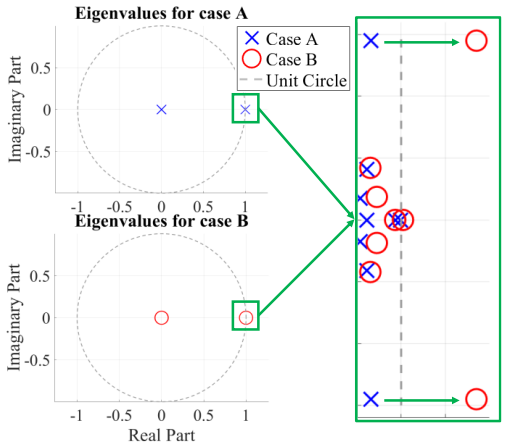
Eigenvalue stability tests for case A and case B. Van Der Schaft, A. and Jeltsema, D. (2014) “Port -Hamiltonian systems theory: An introductory overview,” Foundations and Trends in Systems and Control, 1(2–3), pp. 173–378. Villalva M.G., Gazoli J. R. and Filho E. R. (2009) “Modeling and circuit-based simulation of photovoltaic arrays,” IEEE. Xie, L., Zhan...
work page 2014
discussion (0)
Sign in with ORCID, Apple, or X to comment. Anyone can read and Pith papers without signing in.