Pairing properties of correlated three-leg ladders with strong interchain couplings near 1/3 filling
Pith reviewed 2026-05-10 04:06 UTC · model grok-4.3
The pith
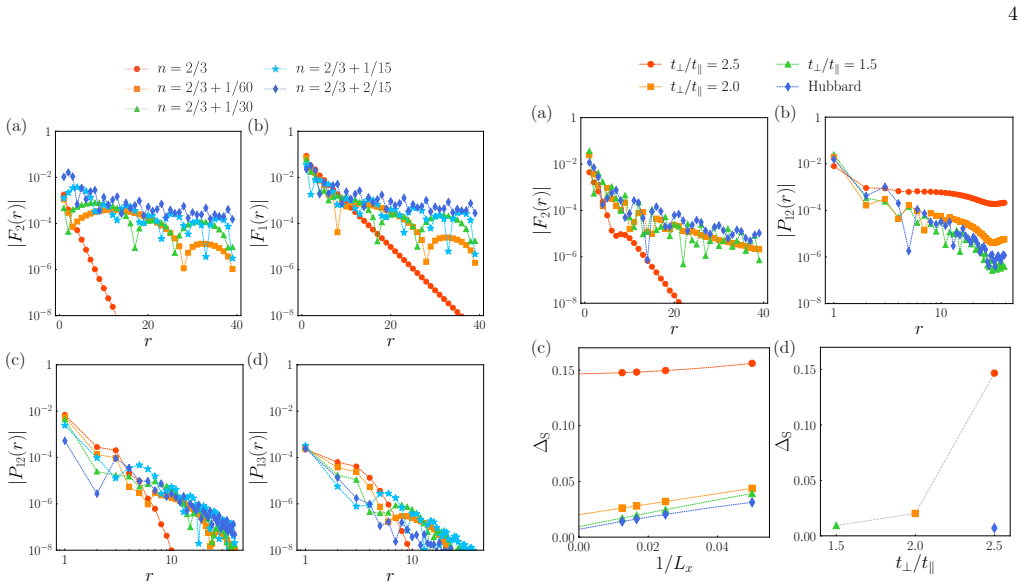
In three-leg t-J ladders with strong interchain couplings, hole doping near 1/3 filling produces power-law decaying pair correlations while spin correlations decay exponentially.
A machine-rendered reading of the paper's core claim, the machinery that carries it, and where it could break.
Core claim
At one-third filling the three-leg t-J ladder with strong interchain couplings hosts a spin-gapped state. Upon hole doping, pair correlations develop with power-law decays while spin correlations decay exponentially. Electron doping fails to induce substantial pair correlations. The authors also examine the hole-doped regime of the corresponding three-leg Hubbard model for comparison.
What carries the argument
Density-matrix renormalization group evaluation of pair and spin correlation functions in the doped three-leg t-J ladder, which distinguishes power-law from exponential decay to identify the dominant instability.
If this is right
- Pair correlations dominate over spin correlations in the hole-doped regime near 1/3 filling.
- The spin sector remains gapped, as shown by the exponential decay of spin correlations.
- Electron doping into the 1/3-filled state does not produce comparable pairing tendencies.
- The hole-electron asymmetry may influence doping-dependent behavior in related nickelate systems.
Where Pith is reading between the lines
- If the pairing survives in two-dimensional extensions of the model, it could indicate a microscopic route toward superconductivity in trilayer nickelates.
- Analogous calculations on four-leg or wider ladders would test whether the three-leg geometry is essential for the observed pairing dominance.
- The contrast with the Hubbard model implies that projecting out double occupancy is key to stabilizing the power-law pairing.
Load-bearing premise
The t-J model with strong interchain couplings and the selected parameter regime accurately represents the low-energy physics of trilayer nickelate superconductors near 1/3 filling.
What would settle it
Experimental detection of power-law pair correlations together with exponentially decaying spin correlations in a hole-doped trilayer nickelate near 1/3 filling, or the absence of such behavior in refined DMRG runs with altered interchain coupling strengths.
Figures


read the original abstract
We investigate the ground-state properties of correlated three-leg ladders near 1/3 filling. We apply the density-matrix renormalization group method to the three-leg t-J ladder with strong interchain couplings and evaluate its pairing nature. When holes are doped into the spin-gapped state at 1/3 filling, we find that pair correlations develop with power-law decays while spin correlations decay exponentially. On the other hand, doping of electrons into the 1/3-filled state does not give rise to substantial pair correlations. We also discuss the hole-doped state in the three-leg Hubbard model to compare it with the pairing state in the t-J model. Our numerical demonstrations provide insights into the electronic properties of trilayer nickelate superconductors.
Editorial analysis
A structured set of objections, weighed in public.
Referee Report
Summary. The manuscript uses DMRG to study the three-leg t-J ladder (and, for comparison, the Hubbard model) with strong interchain couplings near 1/3 filling. It reports that hole doping away from the spin-gapped 1/3-filled state produces pair correlations that decay as a power law while spin correlations decay exponentially; electron doping yields no substantial pairing. These findings are presented as providing insight into the low-energy physics of trilayer nickelate superconductors.
Significance. If the reported distinction between power-law pairing and gapped spin correlations survives rigorous convergence checks, the work would supply concrete numerical evidence for pairing tendencies in a doped spin-gapped quasi-1D system, directly relevant to the ongoing discussion of superconductivity in trilayer nickelates. The hole-versus-electron doping asymmetry is a potentially falsifiable prediction.
major comments (2)
- [Numerical results / DMRG analysis] The central claim (power-law pair correlations versus exponential spin decay upon hole doping) is stated in the abstract and elaborated in the numerical results, yet no quantitative pair exponent, spin correlation length, finite-size scaling data (e.g., L = 24 to 72), bond-dimension convergence (e.g., chi = 1000 to 4000), or truncation-error estimates are provided. Without these, the asymptotic classification cannot be distinguished from finite-size or truncation artifacts in DMRG.
- [Model comparison section] The comparison between the t-J and Hubbard models is used to argue that the pairing state is robust, but the manuscript does not quantify how the effective parameters (t, J, interchain couplings) map between the two models or demonstrate that the observed power-law behavior persists under modest variations of the interchain coupling strength.
minor comments (2)
- [Abstract] The abstract refers to 'power-law decays' without quoting the fitted exponent or the fitting window, which would help readers assess the quality of the power-law claim.
- [Figures] Figure captions and axis labels for the correlation plots should explicitly state the system length L and bond dimension chi used for each data set.
Simulated Author's Rebuttal
We thank the referee for the careful reading of our manuscript and the positive evaluation of its potential significance. The comments identify areas where additional details will improve the presentation of our DMRG results. We respond to each major comment below and have revised the manuscript accordingly.
read point-by-point responses
-
Referee: [Numerical results / DMRG analysis] The central claim (power-law pair correlations versus exponential spin decay upon hole doping) is stated in the abstract and elaborated in the numerical results, yet no quantitative pair exponent, spin correlation length, finite-size scaling data (e.g., L = 24 to 72), bond-dimension convergence (e.g., chi = 1000 to 4000), or truncation-error estimates are provided. Without these, the asymptotic classification cannot be distinguished from finite-size or truncation artifacts in DMRG.
Authors: We agree that explicit quantitative measures and convergence diagnostics are necessary to firmly establish the asymptotic behavior. The original figures display correlation functions for several system sizes, but we did not report fitted exponents, correlation lengths, or detailed truncation and bond-dimension data. In the revised manuscript we have added a new subsection on numerical methods and convergence. It includes finite-size scaling for L up to 72, bond-dimension sweeps, truncation-error estimates, and extracted pair-correlation exponents together with spin correlation lengths. These additions confirm that the power-law pairing and exponential spin decay are not finite-size or truncation artifacts. revision: yes
-
Referee: [Model comparison section] The comparison between the t-J and Hubbard models is used to argue that the pairing state is robust, but the manuscript does not quantify how the effective parameters (t, J, interchain couplings) map between the two models or demonstrate that the observed power-law behavior persists under modest variations of the interchain coupling strength.
Authors: The referee correctly observes that the original text does not provide an explicit parameter mapping or tests of interchain-coupling variations. The t-J model is introduced as the strong-coupling limit of the Hubbard model, but this correspondence was not quantified. In the revised manuscript we have expanded the model-comparison section to state the parameter correspondence (J/t derived from the Hubbard U) and to present additional DMRG data for interchain couplings varied by approximately 20 percent around the nominal value. These calculations show that the power-law decay of pair correlations remains stable, supporting the robustness of the reported pairing state. revision: yes
Circularity Check
No significant circularity: central claims are direct DMRG outputs
full rationale
The paper's core results—power-law pair correlations and exponential spin decay upon hole doping away from the 1/3-filled spin-gapped state—are obtained as direct numerical outputs from DMRG simulations on the three-leg t-J ladder Hamiltonian. No parameters are fitted to subsets of the target data and then relabeled as predictions; no self-definitional loops exist in the correlation functions; and no load-bearing uniqueness theorems or ansatzes are imported via self-citation. The derivation chain consists of model definition, numerical method application, and measurement of correlation functions, all of which remain independent of the reported asymptotic behaviors. The comparison to the Hubbard model is likewise a separate numerical run. This is the standard, non-circular structure for a computational condensed-matter study.
Axiom & Free-Parameter Ledger
axioms (1)
- domain assumption The t-J model is an appropriate effective low-energy description for the strongly correlated electrons in three-leg ladders near 1/3 filling.
Reference graph
Works this paper leans on
-
[1]
H. Sun, M. Huo, X. Hu, J. Li, Z. Liu, Y. Han, L. Tang, Z. Mao, P. Yang, B. Wang, J. Cheng, D.-X. Yao, G.-M. Zhang, and M. Wang, Signatures of superconductivity near 80 K in a nickelate under high pressure, Nature621, 493 (2023)
work page 2023
-
[2]
J. Hou, P.-T. Yang, Z.-Y. Liu, J.-Y. Li, P.-F. Shan, L. Ma, G. Wang, N.-N. Wang, H.-Z. Guo, J.-P. Sun, Y. Uwatoko, M. Wang, G.-M. Zhang, B.-S. Wang, and J.-G. Cheng, Emergence of high-temperature supercon- ducting phase in pressurized La 3Ni2O7 crystals, Chin. Phys. Lett.40, 117302 (2023)
work page 2023
-
[3]
G. Wang, N. N. Wang, X. L. Shen, J. Hou, L. Ma, L. F. Shi, Z. A. Ren, Y. D. Gu, H. M. Ma, P. T. Yang, Z. Y. Liu, H. Z. Guo, J. P. Sun, G. M. Zhang, S. Calder, J.-Q. Yan, B. S. Wang, Y. Uwatoko, and J.-G. Cheng, Pressure-induced superconductivity in polycrys- talline La3Ni2O7−δ, Phys. Rev. X14, 011040 (2024)
work page 2024
- [4]
-
[5]
N. Wang, G. Wang, X. Shen, J. Hou, J. Luo, X. Ma, H. Yang, L. Shi, J. Dou, J. Feng, J. Yang, Y. Shi, Z. Ren, H. Ma, P. Yang, Z. Liu, Y. Liu, H. Zhang, X. Dong, Y. Wang, K. Jiang, J. Hu, S. Nagasaki, K. Kitagawa, S. Calder, J. Yan, J. Sun, B. Wang, R. Zhou, Y. Uwatoko, and J. Cheng, Bulk high-temperature superconductivity in pressurized tetragonal La 2PrNi...
work page 2024
-
[6]
E. K. Ko, Y. Yu, Y. Liu, L. Bhatt, J. Li, V. Thampy, C.-T. Kuo, B. Y. Wang, Y. Lee, K. Lee, J.-S. Lee, B. H. Goodge, D. A. Muller, and H. Y. Hwang, Signa- tures of ambient pressure superconductivity in thin film La3Ni2O7, Nature638, 935 (2025)
work page 2025
-
[7]
G. Zhou, W. Lv, H. Wang, Z. Nie, Y. Chen, Y. Li, H. Huang, W.-Q. Chen, Y.-J. Sun, Q.-K. Xue, and Z. Chen, Ambient-pressure superconductivity onset above 40 K in (La,Pr) 3Ni2O7 films, Nature640, 641 (2025)
work page 2025
-
[8]
Z. Luo, X. Hu, M. Wang, W. W´ u, and D.-X. Yao, Bilayer two-orbital model of La 3Ni2O7 under pressure, Phys. Rev. Lett.131, 126001 (2023)
work page 2023
-
[9]
Q.-G. Yang, D. Wang, and Q.-H. Wang, Possibles ±- wave superconductivity in La3Ni2O7, Phys. Rev. B108, L140505 (2023)
work page 2023
-
[10]
Y. Shen, M. Qin, and G.-M. Zhang, Effective bi- layer model Hamiltonian and density-matrix renormal- ization group study for the high-T c superconductivity in La 3Ni2O7 under high pressure, Chin. Phys. Lett.40, 127401 (2023)
work page 2023
-
[11]
H. Oh and Y.-H. Zhang, Type-IIt−Jmodel and shared superexchange coupling from Hund’s rule in supercon- ducting La3Ni2O7, Phys. Rev. B108, 174511 (2023)
work page 2023
-
[12]
V. Christiansson, F. Petocchi, and P. Werner, Correlated electronic structure of La 3Ni2O7 under pressure, Phys. Rev. Lett.131, 206501 (2023)
work page 2023
-
[13]
Y. Zhang, L.-F. Lin, A. Moreo, and E. Dagotto, Elec- tronic structure, dimer physics, orbital-selective behav- ior, and magnetic tendencies in the bilayer nickelate su- perconductor La 3Ni2O7 under pressure, Phys. Rev. B 108, L180510 (2023)
work page 2023
-
[14]
Y.-f. Yang, G.-M. Zhang, and F.-C. Zhang, Interlayer valence bonds and two-component theory for high-Tc su- perconductivity of La 3Ni2O7 under pressure, Phys. Rev. B108, L201108 (2023)
work page 2023
-
[15]
F. Lechermann, J. Gondolf, S. B¨ otzel, and I. M. Eremin, Electronic correlations and superconducting instability in La 3Ni2O7 under high pressure, Phys. Rev. B108, L201121 (2023)
work page 2023
- [16]
-
[17]
Z. Liao, L. Chen, G. Duan, Y. Wang, C. Liu, R. Yu, and Q. Si, Electron correlations and superconductivity in La 3Ni2O7 under pressure tuning, Phys. Rev. B108, 214522 (2023)
work page 2023
- [18]
- [19]
-
[20]
Y. Cao and Y.-f. Yang, Flat bands promoted by Hund’s rule coupling in the candidate double-layer high- temperature superconductor La 3Ni2O7 under high pres- sure, Phys. Rev. B109, L081105 (2024)
work page 2024
-
[21]
H. Sakakibara, N. Kitamine, M. Ochi, and K. Kuroki, Possible highT c superconductivity in La 3Ni2O7 under high pressure through manifestation of a nearly half-filled bilayer Hubbard model, Phys. Rev. Lett.132, 106002 (2024)
work page 2024
-
[22]
Y. Zhang, L.-F. Lin, A. Moreo, T. A. Maier, and E. Dagotto, Structural phase transition,s ±-wave pair- ing, and magnetic stripe order in bilayered superconduc- tor La 3Ni2O7 under pressure, Nat. Commun.15, 2470 (2024)
work page 2024
- [23]
- [24]
-
[25]
C. Lu, Z. Pan, F. Yang, and C. Wu, Interlayer-coupling- driven high-temperature superconductivity in La 3Ni2O7 under pressure, Phys. Rev. Lett.132, 146002 (2024)
work page 2024
-
[26]
W. W´ u, Z. Luo, D.-X. Yao, and M. Wang, Superex- change and charge transfer in the nickelate superconduc- tor La3Ni2O7 under pressure, Sci. China Phys. Mech. As- tron.67, 117402 (2024)
work page 2024
-
[27]
L. C. Rhodes and P. Wahl, Structural routes to stabilize superconducting La 3Ni2O7 at ambient pressure, Phys. Rev. Mater.8, 044801 (2024)
work page 2024
-
[28]
J.-X. Wang, Z. Ouyang, R.-Q. He, and Z.-Y. Lu, Non- Fermi liquid and Hund correlation in La 4Ni3O10 under high pressure, Phys. Rev. B109, 165140 (2024)
work page 2024
-
[29]
B. Geisler, J. J. Hamlin, G. R. Stewart, R. G. Hen- nig, and P. J. Hirschfeld, Structural transitions, octa- hedral rotations, and electronic properties of A 3Ni2O7 rare-earth nickelates under high pressure, npj Quantum Mater.9, 38 (2024)
work page 2024
-
[30]
H. LaBollita, J. Kapeghian, M. R. Norman, and A. S. Botana, Electronic structure and magnetic tendencies of trilayer La4Ni3O10 under pressure: Structural transition, molecular orbitals, and layer differentiation, Phys. Rev. B109, 195151 (2024)
work page 2024
- [31]
-
[32]
Z. Luo, B. Lv, M. Wang, W. W´ u, and D.-X. Yao, High- Tc superconductivity in La 3Ni2O7 based on the bilayer two-orbitalt–Jmodel, npj Quantum Mater.9, 61 (2024)
work page 2024
-
[33]
Q.-G. Yang, K.-Y. Jiang, D. Wang, H.-Y. Lu, and Q.-H. Wang, Effective model ands ±-wave superconductivity in trilayer nickelate La4Ni3O10, Phys. Rev. B109, L220506 (2024)
work page 2024
-
[34]
C.-Q. Chen, Z. Luo, M. Wang, W. W´ u, and D.-X. Yao, Trilayer multiorbital models of La4Ni3O10, Phys. Rev. B 110, 014503 (2024)
work page 2024
-
[35]
J. Chen, F. Yang, and W. Li, Orbital-selective supercon- ductivity in the pressurized bilayer nickelate La 3Ni2O7: An infinite projected entangled-pair state study, Phys. Rev. B110, L041111 (2024)
work page 2024
-
[36]
C. Lu, Z. Pan, F. Yang, and C. Wu, Interplay of two Eg orbitals in superconducting La3Ni2O7 under pressure, Phys. Rev. B110, 094509 (2024)
work page 2024
-
[37]
H. Yang, H. Oh, and Y.-H. Zhang, Strong pairing from a small Fermi surface beyond weak coupling: Application to La3Ni2O7, Phys. Rev. B110, 104517 (2024)
work page 2024
-
[38]
S. Ryee, N. Witt, and T. O. Wehling, Quenched pair breaking by interlayer correlations as a key to super- conductivity in La 3Ni2O7, Phys. Rev. Lett.133, 096002 (2024)
work page 2024
-
[39]
J.-X. Zhang, H.-K. Zhang, Y.-Z. You, and Z.-Y. Weng, Strong pairing originated from an emergentZ 2 Berry phase in La3Ni2O7, Phys. Rev. Lett.133, 126501 (2024)
work page 2024
-
[40]
Y. Zhang, L.-F. Lin, A. Moreo, T. A. Maier, and E. Dagotto, Prediction ofs ±-wave superconductivity enhanced by electronic doping in trilayer nickelates La4Ni3O10 under pressure, Phys. Rev. Lett.133, 136001 (2024)
work page 2024
-
[41]
H. Schl¨ omer, U. Schollw¨ ock, F. Grusdt, and A. Bohrdt, Superconductivity in the pressurized nickelate La 3Ni2O7 in the vicinity of a BEC–BCS crossover, Commun. Phys. 7, 366 (2024)
work page 2024
-
[42]
H. Oh, B. Zhou, and Y.-H. Zhang, Type-IIt−Jmodel in charge transfer regime in bilayer La 3Ni2O7 and trilayer La4Ni3O10, Phys. Rev. B111, L020504 (2025)
work page 2025
-
[43]
Y.-Y. Zheng and W. W´ u,s ±-wave superconductivity in the bilayer two-orbital Hubbard model, Phys. Rev. B 111, 035108 (2025)
work page 2025
-
[44]
J.-Y. You, Z. Zhu, M. Del Ben, W. Chen, and Z. Li, Unlikelihood of a phonon mechanism for the high- temperature superconductivity in La 3Ni2O7, npj Com- put. Mater.11, 3 (2025)
work page 2025
-
[45]
M. Ochi, H. Sakakibara, H. Usui, and K. Kuroki, Theo- retical study of the crystal structure of the bilayer nickel oxychloride Sr3Ni2O5Cl2 and analysis of possible uncon- ventional superconductivity, Phys. Rev. B111, 064511 (2025)
work page 2025
-
[46]
K.-Y. Jiang, Y.-H. Cao, Q.-G. Yang, H.-Y. Lu, and Q.-H. Wang, Theory of pressure dependence of superconductiv- ity in bilayer nickelate La 3Ni2O7, Phys. Rev. Lett.134, 076001 (2025)
work page 2025
- [47]
-
[48]
S. Kamiyama, T. Kaneko, K. Kuroki, and M. Ochi, Opti- cal control of the crystal structure in the bilayer nickelate superconductor La3Ni2O7 via nonlinear phononics, Phys. Rev. B112, 094115 (2025)
work page 2025
- [49]
-
[50]
K. Ushio, S. Kamiyama, Y. Hoshi, R. Mizuno, M. Ochi, K. Kuroki, and H. Sakakibara, Theoretical study on am- bient pressure superconductivity in La 3Ni2O7 thin films: structural analysis, model construction, and robustness ofs±-wave pairing, arXiv:2506.20497. 8
work page internal anchor Pith review Pith/arXiv arXiv
-
[51]
S. Kamiyama, R. Kohno, Y. Hoshi, K. Ushio, D. Nakaoka, H. Sakakibara, and K. Kuroki, Theoret- ical proposal of superconductivity in hole-doped re- duced bilayer nickelate La 3Ni2O6: a manifestation of orbital-space bilayer model with incipient bands, arXiv:2603.11771
-
[52]
H. Watanabe, H. Sakakibara, and K. Kuroki, Hi- erarchical structure of primary and hybridization- induced superconducting correlations in bilayer nicke- lates, arXiv:2603.13604
-
[53]
H. Sakakibara, M. Ochi, H. Nagata, Y. Ueki, H. Saku- rai, R. Matsumoto, K. Terashima, K. Hirose, H. Ohta, M. Kato, Y. Takano, and K. Kuroki, Theoretical analy- sis on the possibility of superconductivity in the trilayer Ruddlesden-Popper nickelate La 4Ni3O10 under pressure and its experimental examination: Comparison with La3Ni2O7, Phys. Rev. B109, 144511 (2024)
work page 2024
- [54]
-
[55]
J. Li, C.-Q. Chen, C. Huang, Y. Han, M. Huo, X. Huang, P. Ma, Z. Qiu, J. Chen, X. Hu, L. Chen, T. Xie, B. Shen, H. Sun, D.-X. Yao, and M. Wang, Structural transition, electric transport, and electronic structures in the com- pressed trilayer nickelate La 4Ni3O10, Sci. China Phys. Mech. Astron.67, 117403 (2024)
work page 2024
-
[56]
Y. Zhu, D. Peng, E. Zhang, B. Pan, X. Chen, L. Chen, H. Ren, F. Liu, Y. Hao, N. Li, Z. Xing, F. Lan, J. Han, J. Wang, D. Jia, H. Wo, Y. Gu, Y. Gu, L. Ji, W. Wang, H. Gou, Y. Shen, T. Ying, X. Chen, W. Yang, H. Cao, C. Zheng, Q. Zeng, J.-g. Guo, and J. Zhao, Superconduc- tivity in pressurized trilayer La4Ni3O10−δ single crystals, Nature631, 531 (2024)
work page 2024
-
[57]
M. Kakoi, T. Oi, Y. Ohshita, M. Yashima, K. Kuroki, T. Kato, H. Takahashi, S. Ishiwata, Y. Adachi, N. Hatada, T. Uda, and H. Mukuda, Multiband metal- lic ground state in multilayered nickelates La3Ni2O7 and La4Ni3O10 probed by 139La-NMR at ambient pressure, J. Phys. Soc. Jpn.93, 053702 (2024)
work page 2024
- [58]
-
[59]
M. Zhang, C. Pei, D. Peng, X. Du, W. Hu, Y. Cao, Q. Wang, J. Wu, Y. Li, H. Liu, C. Wen, J. Song, Y. Zhao, C. Li, W. Cao, S. Zhu, Q. Zhang, N. Yu, P. Cheng, L. Zhang, Z. Li, J. Zhao, Y. Chen, C. Jin, H. Guo, C. Wu, F. Yang, Q. Zeng, S. Yan, L. Yang, and Y. Qi, Supercon- ductivity in trilayer nickelate La4Ni3O10 under pressure, Phys. Rev. X15, 021005 (2025)
work page 2025
- [60]
-
[61]
E. Arrigoni, Spin and charge excitations in a three-legs fermionic ladder: a renormalization-group study, Phys. Lett. A215, 91 (1996)
work page 1996
-
[62]
Arrigoni, Phase diagram of three fermionic chains: A renormalization-group study, Phys
E. Arrigoni, Phase diagram of three fermionic chains: A renormalization-group study, Phys. Status Solidi B195, 425 (1996)
work page 1996
- [63]
-
[64]
H.-H. Lin, L. Balents, and M. P. A. Fisher,n-chain Hub- bard model in weak coupling, Phys. Rev. B56, 6569 (1997)
work page 1997
-
[65]
T. M. Rice, S. Haas, M. Sigrist, and F.-C. Zhang, Lightly dopedt−Jthree-leg ladders: An analog for the under- doped cuprates, Phys. Rev. B56, 14655 (1997)
work page 1997
-
[66]
S. R. White and D. J. Scalapino, Ground-state properties of the doped three-legt-Jladder, Phys. Rev. B57, 3031 (1998)
work page 1998
- [67]
-
[68]
M. Y. Kagan, S. Haas, and T. M. Rice, Phase diagram of three-leg ladders at strong coupling along the rungs, Physica C317-318, 185 (1999)
work page 1999
-
[69]
E. Dagotto, J. Riera, and D. Scalapino, Superconductiv- ity in ladders and coupled planes, Phys. Rev. B45, 5744 (1992)
work page 1992
-
[70]
R. M. Noack, S. R. White, and D. J. Scalapino, Corre- lations in a two-chain Hubbard model, Phys. Rev. Lett. 73, 882 (1994)
work page 1994
- [71]
-
[72]
S. R. White, Density matrix formulation for quantum renormalization groups, Phys. Rev. Lett.69, 2863 (1992)
work page 1992
-
[73]
S. R. White, Density-matrix algorithms for quantum renormalization groups, Phys. Rev. B48, 10345 (1993)
work page 1993
-
[74]
Schollw¨ ock, The density-matrix renormalization group in the age of matrix product states, Ann
U. Schollw¨ ock, The density-matrix renormalization group in the age of matrix product states, Ann. Phys.326, 96 (2011)
work page 2011
- [75]
-
[76]
Y. Shen, G.-M. Zhang, and M. Qin, Reexamining doped two-legged Hubbard ladders, Phys. Rev. B108, 165113 (2023)
work page 2023
- [77]
- [78]
-
[79]
D. Kato and K. Kuroki, Many-variable variational monte carlo study of superconductivity in two-band Hubbard models with an incipient band, Phys. Rev. Res.2, 023156 (2020)
work page 2020
-
[80]
A. Sheikhan and C. Kollath, Dynamically enhanced un- conventional superconducting correlations in a Hubbard ladder, Phys. Rev. B102, 035163 (2020)
work page 2020
discussion (0)
Sign in with ORCID, Apple, or X to comment. Anyone can read and Pith papers without signing in.