Magnetic-fluctuation-driven suppression of spin-orbit hybridization in the surface ferromagnet GdAg₂/Ag(111)
Pith reviewed 2026-05-10 03:58 UTC · model grok-4.3
The pith
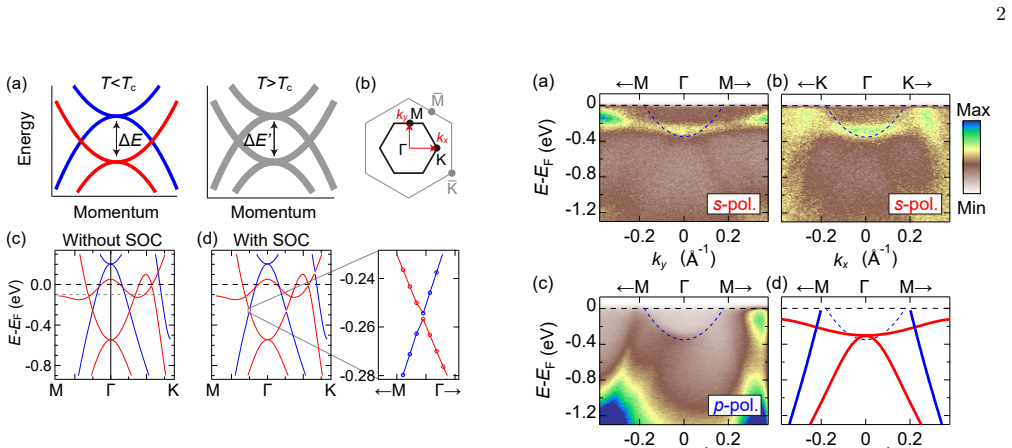
Spin fluctuations suppress spin-orbit hybridization above the Curie temperature in GdAg2/Ag(111) while preserving nodal-line band crossings.
A machine-rendered reading of the paper's core claim, the machinery that carries it, and where it could break.
Core claim
Spin fluctuations preserve the nodal-line-derived band crossings even above the Curie temperature, while SOC-induced hybridization develops only at low temperatures, as evidenced by spectral-weight redistribution. The suppression of the hybridization at high temperature is attributed to spin decoherence and band-dependent scattering, captured by an effective non-Hermitian framework.
What carries the argument
Effective non-Hermitian framework that incorporates spin decoherence and band-dependent scattering to suppress SOC-induced hybridization at elevated temperatures.
If this is right
- Magnetic fluctuations function as a control for SOC-induced hybridization and the associated Berry curvature.
- Nodal-line-derived band crossings stay protected above the Curie temperature owing to spin fluctuations.
- Magnetic systems provide a platform for studying non-Hermitian band physics.
- Temperature can tune the appearance of hybridization gaps in topological magnetic materials.
Where Pith is reading between the lines
- The fluctuation-driven mechanism may appear in other two-dimensional magnetic systems with topological bands.
- Temperature-dependent ARPES on related magnets could help isolate fluctuation effects from phonon or lattice contributions.
Load-bearing premise
The temperature-dependent spectral-weight redistribution seen in ARPES arises primarily from magnetic spin fluctuations and decoherence rather than phonons, lattice changes, or experimental artifacts.
What would settle it
If ARPES measurements showed the SOC-induced hybridization gap remaining open above the Curie temperature, the claim that spin fluctuations suppress it would be contradicted.
Figures


read the original abstract
Magnetic materials hosting topological band structures have attracted intense interest due to the interplay between magnetism and spin-orbit coupling (SOC). Here, using temperature- and polarization-dependent angle-resolved photoemission spectroscopy, we investigate the surface ferromagnet GdAg$_2$/Ag(111), a two-dimensional system with Weyl-nodal-line-like band crossings. We find that spin fluctuations preserve the nodal-line-derived band crossings even above the Curie temperature, while SOC-induced hybridization develops only at low temperatures, as evidenced by spectral-weight redistribution. The suppression of the hybridization at high temperature is attributed to spin decoherence and band-dependent scattering, captured by an effective non-Hermitian framework. Our results establish magnetic fluctuations as a control knob for SOC-induced hybridization and associated Berry curvature, and highlight magnetic systems as a platform for exploring non-Hermitian band physics.
Editorial analysis
A structured set of objections, weighed in public.
Referee Report
Summary. The manuscript reports temperature- and polarization-dependent ARPES measurements on the surface ferromagnet GdAg₂/Ag(111), which hosts Weyl-nodal-line-like band crossings. It claims that spin fluctuations preserve these crossings above the Curie temperature Tc while SOC-induced hybridization (and associated spectral-weight redistribution) appears only below Tc. The high-temperature suppression of hybridization is attributed to spin decoherence and band-dependent scattering, which is captured by an effective non-Hermitian framework. The work positions magnetic fluctuations as a control parameter for SOC hybridization and Berry curvature.
Significance. If the magnetic origin of the observed redistribution is established, the result would provide a concrete experimental demonstration that spin fluctuations can selectively suppress SOC hybridization while preserving nodal crossings, thereby linking magnetic order to non-Hermitian band physics. The temperature-dependent ARPES data and the non-Hermitian modeling constitute a useful platform for exploring fluctuation-controlled topological features in 2D magnets.
major comments (3)
- [Results section on T-dependent ARPES (near Figs. 2–4)] The central claim that spectral-weight redistribution is driven by magnetic spin fluctuations (rather than phonons, lattice expansion, or Fermi-Dirac broadening) is load-bearing, yet the manuscript provides no quantitative subtraction of non-magnetic temperature effects nor a comparison to a non-magnetic reference system. This leaves the attribution untested (see stress-test note).
- [Theoretical modeling section (Eqs. defining the non-Hermitian Hamiltonian)] The effective non-Hermitian framework is introduced to explain the redistribution, but it is unclear whether its band-dependent scattering rates are derived from independent measurements (e.g., linewidth analysis or transport) or adjusted to fit the observed intensity transfer. If the latter, the model risks circularity and does not demonstrate necessity of the magnetic mechanism.
- [Abstract and Fig. 3 caption] No error bars, fitting uncertainties, or explicit exclusion criteria for alternative explanations (phonon Debye-Waller factors, surface relaxation) are reported in the temperature series, making it impossible to verify that the data quantitatively support fluctuation-driven suppression over other T-dependent mechanisms.
minor comments (2)
- [Experimental methods] Polarization dependence should be shown explicitly for all temperatures to confirm the orbital character assignment used to identify hybridization.
- [Introduction or sample characterization] Clarify the precise definition of Tc in the surface layer versus bulk and how it is determined from the ARPES data themselves.
Simulated Author's Rebuttal
We appreciate the referee's positive assessment of the significance of our work and their recommendation for major revision. We have addressed all the major comments by proposing specific revisions to strengthen the evidence for the magnetic origin of the observed effects, clarify the modeling, and improve the reporting of uncertainties and alternative explanations.
read point-by-point responses
-
Referee: [Results section on T-dependent ARPES (near Figs. 2–4)] The central claim that spectral-weight redistribution is driven by magnetic spin fluctuations (rather than phonons, lattice expansion, or Fermi-Dirac broadening) is load-bearing, yet the manuscript provides no quantitative subtraction of non-magnetic temperature effects nor a comparison to a non-magnetic reference system. This leaves the attribution untested (see stress-test note).
Authors: We thank the referee for highlighting this important point. While the manuscript does not include an explicit quantitative subtraction, the temperature series shows changes that are correlated with the magnetic transition temperature Tc. In the revised manuscript, we will add a quantitative estimate of non-magnetic contributions, including phonon Debye-Waller factors calculated from the Debye temperature and lattice expansion effects, demonstrating that they cannot account for the observed spectral weight redistribution. Regarding a non-magnetic reference, such a system is not directly comparable, but the polarization dependence unique to the magnetic order supports our attribution. We will incorporate this analysis in the results section. revision: yes
-
Referee: [Theoretical modeling section (Eqs. defining the non-Hermitian Hamiltonian)] The effective non-Hermitian framework is introduced to explain the redistribution, but it is unclear whether its band-dependent scattering rates are derived from independent measurements (e.g., linewidth analysis or transport) or adjusted to fit the observed intensity transfer. If the latter, the model risks circularity and does not demonstrate necessity of the magnetic mechanism.
Authors: The scattering rates in the non-Hermitian model are informed by the temperature-dependent linewidths extracted from the ARPES spectra, which show increased broadening above Tc consistent with spin fluctuation scattering. We will revise the theoretical section to include the linewidth data and explicitly derive the imaginary potentials from these measurements, thereby demonstrating that the model is not circular but grounded in independent spectral features. This will clarify the necessity of the magnetic mechanism. revision: yes
-
Referee: [Abstract and Fig. 3 caption] No error bars, fitting uncertainties, or explicit exclusion criteria for alternative explanations (phonon Debye-Waller factors, surface relaxation) are reported in the temperature series, making it impossible to verify that the data quantitatively support fluctuation-driven suppression over other T-dependent mechanisms.
Authors: We agree that error bars and uncertainties should be reported. In the revision, we will include error bars on the data points in Fig. 3 and discuss the fitting procedures with uncertainties. Additionally, we will add explicit criteria and arguments excluding phonon Debye-Waller factors and surface relaxation by comparing the temperature dependence to known phonon scales and noting the absence of structural transitions. These additions will be made to the figure caption, abstract if appropriate, and the main text. revision: yes
Circularity Check
No circularity: framework presented as interpretive model for independent ARPES observations
full rationale
The abstract attributes temperature-dependent spectral-weight redistribution to spin decoherence within a non-Hermitian framework, but provides no equations, parameter-fitting procedure, or self-citation chain that reduces the central claim to its own inputs by construction. The observed band crossings and hybridization changes are reported as experimental facts from temperature- and polarization-dependent ARPES; the framework is invoked to interpret them rather than to derive the data. No self-definitional loop, fitted-input prediction, or load-bearing self-citation is exhibited in the given text. The derivation therefore remains self-contained against external benchmarks (ARPES spectra), consistent with a score of 0.
Axiom & Free-Parameter Ledger
free parameters (1)
- band-dependent scattering rates
axioms (1)
- domain assumption ARPES spectral weight directly reflects the underlying band hybridization and its temperature evolution
invented entities (1)
-
effective non-Hermitian framework
no independent evidence
Reference graph
Works this paper leans on
- [1]
-
[2]
C.-Z. Chang, C.-X. Liu, and A. H. MacDonald, Reviews of Modern Physics95, 011002 (2023)
work page 2023
- [3]
-
[4]
J. G. Checkelsky, R. Yoshimi, A. Tsukazaki, K. S. Takahashi, Y. Kozuka, J. Falson, M. Kawasaki, and Y. Tokura, Nature Physics10, 731 (2014)
work page 2014
-
[5]
M. M. Otrokov, I. I. Klimovskikh, H. Bentmann, D. Es- tyunin, A. Zeugner, Z. S. Aliev, S. Gaß, A. U. B. Wolter, A. V. Koroleva, A. M. Shikin, M. Blanco-Rey, M. Hoff- 6 mann, I. P. Rusinov, A. Y. Vyazovskaya, S. V. Ere- meev, Y. M. Koroteev, V. M. Kuznetsov, F. Freyse, J. S´ anchez-Barriga, I. R. Amiraslanov, M. B. Babanly, N. T. Mamedov, N. A. Abdullayev,...
work page 2019
-
[6]
Y. Gong, J. Guo, J. Li, K. Zhu, M. Liao, X. Liu, Q. Zhang, L. Gu, L. Tang, X. Feng, D. Zhang, W. Li, C. Song, L. Wang, P. Yu, X. Chen, Y. Wang, H. Yao, W. Duan, Y. Xu, S.-C. Zhang, X. Ma, Q.-K. Xue, and K. He, Chinese Physics Letters36, 076801 (2019)
work page 2019
-
[7]
Y. Deng, Y. Yu, M. Z. Shi, Z. Guo, Z. Xu, J. Wang, X. H. Chen, and Y. Zhang, Science367, 895 (2020)
work page 2020
-
[8]
K. Kuroda, T. Tomita, M.-T. Suzuki, C. Bareille, A. A. Nugroho, P. Goswami, M. Ochi, M. Ikhlas, M. Nakayama, S. Akebi, R. Noguchi, R. Ishii, N. In- ami, K. Ono, H. Kumigashira, A. Varykhalov, T. Muro, T. Koretsune, R. Arita, S. Shin, T. Kondo, and S. Nakat- suji, Nature Materials16, 1090 (2017)
work page 2017
-
[9]
D. F. Liu, A. J. Liang, E. K. Liu, Q. N. Xu, Y. W. Li, C. Chen, D. Pei, W. J. Shi, S. K. Mo, P. Dudin, T. Kim, C. Cacho, G. Li, Y. Sun, L. X. Yang, Z. K. Liu, S. S. P. Parkin, C. Felser, and Y. L. Chen, Science365, 1282 (2019)
work page 2019
- [10]
-
[11]
I. Belopolski, K. Manna, D. S. Sanchez, G. Chang, B. Ernst, J. Yin, S. S. Zhang, T. Cochran, N. Shumiya, H. Zheng, B. Singh, G. Bian, D. Multer, M. Litskevich, X. Zhou, S.-M. Huang, B. Wang, T.-R. Chang, S.-Y. Xu, A. Bansil, C. Felser, H. Lin, and M. Z. Hasan, Science 365, 1278 (2019)
work page 2019
-
[12]
Q. Xu, E. Liu, W. Shi, L. Muechler, J. Gayles, C. Felser, and Y. Sun, Physical Review B97, 235416 (2018)
work page 2018
-
[13]
E. Liu, Y. Sun, N. Kumar, L. Muechler, A. Sun, L. Jiao, S.-Y. Yang, D. Liu, A. Liang, Q. Xu, J. Kroder, V. S¨ uß, H. Borrmann, C. Shekhar, Z. Wang, C. Xi, W. Wang, W. Schnelle, S. Wirth, Y. Chen, S. T. B. Goennenwein, and C. Felser, Nature Physics14, 1125 (2018)
work page 2018
-
[14]
D. F. Liu, E. K. Liu, Q. N. Xu, J. L. Shen, Y. W. Li, D. Pei, A. J. Liang, P. Dudin, T. K. Kim, C. Cacho, Y. F. Xu, Y. Sun, L. X. Yang, Z. K. Liu, C. Felser, S. S. P. Parkin, and Y. L. Chen, npj Quantum Materials7, 11 (2022)
work page 2022
-
[15]
I. Belopolski, T. A. Cochran, X. Liu, Z.-J. Cheng, X. P. Yang, Z. Guguchia, S. S. Tsirkin, J.-X. Yin, P. Vir, G. S. Thakur, S. S. Zhang, J. Zhang, K. Kaznatcheev, G. Cheng, G. Chang, D. Multer, N. Shumiya, M. Litske- vich, E. Vescovo, T. K. Kim, C. Cacho, N. Yao, C. Felser, T. Neupert, and M. Z. Hasan, Physical Review Letters 127, 256403 (2021)
work page 2021
-
[16]
D. F. Liu, Q. N. Xu, E. K. Liu, J. L. Shen, C. C. Le, Y. W. Li, D. Pei, A. J. Liang, P. Dudin, T. K. Kim, C. Cacho, Y. F. Xu, Y. Sun, L. X. Yang, Z. K. Liu, C. Felser, S. S. P. Parkin, and Y. L. Chen, Physical Review B104, 205140 (2021)
work page 2021
- [17]
-
[18]
J.-Z. Ma, S. M. Nie, C. J. Yi, J. Jandke, T. Shang, M. Y. Yao, M. Naamneh, L. Q. Yan, Y. Sun, A. Chik- ina, V. N. Strocov, M. Medarde, M. Song, Y.-M. Xiong, G. Xu, W. Wulfhekel, J. Mesot, M. Reticcioli, C. Fran- chini, C. Mudry, M. M¨ uller, Y. G. Shi, T. Qian, H. Ding, and M. Shi, Science Advances5, eaaw4718 (2019)
work page 2019
-
[19]
M. X. Sprague, S. Regmi, B. Ghosh, A. P. Sakhya, M. I. Mondal, I. B. Elius, N. Valadez, B. Singh, T. Romanova, D. Kaczorowski, A. Bansil, and M. Neupane, Physical Review B110, 045130 (2024)
work page 2024
-
[20]
D. Li, J. Pearson, S. D. Bader, D. N. McIlroy, C. Wald- fried, and P. A. Dowben, Physical Review B51, 13895 (1995)
work page 1995
-
[21]
E. Weschke, C. Sch¨ ussler-Langeheine, R. Meier, A. V. Fedorov, K. Starke, F. H¨ ubinger, and G. Kaindl, Physical Review Letters77, 3415 (1996)
work page 1996
- [22]
-
[23]
M. Getzlaff, M. Bode, S. Heinze, R. Pascal, and R. Wiesendanger, Journal of Magnetism and Magnetic Materials184, 155 (1998)
work page 1998
- [24]
-
[25]
A. V. Fedorov, T. Valla, F. Liu, P. D. Johnson, M. Wein- ert, and P. B. Allen, Physical Review B65, 212409 (2002)
work page 2002
-
[26]
N. Qin, C. Chen, S. Du, X. Du, X. Zhang, Z. Yin, J. Zhou, R. Xu, X. Gu, Q. Zhang, W. Zhao, Y. Li, S.-K. Mo, Z. Liu, S. Zhang, Y. Guo, P. Tang, Y. Chen, and L. Yang, Physical Review B106, 035129 (2022)
work page 2022
-
[27]
H. Wu, C. Hu, Y. Xie, B. G. Jang, J. Huang, Y. Guo, S. Wu, C. Hu, Z. Yue, Y. Shi, R. Basak, Z. Ren, T. Yil- maz, E. Vescovo, C. Jozwiak, A. Bostwick, E. Roten- berg, A. Fedorov, J. D. Denlinger, C. Klewe, P. Shafer, D. Lu, M. Hashimoto, J. Kono, A. Frano, R. J. Birge- neau, X. Xu, J.-X. Zhu, P. Dai, J.-H. Chu, and M. Yi, Physical Review B109, 104410 (2024)
work page 2024
- [28]
-
[29]
Z. Cheng, I. Belopolski, H. Tien, T. A. Cochran, X. P. Yang, W. Ma, J. Yin, D. Chen, J. Zhang, C. Jozwiak, A. Bostwick, E. Rotenberg, G. Cheng, M. S. Hossain, Q. Zhang, M. Litskevich, Y. Jiang, N. Yao, N. B. M. Schroeter, V. N. Strocov, B. Lian, C. Felser, G. Chang, S. Jia, T. Chang, and M. Z. Hasan, Advanced Materials 35, 2205927 (2023)
work page 2023
-
[30]
R. Lou, L. Zhou, W. Song, A. Fedorov, Z. Tu, B. Jiang, Q. Wang, M. Li, Z. Liu, X. Chen, O. Rader, B. B¨ uchner, Y. Sun, H. Weng, H. Lei, and S. Wang, Nature Commu- nications15, 9823 (2024)
work page 2024
-
[31]
Damascelli, Physica ScriptaT109, 61 (2004)
A. Damascelli, Physica ScriptaT109, 61 (2004)
work page 2004
-
[32]
J. S´ anchez-Barriga, A. Varykhalov, G. Springholz, H. Steiner, R. Kirchschlager, G. Bauer, O. Caha, E. Schierle, E. Weschke, A. A. ¨Unal, S. Valencia, M. Dunst, J. Braun, H. Ebert, J. Min´ ar, E. Golias, L. V. Yashina, A. Ney, V. Hol´ y, and O. Rader, Nature Com- munications7, 10559 (2016)
work page 2016
-
[33]
A. M. Shikin, D. A. Estyunin, I. I. Klimovskikh, S. O. Fil- nov, E. F. Schwier, S. Kumar, K. Miyamoto, T. Okuda, A. Kimura, K. Kuroda, K. Yaji, S. Shin, Y. Takeda, Y. Saitoh, Z. S. Aliev, N. T. Mamedov, I. R. Ami- 7 raslanov, M. B. Babanly, M. M. Otrokov, S. V. Eremeev, and E. V. Chulkov, Scientific Reports10, 13226 (2020)
work page 2020
-
[34]
M. Garnica, M. M. Otrokov, P. C. Aguilar, I. I. Klimovskikh, D. Estyunin, Z. S. Aliev, I. R. Amiraslanov, N. A. Abdullayev, V. N. Zverev, M. B. Babanly, N. T. Mamedov, A. M. Shikin, A. Arnau, A. L. V. de Parga, E. V. Chulkov, and R. Miranda, npj Quantum Materials 7, 7 (2022)
work page 2022
-
[35]
F.-C. Chuang, C.-H. Hsu, H.-L. Chou, C. P. Crisostomo, Z.-Q. Huang, S.-Y. Wu, C.-C. Kuo, W.-C. V. Yeh, H. Lin, and A. Bansil, Physical Review B93, 035429 (2016)
work page 2016
-
[36]
B. Feng, B. Fu, S. Kasamatsu, S. Ito, P. Cheng, C.-C. Liu, Y. Feng, S. Wu, S. K. Mahatha, P. Sheverdyaeva, P. Moras, M. Arita, O. Sugino, T.-C. Chiang, K. Shi- mada, K. Miyamoto, T. Okuda, K. Wu, L. Chen, Y. Yao, and I. Matsuda, Nature Communications8, 1007 (2017)
work page 2017
-
[37]
B. Feng, R.-W. Zhang, Y. Feng, B. Fu, S. Wu, K. Miyamoto, S. He, L. Chen, K. Wu, K. Shimada, T. Okuda, and Y. Yao, Physical Review Letters123, 116401 (2019)
work page 2019
-
[38]
M. ¨Unzelmann, H. Bentmann, P. Eck, T. Kißlinger, B. Geldiyev, J. Rieger, S. Moser, R. C. Vidal, K. Kißner, L. Hammer, M. A. Schneider, T. Fauster, G. Sangiovanni, D. D. Sante, and F. Reinert, Physical Review Letters 124, 176401 (2020)
work page 2020
-
[39]
L. Liu, C. Wang, J. Li, X. Q. Chen, Y. Jia, and J. H. Cho, Physical Review B101, 1 (2020)
work page 2020
-
[40]
J. Lu, L. Gao, S. Song, H. Li, G. Niu, H. Chen, T. Qian, H. Ding, X. Lin, S. Du, and H. J. Gao, ACS Applied Nano Materials4, 8845 (2021)
work page 2021
-
[41]
M. Bauernfeind, J. Erhardt, P. Eck, P. K. Thakur, J. Gabel, T.-L. Lee, J. Sch¨ afer, S. Moser, D. D. Sante, R. Claessen, and G. Sangiovanni, Nature Communica- tions12, 5396 (2021)
work page 2021
- [42]
-
[43]
A. V. Matetskiy, A. Barla, P. Moras, C. Carbone, V. Milotti, C. A. Brondin, Z. R. Benher, M. Holub, P. Ohresser, E. Otero, F. Choueikani, I. A. Shvets, A. N. Mihalyuk, S. V. Eremeev, and P. M. Sheverdyaeva, ACS Nano19, 20863 (2025)
work page 2025
- [44]
-
[45]
See supplementary information at [url] for the details of the methods and analysis
- [46]
-
[47]
L. Fernandez, M. Blanco-Rey, R. Castrillo-Bodero, M. Ilyn, K. Ali, E. Turco, M. Corso, M. Ormaza, P. Gar- giani, M. A. Valbuena, A. Mugarza, P. Moras, P. M. Sheverdyaeva, A. K. Kundu, M. Jugovac, C. Laubschat, J. E. Ortega, and F. Schiller, Nanoscale12, 22258 (2020)
work page 2020
-
[48]
H. Bentmann, S. Abdelouahed, M. Mulazzi, J. J. Henk, and F. Reinert, Physical Review Letters108, 196801 (2012)
work page 2012
-
[49]
B. Zhen, C. W. Hsu, Y. Igarashi, L. Lu, I. Kaminer, A. Pick, S.-L. Chua, J. D. Joannopoulos, and M. Soljaˇ ci´ c, Nature525, 354 (2015)
work page 2015
- [50]
- [51]
-
[52]
N. H. Jo, Y. Wu, T. V. Trevisan, L.-L. Wang, K. Lee, B. Kuthanazhi, B. Schrunk, S. L. Bud’ko, P. C. Canfield, P. P. Orth, and A. Kaminski, Nature Communications 12, 7169 (2021)
work page 2021
-
[53]
S. Hahn, B. Sohn, M. Kim, J. R. Kim, S. Huh, Y. Kim, W. Kyung, M. Kim, D. Kim, Y. Kim, T. W. Noh, J. H. Shim, and C. Kim, Physical Review Letters127, 256401 (2021)
work page 2021
-
[54]
E. J. Bergholtz, J. C. Budich, and F. K. Kunst, Reviews of Modern Physics93, 015005 (2021)
work page 2021
-
[55]
Cayao, Journal of Physics: Condensed Matter35, 254002 (2023)
J. Cayao, Journal of Physics: Condensed Matter35, 254002 (2023)
work page 2023
-
[56]
T. Yoshida, R. Peters, and N. Kawakami, Physical Re- view B98, 035141 (2018)
work page 2018
-
[57]
K. Kawabata, K. Shiozaki, M. Ueda, and M. Sato, Phys- ical Review X9, 041015 (2019)
work page 2019
-
[58]
E. J. Bergholtz and J. C. Budich, Physical Review Re- search1, 012003 (2019)
work page 2019
- [59]
-
[60]
C. Li, Y. Wang, J. Zhang, G. Liu, H. Liu, W. Chen, H. Deng, W. Ma, C. Polley, B. Thiagarajan, T. K. Kim, J. Yin, Y. Shi, T. Xiang, and O. Tjernberg, Advanced Materials37, 2419559 (2025)
work page 2025
discussion (0)
Sign in with ORCID, Apple, or X to comment. Anyone can read and Pith papers without signing in.