NOEMA3D: Spatially resolved dust, CO, and [C I] in massive star-forming main sequence galaxies at cosmic noon
Pith reviewed 2026-05-10 04:19 UTC · model grok-4.3
The pith
Main-sequence galaxies at cosmic noon grow via steady gas accretion through spiral arms and bars.
A machine-rendered reading of the paper's core claim, the machinery that carries it, and where it could break.
Core claim
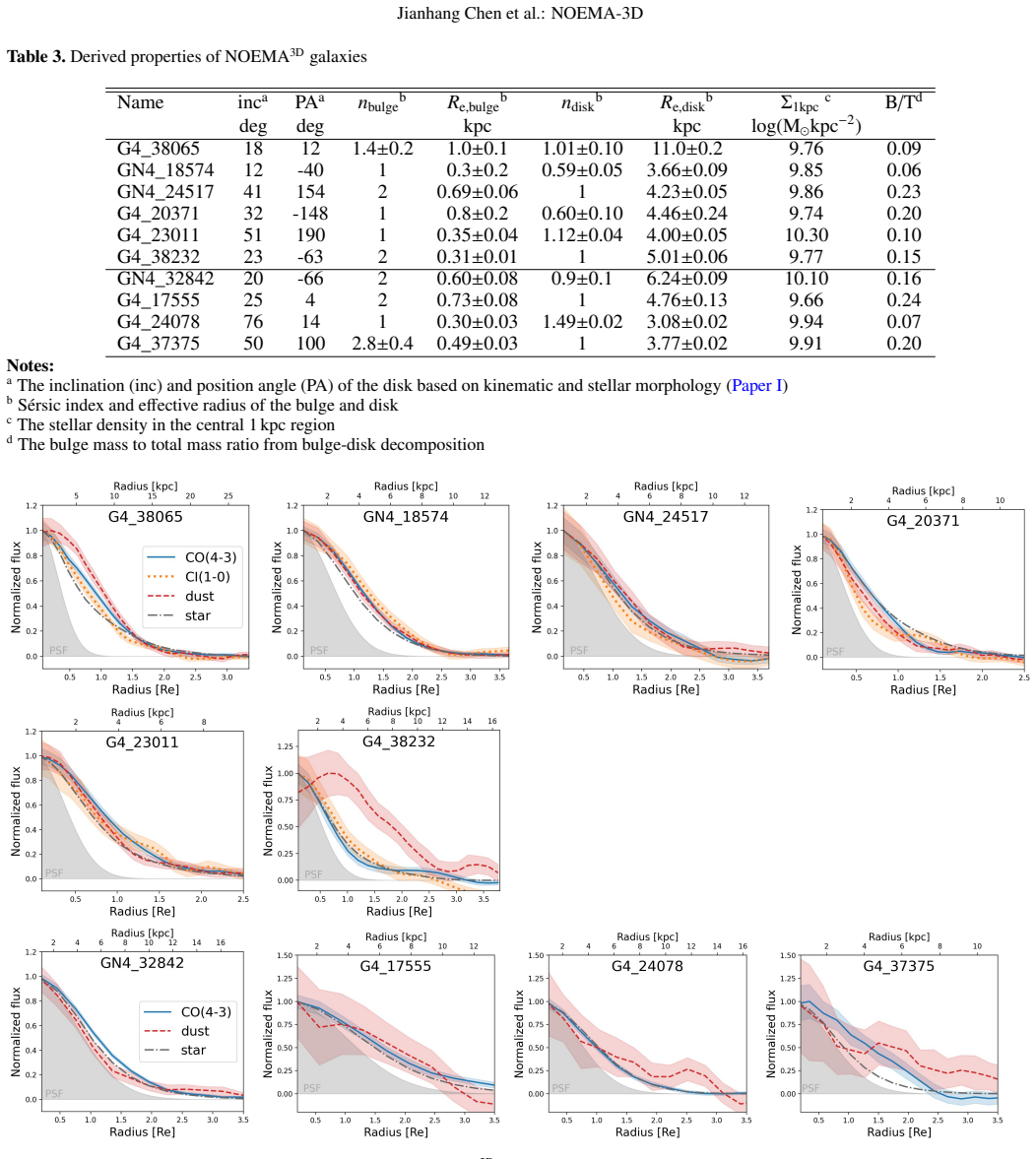
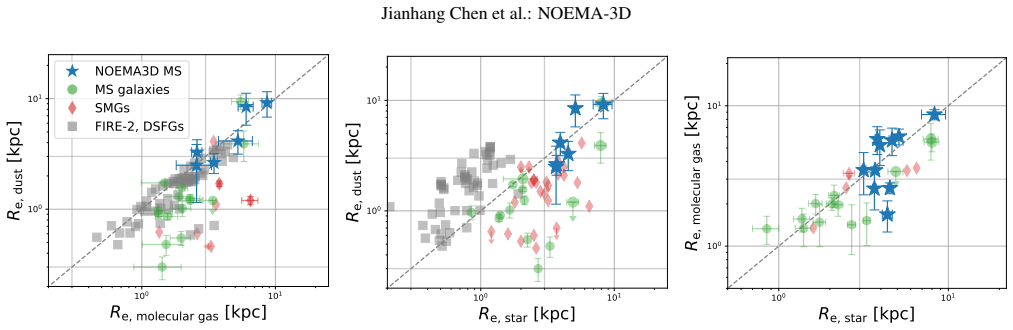
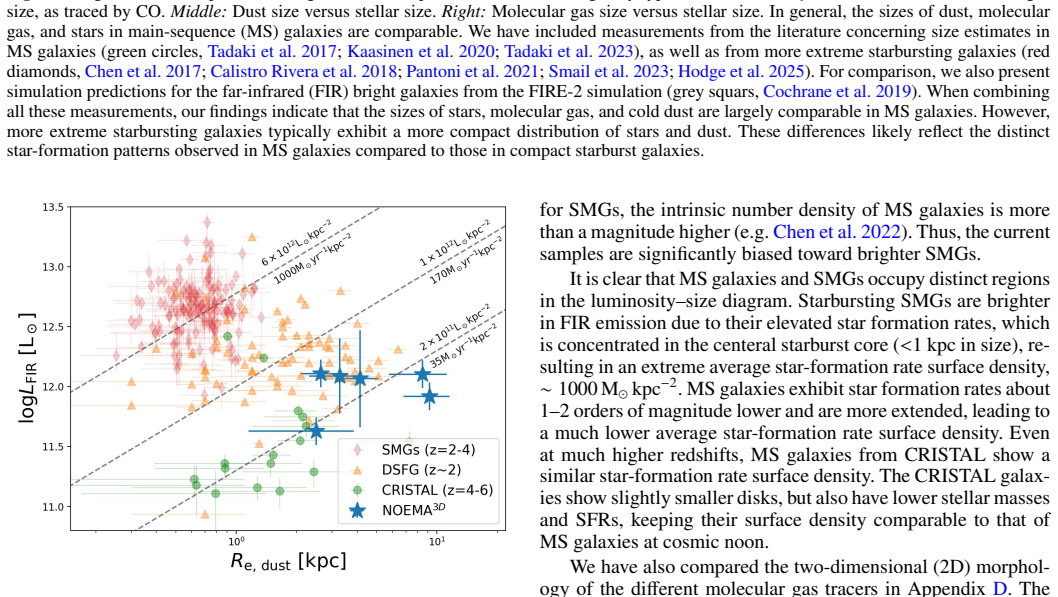
Spatially resolved maps show extended molecular gas and dust distributions comparable to stellar disks in these main-sequence galaxies, unlike central concentrations in starbursts at similar redshifts. CO lines prove most effective for tracing gas distribution and kinematics, while resolved tracer correlations display about twice the scatter of integrated values. Molecular gas fraction and depletion time remain roughly constant out to 2 Re, consistent with a linear Kennicutt-Schmidt law. Combined with ordered cold gas kinematics and regular stellar morphologies, this supports evolution driven by steady gas accretion and transport via prominent spiral arms and/or bars, in contrast to merger-f
What carries the argument
Spatially resolved maps of CO(4-3), CO(3-2), [C I](1-0) emission and dust continuum compared against stellar light and kinematics to trace gas distribution and dynamics.
Load-bearing premise
The ten observed galaxies represent the typical main-sequence population at z=1.1-1.6 and the chosen molecular tracers accurately reflect total cold gas mass and distribution without major biases from excitation conditions or optical depth.
What would settle it
A larger sample of main-sequence galaxies at z~1.5 showing centrally concentrated gas, disturbed kinematics, or varying gas fractions across disks would contradict the steady accretion picture.
Figures




read the original abstract
We present a spatially resolved study of cold molecular gas and dust in ten main-sequence galaxies at z=1.1-1.6, using observations of CO(4-3), CO(3-2), [C I](1-0), and dust continuum from the NOEMA3D survey. We find a widely presence of spatially extended molecular gas and dust, with sizes comparable to those of the stellar disk, in contrast to those of central-dominated starburst galaxies at similar redshifts. While various molecular gas tracers generally exhibit similar spatial distributions, the CO line (J=3-2 or J=4-3) remain the most effective for mapping molecular gas distribution and kinematics. In addition, the spatially resolved correlations between different molecular gas tracers exhibit about two times larger scatter than their galactic-integrated correlations, indicating that interstellar medium (ISM) conditions already deviate from global averages on scales of 3-6 kpc, likely reflecting the clumpy or inhomogeneous ISM in cosmic noon star-forming galaxies. Within our sample, both the molecular gas fraction and its depletion time are nearly constant across the galactic disks out to 2 Re, supporting a global linear Kennicutt-Schmidt law. The presence of extended molecular gas disks, along with regular stellar structures, small central bulges, and ordered cold gas kinematics, supports the idea that the evolution of main-sequence disk galaxies at cosmic noon is driven by steady gas accretion and transport through prominent spiral arms and/or bars. This process stands in contrast to the merger-driven stochastic gas accretion in compact starbursts.
Editorial analysis
A structured set of objections, weighed in public.
Referee Report
Summary. The manuscript reports NOEMA observations of CO(4-3), CO(3-2), [C I](1-0), and dust continuum in ten main-sequence galaxies at z=1.1-1.6. It finds extended molecular gas and dust disks with sizes comparable to the stellar disks (unlike compact starbursts), CO lines as the most reliable tracer, ~2x larger scatter in resolved vs. integrated tracer correlations indicating ISM inhomogeneity on 3-6 kpc scales, and nearly constant molecular gas fractions and depletion times out to 2 R_e supporting a global linear Kennicutt-Schmidt law. These are interpreted as evidence for steady gas accretion and transport via spiral arms/bars driving main-sequence evolution at cosmic noon, in contrast to merger-driven processes.
Significance. If the results hold after detailed verification of data reduction and error propagation, the work supplies important spatially resolved constraints on cold gas in typical (non-starburst) galaxies at cosmic noon. The multi-tracer resolved maps and the reported constancy of gas properties across disks provide direct observational support for secular accretion models over stochastic merger-driven growth, with the noted ISM inhomogeneity offering a useful benchmark for simulations of high-redshift disks.
major comments (2)
- The central claim of nearly constant molecular gas fraction and depletion time out to 2 R_e (supporting the linear KS law) requires explicit quantification of how radial profiles are extracted, including any beam-smearing corrections, inclination effects, and the assumed CO-to-H2 conversion factor; without this, it is difficult to assess robustness against the acknowledged ISM inhomogeneity on 3-6 kpc scales.
- The interpretation that ordered kinematics and regular stellar structures indicate steady accretion rather than mergers rests on the sample being representative; the manuscript should include a direct comparison of the ten galaxies' properties (e.g., stellar mass, SFR, size) to larger z~1.5 main-sequence samples from surveys such as PHIBSS or 3D-HST to address potential selection biases in NOEMA-detectable targets.
minor comments (3)
- Abstract: 'widely presence' should read 'widespread presence'.
- Ensure all figure captions explicitly label the different molecular tracers, radial scales in kpc, and any beam sizes for clarity.
- The discussion of tracer reliability would benefit from a table summarizing the spatial extent and kinematic regularity metrics for each of the ten galaxies.
Simulated Author's Rebuttal
We thank the referee for their positive assessment and constructive comments, which will improve the clarity and robustness of our manuscript. We address each major comment point by point below and will revise the manuscript accordingly.
read point-by-point responses
-
Referee: The central claim of nearly constant molecular gas fraction and depletion time out to 2 R_e (supporting the linear KS law) requires explicit quantification of how radial profiles are extracted, including any beam-smearing corrections, inclination effects, and the assumed CO-to-H2 conversion factor; without this, it is difficult to assess robustness against the acknowledged ISM inhomogeneity on 3-6 kpc scales.
Authors: We agree that additional methodological details are needed to substantiate the radial constancy claim. In the revised manuscript, we will add a dedicated subsection to the Methods section that explicitly quantifies the radial profile extraction procedure. This will include: (i) the azimuthal averaging and radial binning approach, (ii) beam-smearing corrections derived from the NOEMA beam size and source extent, (iii) inclination corrections based on kinematic modeling of the CO velocity fields, and (iv) the adopted CO-to-H2 conversion factor with justification and tests for variations. We will further demonstrate robustness by showing that the near-constant molecular gas fraction and depletion time persist within the uncertainties even when incorporating the factor-of-two larger scatter from ISM inhomogeneity on 3-6 kpc scales. These additions will allow a clearer evaluation of support for the global linear Kennicutt-Schmidt law. revision: yes
-
Referee: The interpretation that ordered kinematics and regular stellar structures indicate steady accretion rather than mergers rests on the sample being representative; the manuscript should include a direct comparison of the ten galaxies' properties (e.g., stellar mass, SFR, size) to larger z~1.5 main-sequence samples from surveys such as PHIBSS or 3D-HST to address potential selection biases in NOEMA-detectable targets.
Authors: We acknowledge the value of explicitly demonstrating sample representativeness to support our interpretation of steady accretion. In the revised manuscript, we will include a new figure and accompanying text that directly compares the stellar masses, star formation rates, effective radii, and specific SFRs of our ten galaxies to the distributions from the PHIBSS survey and 3D-HST catalogs for main-sequence galaxies at z=1.1-1.6. This will show that our NOEMA targets are broadly representative of the typical population, with no strong selection bias toward systems with ordered kinematics or extended disks. Any minor differences will be discussed in the context of generalizing our conclusions on secular versus merger-driven evolution. revision: yes
Circularity Check
No significant circularity: purely observational study with direct measurements
full rationale
The paper reports spatially resolved NOEMA observations of CO, [CI], and dust in ten z=1.1-1.6 main-sequence galaxies. All load-bearing statements (extended gas disks comparable to stellar disks, near-constant gas fractions and depletion times out to 2 Re, larger scatter in resolved vs. integrated correlations, ordered kinematics) are direct empirical results from the data cubes and maps. No equations, fitted parameters, or predictions are defined within the paper and then re-used as outputs. No self-citation chain is invoked to justify a uniqueness theorem or ansatz; the interpretive conclusion about steady accretion versus mergers follows from the contrast between the observed regular disk properties and the known properties of starbursts, without reducing to prior author work by construction. The derivation chain is therefore self-contained against external benchmarks.
Axiom & Free-Parameter Ledger
axioms (2)
- domain assumption CO line intensities can be converted to molecular hydrogen masses using standard conversion factors
- domain assumption The ten galaxies form a representative sample of main-sequence galaxies at z=1.1-1.6
Forward citations
Cited by 1 Pith paper
-
NOEMA3D: Resolving radial gas flows in disk galaxies at z~1.1-1.6 with high-resolution CO observations
High-resolution molecular gas observations show that spiral arms and bars in z~1.5 disk galaxies drive substantial radial inflows at rates matching star formation, linking morphology directly to gas transport.
Reference graph
Works this paper leans on
-
[1]
Alaghband-Zadeh, S., Chapman, S. C., Swinbank, A. M., et al. 2013, MNRAS, 435, 1493
work page 2013
- [2]
-
[3]
Aravena, M., Hodge, J. A., Wagg, J., et al. 2014, MNRAS, 442, 558
work page 2014
-
[4]
Arriagada-Neira, S., Herrera-Camus, R., Villanueva, V ., et al. 2025, A&A, 696, A83
work page 2025
-
[5]
Baker, W. M., Maiolino, R., Bluck, A. F. L., et al. 2022, MNRAS, 510, 3622
work page 2022
- [6]
-
[7]
Barro, G., Faber, S. M., Pérez-González, P. G., et al. 2013, ApJ, 765, 104
work page 2013
-
[8]
Bigiel, F., Leroy, A. K., Walter, F., et al. 2011, ApJ, 730, L13
work page 2011
-
[9]
Bisbas, T. G., Papadopoulos, P. P., & Viti, S. 2015, ApJ, 803, 37
work page 2015
-
[10]
Bluck, A. F. L., Mendel, J. T., Ellison, S. L., et al. 2014, MNRAS, 441, 599
work page 2014
-
[11]
Bolatto, A. D., Warren, S. R., Leroy, A. K., et al. 2015, ApJ, 809, 175
work page 2015
-
[12]
Bolatto, A. D., Wolfire, M., & Leroy, A. K. 2013, ARA&A, 51, 207
work page 2013
- [13]
-
[14]
A., Decarli, R., Walter, F., et al
Boogaard, L. A., Decarli, R., Walter, F., et al. 2023, ApJ, 945, 111
work page 2023
-
[15]
A., van der Werf, P., Weiss, A., et al
Boogaard, L. A., van der Werf, P., Weiss, A., et al. 2020, ApJ, 902, 109
work page 2020
-
[16]
A., Walter, F., Weiß, A., et al
Boogaard, L. A., Walter, F., Weiß, A., et al. 2026, ApJ, 996, 19
work page 2026
-
[17]
Boquien, M., Burgarella, D., Roehlly, Y ., et al. 2019, A&A, 622, A103
work page 2019
-
[18]
Bothwell, M. S., Aguirre, J. E., Aravena, M., et al. 2017, MNRAS, 466, 2825
work page 2017
-
[19]
Bourne, N., Dunlop, J. S., Simpson, J. M., et al. 2019, MNRAS, 482, 3135
work page 2019
-
[20]
Bruzual, G. & Charlot, S. 2003, MNRAS, 344, 1000 Calistro Rivera, G., Hodge, J. A., Smail, I., et al. 2018, ApJ, 863, 56
work page 2003
- [21]
-
[22]
Carilli, C. L. & Walter, F. 2013, ARA&A, 51, 105
work page 2013
-
[23]
2023, The ALMA Wide- band Sensitivity Upgrade
Carpenter, J., Brogan, C., Iono, D., & Mroczkowski, T. 2023, The ALMA Wide- band Sensitivity Upgrade
work page 2023
-
[24]
M., Narayanan, D., & Cooray, A
Casey, C. M., Narayanan, D., & Cooray, A. 2014, PhR, 541, 45
work page 2014
- [25]
- [26]
-
[27]
Chen, C.-C., Hodge, J. A., Smail, I., et al. 2017, ApJ, 846, 108
work page 2017
-
[28]
Chen, J., Ivison, R. J., Zwaan, M. A., et al. 2022, MNRAS Article number, page 16 of 24 Jianhang Chen et al.: NOEMA-3D
work page 2022
-
[29]
2023, Monthly Notices of the Royal Astronomical Society, 520, 2180
Claeyssens, A., Adamo, A., Richard, J., et al. 2023, Monthly Notices of the Royal Astronomical Society, 520, 2180
work page 2023
-
[30]
Cochrane, R. K., Hayward, C. C., Anglés-Alcázar, D., et al. 2019, MNRAS, 488, 1779
work page 2019
- [31]
-
[32]
Costantin, L., Pérez-González, P. G., Guo, Y ., et al. 2023, Nature, 623, 499
work page 2023
- [33]
- [34]
-
[35]
Dale, D. A., Helou, G., Magdis, G. E., et al. 2014, ApJ, 784, 83
work page 2014
-
[36]
Danovich, M., Dekel, A., Hahn, O., Ceverino, D., & Primack, J. 2015, MNRAS, 449, 2087
work page 2015
-
[37]
Davies, R. I., Maciejewski, W., Hicks, E. K. S., et al. 2009, ApJ, 702, 114
work page 2009
- [38]
- [39]
-
[40]
2009, ApJ, 703, 785 Di Teodoro, E
Dekel, A., Sari, R., & Ceverino, D. 2009, ApJ, 703, 785 Di Teodoro, E. M. & Peek, J. E. G. 2021, ApJ, 923, 220
work page 2009
-
[41]
2003, in The Mass of Galaxies at Low and High Redshift, eprint: arXiv:astro-ph/0204213, 324
Dickinson, M., Giavalisco, M., & GOODS Team. 2003, in The Mass of Galaxies at Low and High Redshift, eprint: arXiv:astro-ph/0204213, 324
-
[42]
Drory, N. & Fisher, D. B. 2007, ApJ, 664, 640 Dudzeviˇci¯ut˙e, U., Smail, I., Swinbank, A. M., et al. 2020, MNRAS, 494, 3828
work page 2007
-
[43]
Dunne, L., Maddox, S. J., Papadopoulos, P. P., Ivison, R. J., & Gomez, H. L. 2022, MNRAS, 517, 962
work page 2022
-
[44]
Eales, S., Smith, M. W. L., Auld, R., et al. 2012, ApJ, 761, 168
work page 2012
-
[45]
2007, A&A, 468, 33 Espejo Salcedo, J
Elbaz, D., Daddi, E., Le Borgne, D., et al. 2007, A&A, 468, 33 Espejo Salcedo, J. M., Pastras, S., Vácha, J., et al. 2025, A&A, 700, A42
work page 2007
-
[46]
Fabian, A. 2012, Annu. Rev. Astron. Astrophys., 50, 455 Förster Schreiber, N. M., Renzini, A., Mancini, C., et al. 2018, ApJS, 238, 21 Förster Schreiber, N. M., Shapley, A. E., Genzel, R., et al. 2011, ApJ, 739, 45 Förster Schreiber, N. M. & Wuyts, S. 2020, ARA&A, 58, 661 Frias Castillo, M., Hodge, J., Rybak, M., et al. 2023, ApJ, 945, 128
work page 2012
- [47]
-
[48]
Fujimoto, S., Faisst, A. L., Tsujita, A., et al. 2025, The ALPINE-CRISTAL- JWST Survey: NIRSpec IFU Data Processing and Spatially-resolved Views of Chemical Enrichment in Normal Galaxies at Z=4-6
work page 2025
-
[49]
Gadotti, D. A. 2026, MNRAS, 545, staf2072
work page 2026
-
[50]
Geach, J. E. & Papadopoulos, P. P. 2012, ApJ, 757, 156
work page 2012
-
[51]
Genel, S., Bouché, N., Naab, T., Sternberg, A., & Genzel, R. 2010, ApJ, 719, 229
work page 2010
- [52]
-
[53]
Genzel, R., Förster Schreiber, N. M., Lang, P., et al. 2014, ApJ, 785, 75
work page 2014
- [54]
- [55]
- [56]
-
[57]
C., Cassata, P., & Koekemoer, A
Guo, Y ., Giavalisco, M., Ferguson, H. C., Cassata, P., & Koekemoer, A. M. 2012, ApJ, 757, 120
work page 2012
- [58]
-
[59]
Harrington, K. C., Weiss, A., Yun, M. S., et al. 2021, ApJ, 908, 95 Henríquez-Brocal, K., Herrera-Camus, R., Tacconi, L., et al. 2022, A&A, 657, L15
work page 2021
-
[60]
Hodge, J. A. & da Cunha, E. 2020, R. Soc. open sci., 7, 200556
work page 2020
-
[61]
A., da Cunha, E., Kendrew, S., et al
Hodge, J. A., da Cunha, E., Kendrew, S., et al. 2025, ApJ, 978, 165
work page 2025
-
[62]
A., Riechers, D., Decarli, R., et al
Hodge, J. A., Riechers, D., Decarli, R., et al. 2015, ApJ, 798, L18
work page 2015
-
[63]
Huang, S., Kawabe, R., Umehata, H., et al. 2025, Nature, 641, 861
work page 2025
-
[64]
Jiang, F., Liang, J., Jin, B., et al. 2025, Formation and Environmental Context of Giant Bulgeless Disk Galaxies in the Early Universe: Insights from Cosmo- logical Simulations
work page 2025
- [65]
-
[66]
Jolly, J.-B., Tacconi, L. J., Genzel, R., et al. 2026, NOEMA3D: Resolving Radial Gas Flows in Disk Galaxies at Z~1.1-1.6 with High-Resolution CO Observa- tions, arXiv:2604.18503
work page internal anchor Pith review Pith/arXiv arXiv 2026
- [67]
- [68]
-
[69]
Kalita, B. S., Silverman, J. D., Daddi, E., et al. 2025, MNRAS, 537, 402
work page 2025
-
[70]
Kennicutt, R. C. 1998, ARA&A, 36, 189
work page 1998
-
[71]
Kennicutt, R. C. & Evans, N. J. 2012, ARA&A, 50, 531 Kereš, D., Katz, N., Weinberg, D. H., & Davé, R. 2005, Mon Not R Astron Soc, 363, 2
work page 2012
- [72]
-
[73]
Kreckel, K., Groves, B., Schinnerer, E., et al. 2013, ApJ, 771, 62
work page 2013
-
[74]
Kurtovic, N. T. & Pinilla, P. 2024, A&A, 687, A188
work page 2024
-
[75]
Laurikainen, E., Salo, H., Buta, R., Knapen, J. H., & Comerón, S. 2010, Mon Not R Astron Soc, 405, 1089 Le Conte, Z. A., Gadotti, D. A., Ferreira, L., et al. 2024, MNRAS, 530, 1984 Le Conte, Z. A., Gadotti, D. A., Harvey, T., et al. 2026, A Nuclear Disc at Cosmic Noon: Evidence of Early Bar-Driven Galaxy Evolution
work page 2010
- [76]
-
[77]
Lee, L. L., Förster Schreiber, N. M., Fujimoto, S., et al. 2026, The ALPINE- CRISTAL-JWST Survey: Gas-phase Abundance Gradients of Main Sequence Star-Forming Galaxies and Their Kinematics at $4<z<6$
work page 2026
-
[78]
M., Tanaka, I., Iono, D., et al
Lee, M. M., Tanaka, I., Iono, D., et al. 2021, ApJ, 909, 181
work page 2021
-
[79]
K., Bolatto, A., Gordon, K., et al
Leroy, A. K., Bolatto, A., Gordon, K., et al. 2011, ApJ, 737, 12
work page 2011
-
[80]
Liu, D., Förster Schreiber, N. M., Genzel, R., et al. 2023, ApJ, 942, 98
work page 2023
discussion (0)
Sign in with ORCID, Apple, or X to comment. Anyone can read and Pith papers without signing in.