Self-propulsion protocols for swift non-equilibrium state transitions and enhanced cooling in active systems
Pith reviewed 2026-05-10 01:49 UTC · model grok-4.3
The pith
Non-stationary initial states pre-loaded with negative correlations speed up non-equilibrium transitions in active systems.
A machine-rendered reading of the paper's core claim, the machinery that carries it, and where it could break.
Core claim
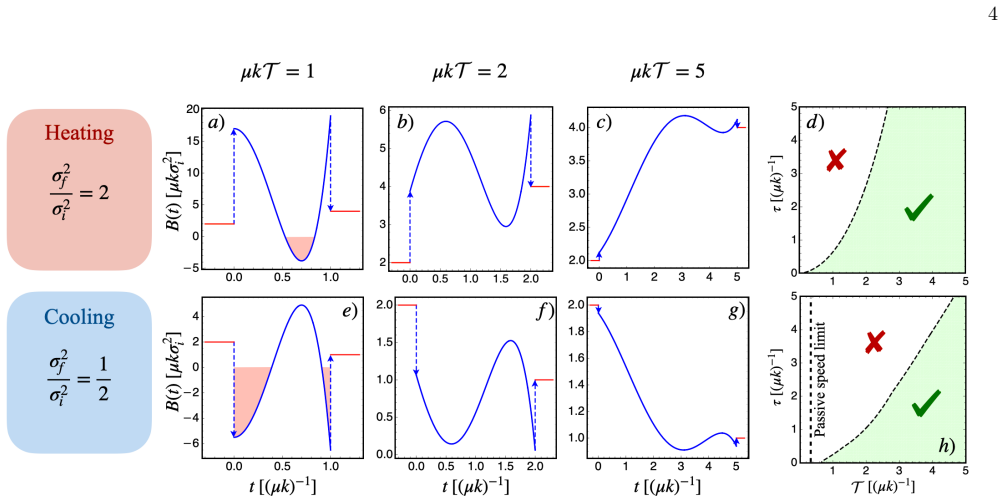
The central claim is that in confined active matter, non-equilibrium state transitions can be controlled exclusively via the self-propulsion statistics. Admissible controls are those respecting positive noise amplitudes and bounds on position-propulsion correlations, which enforce speed limits on transitions. Non-stationary initial states pre-loaded with negative correlations permit faster transitions, enabling active cooling protocols superior to their passive counterparts.
What carries the argument
The admissible control space for self-propulsion statistics, defined by positivity of noise amplitudes and bounds on position-propulsion correlations, which sets speed limits on state transitions and allows speed-ups from non-stationary initial conditions.
If this is right
- Transitions between non-equilibrium states in active matter are subject to strict speed limits imposed by correlation bounds.
- Non-stationary initial states with negative correlations enable faster state changes than stationary ones.
- Active cooling protocols can achieve better performance than passive cooling by exploiting these initial correlations.
- Only the self-propulsion noise statistics need to be controlled to drive these transitions.
Where Pith is reading between the lines
- Similar speed-up effects from pre-loaded negative correlations might appear in other driven systems beyond active matter, such as in colloidal suspensions or biological collectives.
- Experimental tests could involve preparing active particle systems in specific correlated states and measuring transition times under controlled propulsion noise.
- This suggests that initial condition engineering could be a general strategy for accelerating relaxation in non-equilibrium physics.
Load-bearing premise
That positivity of the noise amplitudes together with fundamental bounds on position-propulsion correlations are sufficient to define the admissible control space and impose strict speed limits on transitions.
What would settle it
A measurement or simulation showing a state transition that violates the predicted speed limit while respecting positive noise amplitudes and the correlation bounds.
Figures



read the original abstract
A control framework is proposed for inducing non-equilibrium state transitions in confined active matter, where the statistics of self-propulsion serve as the only control parameter. Positivity of the noise amplitudes and fundamental bounds on position-propulsion correlations define the admissible control space and impose speed-limits on transitions between non-equilibrium states. We show that non-stationary initial states facilitate additional speed-ups, corresponding to pre-loading the state with negative correlations. This enables active cooling protocols that outperform their passive counterparts.
Editorial analysis
A structured set of objections, weighed in public.
Referee Report
Summary. The manuscript proposes a control framework for inducing non-equilibrium state transitions in confined active matter, where the statistics of self-propulsion serve as the only control parameter. Positivity of the noise amplitudes and fundamental bounds on position-propulsion correlations define the admissible control space and impose speed-limits on transitions between non-equilibrium states. Non-stationary initial states facilitate additional speed-ups by pre-loading the state with negative correlations, enabling active cooling protocols that outperform their passive counterparts.
Significance. If the derivations and evidence establish the claimed speed limits and outperformance rigorously, the work would offer a meaningful contribution to non-equilibrium statistical mechanics by providing a self-propulsion-based control scheme with quantifiable bounds, extending ideas from thermodynamic speed limits to active systems. The emphasis on non-stationary initials for correlation pre-loading is a potentially useful insight for enhanced cooling.
major comments (2)
- [Abstract] Abstract: The abstract states results but supplies no equations, derivations, or numerical evidence; central claims about speed limits and outperformance cannot be verified from available text. This is load-bearing for assessing whether the speed limits are independent or tautological.
- [Abstract] Abstract: The weakest assumption that positivity of noise amplitudes together with fundamental bounds on position-propulsion correlations suffice to define the admissible control space and impose strict speed limits requires explicit mathematical demonstration to rule out circularity.
minor comments (2)
- The manuscript would benefit from including at least one explicit example or protocol equation early on to illustrate how self-propulsion statistics are varied to achieve the transitions.
- Clarify the precise definition of 'fundamental bounds on position-propulsion correlations' and how they are derived from the model assumptions.
Simulated Author's Rebuttal
We thank the referee for their thoughtful review and constructive feedback on our manuscript. We address each major comment point by point below, providing clarifications and indicating revisions where they strengthen the presentation without altering the core results.
read point-by-point responses
-
Referee: [Abstract] Abstract: The abstract states results but supplies no equations, derivations, or numerical evidence; central claims about speed limits and outperformance cannot be verified from available text. This is load-bearing for assessing whether the speed limits are independent or tautological.
Authors: We acknowledge that abstracts are concise summaries and typically omit equations or detailed evidence, following standard conventions in physics. The full derivations of the speed limits from noise positivity and correlation bounds appear in Section II (Eqs. 5-12), where the admissible control space is constructed explicitly as a convex set in the space of propulsion statistics. Numerical evidence for outperformance of active cooling over passive protocols is given in Section IV and Figure 4, showing reduced transition times for non-stationary initial states. To address the concern about independence versus tautology, we have added a clarifying paragraph in the introduction explaining that the bounds originate from the underlying Ornstein-Uhlenbeck dynamics of the propulsion variable and are independent of the optimization objective; a protocol violating them would require unphysical negative noise amplitudes. revision: partial
-
Referee: [Abstract] Abstract: The weakest assumption that positivity of noise amplitudes together with fundamental bounds on position-propulsion correlations suffice to define the admissible control space and impose strict speed limits requires explicit mathematical demonstration to rule out circularity.
Authors: We agree that an explicit, non-circular demonstration is essential. In the revised manuscript, we have expanded Section II with a dedicated derivation: starting from the Fokker-Planck equation for the joint position-propulsion distribution, we show that the correlation bound |<x v>| ≤ σ_x σ_v follows directly from the positive-semidefiniteness of the covariance matrix, independent of any control protocol. Positivity of noise amplitudes then restricts the allowable rates of change in the propulsion variance. The speed limit on transitions is obtained by optimizing the time-dependent noise statistics over this constrained set, yielding a geometric bound in control space. This construction is not circular, as the constraints pre-exist the transition problem; we have included a brief counterexample of an inadmissible protocol that would imply negative variances. revision: yes
Circularity Check
No significant circularity; derivation self-contained on stated terms
full rationale
The provided abstract and claims describe a control framework in which positivity of noise amplitudes and bounds on position-propulsion correlations define the admissible space and impose speed limits, with non-stationary initial states enabling additional speed-ups via negative correlations. No equations, derivations, or self-citations are exhibited in the text, so no step can be shown to reduce a prediction to a fitted input, self-definition, or load-bearing self-citation by construction. The framework is presented as internally consistent on its own premises without visible tautological reductions, making this the normal honest finding of no circularity.
Axiom & Free-Parameter Ledger
Reference graph
Works this paper leans on
-
[1]
S. Ramaswamy, The mechanics and statistics of active matter, Annual Review of Condensed Matter Physics1, 323 (2010)
work page 2010
-
[2]
M. C. Marchetti, J.-F. Joanny, S. Ramaswamy, T. B. Liverpool, J. Prost, M. Rao, and R. A. Simha, Hydrody- namics of soft active matter, Reviews of Modern Physics 85, 1143 (2013)
work page 2013
-
[3]
A. Baldassarri, A. Puglisi, and L. Sesta, Engineered swift equilibration of a brownian gyrator, Physical Review E 102, 030105 (2020)
work page 2020
-
[4]
A. Prados, Optimizing the relaxation route with optimal control, Physical Review Research3, 023128 (2021)
work page 2021
- [5]
-
[6]
A. Zhong and M. R. DeWeese, Limited-control optimal protocols arbitrarily far from equilibrium, Physical Re- view E106, 044135 (2022)
work page 2022
-
[7]
M. C. Engel, J. A. Smith, and M. P. Brenner, Optimal control of nonequilibrium systems through automatic dif- ferentiation, Physical Review X13, 041032 (2023)
work page 2023
-
[8]
A. Patr´ on, C. Plata, and A. Prados, Minimum time con- nection between non-equilibrium steady states: the brow- nian gyrator, Journal of Physics A: Mathematical and Theoretical57, 495004 (2024)
work page 2024
- [9]
- [10]
-
[11]
K. S. Olsen, R. Goerlich, Y. Roichman, and H. L¨ owen, Harnessing non-equilibrium forces to optimize work ex- traction, Nature Communications16(2025)
work page 2025
- [12]
-
[13]
R. Garcia-Millan, J. Sch¨ uttler, M. E. Cates, and S. A. Loos, Optimal closed-loop control of active particles and a minimal information engine, Physical Review Letters 135, 088301 (2025)
work page 2025
-
[14]
J. Sch¨ uttler, R. Garcia-Millan, M. E. Cates, and S. A. Loos, Active particles in moving traps: Minimum work protocols and information efficiency of work extraction, Physical Review E112, 024119 (2025)
work page 2025
-
[15]
L. K. Davis, K. Proesmans, and ´E. Fodor, Active matter under control: Insights from response theory, Physical Review X14, 011012 (2024)
work page 2024
-
[16]
A. Soriani, E. Tjhung, ´E. Fodor, and T. Markovich, Con- trol of active field theories at minimal dissipation, arXiv preprint arXiv:2504.19285 (2025)
-
[17]
C. Casert and S. Whitelam, Learning protocols for the fast and efficient control of active matter, Nature Com- munications15, 9128 (2024)
work page 2024
-
[18]
J. Alvarado, E. G. Teich, D. A. Sivak, and J. Bechhoefer, Optimal control in soft and active matter, Annual Review of Condensed Matter Physics17(2026)
work page 2026
-
[19]
M. Baldovin and A. Manacorda, Control protocols for harmonically confined run-and-tumble particles, arXiv preprint arXiv:2602.04560 (2026)
- [20]
- [21]
-
[22]
Y. Wang, E. Lei, Y.-H. Ma, Z. Tu, and G. Li, Ther- modynamic geometric control of active matter, Physical Review E112, 054124 (2025)
work page 2025
-
[23]
A. Le Cunuder, I. A. Mart´ ınez, A. Petrosyan, D. Gu´ ery- Odelin, E. Trizac, and S. Ciliberto, Fast equilibrium switch of a micro mechanical oscillator, Applied Physics Letters109(2016)
work page 2016
-
[24]
D. Gu´ ery-Odelin, C. Jarzynski, C. A. Plata, A. Prados, and E. Trizac, Driving rapidly while remaining in control: classical shortcuts from hamiltonian to stochastic dynam- ics, Reports on Progress in Physics86, 035902 (2023)
work page 2023
-
[25]
D. Gu´ ery-Odelin, A. Ruschhaupt, A. Kiely, E. Tor- rontegui, S. Mart´ ınez-Garaot, and J. G. Muga, Short- cuts to adiabaticity: Concepts, methods, and applica- tions, Reviews of Modern Physics91, 045001 (2019)
work page 2019
-
[26]
I. A. Mart´ ınez, A. Petrosyan, D. Gu´ ery-Odelin, E. Trizac, and S. Ciliberto, Engineered swift equilibration of a brownian particle, Nature Physics12, 843 (2016)
work page 2016
-
[27]
M. Chupeau, S. Ciliberto, D. Gu´ ery-Odelin, and E. Trizac, Engineered swift equilibration for brownian objects: from underdamped to overdamped dynamics, New Journal of Physics20, 075003 (2018)
work page 2018
-
[28]
Inverse engineering of cooling protocols: from normal behavior to Mpemba effects
H. L¨ owen, Inverse engineering of cooling protocols: from normal behavior to mpemba effects, arXiv preprint arXiv:2604.11486 (2026)
work page internal anchor Pith review Pith/arXiv arXiv 2026
-
[29]
M. Baldovin, D. Gu´ ery-Odelin, and E. Trizac, Control of active brownian particles: An exact solution, Physical Review Letters131, 118302 (2023)
work page 2023
- [30]
-
[31]
Shortcuts to state transitions for active matter
G. Cheng, Z. C. Tu, and G. Li, Shortcuts to state transi- tions for active matter, arXiv preprint arXiv:2604.05585 (2026)
work page internal anchor Pith review Pith/arXiv arXiv 2026
-
[32]
B. M. Friedrich, I. H. Riedel-Kruse, J. Howard, and F. J¨ ulicher, High-precision tracking of sperm swimming fine structure provides strong test of resistive force the- ory, Journal of Experimental Biology213, 1226 (2010)
work page 2010
- [33]
-
[34]
A. C. Gleiss, S. J. Jorgensen, N. Liebsch, J. E. Sala, B. Norman, G. C. Hays, F. Quintana, E. Grundy, C. Campagna, A. W. Trites,et al., Convergent evolution in locomotory patterns of flying and swimming animals, Nature Communications2, 352 (2011)
work page 2011
-
[35]
S. Marras, T. Noda, J. F. Steffensen, M. B. Svendsen, J. Krause, A. D. Wilson, R. H. Kurvers, J. Herbert-Read, K. M. Boswell, and P. Domenici, Not so fast: swimming behavior of sailfish during predator–prey interactions us- ing high-speed video and accelerometry, Integrative and Comparative Biology55, 719 (2015)
work page 2015
-
[36]
P. Domenici, The scaling of locomotor performance in predator–prey encounters: from fish to killer whales, Comparative Biochemistry and Physiology Part A: Molecular & Integrative Physiology131, 169 (2001)
work page 2001
-
[37]
I. Buttinoni, G. Volpe, F. K¨ ummel, G. Volpe, and C. Bechinger, Active brownian motion tunable by light, Journal of Physics: Condensed Matter24, 284129 (2012)
work page 2012
- [38]
-
[39]
M. Rey, G. Volpe, and G. Volpe, Light, matter, action: Shining light on active matter, ACS Photonics10, 1188 (2023)
work page 2023
-
[40]
K. Nishiyama, J. Berezney, M. M. Norton, A. Aggarwal, S. Ghosh, Z. Zarei, M. F. Hagan, S. Fraden, and Z. Dogic, Closed-loop control of active nematic flows, Physical Re- view X15, 041053 (2025)
work page 2025
-
[41]
R. Goerlich, L. B. Pires, G. Manfredi, P.-A. Hervieux, and C. Genet, Harvesting information to control nonequi- librium states of active matter, Physical Review E106, 054617 (2022)
work page 2022
-
[42]
G. P. Nguyen, R. Wittmann, and H. L¨ owen, Ac- tive ornstein–uhlenbeck model for self-propelled particles with inertia, Journal of Physics: Condensed Matter34, 035101 (2022)
work page 2022
-
[43]
L. L. Bonilla, Active ornstein-uhlenbeck particles, Phys- ical Review E100, 022601 (2019)
work page 2019
- [44]
-
[45]
A. Sharma and J. M. Brader, Brownian systems with spatially inhomogeneous activity, Physical Review E96, 032604 (2017)
work page 2017
-
[46]
A. Jurado Romero, C. Calero, and R. Rey, Enhance- ment of swimmer diffusion through regular kicks: ana- lytic mapping of a scale-independent parameter space, Journal of Statistical Mechanics: Theory and Experi- ment2024, 063201 (2024)
work page 2024
-
[47]
L. L. Gutierrez-Martinez and M. Sandoval, Time- dependent propulsion of fully inertial active stochastic particles: theory and simulations, Journal of Physics: Condensed Matter37, 135102 (2025)
work page 2025
-
[48]
H. L¨ owen, Gigantic dynamical spreading and anomalous diffusion of jerky active particles, Physical Review E112, 045412 (2025)
work page 2025
-
[49]
Durrett,Probability: theory and examples, Vol
R. Durrett,Probability: theory and examples, Vol. 49 (Cambridge university press, 2019)
work page 2019
-
[50]
L. B. Pires, R. Goerlich, A. L. da Fonseca, M. Debios- sac, P.-A. Hervieux, G. Manfredi, and C. Genet, Opti- mal time-entropy bounds and speed limits for brownian thermal shortcuts, Physical Review Letters131, 097101 (2023)
work page 2023
-
[51]
A. Patr´ on, A. Prados, and C. A. Plata, Thermal brachis- tochrone for harmonically confined brownian particles, The European Physical Journal Plus137, 1 (2022)
work page 2022
-
[52]
C. A. Plata, D. Gu´ ery-Odelin, E. Trizac, and A. Prados, Finite-time adiabatic processes: Derivation and speed limit, Physical Review E101, 032129 (2020)
work page 2020
- [53]
discussion (0)
Sign in with ORCID, Apple, or X to comment. Anyone can read and Pith papers without signing in.