A Proximal Primal-Dual Approach to Generalized JKO Schemes for Doubly Nonlinear Parabolic Equations
Pith reviewed 2026-05-10 01:20 UTC · model grok-4.3
The pith
A proximal primal-dual method yields explicit formulas for proximal operators in generalized JKO schemes for doubly nonlinear equations.
A machine-rendered reading of the paper's core claim, the machinery that carries it, and where it could break.
Core claim
By recasting the generalized JKO scheme as a proximal primal-dual optimization problem, explicit formulas for the proximal operators with general costs are obtained, which are then used to approximate the solutions of doubly nonlinear parabolic equations in a computationally tractable manner.
What carries the argument
The proximal primal-dual algorithm applied to the generalized JKO scheme, which derives and applies proximal operators for general costs to discretize the gradient-flow dynamics.
If this is right
- The method produces numerical solutions for the p-Laplace equation as a special case.
- Flux-limited equations including the relativistic heat equation can be handled within the same framework.
- Validation occurs by recovering the qualitative behavior of known steepest descent evolutions.
- The scheme extends variational optimization techniques to a broad family of doubly nonlinear parabolic PDEs.
Where Pith is reading between the lines
- The explicit proximal formulas may simplify implementation for other gradient flows with similar cost structures not explicitly tested here.
- This optimization lens could connect to related numerical methods for measure-valued or nonlinear diffusion problems.
- Parameter studies on the general cost functions might become feasible in applications where direct discretization is costly.
Load-bearing premise
Explicit and efficiently computable formulas for the proximal operators exist for the general family of costs considered and the discrete scheme reproduces the continuous dynamics without uncontrolled artifacts.
What would settle it
A numerical test on a known case such as the heat equation or p-Laplace flow where the computed solutions deviate from the exact or expected qualitative behavior would falsify the approach.
Figures


read the original abstract
Variational methods based on optimization strategies are proposed to numerically solve a large family of nonlinear partial differential equations. They are all particular instances of gradient flows with general costs, including the $p$-Laplace equation and flux-limited equations such as the relativistic heat equation. This is achieved by computing explicit formulas for proximal operators with general costs amenable to efficient numerical approximation. We showcase our numerical approach via validation of the results by recovering the qualitative behavior of particular known cases of this large family of steepest descent evolutions.
Editorial analysis
A structured set of objections, weighed in public.
Referee Report
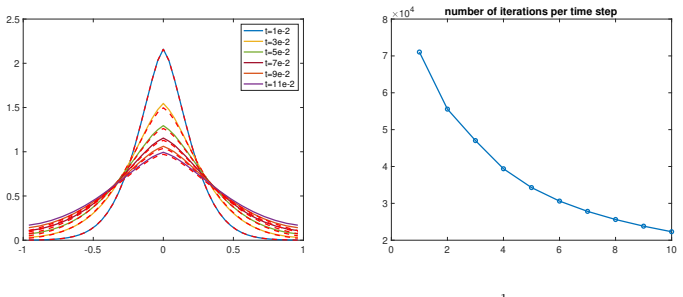
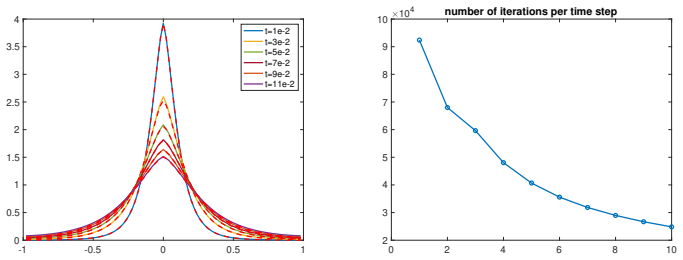
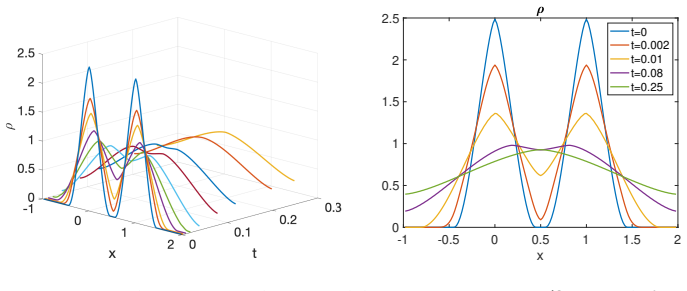
Summary. The manuscript proposes a proximal primal-dual variational method to discretize generalized JKO gradient flows for doubly nonlinear parabolic equations, including the p-Laplace equation and flux-limited equations such as the relativistic heat equation. Explicit formulas for proximal operators associated with general costs are derived to enable efficient numerical approximation, with validation performed by recovering the expected qualitative features (e.g., finite propagation speed) on a small number of textbook cases.
Significance. If the explicit proximal formulas are correct and the resulting scheme is shown to be consistent and convergent, the approach would provide a useful optimization-based framework for treating a broad family of nonlinear PDEs as gradient flows with general costs, extending classical JKO schemes to doubly nonlinear settings.
major comments (2)
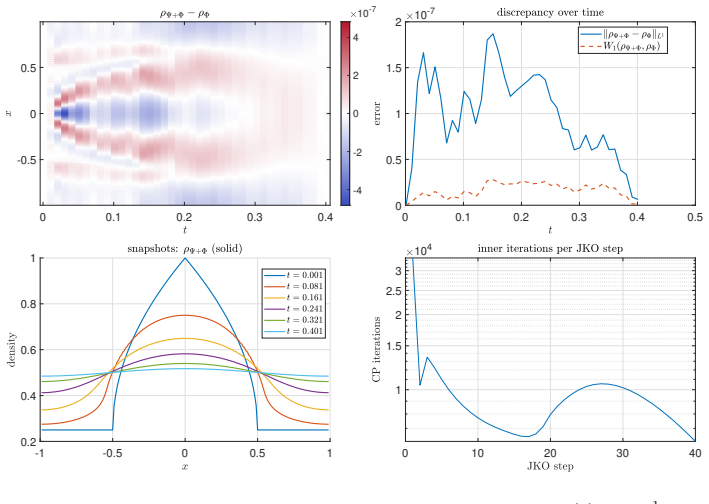
- [Numerical validation] Numerical validation section: the scheme is tested only by qualitative recovery of known behaviors (finite propagation speed, etc.) on a few instances; no a-priori error estimates, no convergence tables under mesh/time-step refinement, and no quantitative comparison to exact solutions or high-resolution references are provided. This directly affects the central claim that the proximal discretization faithfully reproduces the continuous dynamics without uncontrolled artifacts.
- [§3] Proximal-operator derivations (abstract and §3): while explicit formulas are asserted to exist and be amenable to efficient approximation for general costs, the manuscript supplies neither the full derivations nor an analysis of their computational cost or stability for arbitrary costs beyond the validated special cases. This is load-bearing for the claim of broad applicability.
minor comments (2)
- [Introduction] Notation for the general cost functional and the associated proximal operator could be introduced with a single consolidated definition early in the paper to improve readability.
- [Introduction] A few references to recent work on proximal methods for flux-limited equations appear to be missing; adding them would strengthen the literature context.
Simulated Author's Rebuttal
We thank the referee for the careful reading and constructive feedback on our manuscript. We address the two major comments point by point below, indicating the revisions we intend to incorporate.
read point-by-point responses
-
Referee: Numerical validation section: the scheme is tested only by qualitative recovery of known behaviors (finite propagation speed, etc.) on a few instances; no a-priori error estimates, no convergence tables under mesh/time-step refinement, and no quantitative comparison to exact solutions or high-resolution references are provided. This directly affects the central claim that the proximal discretization faithfully reproduces the continuous dynamics without uncontrolled artifacts.
Authors: We acknowledge that the present numerical section emphasizes qualitative recovery of features such as finite propagation speed to illustrate the scheme's fidelity to the underlying doubly nonlinear dynamics. For many equations in the family, closed-form exact solutions are unavailable, which limits direct quantitative error measurement. Nevertheless, we agree that additional quantitative evidence would strengthen the central claim. In the revised manuscript we will add a new subsection containing mesh-refinement studies and L^1-error tables for the linear heat equation (where exact solutions exist) and for the p-Laplacian with p=2, together with comparisons against high-resolution finite-volume references for the relativistic heat equation. We will also explicitly note that a priori error estimates lie outside the scope of this work, whose focus is the construction of explicit proximal operators, and flag this as an important direction for future analysis. revision: partial
-
Referee: Proximal-operator derivations (abstract and §3): while explicit formulas are asserted to exist and be amenable to efficient approximation for general costs, the manuscript supplies neither the full derivations nor an analysis of their computational cost or stability for arbitrary costs beyond the validated special cases. This is load-bearing for the claim of broad applicability.
Authors: Section 3 does derive the proximal operators by reducing the variational problem to a scalar optimization whose solution yields an explicit formula for each cost. To address the referee's concern, we will expand §3 with a complete, self-contained derivation (including the first-order optimality conditions and the reduction to a one-dimensional problem) and move the most technical steps to a new appendix. We will also add a short subsection that quantifies the computational cost: for costs satisfying standard convexity and growth assumptions the proximal step is solved by a safeguarded Newton or bisection method whose complexity is linear in the number of spatial degrees of freedom. Stability of the resulting time-stepping scheme under a mild CFL-type restriction derived from the proximal mapping will likewise be stated. These additions will make the general applicability explicit while retaining the validated special cases as illustrative examples. revision: yes
Circularity Check
No circularity: derivation relies on standard proximal-operator theory applied to external PDE models
full rationale
The paper computes explicit proximal-operator formulas for general costs and applies them to discretize doubly nonlinear gradient flows. These formulas are derived directly from the given cost functions without re-using the target PDE solution or fitted parameters as inputs. Validation consists of qualitative reproduction of known behaviors on textbook cases, which constitutes external checking rather than self-referential fitting. No self-definitional equations, no prediction of fitted quantities, and no load-bearing self-citations appear in the derivation chain. The scheme is therefore self-contained against the stated assumptions.
Axiom & Free-Parameter Ledger
axioms (1)
- domain assumption Existence and uniqueness of proximal operators for the chosen family of costs and energies.
Reference graph
Works this paper leans on
-
[1]
M. Agueh. Existence of solutions to degenerate paraboli c equations via the Monge-Kantorovich theory. Adv. Differential Equations , 10(3):309–360, 2005
work page 2005
-
[2]
M. Agueh. Rates of decay to equilibria for p-Laplacian type equations. Nonlinear Anal. , 68(7):1909–1927, 2008
work page 1909
- [3]
-
[4]
L. Ambrosio, N. Gigli, and G. Savar´ e. Gradient flows: in metric spaces and in the space of probability measures. Springer Science & Business Media, 2008
work page 2008
- [5]
- [6]
-
[7]
H. H. Bauschke and P. L. Combettes. Convex analysis and monotone operator theory in Hilbert spaces. CMS Books in Mathematics/Ouvrages de Math´ ematiques de la SMC. Springer, Cham, second edition, 2017. With a foreword by H´ edy Attouch . 24
work page 2017
-
[8]
N. Bellomo, A. Bellouquid, J. Nieto, and J. Soler. On the a symptotic theory from microscopic to macroscopic growing tissue models: an overview with perspe ctives. Math. Models Methods Appl. Sci. , 22(1):1130001, 37, 2012
work page 2012
-
[9]
J.-D. Benamou and Y. Brenier. A computational fluid mecha nics solution to the monge- kantorovich mass transfer problem. Numerische Mathematik , 84(3):375–393, 2000
work page 2000
-
[10]
J.-D. Benamou and G. Carlier. Augmented Lagrangian met hods for transport optimization, mean field games and degenerate elliptic equations. J. Optim. Theory Appl. , 167(1):1–26, 2015
work page 2015
-
[11]
J. Bertrand, A. Pratelli, and M. Puel. Kantorovich pote ntials and continuity of total cost for relativistic cost functions. J. Math. Pures Appl. (9) , 110:93–122, 2018
work page 2018
-
[12]
J. Bertrand and M. Puel. The optimal mass transport prob lem for relativistic costs. Calc. Var. Partial Differential Equations , 46(1-2):353–374, 2013
work page 2013
-
[13]
Y. Brenier. Extended Monge-Kantorovich theory. In Optimal transportation and applications (Martina Franca, 2001) , volume 1813 of Lecture Notes in Math. , pages 91–121. Springer, Berlin, 2003
work page 2001
-
[14]
L. M. Brice˜ no-Arias, P. L. Combettes, and F. J. Silva. P roximity operators of perspective functions with nonlinear scaling. SIAM J. Optim. , 34(4):3212–3234, 2024
work page 2024
-
[15]
L. M. Brice˜ no-Arias, D. Kalise, and F. J. Silva. Proxim al methods for stationary mean field games with local couplings. SIAM J. Control Optim. , 56(2):801–836, 2018
work page 2018
-
[16]
L. M. Brice˜ no-Arias, D. Kalise, Z. Kobeissi, M. Lauri` ere, A. M. Gonzalez, and F. J. Silva. On the implementation of a primal-dual algorithm for second or der time-dependent mean field games with local couplings. ESAIM: Proceedings and Surveys , 65:330–348, 2019
work page 2019
-
[17]
T. Caillet and F. Santambrogio. Doubly nonlinear diffus ive PDEs: new existence results via generalized Wasserstein gradient flows. SIAM J. Math. Anal. , 56(6):7043–7073, 2024
work page 2024
-
[18]
G. Carlier, V. Duval, G. Peyr´ e, and B. Schmitzer. Conve rgence of entropic schemes for optimal transport and gradient flows. SIAM Journal on Mathematical Analysis , 49(2):1385–1418, 2017
work page 2017
-
[19]
J. A. Carrillo, V. Caselles, and S. Moll. On the relativi stic heat equation in one space dimension. Proc. Lond. Math. Soc. (3) , 107(6):1395–1423, 2013
work page 2013
-
[20]
J. A. Carrillo, K. Craig, L. W ang, and C. W ei. Primal dual methods for wasserstein gradient flows. Foundations of Computational Mathematics , 22(2):389–443, 2022
work page 2022
-
[21]
J. A. Carrillo, R. S. Gvalani, and J. S.-H. W u. An invaria nce principle for gradient flows in the space of probability measures. J. Differential Equations , 345:233–284, 2023
work page 2023
-
[22]
J. A. Carrillo, D. Matthes, and M.-T. W olfram. Lagrangi an schemes for Wasserstein gradient flows. In Geometric partial differential equations. Part II , volume 22 of Handb. Numer. Anal., pages 271–311. Elsevier/North-Holland, Amsterdam, 2021
work page 2021
-
[23]
J. A. Carrillo, R. McCann, and C. Villani. Kinetic equil ibration rates for granular media and related equations: entropy dissipation and mass transp ortation estimates. Rev. Mat. Iberoamericana, 19(3):971–1018, 2003
work page 2003
-
[24]
J. A. Carrillo, R. J. McCann, and C. Villani. Contractio ns in the 2-Wasserstein length space and thermalization of granular media. Arch. Ration. Mech. Anal. , 179(2):217–263, 2006
work page 2006
-
[25]
J. A. Carrillo and J. Moll. Numerical simulation of diffu sive and aggregation phenomena in nonlinear continuity equations by evolving diffeomorphi sms. SIAM J. Sci. Comput. , 31(6):4305–4329, 2009
work page 2009
-
[26]
J. A. Carrillo, L. W ang, and C. W ei. Structure preservin g primal dual methods for gradient flows with nonlinear mobility transport distances. SIAM J. Numer. Anal. , 62(1):376–399, 2024
work page 2024
-
[27]
A. Chambolle and T. Pock. A first-order primal-dual algo rithm for convex problems with application to imaging. J. Math. Imaging Vis. , 40:120–145, 2011
work page 2011
-
[28]
P. L. Combettes and C. L. M¨ uller. Perspective function s: proximal calculus and applications in high-dimensional statistics. J. Math. Anal. Appl. , 457(2):1283–1306, 2018
work page 2018
-
[29]
P. L. Combettes and C. L. M¨ uller. Perspective maximum l ikelihood-type estimation via prox- imal decomposition. Electron. J. Stat. , 14(1):207–238, 2020
work page 2020
-
[30]
L. Condat. A primal-dual splitting method for convex op timization involving Lipschitzian, proximable and linear composite terms. J. Optim. Theory Appl. , 158(2):460–479, 2013
work page 2013
-
[31]
D. Davis and W. Yin. A three-operator splitting scheme a nd its optimization applications. Set-valued and variational analysis , 25(4):829–858, 2017
work page 2017
-
[32]
M. Fukushima, Z.-Q. Luo, and P. Tseng. Smoothing functi ons for second-order-cone comple- mentarity problems. SIAM Journal on Optimization , 12(2):436–460, 2002
work page 2002
- [33]
- [34]
-
[35]
W. Li, J. Lu, and L. W ang. Fisher information regulariza tion schemes for Wasserstein gradient flows. J. Comput. Phys. , pages 109449, 24pp., 2020
work page 2020
-
[36]
D. Matthes and B. S¨ ollner. Discretization of flux-limi ted gradient flows: Γ-convergence and numerical schemes. Math. Comp. , 89(323):1027–1057, 2020
work page 2020
-
[37]
R. J. McCann and M. Puel. Constructing a relativistic he at flow by transport time steps. Ann. Inst. H. Poincar´ e C Anal. Non Lin´ eaire, 26(6):2539–2580, 2009
work page 2009
-
[38]
A. Mielke. On evolutionary Γ -convergence for gradient systems. In Macroscopic and large scale phenomena: coarse graining, mean field limits and ergo dicity, volume 3 of Lect. Notes Appl. Math. Mech. , pages 187–249. Springer, [Cham], 2016
work page 2016
-
[39]
F. Otto. Double degenerate diffusion equations as steep est descent. Sonderforschungsbereich, 256, 1996
work page 1996
-
[40]
F. Otto. The geometry of dissipative evolution equatio ns: the porous medium equation. Comm. Partial Differential Equations , 26(1-2):101–174, 2001
work page 2001
-
[41]
N. Papadakis, G. Peyre, and E. Oudet. Optimal transport with proximal splitting. SIAM. J. Image. Sci. , 7(1):212–238, 2014
work page 2014
-
[42]
B. Perthame, N. Vauchelet, and Z. W ang. The flux limited K eller-Segel system; properties and derivation from kinetic equations. Rev. Mat. Iberoam. , 36(2):357–386, 2020
work page 2020
-
[43]
G. Peyr´ e. Entropic approximation of Wasserstein grad ient flows. SIAM Journal on Imaging Sciences, 8(4):2323–2351, 2015
work page 2015
-
[44]
G. Peyr´ e, M. Cuturi, et al. Computational optimal tran sport: With applications to data science. Foundations and Trends ® in Machine Learning , 11(5-6):355–607, 2019
work page 2019
-
[45]
W. H. Press, S. A. Teukolsky, W. T. Vetterling, and B. P. F lannery. Numerical recipes in Fortran 77 and Fortran 90 . Cambridge University Press, Cambridge, second edition,
-
[46]
The art of scientific and parallel computing
-
[47]
R. T. Rockafellar. Level sets and continuity of conjuga te convex functions. Trans. Amer. Math. Soc., 123:46–63, 1966
work page 1966
-
[48]
F. Santambrogio. {Euclidean, metric, and Wasserstein } gradient flows: an overview. Bull. Math. Sci. , 7(1):87–154, 2017
work page 2017
-
[49]
S. Serfaty. Gamma-convergence of gradient flows on Hilb ert and metric spaces and applications. Discrete Contin. Dyn. Syst. , 31(4):1427–1451, 2011
work page 2011
-
[50]
B. a. C. V˜ u. A splitting algorithm for dual monotone inc lusions involving cocoercive operators. Adv. Comput. Math. , 38(3):667–681, 2013
work page 2013
-
[51]
J. Vazquez. The Porous Medium Equation . Oxford Mathematical Monographs. Oxford Uni- versity Press, 2007. Oxford, UK
work page 2007
-
[52]
J. L. V´ azquez. The evolution fractional p-Laplacian equation in RN . Fundamental solution and asymptotic behaviour. Nonlinear Anal. , 199:112034, 32, 2020
work page 2020
-
[53]
C. Villani. Topics in Optimal Transport . 58 AMS. Grad. Stud. Math., 2003. Providence, RI
work page 2003
-
[54]
M. Yan. A new primal-dual algorithm for minimizing the s um of three functions with a linear operator. J. Sci. Comput. , 76(3):1698–1717, 2018. 26
work page 2018
discussion (0)
Sign in with ORCID, Apple, or X to comment. Anyone can read and Pith papers without signing in.