Recognition: unknown
XRF 241001A/SN 2024aiiq: A Faint Soft X-ray Transient Detected by SVOM with a Broad-Line Type Ic Supernova Revealed by JWST
Pith reviewed 2026-05-09 23:50 UTC · model grok-4.3
The pith
XRF 241001A is a soft low-luminosity collapsar event from a weak relativistic jet viewed on-axis, forming the low-energy tail of the long GRB population.
A machine-rendered reading of the paper's core claim, the machinery that carries it, and where it could break.
Core claim
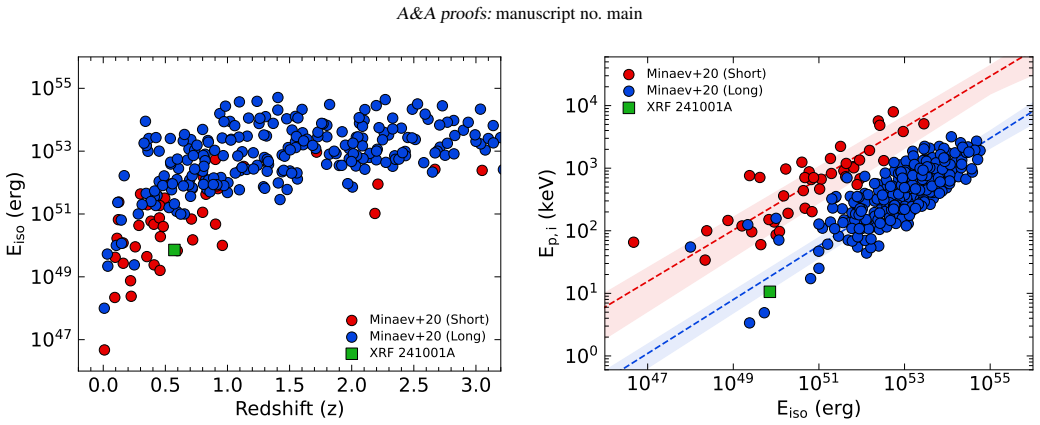
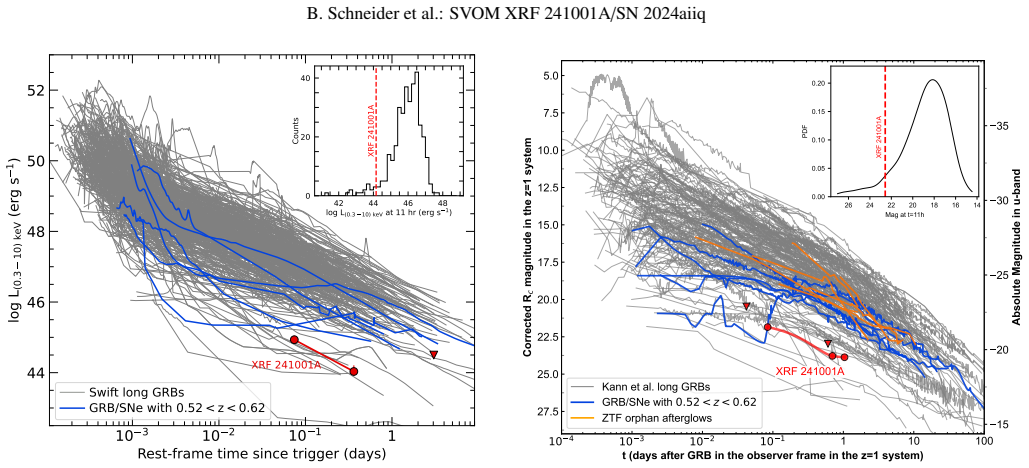
XRF 241001A at redshift 0.573 shows T90 of 3.14 seconds with Epeak below 10 keV and Eiso of about 8 times 10 to the 49 erg; its X-ray to radio afterglow is consistent with an on-axis relativistic jet, while JWST/NIRSpec spectra reveal a broad-line Type Ic supernova matching events like SN 1998bw, confirming the collapsar origin.
What carries the argument
Afterglow modeling from X-ray to radio that favors an on-axis relativistic jet, together with the broad-line Type Ic supernova spectrum from JWST that establishes the collapsing-star progenitor.
If this is right
- XRFs occupy the low-energy extension of the long GRB population rather than forming a fully separate class.
- SVOM's ECLAIRs instrument can systematically detect the soft, sub-luminous end of collapsar events.
- Weak relativistic jets in collapsing stars can still produce observable X-ray flashes accompanied by broad-line Type Ic supernovae.
- The Amati relation continues to hold for these low-energy events, extending its validity into the faint regime.
Where Pith is reading between the lines
- Jet power in collapsars may vary continuously rather than in discrete on/off states, with weaker jets naturally producing softer XRFs.
- Complete GRB population statistics will require counting XRFs to avoid underestimating the total rate of jet-producing collapses.
- Similar events found in future SVOM data could test whether all soft XRFs carry broad-line Type Ic supernovae.
Load-bearing premise
The faint afterglow is produced by a relativistic jet viewed directly on-axis instead of off-axis geometry or a non-relativistic outflow.
What would settle it
An afterglow light curve or spectrum that cannot be fit by any on-axis jet model, or a supernova spectrum lacking the broad lines and instead matching a different type, would disprove the claimed origin.
Figures




read the original abstract
X-ray flashes (XRFs) are a type of gamma-ray bursts (GRBs) with prompt emission predominantly below 30 keV poorly detected by previous missions. The advent of the SVOM mission, with its wide-field instrument ECLAIRs, provides a new way to detect soft X-ray transients such as XRFs. We present photometric and spectroscopic observations of XRF 241001A detected by SVOM, a soft, sub-luminous, and low-energetic burst located in a poorly populated region of the Amati relation. We investigate the origin of its faint, soft high-energy emission to assess its connection to the long GRB population. We analyze the SVOM/ECLAIRs prompt emission and model its afterglow emission from X-ray to-radio. We present JWST/NIRSpec and SVOM/VT observations of the associated supernova (SN 2024aiiq), which we model with an Arnett radioactive decay component and compare its properties with previously detected GRB/SNe. XRF 241001A is located at z = 0.573 and has a prompt emission dominated by photons below 20 keV with a duration of T90 = 3.14 seconds. Its spectrum can be modeled by non-thermal or thermal models, all pointing towards a low Epeak < 10 keV and Eiso ~ 8x10^49 erg. The X-ray-to-radio afterglow modeling favors an origin from a relativistic jet viewed on-axis. In the optical, XRF 241001A exhibits an early blue emission, similar to that detected in some fast X-ray transients and inconsistent with synchrotron emission. The JWST/NIRSpec observations firmly established its collapsar origin by revealing a SN Type Ic with broad lines, comparable to SN 1998bw and SN 2025kg-like events. XRF 241001A is a soft, low-luminosity collapsar event produced by a weak relativistic jet observed on-axis, supporting the view that part of the XRF population forms the low-energy tail of the long GRB population. It demonstrates the potential of SVOM/ECLAIRs to probe the soft regime of the high-energy transient population.
Editorial analysis
A structured set of objections, weighed in public.
Referee Report
Summary. The manuscript reports the SVOM/ECLAIRs detection of the soft X-ray flash XRF 241001A at z=0.573, with T90=3.14 s, prompt spectrum yielding Epeak <10 keV and Eiso ~8e49 erg, X-ray-to-radio afterglow data modeled as arising from an on-axis relativistic jet, early blue optical emission noted as inconsistent with synchrotron, and JWST/NIRSpec plus SVOM/VT data revealing an associated broad-line Type Ic supernova SN 2024aiiq whose light curve is fit with an Arnett radioactive-decay model and compared to events like SN 1998bw. The central claim is that XRF 241001A is a low-luminosity collapsar event powered by a weak relativistic jet, placing part of the XRF population on the low-energy tail of long GRBs.
Significance. If the afterglow modeling is robust, the result adds a well-observed example supporting the continuity between XRFs and long GRBs from collapsars, with the low Eiso and soft spectrum filling a sparsely populated region of the Amati relation. The JWST spectroscopic confirmation of the broad-line Ic supernova provides a rare multi-wavelength anchor for the collapsar interpretation. The work also demonstrates SVOM/ECLAIRs' ability to detect and localize soft transients missed by prior missions.
major comments (2)
- [Abstract and afterglow modeling] Abstract and afterglow modeling section: the statement that 'X-ray-to-radio afterglow modeling favors an origin from a relativistic jet viewed on-axis' is load-bearing for the central claim linking XRF 241001A to the low-energy tail of long GRBs. However, the same paragraph reports early blue optical emission 'inconsistent with synchrotron emission' from such a jet. This tension requires explicit resolution: either the forward-shock model (with on-axis viewing angle and standard microphysical parameters) simultaneously reproduces the X-ray, optical, and radio data at Eiso ~8e49 erg, or an additional component (e.g., cocoon) is needed. Quantitative fit statistics (reduced chi-squared, best-fit parameters with uncertainties, and comparison to alternative models) must be provided to demonstrate that the on-axis jet interpretation is preferred over non-relativistic or off-axis alternatives.
- [SN 2024aiiq observations and modeling] SN 2024aiiq section: the classification as a broad-line Type Ic supernova and the Arnett-model fit are used to establish the collapsar origin. The manuscript states the spectrum is 'comparable to SN 1998bw and SN 2025kg-like events' but does not report the specific light-curve fit parameters, reduced chi-squared, or exclusion of alternative supernova templates. These details are needed to quantify how firmly the spectroscopic and photometric data support the collapsar interpretation at the reported redshift.
minor comments (2)
- [Abstract] The abstract would benefit from including at least one quantitative measure of afterglow fit quality (e.g., reduced chi-squared or degrees of freedom) alongside the statement that modeling 'favors' the jet origin.
- [Prompt emission analysis] Notation for Epeak and Eiso should be defined on first use with units and the precise energy range over which Eiso is integrated.
Simulated Author's Rebuttal
We thank the referee for their constructive and detailed comments, which have helped us strengthen the presentation of our results. We address each major comment point by point below. Where the referee correctly identifies gaps in quantitative details, we have revised the manuscript to incorporate the requested information.
read point-by-point responses
-
Referee: [Abstract and afterglow modeling] Abstract and afterglow modeling section: the statement that 'X-ray-to-radio afterglow modeling favors an origin from a relativistic jet viewed on-axis' is load-bearing for the central claim linking XRF 241001A to the low-energy tail of long GRBs. However, the same paragraph reports early blue optical emission 'inconsistent with synchrotron emission' from such a jet. This tension requires explicit resolution: either the forward-shock model (with on-axis viewing angle and standard microphysical parameters) simultaneously reproduces the X-ray, optical, and radio data at Eiso ~8e49 erg, or an additional component (e.g., cocoon) is needed. Quantitative fit statistics (reduced chi-squared, best-fit parameters with uncertainties, and comparison to alternative models) must be provided to demonstrate that the on-axis jet interpretation is preferred over non-relat
Authors: We agree that the early blue optical emission creates a clear tension with a pure synchrotron forward-shock model from an on-axis jet, and the manuscript already flags this inconsistency. We interpret the blue excess as likely arising from an additional component (e.g., cocoon or shock-breakout emission) while the X-ray-to-radio afterglow remains well-described by the on-axis relativistic jet. In the revised manuscript we have added the requested quantitative details: reduced chi-squared values for the best-fit on-axis jet model, best-fit microphysical parameters with uncertainties, and explicit comparisons to off-axis and non-relativistic alternatives. These show that the on-axis jet is statistically preferred for the X-ray, late optical, and radio data once the early blue excess is excluded from the fit. revision: yes
-
Referee: [SN 2024aiiq observations and modeling] SN 2024aiiq section: the classification as a broad-line Type Ic supernova and the Arnett-model fit are used to establish the collapsar origin. The manuscript states the spectrum is 'comparable to SN 1998bw and SN 2025kg-like events' but does not report the specific light-curve fit parameters, reduced chi-squared, or exclusion of alternative supernova templates. These details are needed to quantify how firmly the spectroscopic and photometric data support the collapsar interpretation at the reported redshift.
Authors: We accept that the original text lacked the numerical fit details. The revised manuscript now reports the Arnett-model parameters (nickel mass, ejecta mass, and kinetic energy) with 1-sigma uncertainties, the reduced chi-squared of the fit, and a brief discussion of why Type II or Ib templates are ruled out by the absence of H/He lines and the broad-line spectroscopic features. These additions quantify the strength of the broad-line Ic classification and the collapsar interpretation at z=0.573. revision: yes
Circularity Check
No circularity: observational data and standard modeling
full rationale
This is an observational astronomy paper reporting detection, photometry, spectroscopy, and afterglow/SN modeling of a transient. The central claim (weak on-axis jet + collapsar origin) follows from fitting observed light curves and spectra to standard synchrotron and Arnett models; no equation or result is shown to reduce by construction to a fitted parameter renamed as prediction, nor to any self-citation chain. The provided text contains no load-bearing self-citations, uniqueness theorems, or ansatzes imported from prior author work. Early blue emission is noted as inconsistent with pure synchrotron but does not create a definitional loop. Score 0 is the expected outcome for such reports.
Axiom & Free-Parameter Ledger
free parameters (2)
- Epeak =
<10 keV
- Eiso =
~8e49 erg
axioms (2)
- domain assumption Redshift z=0.573 from spectroscopic observations
- domain assumption Afterglow arises from synchrotron emission in a relativistic jet
Forward citations
Cited by 2 Pith papers
-
Magnetar Engines in Broad-lined Type Ic Supernovae and a Unified Picture for Magnetar-powered Stripped-envelope Supernovae
Broad-lined Type Ic supernovae are powered by magnetar engines, showing a universal ejecta-mass versus initial-spin correlation across stripped-envelope supernova types that supports a common progenitor framework.
-
ECLAIRs: the SVOM high-energy transient trigger camera
ECLAIRs is the autonomous trigger and localization camera for high-energy transients on the SVOM satellite, with reported design details and early science performance through March 2025.
Reference graph
Works this paper leans on
-
[1]
P., Abbott, R., Abbott, T
Abbott, B. P., Abbott, R., Abbott, T. D., et al. 2017, ApJ, 848, L13
2017
-
[2]
2002, in Society of Photo-Optical Instrumentation Engineers (SPIE) Conference Series, V ol
Aldering, G., Adam, G., Antilogus, P., et al. 2002, in Society of Photo-Optical Instrumentation Engineers (SPIE) Conference Series, V ol. 4836, Survey and Other Telescope Technologies and Discoveries, ed. J. A. Tyson & S. Wolff, 61–72
2002
-
[3]
2002, A&A, 390, 81
Amati, L., Frontera, F., Tavani, M., et al. 2002, A&A, 390, 81
2002
-
[4]
2020, MNRAS, 497, 5518
Antier, S., Agayeva, S., Almualla, M., et al. 2020, MNRAS, 497, 5518
2020
-
[5]
L., Frederiks, D
Aptekar, R. L., Frederiks, D. D., Golenetskii, S. V ., et al. 1995, Space Sci. Rev., 71, 265
1995
-
[6]
1999, Astrophysics Source Code Library
Arnaud, K., Dorman, B., & Gordon, C. 1999, Astrophysics Source Code Library
1999
-
[7]
Arnett, W. D. 1980, ApJ, 237, 541
1980
-
[8]
Arnett, W. D. 1982, ApJ, 253, 785
1982
-
[9]
D., et al
Ashton, G., Hübner, M., Lasky, P. D., et al. 2019, ApJS, 241, 27
2019
-
[10]
B., Abdo, A
Atwood, W. B., Abdo, A. A., Ackermann, M., et al. 2009, ApJ, 697, 1071
2009
-
[11]
Barraud, C., Daigne, F., Mochkovitch, R., & Atteia, J. L. 2005, A&A, 440, 809
2005
-
[12]
P., et al
Barraud, C., Olive, J.-F., Lestrade, J. P., et al. 2003, A&A, 400, 1021
2003
-
[13]
C., Kulkarni, S
Bellm, E. C., Kulkarni, S. R., Graham, M. J., et al. 2019, PASP, 131, 018002
2019
-
[14]
2010, Astrophysics Source Code Library
Bertin, E. 2010, Astrophysics Source Code Library
2010
-
[15]
2018, ApJ, 866, 97
Bi, X., Mao, J., Liu, C., & Bai, J.-M. 2018, ApJ, 866, 97
2018
-
[16]
& Tonry, J
Blondin, S. & Tonry, J. L. 2007, ApJ, 666, 1024
2007
-
[17]
C., Perola, G
Boella, G., Butler, R. C., Perola, G. C., et al. 1997, A&AS, 122, 299
1997
-
[18]
A., Caputo, R., & Team, S
Breeveld, A. A., Caputo, R., & Team, S. 2024, GRB Coordinates Network, Cir- cular Service, No. 37678, 37678, 37678
2024
-
[19]
A., Landsman, W., Holland, S
Breeveld, A. A., Landsman, W., Holland, S. T., et al. 2011, in American Institute of Physics Conference Series, V ol. 1358, Gamma Ray Bursts 2010, ed. J. E
2011
-
[20]
M., Baliber, N., Bianco, F
Brown, T. M., Baliber, N., Bianco, F. B., et al. 2013, PASP, 125, 1031
2013
-
[21]
2014, A&A, 564, A125
Buchner, J., Georgakakis, A., Nandra, K., et al. 2014, A&A, 564, A125
2014
-
[22]
N., Hill, J
Burrows, D. N., Hill, J. E., Nousek, J. A., et al. 2005, Space Sci. Rev., 120, 165
2005
-
[23]
2023, JWST Calibration Pipeline
Bushouse, H., Eisenhamer, J., Dencheva, N., et al. 2023, JWST Calibration Pipeline
2023
-
[24]
R., Sakamoto, T., Suzuki, M., et al
Butler, N. R., Sakamoto, T., Suzuki, M., et al. 2005, ApJ, 621, 884
2005
-
[25]
J., et al
Campana, S., Mangano, V ., Blustin, A. J., et al. 2006, Nature, 442, 1008
2006
-
[26]
2017, Advances in Astronomy, 2017, 8929054
Cano, Z., Wang, S.-Q., Dai, Z.-G., & Wu, X.-F. 2017, Advances in Astronomy, 2017, 8929054
2017
-
[27]
2003, PASP, 115, 763
Chabrier, G. 2003, PASP, 115, 763
2003
-
[28]
2025, in Society of Photo-Optical Instrumenta- tion Engineers (SPIE) Conference Series, V ol
Chen, Y ., Han, D., Cui, W., et al. 2025, in Society of Photo-Optical Instrumenta- tion Engineers (SPIE) Conference Series, V ol. 13531, EUV and X-ray Optics: Synergy between Laboratory and Space IX, ed. R. Hudec & L. Pina, 1353102
2025
-
[29]
Chevalier, R. A. & Fransson, C. 2008, ApJ, 683, L135
2008
-
[30]
A., Gompertz, B
Chrimes, A. A., Gompertz, B. P., Kann, D. A., et al. 2022, MNRAS, 515, 2591
2022
-
[31]
Clark, B. G. 1980, Astronomy and Astrophysics, 89, 89
1980
-
[32]
Cleveland, W. S. 1979, Journal of the American Statistical Association, 74, 74
1979
-
[33]
2024, GRB Coordinates Network, 37655, 37655
Coleiro, A., Cangemi, F., Maiolino, T., et al. 2024, GRB Coordinates Network, 37655, 37655
2024
-
[34]
Y ., Tanvir, N
Cordier, B., Wei, J. Y ., Tanvir, N. R., et al. 2025, A&A, 704, L7
2025
-
[35]
2024, GRB Coordinates Network, 37655, 37655 de Pasquale, M., Piro, L., Gendre, B., et al
Dagoneau, N., Schanne, S., Chateau, F., et al. 2024, GRB Coordinates Network, 37655, 37655 de Pasquale, M., Piro, L., Gendre, B., et al. 2006, A&A, 455, 813
2024
-
[36]
J., Lang, D., et al
Dey, A., Schlegel, D. J., Lang, D., et al. 2019, AJ, 157, 168 Article number, page 15 of 24 A&A proofs:manuscript no. main
2019
-
[37]
2010, Science China Physics, Mechanics, and Astronomy, 53, 40
Dong, Y ., Wu, B., Li, Y ., Zhang, Y ., & Zhang, S. 2010, Science China Physics, Mechanics, and Astronomy, 53, 40
2010
-
[38]
Eichler, D., Livio, M., Piran, T., & Schramm, D. N. 1989, Nature, 340, 126
1989
-
[39]
A., Beardmore, A
Evans, P. A., Beardmore, A. P., Page, K. L., et al. 2009, MNRAS, 397, 1177
2009
-
[40]
A., Beardmore, A
Evans, P. A., Beardmore, A. P., Page, K. L., et al. 2007, A&A, 469, 379
2007
-
[41]
A., Willingale, R., Osborne, J
Evans, P. A., Willingale, R., Osborne, J. P., et al. 2010, A&A, 519, A102
2010
-
[42]
Eyles-Ferris, R. A. J., Jonker, P. G., Levan, A. J., et al. 2025, ApJ, 988, L14
2025
-
[43]
M., Willmer, C
Faber, S. M., Willmer, C. N. A., Wolf, C., et al. 2007, ApJ, 665, 265
2007
-
[44]
2020, in Society of Photo-Optical Instrumenta- tion Engineers (SPIE) Conference Series, V ol
Fan, X., Zou, G., Wei, J., et al. 2020, in Society of Photo-Optical Instrumenta- tion Engineers (SPIE) Conference Series, V ol. 11443, Space Telescopes and Instrumentation 2020: Optical, Infrared, and Millimeter Wave, ed. M. Lystrup & M. D. Perrin, 114430Q
2020
-
[45]
P., & Bridges, M
Feroz, F., Hobson, M. P., & Bridges, M. 2009, MNRAS, 398, 1601
2009
-
[46]
H., Brooks, J
Frater, R. H., Brooks, J. W., & Whiteoak, J. B. 1992, Journal of Electrical and Electronics Engineering Australia, 12, 12
1992
-
[47]
S., Levan, A
Fruchter, A. S., Levan, A. J., Strolger, L., et al. 2006, Nature, 441, 463
2006
-
[48]
Fynbo, J. P. U., Sollerman, J., Hjorth, J., et al. 2004, ApJ, 609, 962
2004
-
[49]
P., Mather, J
Gardner, J. P., Mather, J. C., Clampin, M., et al. 2006, Space Sci. Rev., 123, 485
2006
-
[50]
2004, ApJ, 611, 1005
Gehrels, N., Chincarini, G., Giommi, P., et al. 2004, ApJ, 611, 1005
2004
-
[51]
2004, ApJ, 616, 331
Ghirlanda, G., Ghisellini, G., & Lazzati, D. 2004, ApJ, 616, 331
2004
-
[52]
2014, in Society of Photo-Optical Instru- mentation Engineers (SPIE) Conference Series, V ol
Godet, O., Nasser, G., Atteia, J.-., et al. 2014, in Society of Photo-Optical Instru- mentation Engineers (SPIE) Conference Series, V ol. 9144, Space Telescopes and Instrumentation 2014: Ultraviolet to Gamma Ray, ed. T. Takahashi, J.- W. A. den Herder, & M. Bautz, 914424
2014
-
[53]
2006, in Society of Photo-Optical In- strumentation Engineers (SPIE) Conference Series, V ol
Goldoni, P., Royer, F., François, P., et al. 2006, in Society of Photo-Optical In- strumentation Engineers (SPIE) Conference Series, V ol. 6269, Ground-based and Airborne Instrumentation for Astronomy, ed. I. S. McLean & M. Iye, 62692K
2006
-
[54]
P., Levan, A
Gompertz, B. P., Levan, A. J., Malesani, D. B., et al. 2024, GRB Coordinates Network, 37867, 37867
2024
-
[55]
P., Ravasio, M
Gompertz, B. P., Ravasio, M. E., Nicholl, M., et al. 2023, Nature Astronomy, 7, 67
2023
-
[56]
2009, A&A, 499, 439
Guidorzi, C., Clemens, C., Kobayashi, S., et al. 2009, A&A, 499, 439
2009
-
[57]
2025, ApJ, 986, L4
Hamidani, H., Sato, Y ., Kashiyama, K., et al. 2025, ApJ, 986, L4
2025
-
[58]
I., Kippen, R
Heise, J., Zand, J. I., Kippen, R. M., & Woods, P. M. 2001, in Gamma-ray Bursts in the Afterglow Era, ed. E. Costa, F. Frontera, & J. Hjorth, 16 HI4PI Collaboration, Ben Bekhti, N., Flöer, L., et al. 2016, A&A, 594, A116
2001
-
[59]
2012, ApJ, 756, 187
Hjorth, J., Malesani, D., Jakobsson, P., et al. 2012, ApJ, 756, 187
2012
-
[60]
2003, Nature, 423, 847
Hjorth, J., Sollerman, J., Møller, P., et al. 2003, Nature, 423, 847
2003
-
[61]
Ho, A. Y . Q., Perley, D. A., Beniamini, P., et al. 2020, ApJ, 905, 98
2020
-
[62]
Ho, A. Y . Q., Perley, D. A., Yao, Y ., et al. 2022, ApJ, 938, 85
2022
-
[63]
Ho, A. Y . Q., Phinney, E. S., Ravi, V ., et al. 2019, ApJ, 871, 73 Högbom, J. A. 1974, Astronomy and Astrophysics Supplement Series, 15, 15
2019
-
[64]
T., Boyd, P
Holland, S. T., Boyd, P. T., Gorosabel, J., et al. 2007, AJ, 133, 122 Ivezi´c, Ž., Kahn, S. M., Tyson, J. A., et al. 2019, ApJ, 873, 111
2007
-
[65]
2019, Nature, 565, 324
Izzo, L., de Ugarte Postigo, A., Maeda, K., et al. 2019, Nature, 565, 324
2019
-
[66]
& Malesani, D
Izzo, L. & Malesani, D. B. 2024, GRB Coordinates Network, 37667, 37667
2024
-
[67]
2022, A&A, 661, A80
Jakobsen, P., Ferruit, P., Alves de Oliveira, C., et al. 2022, A&A, 661, A80
2022
-
[68]
Jiang, S.-Q., Xu, D., van Hoof, A. P. C., et al. 2025, ApJ, 988, L34
2025
-
[69]
2013, A&A, 560, A91
Jones, A., Noll, S., Kausch, W., Szyszka, C., & Kimeswenger, S. 2013, A&A, 560, A91
2013
-
[70]
2007, ApJ, 654, 385
Kaneko, Y ., Ramirez-Ruiz, E., Granot, J., et al. 2007, ApJ, 654, 385
2007
-
[71]
A., Klose, S., & Zeh, A
Kann, D. A., Klose, S., & Zeh, A. 2006, ApJ, 641, 993
2006
-
[72]
A., Klose, S., Zhang, B., et al
Kann, D. A., Klose, S., Zhang, B., et al. 2011, ApJ, 734, 96
2011
-
[73]
A., Klose, S., Zhang, B., et al
Kann, D. A., Klose, S., Zhang, B., et al. 2010, ApJ, 720, 1513
2010
-
[74]
2025, Acta Polytechnica, 65, 50
Karpov, S. 2025, Acta Polytechnica, 65, 50
2025
-
[75]
Kennicutt, Jr., R. C. 1998, ARA&A, 36, 189
1998
-
[76]
M., Woods, P
Kippen, R. M., Woods, P. M., Heise, J., et al. 2001, in Gamma-ray Bursts in the Afterglow Era, ed. E. Costa, F. Frontera, & J. Hjorth, 22
2001
-
[77]
& Thierry, P
Klotz, A. & Thierry, P. 2019, Experimental Astronomy, 48, 121
2019
-
[78]
A., Fishman, G
Kouveliotou, C., Meegan, C. A., Fishman, G. J., et al. 1993, ApJ, 413, L101
1993
-
[79]
2018, arXiv e-prints, arXiv:1803.01187 Krühler, T., Malesani, D., Fynbo, J
Krogager, J.-K. 2018, arXiv e-prints, arXiv:1803.01187 Krühler, T., Malesani, D., Fynbo, J. P. U., et al. 2015, A&A, 581, A125
-
[80]
& Zhang, B
Kumar, P. & Zhang, B. 2015, Phys. Rep., 561, 1
2015
discussion (0)
Sign in with ORCID, Apple, or X to comment. Anyone can read and Pith papers without signing in.