Efficient Symbolic Computations for Identifying Causal Effects
Pith reviewed 2026-05-09 23:22 UTC · model grok-4.3
The pith
An efficient algorithm finds the lowest-degree formulas that identify causal effects from data in linear models.
A machine-rendered reading of the paper's core claim, the machinery that carries it, and where it could break.
Core claim
For linear structural causal models, rational identifiability of a causal effect is decidable by searching for polynomials of bounded degree that satisfy the required algebraic relations; the presented algorithm performs this search and returns the lowest-degree solution in quasi-polynomial time whenever such a solution of prespecified maximal degree exists.
What carries the argument
A bounded-degree symbolic search procedure that enumerates candidate polynomials satisfying the linear model constraints and extracts the resulting rational identifying formula for the target causal effect.
If this is right
- Causal effects previously checked only on tiny graphs can now be tested on graphs with dozens of variables.
- The returned formulas are the simplest possible within the degree limit, yielding compact expressions for effect estimation.
- Rational identifiability becomes a routine computational check rather than a manual algebraic exercise.
- The approach separates the question of existence of any identifying formula from the harder question of finding one of minimal complexity.
Where Pith is reading between the lines
- Combining the procedure with automated causal graph search could produce end-to-end pipelines that both discover structure and derive explicit effect estimators.
- The same bounded-degree technique may extend to other algebraic identifiability problems outside causal inference, such as parameter recovery in linear systems.
- In applied domains the method supplies ready-to-use algebraic expressions that can be plugged directly into estimation routines without numerical optimization.
Load-bearing premise
An identifying formula of bounded degree is assumed to exist for the effect of interest.
What would settle it
A concrete linear causal graph together with a known low-degree identifying formula for some effect, on which the algorithm either fails to return that formula or exceeds quasi-polynomial runtime.
Figures



read the original abstract
Determining identifiability of causal effects from observational data under latent confounding is a central challenge in causal inference. For linear structural causal models, identifiability of causal effects is decidable through symbolic computation. However, standard approaches based on Gr\"obner bases become computationally infeasible beyond small settings due to their doubly exponential complexity. In this work, we study how to practically use symbolic computation for deciding rational identifiability. In particular, we present an efficient algorithm that provably finds the lowest degree identifying formulas. For a causal effect of interest, if there exists an identification formula of a prespecified maximal degree, our algorithm returns such a formula in quasi-polynomial time.
Editorial analysis
A structured set of objections, weighed in public.
Referee Report
Summary. The manuscript presents an efficient algorithm for symbolic computation of rational identifying formulas for causal effects in linear structural causal models with latent confounding. It claims that, given a prespecified maximal degree, if an identifying formula of that degree exists then the algorithm returns the lowest-degree such formula in quasi-polynomial time, offering a practical improvement over the doubly-exponential complexity of Gröbner basis methods.
Significance. If the central claims hold, the work would meaningfully advance practical causal inference by making symbolic identifiability checks feasible on larger graphs where Gröbner bases become intractable. The conditional efficiency guarantee, focus on lowest-degree formulas, and restriction to linear SCMs with rational identifiability constitute a clear algorithmic contribution; any accompanying formal proofs or reproducible implementations would further strengthen its value.
minor comments (3)
- The abstract and introduction would benefit from a brief, self-contained example of a low-degree identifying formula to illustrate the output of the algorithm.
- §4 (complexity analysis): the quasi-polynomial bound is stated clearly but the dependence on the maximal degree parameter could be made more explicit for readers.
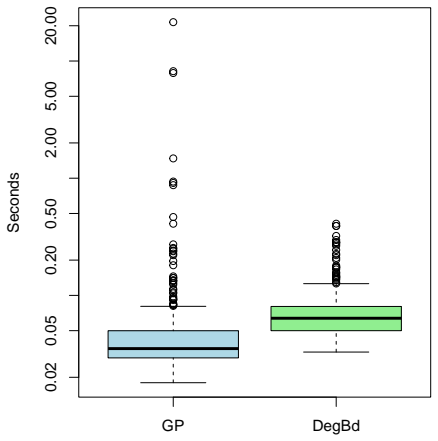
- Table 2 (runtime comparisons): adding a column for the degree of the returned formula would help readers assess whether the efficiency gain preserves the lowest-degree property.
Simulated Author's Rebuttal
We thank the referee for their positive summary of the manuscript, recognition of its potential practical impact, and recommendation for minor revision. No major comments were provided in the report.
Circularity Check
No significant circularity; algorithmic result is self-contained
full rationale
The paper presents a new algorithm for computing lowest-degree rational identifying formulas for causal effects in linear SCMs, with a quasi-polynomial runtime guarantee conditional on existence within a bounded degree. This is positioned as a practical improvement over the doubly-exponential cost of Gröbner bases. The derivation relies on standard symbolic algebra and complexity arguments that are external to the paper; no step reduces by construction to a fitted parameter, self-definition, or load-bearing self-citation. The central claim is scoped explicitly to the linear/rational setting and does not rename or smuggle in prior results as new derivations.
Axiom & Free-Parameter Ledger
axioms (2)
- domain assumption Linear structural causal models admit decidable rational identifiability via symbolic computation
- standard math Gröbner basis methods have doubly exponential complexity
Reference graph
Works this paper leans on
-
[1]
Abbott, J., Bigatti, A. M., and Robbiano, L. (2017). Implicitization of hypersurfaces. Journal of Symbolic Computation , 81:20--40
work page 2017
-
[2]
Améndola, C., Puente, L. D. G., Pons, R. H., Kuznetsova, O., Motwani, H. J., Petrovic, S., Stillman, M., and Sullivant, S. (2020). GraphicalModels: discrete and Gaussian graphical models. Version 2.0 . A Macaulay2 package available at https://github.com/Macaulay2/M2/tree/stable/M2/Macaulay2/packages
work page 2020
-
[3]
Bollen, K. A. (1989). Structural equations with latent variables . Wiley Series in Probability and Mathematical Statistics: Applied Probability and Statistics. John Wiley & Sons, Inc., New York
work page 1989
-
[4]
Bowden, R. J. and Turkington, D. A. (1984). Instrumental variables , volume 8 of Econometric Society Monographs in Quantitative Economics . Cambridge University Press, Cambridge
work page 1984
-
[5]
Chen, B., Kumor, D., and Bareinboim, E. (2017). Identification and model testing in linear structural equation models using auxiliary variables. In Proceedings of the 34th International Conference on Machine Learning , pages 757--766. JMLR
work page 2017
-
[6]
Chen, B., Pearl, J., and Bareinboim, E. (2016). Incorporating knowledge into structural equation models using auxiliary variables. In Proceedings of the 25th International Joint Conference on Artificial Intelligence , pages 3577--3583. AAAI Press
work page 2016
-
[7]
Cormen, T. H., Leiserson, C. E., Rivest, R. L., and Stein, C. (2009). Introduction to algorithms . MIT Press, Cambridge, MA, third edition
work page 2009
-
[8]
Cox, D. A., Little, J., and O'Shea, D. (2015). Ideals, varieties, and algorithms . Undergraduate Texts in Mathematics. Springer, Cham, fourth edition
work page 2015
-
[9]
Dettling, P., Homs, R., Am\'endola, C., Drton, M., and Hansen, N. R. (2023). Identifiability in continuous L yapunov models. SIAM Journal on Matrix Analysis and Applications , 44(4):1799--1821
work page 2023
-
[10]
o rfler, J., van der Zander, B., Bl\
D\" o rfler, J., van der Zander, B., Bl\" a ser, M., and Li\' s kiewicz, M. (2024). On the complexity of identification in linear structural causal models. In Advances in Neural Information Processing Systems , volume 37, pages 100108--100130. Curran Associates, Inc
work page 2024
-
[11]
Drton, M. and Weihs, L. (2016). Generic identifiability of linear structural equation models by ancestor decomposition. Scandinavian Journal of Statistics. Theory and Applications , 43(4):1035--1045
work page 2016
-
[12]
Ene, V. and Herzog, J. (2012). Gr\"obner bases in commutative algebra , volume 130 of Graduate Studies in Mathematics . American Mathematical Society, Providence, RI
work page 2012
-
[13]
Faug\'ere, J.-C. (1999). A new efficient algorithm for computing G r\"obner bases (F_4) . Journal of Pure and Applied Algebra , 139(1-3):61--88
work page 1999
-
[14]
Faug\`ere, J.-C. (2002). A new efficient algorithm for computing G r\"obner bases without reduction to zero (F_5) . In Proceedings of the 2002 I nternational S ymposium on S ymbolic and A lgebraic C omputation , pages 75--83. ACM, New York
work page 2002
-
[15]
Faug\`ere, J.-C., Safey El Din, M., and Verron, T. (2016). On the complexity of computing G r\"obner bases for weighted homogeneous systems. Journal of Symbolic Computation , 76:107--141
work page 2016
-
[16]
Finch, S. R. (2019). Mathematical constants. II , volume 169 of Encyclopedia of Mathematics and its Applications . Cambridge University Press, Cambridge
work page 2019
-
[17]
Foygel, R., Draisma, J., and Drton, M. (2012a). Half-trek criterion for generic identifiability of linear structural equation models. The Annals of Statistics , 40(3):1682--1713
-
[18]
Foygel, R., Draisma, J., and Drton, M. (2012b). Supplement to half-trek criterion for generic identifiability of linear structural equation models. The Annals of Statistics , 40(3)
-
[19]
D., Spielvogel, S., and Sullivant, S
Garcia-Puente, L. D., Spielvogel, S., and Sullivant, S. (2010). Identifying causal effects with computer algebra. In Proceedings of the 26th Conference on Uncertainty in Artificial Intelligence . AUAI Press
work page 2010
-
[20]
Grayson, D. R. and Stillman, M. E. (2025). Macaulay2, a software system for research in algebraic geometry. Version 1.25.11, available at https://www.macaulay2.com
work page 2025
-
[21]
Hernán, M. and Robins, J. (2025). Causal Inference: What If . Chapman & Hall/CRC Monographs on Statistics & Applied Probab. CRC Press
work page 2025
-
[22]
Kreuzer, M. and Robbiano, L. (2005). Computational commutative algebra. 2 . Springer-Verlag, Berlin
work page 2005
-
[23]
Kumor, D., Chen, B., and Bareinboim, E. (2019). Efficient identification in linear structural causal models with instrumental cutsets. In Advances in Neural Information Processing Systems , volume 32, pages 12477--12486. Curran Associates, Inc
work page 2019
-
[24]
Kumor, D., Cinelli, C., and Bareinboim, E. (2020). Efficient identification in linear structural causal models with auxiliary cutsets. In Proceedings of the 37th International Conference on Machine Learning , volume 119 of Proceedings of Machine Learning Research , pages 5501--5510. PMLR
work page 2020
-
[25]
Mayr, E. W. (1997). Some complexity results for polynomial ideals. Journal of Complexity , 13(3):303--325
work page 1997
-
[26]
Pearl, J. (2009). Causality . Cambridge University Press, Cambridge, second edition
work page 2009
-
[27]
Spirtes, P., Glymour, C., and Scheines, R. (2000). Causation, prediction, and search . Adaptive Computation and Machine Learning. MIT Press, Cambridge, MA, second edition
work page 2000
-
[28]
Sturma, N., Kranzlmueller, M., Portakal, I., and Drton, M. (2026). Matching criterion for identifiability in sparse factor analysis. Psychometrika , page 1–20
work page 2026
-
[29]
Sullivant, S. (2018). Algebraic statistics , volume 194 of Graduate Studies in Mathematics . American Mathematical Society, Providence, RI
work page 2018
-
[30]
Sullivant, S., Talaska, K., and Draisma, J. (2010). Trek separation for G aussian graphical models. The Annals of Statistics , 38(3):1665--1685
work page 2010
-
[31]
Tian, J. (2005). Identifying direct causal effects in linear models. In Proceedings of the 20th National Conference on Artificial Intelligence , pages 346--352. Association for the Advancement of Artificial Intelligence, AAAI Press
work page 2005
-
[32]
Tian, J. (2009). Parameter identification in a class of linear structural equation models. In Proceedings of the 21st International Joint Conference on Artificial Intelligence , pages 1970--1975. AAAI Press
work page 2009
-
[33]
Voros, A. (1987). Spectral functions, special functions and the Selberg zeta function . Communications in Mathematical Physics , 110(3):439 -- 465
work page 1987
-
[34]
I., Nguyen, N., Robeva, E., and Drton, M
Weihs, L., Robinson, B., Dufresne, E., Kenkel, J., Kubjas Reginald McGee II, K., Reginald, M. I., Nguyen, N., Robeva, E., and Drton, M. (2017). Determinantal generalizations of instrumental variables. Journal of Causal Inference , 6(1)
work page 2017
-
[35]
Wright, P. G. (1928). Tariff on Animal and Vegetable Oils . Macmillan Company, New York
work page 1928
-
[36]
Wright, S. (1921). Correlation and causation. Journal of agricultural research , 20(7):557 -- 585
work page 1921
-
[37]
Wright, S. (1934). The method of path coefficients. The Annals of Mathematical Statistics , 5(3):161–215
work page 1934
discussion (0)
Sign in with ORCID, Apple, or X to comment. Anyone can read and Pith papers without signing in.