Efficient Design of Fronthaul-Constrained Uplink Reception for Cell-Free XL-MIMO
Pith reviewed 2026-05-09 21:38 UTC · model grok-4.3
The pith
A fractional programming algorithm jointly optimizes linear transforms at access points and fronthaul compression to maximize uplink sumrate in cell-free XL-MIMO systems.
A machine-rendered reading of the paper's core claim, the machinery that carries it, and where it could break.
Core claim
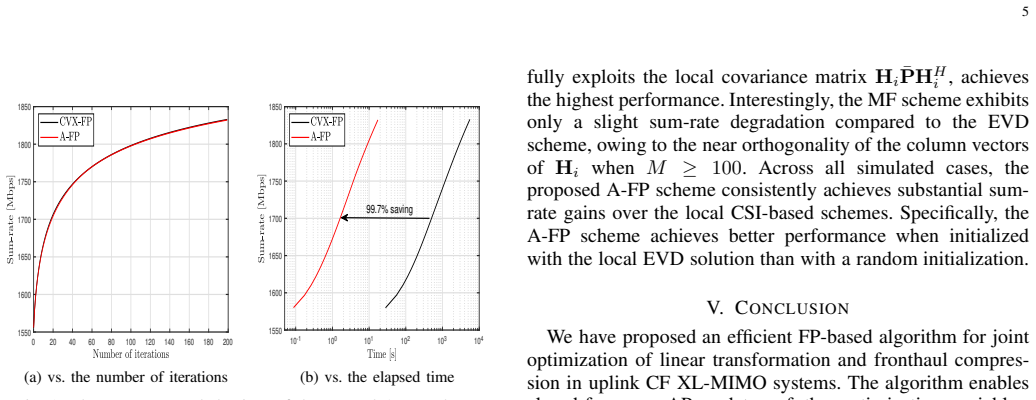
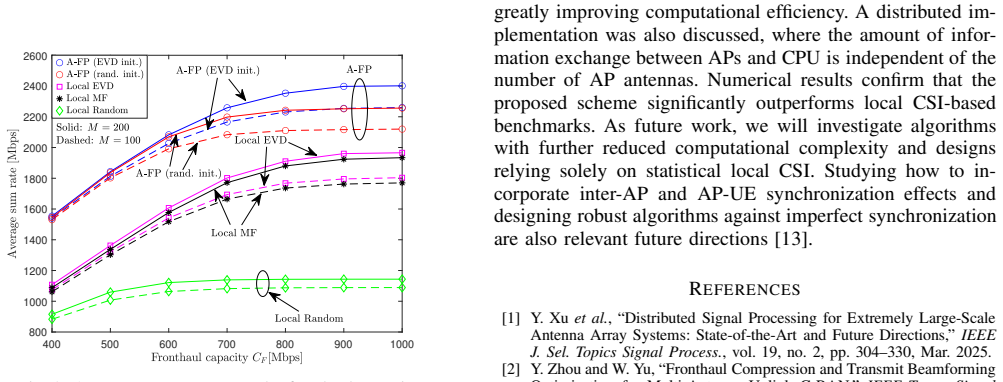
The central claim is that the proposed FP-based iterative algorithm and its accelerated decentralized variant A-FP achieve substantially higher uplink sum rates than scalable baselines that use only local channel state information, while cutting computational complexity relative to general-purpose solvers and keeping fronthaul overhead independent of antenna count.
What carries the argument
Fractional programming (FP) iterative algorithm that jointly updates dimension-reducing linear transform matrices at the access points and fronthaul compression strategies to maximize the uplink sumrate.
If this is right
- Uplink sum rates increase without any increase in fronthaul capacity.
- Computational burden drops enough to make real-time operation feasible at scale.
- Decentralized execution becomes practical because fronthaul signaling stays constant as antenna numbers grow.
- Scalable reception design extends to systems with hundreds of antennas per access point.
Where Pith is reading between the lines
- The same transform-and-compression framework could be adapted to time-varying channels by running the iteration on a sliding window of recent estimates.
- Energy savings at the access points may follow from the dimension reduction, though this is not quantified in the paper.
- The decentralized A-FP structure suggests a natural path to hybrid centralized-distributed processing in future 6G cell-free networks.
Load-bearing premise
The optimization assumes that accurate channel state information is available at the access points and central unit and that the iterative procedure converges to a performance-relevant solution in practical time.
What would settle it
A numerical experiment or hardware test in which the A-FP scheme either fails to exceed the sumrate of local-CSI baselines or requires more total operations than a general solver would disprove the performance and complexity claims.
Figures
read the original abstract
With the evolution of multiple-input multiple-output (MIMO) technology toward extremely large (XL) MIMO systems comprising hundreds of, or more, antennas, this work investigates scalable and fronthaul-efficient reception design for the uplink of cell-free (CF) XL-MIMO systems. In such systems, the uplink signals transmitted by mobile user equipments (UEs) are jointly decoded at a central processing unit (CPU) connected to distributed access points (APs) via finite-capacity fronthaul links. We address the joint optimization of linear transform matrices, used by the APs to reduce the signal dimension and fronthaul load, and fronthaul compression strategies to maximize the uplink sumrate. A fractional programming (FP)-based iterative algorithm is first developed, followed by a reduced-complexity variant, termed accelerated FP (A-FP), along with its decentralized implementation whose fronthaul overhead remains independent of the number of AP antennas. Numerical results show that the proposed A-FP scheme significantly reduces computational complexity compared to FP implemented with general-purpose solvers, while substantially outperforming scalable baseline schemes that rely solely on local channel state information.
Editorial analysis
A structured set of objections, weighed in public.
Referee Report
Summary. The paper addresses fronthaul-constrained uplink reception in cell-free XL-MIMO systems by jointly optimizing linear transform matrices at the access points and fronthaul compression strategies to maximize the uplink sum-rate. It first develops a fractional programming (FP)-based iterative algorithm, then introduces a reduced-complexity accelerated FP (A-FP) variant with a decentralized implementation whose fronthaul overhead is independent of the number of AP antennas. Numerical results are presented to show that A-FP reduces computational complexity relative to general-purpose FP solvers while outperforming scalable baselines that use only local channel state information.
Significance. If the reported numerical gains hold under the stated model, the work offers a scalable approach to managing finite fronthaul capacity in large-scale cell-free MIMO deployments, which is relevant for future XL-MIMO systems. The complexity reduction achieved by A-FP and the decentralized implementation that decouples overhead from antenna count are practical strengths. The approach builds on standard FP techniques with explicit compression constraints and does not rely on fitted parameters or circular derivations.
minor comments (4)
- Abstract: the claim of 'significantly reduces computational complexity' and 'substantially outperforming' would be strengthened by including at least one quantitative example (e.g., complexity order or sum-rate gap) or a reference to the specific figure/table that supports it.
- Numerical results section: clarify the number of Monte Carlo realizations, the exact definition of the local-CSI baselines (e.g., which local processing is used), and whether error bars or variance measures are shown, as these details affect the reliability of the outperformance claims.
- Algorithm description: state the convergence tolerance and maximum iteration count used for both FP and A-FP; without this, it is difficult to confirm that the reported performance corresponds to a converged solution under practical stopping criteria.
- Decentralized implementation: specify how the fronthaul overhead independence from AP antenna count is achieved in the message-passing steps, and whether any additional assumptions (e.g., perfect local CSI at each AP) are required.
Simulated Author's Rebuttal
We thank the referee for the positive and accurate summary of our manuscript on fronthaul-constrained uplink reception in cell-free XL-MIMO systems. The referee correctly highlights the FP-based algorithm, the reduced-complexity A-FP variant, the decentralized implementation with fronthaul overhead independent of antenna count, and the numerical gains over local-CSI baselines. No major comments were raised in the report.
Circularity Check
No significant circularity
full rationale
The paper develops an FP-based iterative algorithm for joint optimization of linear transforms and fronthaul compression to maximize uplink sum-rate under capacity constraints, followed by an accelerated A-FP variant with decentralized implementation. This is a direct application of the known fractional programming technique to the stated objective and constraints, without any reduction of the central derivation to fitted parameters, self-referential definitions, or load-bearing self-citations. Numerical results compare the proposed scheme against general-purpose solvers and local-CSI baselines, but the derivation chain itself remains independent and self-contained.
Axiom & Free-Parameter Ledger
axioms (2)
- domain assumption Uplink signals from UEs are received at distributed APs and forwarded over finite-capacity fronthaul to a CPU for joint decoding
- domain assumption Linear transform matrices at APs reduce signal dimension before compression
Reference graph
Works this paper leans on
-
[1]
Y . Xu et al. , “Distributed Signal Processing for Extremely Large-Scal e Antenna Array Systems: State-of-the-Art and Future Direct ions,” IEEE J. Sel. Topics Signal Process. , vol. 19, no. 2, pp. 304–330, Mar. 2025
work page 2025
-
[2]
Fronthaul Compression and Transmit Be amforming Optimization for Multi-Antenna Uplink C-RAN,
Y . Zhou and W. Y u, “Fronthaul Compression and Transmit Be amforming Optimization for Multi-Antenna Uplink C-RAN,” IEEE Trans. Signal Process., vol. 64, no. 16, pp. 4138–4151, August 15, 2016
work page 2016
-
[3]
Fronthaul-aware design fo r cloud radio access networks,
L. Liu, W. Y u, and O. Simeone, “Fronthaul-aware design fo r cloud radio access networks,” Key Technologies for 5G Wireless Systems . Cambridge, UK: Cambridge Univ. Press, 2017, p. 48–75
work page 2017
-
[4]
F. Wiffen, M. Z. Bocus, A. Doufexi, and W. H. Chin, “MF-bas ed dimen- sion reduction signal compression for fronthaul-constrai ned distributed MIMO C-RAN,” in Proc. IEEE WCNC 2020 , Virtual, May 2020
work page 2020
-
[5]
Y . Xu, L. Zhu, R. Shi and T. -H. Chang, “Joint Compression a nd Multiuser Equalization for Multi-Carrier Massive MIMO Sys tems With Decentralized Baseband Processing,” IEEE Trans. Signal Process. , vol. 72, pp. 5708–5724, 2024
work page 2024
-
[6]
Decent ralized MIMO Systems With Imperfect CSI Using LMMSE Receivers,
Z. Zhuang, X. Zhang, D. Xu, S. Song and Y . C. Eldar, “Decent ralized MIMO Systems With Imperfect CSI Using LMMSE Receivers,” IEEE J. Sel. Topics Signal Process. , vol. 19, no. 2, pp. 331–348, Mar. 2025
work page 2025
-
[7]
K. Shen, W. Y u, L. Zhao and D. P . Palomar, “Optimization of MIMO Device-to-Device Networks via Matrix Fractional Programm ing: A Minorization-Maximization Approach,” IEEE/ACM Trans. Netw. , vol. 27, no. 5, pp. 2164–2177, Oct. 2019
work page 2019
-
[8]
D. Kim and S.-H. Park, “Accelerated Fractional Programm ing for Multi-User ISAC Beamforming Optimization With Per-Group P ower Constraints,” IEEE Wireless Commun. Lett. , vol. 14, no. 4, pp. 1174– 1178, Apr. 2025
work page 2025
-
[9]
CVX: MA TLAB software for disciplin ed convex programming,
M. Grant and S.Boyd, “CVX: MA TLAB software for disciplin ed convex programming,” Second Edition, Third Printing, pp. 1–786, V er. 2.2, Jan. 2020
work page 2020
-
[10]
Subgradient methods for sadd le-point problems,
A. Nedic and A. Ozdaglar, “Subgradient methods for sadd le-point problems,” J. Optim. THeory Appl. , vol. 142, pp. 205–228, Jul. 2009
work page 2009
-
[11]
A. Ben-Tal and A. Nemirovski, (Georgia Inst. Technol., Atlanta, GA, USA). Lecture Note of Lectures on Mod- ern Convex Optimization. (2019). [Online]. Available: https://www2.isye.gatech.edu/nemirovs/LMCO_ LN.pdf
work page 2019
-
[12]
Propagation Path Loss Models for 5G Urban Micro- and Macro-Cellular Scenarios,
S. Sun et al. , “Propagation Path Loss Models for 5G Urban Micro- and Macro-Cellular Scenarios,” in Proc. IEE VTC 2016 Spring , Nanjing, China, May 2016
work page 2016
-
[13]
Massive Synchrony in Distributed Anten na Systems,
E. G. Larsson, “Massive Synchrony in Distributed Anten na Systems,” IEEE Trans. Signal Process. , vol. 72, pp. 855–866, 2024
work page 2024
discussion (0)
Sign in with ORCID, Apple, or X to comment. Anyone can read and Pith papers without signing in.