Cryogenic shock exfoliation for ultrahigh mobility rhombohedral graphite nanoelectronics
Pith reviewed 2026-05-09 20:05 UTC · model grok-4.3
The pith
Cryogenic shock exfoliation produces large rhombohedral graphene flakes enabling devices with over 200 micrometer electron mean free paths.
A machine-rendered reading of the paper's core claim, the machinery that carries it, and where it could break.
Core claim
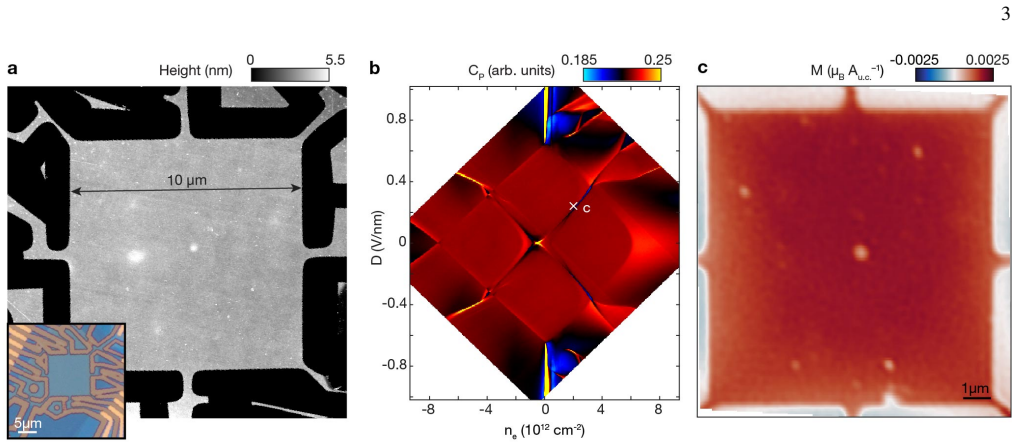
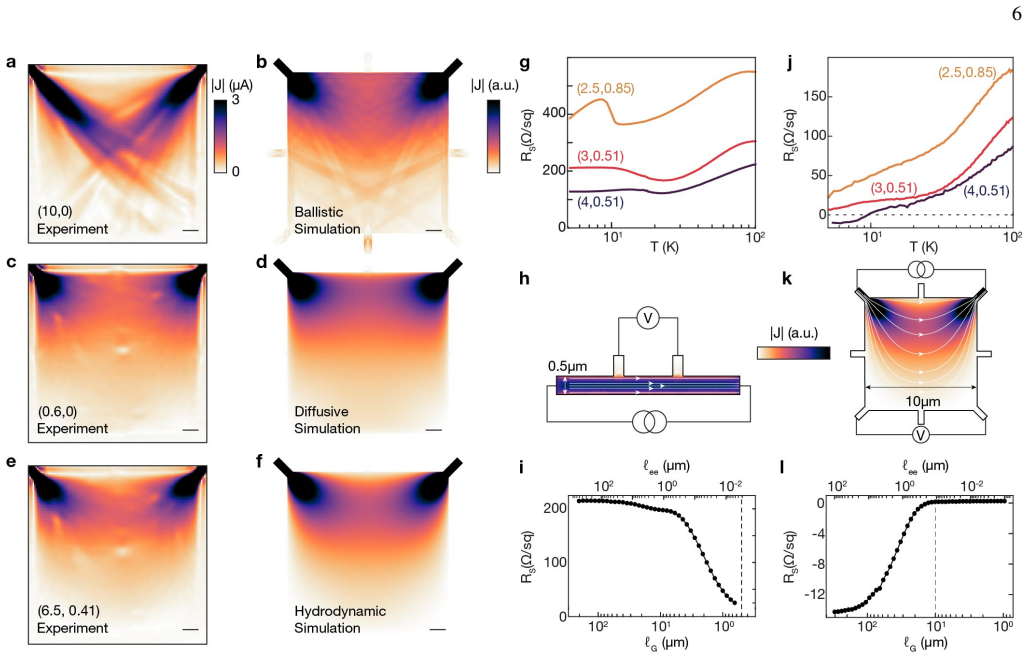
Cryogenic shock exfoliation, when paired with low-pressure van der Waals assembly, produces rhombohedral multilayer graphene devices exceeding 1300 μm² in area with 90% fabrication yield. These devices show uniform spin magnetism over central 10×10 μm² areas. Transverse magnetic focusing measures a disorder mean free path exceeding 200 μm at low temperatures. Within the flat surface bands, a size-driven crossover from Poiseuille to porous electron flow appears in the strong electron-electron interaction regime.
What carries the argument
Cryogenic shock exfoliation is the mechanical separation process performed at low temperatures that increases the abundance of rhombohedral stacking in graphene flakes, which the low-pressure assembly then preserves to create high-quality devices.
If this is right
- Large mesoscopic devices become available for exploring correlated electron phenomena in rhombohedral graphene.
- High mobility allows clear observation of hydrodynamic electron flow and its size dependence.
- Uniform magnetism over extended areas supports studies of spin textures in scalable geometries.
- The 90% yield reduces the effort needed to produce samples suitable for nanoelectronics.
- Electron mean free paths above 200 μm open access to longer coherence lengths for quantum effects.
Where Pith is reading between the lines
- This method could be adapted to other multilayer stackings to improve yields in related materials.
- Systematic variation of device size may map the full phase diagram of hydrodynamic transport in flat-band graphene.
- Preservation of stacking order might allow incorporation of RMG into heterostructures with other 2D materials without losing the desired phases.
- Ultrahigh mobility samples could reveal new interaction-driven states not accessible in lower quality devices.
Load-bearing premise
The cryogenic shock and low-pressure assembly steps do not introduce defects or disrupt the rhombohedral stacking sequence that determines the electronic properties.
What would settle it
Detection of a mean free path shorter than 200 micrometers or spatially varying spin magnetism in multiple devices prepared by this exfoliation method would contradict the claim of ultrahigh quality and uniformity.
Figures


read the original abstract
Rhombohedral multilayer graphene (RMG) offers a highly tunable platform for correlated electron physics, featuring field-effect control of magnetic, superconducting, and topological phases[1-24]. The promise of these materials has been held back by the limited abundance of rhombohedral stacking in natural graphite, which constrains both sample yield and useful area. Here we introduce 'cryogenic shock exfoliation' to produce large area rhombohedral graphene flakes which, combined with a low-pressure van der Waals assembly technique that preserves stacking order, enable highly uniform devices exceeding 1300 $\mu m^2$ with fabrication yields of 90%. Using scanning nanoSQUID-on-tip imaging, we demonstrate uniform spin magnetism over the full central 10 times 10 $\mu m^2$ area of our devices. Transverse magnetic focusing reveals a disorder mean free path exceeding 200 $\mu m$ at low temperatures. Within the flat surface bands of RMG[20], we observe a size-driven crossover from Poiseuille to porous electron flow in the intermediate-temperature regime of strong electron-electron hydrodynamics[16, 25], providing a further signature of ultrahigh device quality. Our approach overcomes a key materials bottleneck in the fabrication of mesoscopic rhombohedral graphene devices, paving the way for incorporating strongly correlated phases into two-dimensional nanoelectronics.
Editorial analysis
A structured set of objections, weighed in public.
Referee Report
Summary. The paper introduces 'cryogenic shock exfoliation' combined with low-pressure van der Waals assembly to produce large-area rhombohedral multilayer graphene (RMG) flakes at 90% yield, enabling devices >1300 μm². It reports uniform spin magnetism over 10×10 μm² via nanoSQUID-on-tip imaging, a disorder mean free path >200 μm from transverse magnetic focusing at low T, and a size-driven crossover from Poiseuille to porous electron flow in the hydrodynamic regime within the flat bands of RMG.
Significance. If the claims hold, the work removes a major materials bottleneck for RMG by increasing usable area and yield while preserving stacking order, directly enabling mesoscopic devices for correlated phases. Credit is due for the direct, spatially resolved evidence (nanoSQUID uniformity and magnetic focusing) that supports the ultrahigh-mobility and hydrodynamic signatures; these are stronger than typical indirect mobility estimates in the field.
major comments (2)
- [Methods] Methods section: The cryogenic shock exfoliation protocol is presented at a high level without quantitative parameters (cooling rate, shock pressure, substrate temperature, or post-exfoliation stacking verification via Raman or STM maps). Because the central claim of defect-free rhombohedral order and l_mfp > 200 μm rests on this preservation, insufficient detail prevents assessment of reproducibility and rules out alternative explanations such as local Bernal regions or strain-induced defects.
- [Results] Results (transverse magnetic focusing and hydrodynamic crossover): The mean-free-path extraction and the identification of the Poiseuille-to-porous crossover lack reported error bars, fitting procedures, or quantitative comparison to hydrodynamic theory (e.g., viscosity or Gurzhi length). These omissions are load-bearing for the claim of ultrahigh quality and the size-driven hydrodynamic signature.
minor comments (2)
- [Abstract] Abstract: The term 'porous electron flow' appears without a one-sentence definition or reference; a brief clarification would aid readers outside the hydrodynamic-transport subfield.
- [Figures] Figure captions and text: Ensure consistent use of '10×10 μm²' with explicit scale bars and labels on all nanoSQUID and focusing images.
Simulated Author's Rebuttal
We thank the referee for the positive evaluation of the significance of our work and for the constructive major comments. We address each point below and will incorporate the suggested improvements into the revised manuscript.
read point-by-point responses
-
Referee: [Methods] Methods section: The cryogenic shock exfoliation protocol is presented at a high level without quantitative parameters (cooling rate, shock pressure, substrate temperature, or post-exfoliation stacking verification via Raman or STM maps). Because the central claim of defect-free rhombohedral order and l_mfp > 200 μm rests on this preservation, insufficient detail prevents assessment of reproducibility and rules out alternative explanations such as local Bernal regions or strain-induced defects.
Authors: We agree that the Methods section requires additional quantitative detail to support reproducibility and to strengthen the central claims. In the revised manuscript we will expand the description of the cryogenic shock exfoliation protocol to include the specific cooling rate, shock pressure, and substrate temperature. We will also add post-exfoliation stacking verification using Raman spectroscopy maps and STM imaging to confirm the preservation of rhombohedral order across the device area and to address possible local Bernal regions or strain-induced defects. revision: yes
-
Referee: [Results] Results (transverse magnetic focusing and hydrodynamic crossover): The mean-free-path extraction and the identification of the Poiseuille-to-porous crossover lack reported error bars, fitting procedures, or quantitative comparison to hydrodynamic theory (e.g., viscosity or Gurzhi length). These omissions are load-bearing for the claim of ultrahigh quality and the size-driven hydrodynamic signature.
Authors: We acknowledge that the presentation of the transverse magnetic focusing data and the hydrodynamic crossover would be improved by the inclusion of error bars, explicit fitting procedures, and direct comparison to hydrodynamic theory. In the revised manuscript we will add error bars to the extracted mean-free-path values, describe the fitting procedures used for the focusing data, and provide quantitative comparisons to hydrodynamic predictions, including estimates of viscosity and the Gurzhi length, to better support the ultrahigh-mobility and size-driven crossover claims. revision: yes
Circularity Check
No significant circularity: experimental claims rest on direct measurements
full rationale
This is a materials fabrication and characterization paper with no derivation chain, model predictions, or fitted parameters. Claims of ultrahigh mobility (l_mfp > 200 μm), uniform magnetism, and hydrodynamic crossover are supported by direct experimental signatures: nanoSQUID-on-tip imaging and transverse magnetic focusing data. No equations, ansatzes, or self-citations are invoked to derive results from inputs; references to prior RMG literature provide background only. The fabrication method (cryogenic shock exfoliation + low-pressure vdW assembly) is presented as an empirical advance whose quality is validated by the measurements themselves, with no reduction of outputs to inputs by construction.
Axiom & Free-Parameter Ledger
axioms (2)
- domain assumption Van der Waals forces allow stacking order preservation during low-pressure assembly without introducing significant defects.
- standard math Standard solid-state physics models apply to interpret transverse magnetic focusing and electron hydrodynamics in graphene.
Forward citations
Cited by 2 Pith papers
-
Characterizing electronic scattering rates with transport in multiterminal devices
A five-terminal geometry diagnoses ballistic-hydrodynamic-Ohmic crossovers and extracts momentum-relaxing and conserving scattering rates from current partition in electron liquids.
-
Characterizing electronic scattering rates with transport in multiterminal devices
Current partition in a five-terminal geometry diagnoses ballistic-hydrodynamic-Ohmic crossovers and extracts momentum-relaxing and conserving scattering rates in 2D electron systems.
Reference graph
Works this paper leans on
-
[1]
Y . Shi, S. Xu, Y . Yang, S. Slizovskiy, S. V . Morozov, S. K. Son, S. Ozdemir, C. Mullan, J. Barrier, J. Yin, A. I. Berdyu- gin, B. A. Piot, T. Taniguchi, K. Watanabe, V . I. Fal’ko, K. S. Novoselov, A. K. Geim, and A. Mishchenko, Nature584, 210 (2020), iSBN: 4158602025
work page 2020
-
[2]
H. Zhou, T. Xie, T. Taniguchi, K. Watanabe, and A. F. Young, Nature598, 434 (2021)
work page 2021
-
[3]
H. Zhou, T. Xie, A. Ghazaryan, T. Holder, J. R. Ehrets, E. M. Spanton, T. Taniguchi, K. Watanabe, E. Berg, M. Serbyn, and A. F. Young, Nature598, 429 (2021)
work page 2021
-
[4]
H. Zhou, L. Holleis, Y . Saito, L. Cohen, W. Huynh, C. L. Pat- terson, F. Yang, T. Taniguchi, K. Watanabe, and A. F. Young, Science375, 774 (2022)
work page 2022
-
[5]
G. Chen, L. Jiang, S. Wu, B. Lyu, H. Li, B. L. Chittari, K. Watanabe, T. Taniguchi, Z. Shi, J. Jung, Y . Zhang, and F. Wang, Nature Physics15, 237 (2019)
work page 2019
-
[6]
G. Chen, A. L. Sharpe, P. Gallagher, I. T. Rosen, E. J. Fox, L. Jiang, B. Lyu, H. Li, K. Watanabe, T. Taniguchi, J. Jung, Z. Shi, D. Goldhaber-Gordon, Y . Zhang, and F. Wang, Nature 572, 215 (2019)
work page 2019
-
[7]
T. Arp, O. Sheekey, H. Zhou, C. L. Tschirhart, C. L. Patter- son, H. M. Yoo, L. Holleis, E. Redekop, G. Babikyan, T. Xie, J. Xiao, Y . Vituri, T. Holder, T. Taniguchi, K. Watanabe, M. E. Huber, E. Berg, and A. F. Young, Nature Physics20, 1413 (2024)
work page 2024
-
[8]
T. Han, Z. Lu, G. Scuri, J. Sung, J. Wang, T. Han, K. Watanabe, T. Taniguchi, L. Fu, H. Park, and L. Ju, Nature623, 41 (2023)
work page 2023
-
[9]
T. Han, Z. Lu, Y . Yao, J. Yang, J. Seo, C. Yoon, K. Watanabe, T. Taniguchi, L. Fu, F. Zhang, and L. Ju, Science384, 647 (2024)
work page 2024
-
[10]
K. Liu, J. Zheng, Y . Sha, B. Lyu, F. Li, Y . Park, Y . Ren, K. Watanabe, T. Taniguchi, J. Jia, W. Luo, Z. Shi, J. Jung, and G. Chen, Nature Nanotechnology19, 188 (2024)
work page 2024
-
[11]
W. Zhou, J. Ding, J. Hua, L. Zhang, K. Watanabe, T. Taniguchi, W. Zhu, and S. Xu, Nature Communications15, 2597 (2024)
work page 2024
-
[12]
Z. Lu, T. Han, Y . Yao, A. P. Reddy, J. Yang, J. Seo, K. Watan- abe, T. Taniguchi, L. Fu, and L. Ju, Nature626, 759 (2024)
work page 2024
-
[13]
C. L. Patterson, O. I. Sheekey, T. B. Arp, L. F. W. Holleis, J. M. Koh, Y . Choi, T. Xie, S. Xu, Y . Guo, H. Stoyanov, E. Re- dekop, C. Zhang, G. Babikyan, D. Gong, H. Zhou, X. Cheng, T. Taniguchi, K. Watanabe, M. E. Huber, C. Jin, E. Lantagne- Hurtubise, J. Alicea, and A. F. Young, Nature641, 632 (2025)
work page 2025
-
[14]
Y . Choi, Y . Choi, M. Valentini, C. L. Patterson, L. F. W. Holleis, O. I. Sheekey, H. Stoyanov, X. Cheng, T. Taniguchi, K. Watan- abe, and A. F. Young, Nature639, 342 (2025)
work page 2025
-
[15]
T. Han, Z. Lu, Z. Hadjri, L. Shi, Z. Wu, W. Xu, Y . Yao, A. A. Cotten, O. S. Sedeh, H. Weldeyesus, J. Yang, J. Seo, S. Ye, M. Zhou, H. Liu, G. Shi, Z. Hua, K. Watanabe, T. Taniguchi, P. Xiong, D. M. Zumbuehl, L. Fu, and L. Ju, Nature (2025), 10.1038/s41586-025-09169-7
-
[16]
L. Holleis, T. Xie, S. Xu, H. Zhou, C. L. Patterson, A. Panigrahi, T. Taniguchi, K. Watanabe, L. S. Levitov, C. Jin, E. Berg, and A. F. Young, Nature640, 355 (2025)
work page 2025
-
[17]
N. Auerbach, S. Dutta, M. Uzan, Y . Vituri, Y . Zhou, A. Y . Meltzer, S. Grover, T. Holder, P. Emanuel, M. E. Huber, Y . Myasoedov, K. Watanabe, T. Taniguchi, Y . Oreg, E. Berg, and E. Zeldov, Nature Physics21, 1765 (2025)
work page 2025
-
[18]
Y . Zhang, Y .-Y . Zhou, S. Zhang, H. Cai, L.-H. Tong, W.-Y . Liao, R.-J. Zou, S.-M. Xue, Y . Tian, T. Chen, Q. Tian, C. Zhang, Y . Wang, X. Zou, X. Liu, Y . Hu, Y .-N. Ren, L. Zhang, L. Zhang, 8 W.-X. Wang, L. He, L. Liao, Z. Qin, and L.-J. Yin, Nature Nanotechnology20, 222 (2025)
work page 2025
-
[19]
J. Xie, Z. Huo, X. Lu, Z. Feng, Z. Zhang, W. Wang, Q. Yang, K. Watanabe, T. Taniguchi, K. Liu, Z. Song, X. C. Xie, J. Liu, and X. Lu, Nature Materials24, 1042 (2025)
work page 2025
-
[20]
Flat band surface state superconductivity in thick rhombohe- dral graphene,
Y . Guo, O. I. Sheekey, T. Arp, K. Kol ´aˇr, T. Charpentier, L. Holleis, B. Foutty, A. Keough, M. Kang-Chou, M. E. Huber, T. Taniguchi, K. Watanabe, C. Lewandowski, and A. F. Young, “Flat band surface state superconductivity in thick rhombohe- dral graphene,” (2025), arXiv:2511.17423 [cond-mat]
- [21]
-
[22]
Extreme Anisotropy in the Metallic and Superconducting Phases of Rhombohedral Hexalayer Graphene,
P. Qin, H.-T. Wu, R. Q. Nguyen, E. Morissette, N. J. Zhang, K. Watanabe, T. Taniguchi, and J. I. A. Li, “Extreme Anisotropy in the Metallic and Superconducting Phases of Rhombohedral Hexalayer Graphene,” (2025), version Number: 4
work page 2025
- [23]
-
[24]
R. Zhang, B. A. Foutty, O. Sheekey, T. Arp, S. Xu, T. Xie, Y . Guo, H. Stoyanov, S. Gu, A. Keough, E. Redekop, C. Zhang, T. Taniguchi, K. Watanabe, M. E. Huber, C. Jin, E. Berg, and A. F. Young, “Imaging the Meissner effect and local superfluid stiffness in a graphene superconductor,” (2026), arXiv:2603.25807 [cond-mat]
-
[25]
Imaging flat band electron hydrodynamics in biased bilayer graphene,
C. Zhang, E. Redekop, H. Stoyanov, J. H. Farrell, S. Kim, L. Holleis, D. Gong, A. Keough, Y . Choi, T. Taniguchi, K. Watanabe, M. E. Huber, A. C. B. Jayich, A. Lucas, and A. F. Young, “Imaging flat band electron hydrodynamics in bi- ased bilayer graphene,” (2026), arXiv:2603.11175 [cond-mat]
work page internal anchor Pith review arXiv 2026
-
[26]
K. S. Novoselov, A. K. Geim, S. V . Morozov, D. Jiang, Y . Zhang, S. V . Dubonos, I. V . Grigorieva, and A. A. Firsov, Science306, 666 (2004)
work page 2004
-
[27]
A. K. Geim and I. V . Grigorieva, Nature499, 419 (2013)
work page 2013
-
[28]
H. S. Lipson and A. R. Stokes, Proceedings of the Royal Society of London. Series A. Mathematical and Physical Sciences181, 101 (1942)
work page 1942
-
[29]
C. H. Lui, Z. Li, Z. Chen, P. V . Klimov, L. E. Brus, and T. F. Heinz, Nano Letters11, 164 (2011)
work page 2011
-
[30]
M. Yankowitz, J. I.-J. Wang, A. G. Birdwell, Y .-A. Chen, K. Watanabe, T. Taniguchi, P. Jacquod, P. San-Jose, P. Jarillo- Herrero, and B. J. LeRoy, Nature Materials13, 786 (2014)
work page 2014
- [31]
-
[32]
Y . Yang, Y . C. Zou, C. R. Woods, Y . Shi, J. Yin, S. Xu, S. Ozdemir, T. Taniguchi, K. Watanabe, A. K. Geim, K. S. Novoselov, S. J. Haigh, and A. Mishchenko, Nano Letters19, 8526 (2019)
work page 2019
-
[33]
H. Li, M. I. B. Utama, S. Wang, W. Zhao, S. Zhao, X. Xiao, Y . Jiang, L. Jiang, T. Taniguchi, K. Watanabe, A. Weber- Bargioni, A. Zettl, and F. Wang, Nano Letters20, 3106 (2020)
work page 2020
-
[34]
A. Dey, A. Azizimanesh, S. M. Wu, and H. Askari, ACS Ap- plied Materials and Interfaces16, 8169 (2024)
work page 2024
-
[35]
J. P. Nery, M. Calandra, and F. Mauri, Nano Letters20, 5017 (2020)
work page 2020
-
[36]
R. N. GURZHI, J .Exptl. Theoret. Phys121, 771 (1963)
work page 1963
-
[37]
Z. Lu, T. Han, Y . Yao, Z. Hadjri, J. Yang, J. Seo, L. Shi, S. Ye, K. Watanabe, T. Taniguchi, and L. Ju, Nature637, 1090 (2025), iSBN: 4158602408
work page 2025
-
[38]
Z. Feng, W. Wang, Y . You, Y . Chen, K. Watanabe, T. Taniguchi, C. Liu, K. Liu, and X. Lu, Physical Review Applied23, 034012 (2025)
work page 2025
-
[39]
L. Holleis, L. Cohen, N. Samuelson, C. L. Patterson, Y . Choi, M. Valentini, O. Sheekey, Y . Choi, J. Zhou, H. Stoyanov, T. Taniguchi, K. Watanabe, Q. Hu, J. H. Kim, C. Phillips, P. D. Wolf, and A. F. Young, Nano Letters25, 12487 (2025)
work page 2025
-
[40]
P. Laves and Y . Baskdj, Zeitschrift fuer Kristallographie107, 337 (1956)
work page 1956
-
[41]
H. Van Houten, C. W. J. Beenakker, J. G. Williamson, M. E. I. Broekaart, P. H. M. Van Loosdrecht, B. J. Van Wees, J. E. Mooij, C. T. Foxon, and J. J. Harris, Physical Review B39, 8556 (1989)
work page 1989
-
[42]
T. Taychatanapat, K. Watanabe, T. Taniguchi, and P. Jarillo- Herrero, Nature Physics9, 225 (2013)
work page 2013
-
[43]
J. Ingla-Ayn ´es, A. L. R. Manesco, T. S. Ghiasi, S. V olosheniuk, K. Watanabe, T. Taniguchi, and H. S. J. v. d. Zant, Nano Letters 23, 5453 (2023)
work page 2023
-
[44]
A. S. Mayorov, R. V . Gorbachev, S. V . Morozov, L. Brit- nell, R. Jalil, L. A. Ponomarenko, P. Blake, K. S. Novoselov, K. Watanabe, T. Taniguchi, and A. K. Geim, Nano Letters11, 2396 (2011)
work page 2011
-
[45]
L. Wang, I. Meric, P. Y . Huang, Q. Gao, Y . Gao, H. Tran, T. Taniguchi, K. Watanabe, L. M. Campos, D. A. Muller, J. Guo, P. Kim, J. Hone, K. L. Shepard, and C. R. Dean, Sci- ence342, 614 (2013)
work page 2013
-
[46]
W. Wang, N. Clark, M. Hamer, A. Carl, E. Tovari, S. Sullivan- Allsop, E. Tillotson, Y . Gao, H. De Latour, F. Selles, J. Howarth, E. G. Castanon, M. Zhou, H. Bai, X. Li, A. We- ston, K. Watanabe, T. Taniguchi, C. Mattevi, T. H. Bointon, P. V . Wiper, A. J. Strudwick, L. A. Ponomarenko, A. V . Kre- tinin, S. J. Haigh, A. Summerfield, and R. Gorbachev, Natu...
work page 2023
-
[47]
A. Lucas and K. C. Fong, Journal of Physics: Condensed Matter 30, 053001 (2018)
work page 2018
-
[48]
J. A. Sulpizio, L. Ella, A. Rozen, J. Birkbeck, D. J. Perello, D. Dutta, M. Ben-Shalom, T. Taniguchi, K. Watanabe, T. Holder, R. Queiroz, A. Principi, A. Stern, T. Scaffidi, A. K. Geim, and S. Ilani, Nature576, 75 (2019)
work page 2019
-
[49]
M. J. H. Ku, T. X. Zhou, Q. Li, Y . J. Shin, J. K. Shi, C. Burch, L. E. Anderson, A. T. Pierce, Y . Xie, A. Hamo, U. V ool, H. Zhang, F. Casola, T. Taniguchi, K. Watanabe, M. M. Fogler, P. Kim, A. Yacoby, and R. L. Walsworth, Nature583, 537 (2020)
work page 2020
-
[50]
A. Jenkins, S. Baumann, H. Zhou, S. A. Meynell, Y . Daipeng, K. Watanabe, T. Taniguchi, A. Lucas, A. F. Young, and A. C. Bleszynski Jayich, Physical Review Letters129, 087701 (2022)
work page 2022
- [51]
-
[52]
Speed-up via quantum sampling,
A. Stern, T. Scaffidi, O. Reuven, C. Kumar, J. Birkbeck, and S. Ilani, Physical Review Letters129(2022), 10.1103/Phys- RevLett.129.157701
-
[53]
S. Feng, K. Cao, Y . Gao, Y . Han, Z. Liu, Y . Lu, and Z. Xu, Communications Materials3, 28 (2022)
work page 2022
-
[54]
Y . Kolumbus, A. Zalic, N. Fardian-Melamed, Z. Barkay, D. Rotem, D. Porath, and H. Steinberg, Journal of Physics: Condensed Matter30, 475704 (2018)
work page 2018
-
[55]
A. Finkler, Y . Segev, Y . Myasoedov, M. L. Rappaport, L. Ne’eman, D. Vasyukov, E. Zeldov, M. E. Huber, J. Martin, and A. Yacoby, Nano Letters10, 1046 (2010)
work page 2010
-
[56]
D. Vasyukov, Y . Anahory, L. Embon, D. Halbertal, J. Cuppens, L. Ne’eman, A. Finkler, Y . Segev, Y . Myasoedov, M. L. Rappa- 9 port, M. E. Huber, and E. Zeldov, Nature nanotechnology8, 10 (2013)
work page 2013
-
[57]
E. Redekop, C. Zhang, H. Park, J. Cai, E. Anderson, O. Sheekey, T. Arp, G. Babikyan, S. Salters, K. Watanabe, T. Taniguchi, M. E. Huber, X. Xu, and A. F. Young, Nature 635, 584 (2024)
work page 2024
- [58]
-
[59]
D. M. Feldmann, Physical Review B69, 144515 (2004)
work page 2004
-
[60]
A. Y . Meltzer, E. Levin, and E. Zeldov, Physical Review Ap- plied8, 064030 (2017)
work page 2017
-
[61]
jackhfarrell/FermiHarmonics: v0.1.0 - Square Bells UCSB,
J. Farrell, “jackhfarrell/FermiHarmonics: v0.1.0 - Square Bells UCSB,” (2026)
work page 2026
-
[62]
C. Q. Cook and A. Lucas, Physical Review B99, 235148 (2019)
work page 2019
-
[63]
P. J. Ledwith, H. Guo, and L. Levitov, Annals of Physics411, 167913 (2019). 10 MATERIALS AND METHODS Cryogenic shock exfoliation statistics.To quantify the improvement over standard mechanical exfoliation, both methods are compared on the same total Si substrate area. For the standard process, steps I and II of Fig. 1a are followed; the chip is then coole...
work page 2019
discussion (0)
Sign in with ORCID, Apple, or X to comment. Anyone can read and Pith papers without signing in.