Thermal background reduction for mid-infrared imaging by low-rank background and sparse point-source modelling
Pith reviewed 2026-05-08 09:57 UTC · model grok-4.3
The pith
A low-rank background model paired with sparse source modeling cuts thermal noise in mid-infrared images without chopping or nodding.
A machine-rendered reading of the paper's core claim, the machinery that carries it, and where it could break.
Core claim
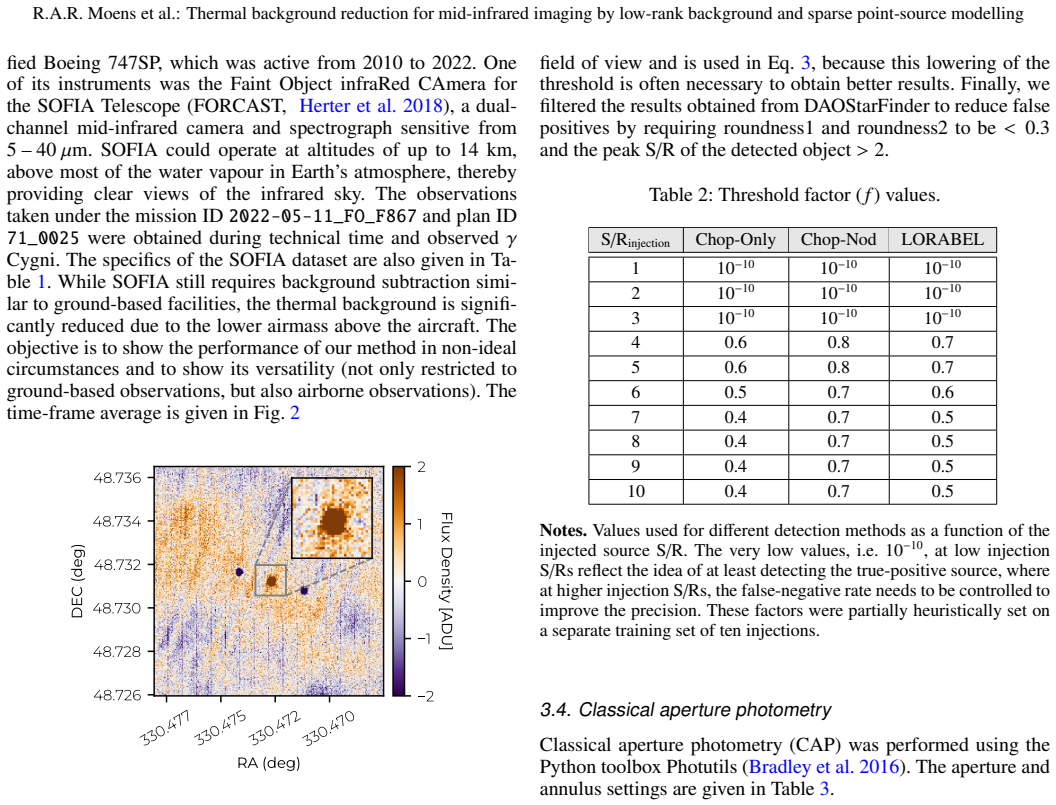
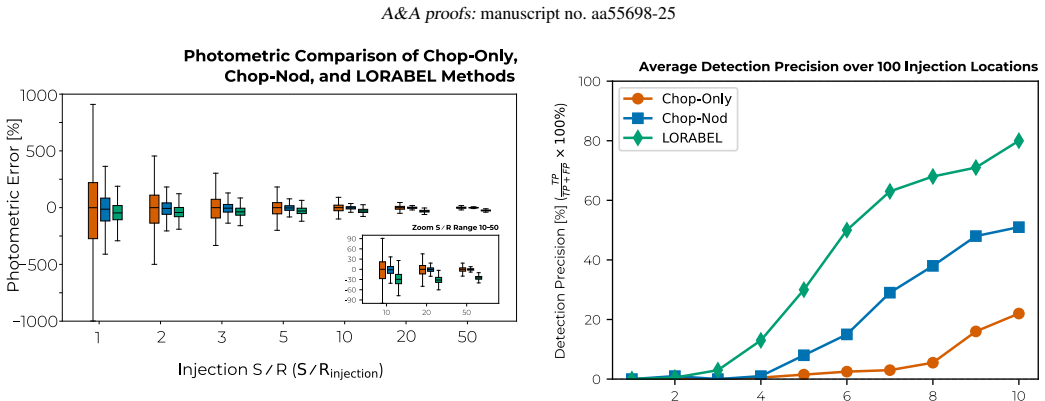
We present LORABEL, a low-rank background and sparse point-source modelling technique for thermal background reduction in mid-infrared imaging. When applied to SOFIA airborne data it produces a 20-100 fold decrease in mean background flux compared with the traditional chop-nod method while preserving most of the source flux. On ground-based VISIR data with low signal-to-noise ratios it reduces variation in photometric error relative to chopping differences or full chop-nod sequences, though it introduces a bias, and it improves detection precision. The method operates without nodding, masking, or extra overheads and appears suitable for both ground-based and airborne instruments.
What carries the argument
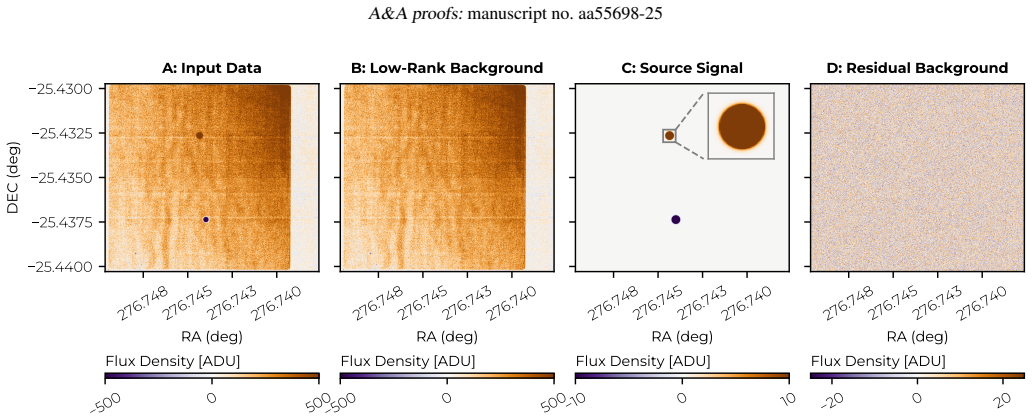
Low-rank background and sparse point-source modelling, which decomposes each image into a low-rank component that captures the spatially and temporally variable thermal background and a sparse component that isolates the astronomical point sources.
If this is right
- The method enables background subtraction on next-generation extremely large telescopes where physical nodding is not feasible.
- It increases detection precision for faint mid-infrared sources compared with traditional techniques.
- The same low-rank plus sparse decomposition works on both ground-based and airborne platforms.
- In low signal-to-noise regimes it produces more stable photometric measurements than chopping or chop-nod sequences alone.
Where Pith is reading between the lines
- The reported background reduction suggests the technique could support deeper imaging or fainter-source surveys with existing mid-infrared instruments.
- The bias introduced in low signal-to-noise cases may need calibration or hybrid use with conventional methods for high-precision photometry.
- The paper's suggestion of wider instrumental applicability points to possible tests on space-based mid-infrared data where background is still present but nodding is unavailable.
Load-bearing premise
The thermal background can be accurately captured by a low-rank model and astronomical sources by a sparse model across the tested observational conditions without introducing artifacts that compromise photometry or detection.
What would settle it
Applying LORABEL to independent mid-infrared datasets from similar instruments and finding that the background flux reduction falls below a factor of ten or that source photometry deviates substantially from known values would falsify the reported performance.
Figures

read the original abstract
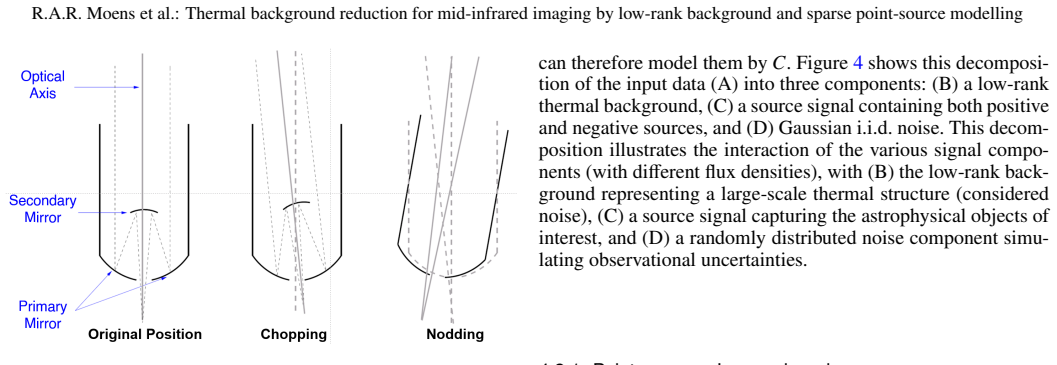
Mid-infrared astronomy from the ground faces critical challenges in accurately detecting and quantifying sources due to the dominant spatially and time-variable background noise. Moreover, chopping and nodding, the traditional methods for dealing with these background issues, will not be technically feasible on the next generation of extremely large telescopes. This limitation requires the development of novel computational methods for a robust background reduction. We present and evaluate a novel method named LOw-RAnk Background ELimination (LORABEL) to improve the sensitivity of mid-infrared astronomical observations, without the need for classical telescope nodding, source masking, or other overheads in observing time. We applied a low-rank background-reduction strategy to (1) data taken on the ground with the VISIR with synthetically injected sources, and (2) airborne data from SOFIA. We compared the performance of our new method to classical chopping and nodding techniques, and analysed the effect on source photometry and detection precision for different observational scenarios. In regimes with a low signal-to-noise ratio (S/N $<5$) in the ground-based VISIR data, LORABEL reduces variation in the photometric error with respect to chopping differences alone and even the classical chop-nod sequence, at the cost of introducing a bias. Secondly, we demonstrate that LORABEL increases detection precision in comparison to traditional background-reduction methods. For the SOFIA dataset, we achieve a $20-100$ fold decrease in mean background flux with respect to the traditional chop-nod method while preserving most of the source flux. Our findings suggest that LORABEL is applicable to a wider range of instrumental observation, that is, both ground-based and airborne, and it is a suitable tool in the context of faint-source detection.
Editorial analysis
A structured set of objections, weighed in public.
Referee Report
Summary. The manuscript introduces LORABEL, a method that decomposes mid-infrared images into a low-rank component capturing thermal background and a sparse component isolating point sources. It applies the technique to two datasets: ground-based VISIR observations with synthetically injected sources and airborne SOFIA data. The central claims are that LORABEL achieves a 20-100 fold reduction in mean background flux relative to chop-nod on SOFIA while preserving most source flux, reduces photometric error variation at low S/N (<5) on VISIR compared to chopping or chop-nod (at the cost of bias), and improves detection precision overall, offering a nodding-free alternative for future ELTs.
Significance. If the low-rank/sparse separation proves robust without substantial flux leakage, the work addresses a genuine observational bottleneck for mid-IR astronomy on extremely large telescopes where traditional chopping and nodding become impractical. The quantitative gains reported on real airborne and ground data, combined with the explicit acknowledgment of a bias trade-off, provide a practical starting point for computational background mitigation. The approach leverages standard assumptions in a new instrumental context rather than introducing untested axioms.
major comments (3)
- [VISIR results] VISIR results section: the reported reduction in photometric error variation for S/N <5 is presented as an improvement over chopping and chop-nod, yet the manuscript does not quantify the exact reduction factor, the number of independent source injections or frames used for the statistic, or the magnitude of the introduced bias (e.g., fractional flux offset). Without these, it is difficult to assess whether the trade-off is acceptable for science applications.
- [SOFIA results] SOFIA dataset analysis: the 20-100 fold decrease in mean background flux is a load-bearing claim, but the text does not specify the precise definition of 'mean background flux' (e.g., median over masked regions, RMS in source-free areas), how the low-rank rank parameter was fixed across frames, or whether any residual source flux was subtracted before the comparison. This leaves open the possibility that part of the reported gain arises from the decomposition's implicit source masking rather than background modeling alone.
- [Methods] Methods section on decomposition: the choice of low-rank order and sparsity threshold is central to the separation guarantee, yet no cross-validation on held-out frames, sensitivity analysis to rank variation, or test for violation of the incoherence condition between background and sources is described. If background rank changes with airmass or instrument state, or if source density exceeds the sparsity assumption, flux misattribution becomes likely, undermining the photometry and detection claims.
minor comments (2)
- [Abstract] The abstract states that 'most of the source flux' is preserved; a quantitative recovery fraction (with uncertainty) measured on the injected sources would make this claim more precise and comparable across methods.
- [Methods] Notation for the low-rank and sparse components should be introduced once with explicit mathematical definitions (e.g., the optimization objective) rather than relying on descriptive text, to aid reproducibility.
Simulated Author's Rebuttal
We thank the referee for the constructive and detailed review. The comments highlight areas where additional quantification and validation will strengthen the manuscript. We address each major comment below and indicate the revisions we will implement.
read point-by-point responses
-
Referee: [VISIR results] VISIR results section: the reported reduction in photometric error variation for S/N <5 is presented as an improvement over chopping and chop-nod, yet the manuscript does not quantify the exact reduction factor, the number of independent source injections or frames used for the statistic, or the magnitude of the introduced bias (e.g., fractional flux offset). Without these, it is difficult to assess whether the trade-off is acceptable for science applications.
Authors: We agree that explicit quantification is needed for readers to evaluate the photometric trade-off. The current text and figures demonstrate the improvement qualitatively, but we will revise the VISIR results section to report the exact reduction factor in photometric error variation, the number of independent source injections and frames used for the statistics, and the magnitude of the introduced bias (as a fractional flux offset). These details will be added directly to the main text along with a summary table of the relevant metrics. revision: yes
-
Referee: [SOFIA results] SOFIA dataset analysis: the 20-100 fold decrease in mean background flux is a load-bearing claim, but the text does not specify the precise definition of 'mean background flux' (e.g., median over masked regions, RMS in source-free areas), how the low-rank rank parameter was fixed across frames, or whether any residual source flux was subtracted before the comparison. This leaves open the possibility that part of the reported gain arises from the decomposition's implicit source masking rather than background modeling alone.
Authors: We agree that precise definitions are required to substantiate the claim. 'Mean background flux' refers to the average value computed over source-free regions after applying a conservative threshold-based mask to exclude pixels above a noise level consistent with point sources. The low-rank order was held fixed at rank 3 for the entire SOFIA dataset after inspecting the singular-value spectrum on a representative subset of frames. No residual source flux was subtracted prior to the comparison; the low-rank component is obtained after the joint decomposition isolates sources in the sparse term. We will add these clarifications to the SOFIA analysis section and describe the masking procedure explicitly to rule out implicit masking effects. revision: yes
-
Referee: [Methods] Methods section on decomposition: the choice of low-rank order and sparsity threshold is central to the separation guarantee, yet no cross-validation on held-out frames, sensitivity analysis to rank variation, or test for violation of the incoherence condition between background and sources is described. If background rank changes with airmass or instrument state, or if source density exceeds the sparsity assumption, flux misattribution becomes likely, undermining the photometry and detection claims.
Authors: We acknowledge the value of additional validation. The original analysis did not include formal cross-validation on held-out frames because the available independent observations were limited. We will add a sensitivity analysis to rank variation (showing stability for ranks 2–5) in the revised methods section. We will also expand the discussion of the underlying assumptions, noting that the mid-IR thermal background is spatially smooth while sources are point-like, and that source-flux preservation in our tests supports the separation in practice. A dedicated test for incoherence violation on synthetic data with controlled violations can be included as supplementary material. revision: partial
Circularity Check
No significant circularity in derivation or performance claims
full rationale
The paper introduces LORABEL as an application of standard low-rank plus sparse decomposition (background modeled as low-rank, sources as sparse) to VISIR and SOFIA mid-IR datasets. Performance metrics (background flux reduction, photometric error variation) are reported as direct empirical measurements against chop-nod baselines on the same data, with explicit notes on bias trade-offs at low S/N. No load-bearing step equates a fitted parameter to a 'prediction' by construction, invokes self-citations for uniqueness theorems, or renames known results as novel derivations. The method assumptions are tested via synthetic injections and cross-method comparisons rather than being self-referential.
Axiom & Free-Parameter Ledger
Reference graph
Works this paper leans on
-
[1]
2016, Astrophysics Source Code Library, ascl
Bradley, L., Sipocz, B., Robitaille, T., et al. 2016, Astrophysics Source Code Library, ascl
work page 2016
-
[2]
R., Lenzen, R., Pantin, E., et al
Brandl, B. R., Lenzen, R., Pantin, E., et al. 2012, in Ground-based and Airborne Instrumentation for Astronomy IV , V ol. 8446, SPIE, 554–566
work page 2012
-
[3]
2020, in Ground- based and Airborne Instrumentation for Astronomy VIII, V ol
Burtscher, L., Politopoulos, I., Fernández-Acosta, S., et al. 2020, in Ground- based and Airborne Instrumentation for Astronomy VIII, V ol. 11447, SPIE, 1678–1694
work page 2020
-
[4]
Candes, E. & Romberg, J. 2007, Inverse problems, 23, 969 Candès, E. J., Li, X., Ma, Y ., & Wright, J. 2011, Journal of the ACM (JACM), 58, 1 ESO. 2024, ESO - Overview — eso.org,https://www.eso.org/sci/ facilities/paranal/instruments/visir/overview.html, [Ac- cessed 27-02-2025] Gomez Gonzalez, C., Absil, O., Absil, P.-A., et al. 2016, A&A, 589, A54
work page 2007
-
[5]
Heikamp, S., Brandl, B. R., Keller, C. U., et al. 2014, in Society of Photo-Optical Instrumentation Engineers (SPIE) Conference Series, V ol. 9147, Ground- based and Airborne Instrumentation for Astronomy V , ed. S. K. Ramsay, I. S. McLean, & H. Takami, 91479T
work page 2014
-
[6]
Herter, T. L., Adams, J. D., Gull, G. E., et al. 2018, Journal of Astronomical Instrumentation, 7, 1840005
work page 2018
-
[7]
Irace, W. & Rosing, D. 1983, Journal of the British Interplanetary Society, 36, 27
work page 1983
-
[8]
2000, in Airborne Telescope Systems, V ol
Krabbe, A. 2000, in Airborne Telescope Systems, V ol. 4014, SPIE, 276–281
work page 2000
-
[9]
Lacy, J., Richter, M., Greathouse, T., Jaffe, D., & Zhu, Q. 2002, PASP, 114, 153
work page 2002
-
[10]
2006, Statistical regularization and denoising (na)
Lenzen, F. 2006, Statistical regularization and denoising (na)
work page 2006
- [11]
- [12]
-
[13]
1983, A&A, 117, 46 Petit dit de la Roche, D
Papoular, R. 1983, A&A, 117, 46 Petit dit de la Roche, D. J. M., van den Ancker, M. E., Kissler-Patig, M., Ivanov, V . D., & Fedele, D. 2020, MNRAS, 491, 1795
work page 1983
-
[14]
Pietrow, A. G. M. 2016, Master’s thesis, Leiden University
work page 2016
-
[15]
Pietrow, A. G. M., Burtscher, L., & Brandl, B. 2019, Research Notes of the American Astronomical Society, 3, 42
work page 2019
-
[16]
H., Wright, G., Böker, T., et al
Rieke, G. H., Wright, G., Böker, T., et al. 2015, PASP, 127, 584
work page 2015
-
[17]
1998, in Infrared Astronomical Instru- mentation, V ol
Rio, Y ., Lagage, P.-O., Dubreuil, D., et al. 1998, in Infrared Astronomical Instru- mentation, V ol. 3354, SPIE, 615–626
work page 1998
-
[18]
Rousseau, H., Ertel, S., Defrère, D., Faramaz, V ., & Wagner, K. 2024, A&A, 687, A147
work page 2024
-
[19]
Sauter, J., Brandner, W., Heidt, J., & Cantalloube, F. 2024, PASP, 136, 095001
work page 2024
-
[20]
M., Ciardi, D., French, J., et al
Telesco, C. M., Ciardi, D., French, J., et al. 2003, in Society of Photo-Optical Instrumentation Engineers (SPIE) Conference Series, V ol. 4841, Instrument Design and Performance for Optical/Infrared Ground-based Telescopes, ed. M. Iye & A. F. M. Moorwood, 913–922
work page 2003
-
[21]
Torres-Quijano, A. R., Packham, C., & Acosta, S. F. 2021, PASP, 133, 114501
work page 2021
-
[22]
2021, Nature Communications, 12, 922
Wagner, K., Boehle, A., Pathak, P., et al. 2021, Nature Communications, 12, 922
work page 2021
- [23]
-
[24]
Zhou, Z., Li, X., Wright, J., Candes, E., & Ma, Y . 2010, in 2010 IEEE interna- tional symposium on information theory, IEEE, 1518–1522 Article number, page 11 of 12 A&A proofs:manuscript no. aa55698-25 Appendix A: Time-integrated SOFIA data for the F197 filter 330.470330.472330.475330.477 RA (deg) 48.726 48.728 48.730 48.732 48.734 48.736DEC (deg) A: Inp...
discussion (0)
Sign in with ORCID, Apple, or X to comment. Anyone can read and Pith papers without signing in.