Visons in Kitaev Spin Liquids with Majorana Fermi Surfaces
Pith reviewed 2026-05-08 09:45 UTC · model grok-4.3
The pith
Visons in Kitaev spin liquids with Majorana Fermi surfaces have gaps that decrease as the Fermi surface enlarges, indicating instability of the spin liquid state.
A machine-rendered reading of the paper's core claim, the machinery that carries it, and where it could break.
Core claim
In Kitaev-type models where Majorana fermions form a Fermi surface, the vison gap decreases as the size of the Fermi surface increases. This is obtained by comparing numerical results on finite systems with an analytical Green's function approach that treats the vison pair as a local impurity potential, signalling an instability of the quantum spin liquid ground state.
What carries the argument
The mapping of vison pair creation to a local impurity potential for the Majorana fermions, solved via Green's function techniques to compute the gap while accounting for finite-size effects from the gapless modes.
If this is right
- The vison gap decrease with larger Fermi surfaces indicates an instability of the quantum spin liquid ground state.
- Larger Fermi surfaces suppress the change in local spin correlations due to Majorana-vison scattering.
- The Green's function method allows reliable extraction of the gap despite strong finite-size effects from gapless fermions.
Where Pith is reading between the lines
- If the gap closes completely in the thermodynamic limit, the spin liquid may give way to a different ordered phase at large Fermi surfaces.
- Similar vison instabilities could occur in other Z2 spin liquids that host gapless fermion modes.
- Tuning the Fermi surface size in numerical simulations or candidate materials could test the predicted gap reduction directly.
Load-bearing premise
The creation of a vison pair can be accurately modeled as introducing a local impurity potential in the Majorana fermion system, and finite-size effects are properly controlled when comparing numerical and analytical results.
What would settle it
A calculation of the vison gap in the thermodynamic limit for a model with a large Fermi surface that shows the gap remains finite or increases instead of decreasing.
Figures


read the original abstract
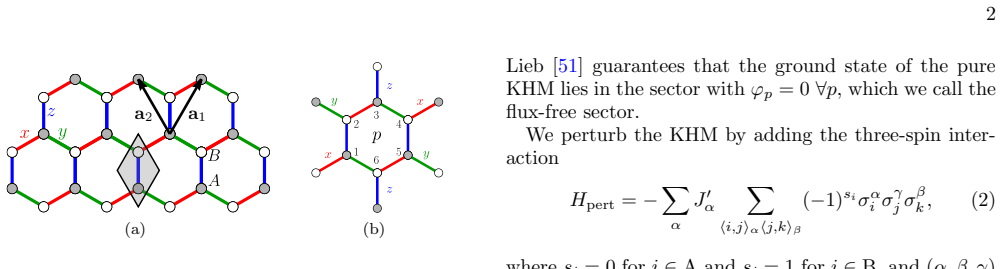
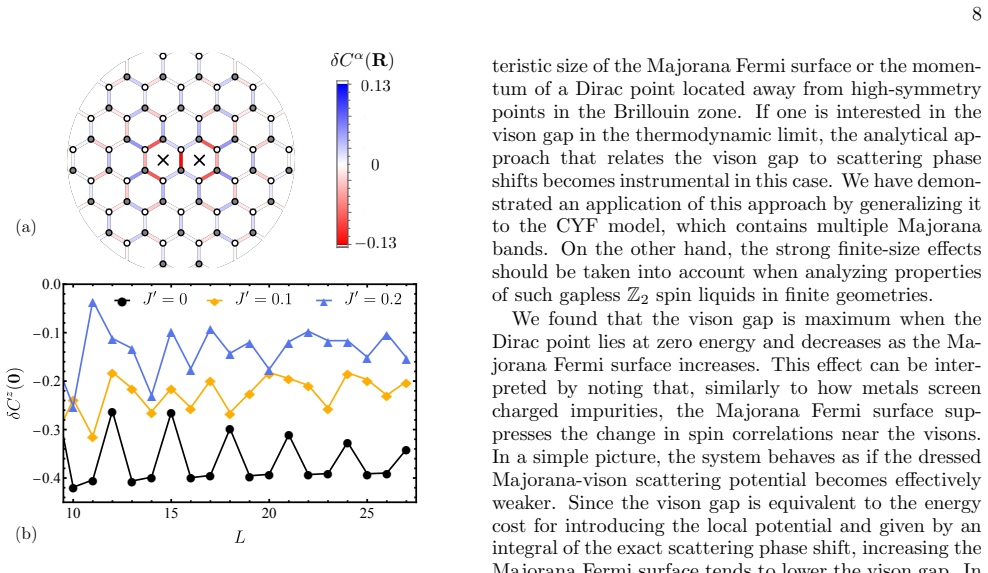
The excitation spectrum of Kitaev quantum spin liquids consists of itinerant Majorana fermions, which can be gapless or gapped, and vortices of a $\mathbb{Z}_2$ gauge field, known as visons, which are always gapped. In this work, we investigate visons in Kitaev-type models where the Majorana fermions form a Fermi surface. In this case, the creation of a vison pair is analogous to introducing a local impurity potential in a metal. Since the gapless modes lead to strong finite-size effects, we compare the numerical calculation of the vison gap on finite lattices with the result from an analytical approach based on Green's function techniques. We find that the vison gap decreases as the size of the Fermi surface increases, signalling an instability of the quantum spin liquid ground state. We also show that larger Fermi surfaces tend to suppress the change in local spin correlations due to the Majorana-vison scattering potential.
Editorial analysis
A structured set of objections, weighed in public.
Referee Report
Summary. The paper investigates visons in Kitaev-type quantum spin liquid models with gapless Majorana fermions forming a Fermi surface. It treats vison-pair creation as analogous to a local impurity potential for the Majoranas and compares finite-lattice numerical computations of the vison gap against analytical results obtained via Green's functions and the T-matrix approximation. The central finding is that the vison gap decreases with increasing Fermi-surface size, which the authors interpret as signaling an instability of the QSL ground state; they additionally report that larger Fermi surfaces suppress the change in local spin correlations induced by the scattering potential.
Significance. If the reported trend is robust, the result would indicate that extended Majorana Fermi surfaces destabilize Kitaev QSLs through vison proliferation, providing a concrete mechanism relevant to the stability of gapless fractionalized phases and to candidate materials. The dual numerical-analytical strategy is a methodological strength when finite-size effects are controlled, but the gapless nature of the Majorana spectrum makes such control essential for the claim.
major comments (2)
- [Numerical-analytical comparison of vison gaps] The central claim that the vison gap decreases with Fermi-surface size rests on the numerical-analytical comparison, yet the manuscript does not demonstrate that the extrapolation procedure remains size-independent when the Fermi surface is enlarged. Because the Majorana spectrum is gapless, impurity-induced power-law oscillations are present; any mismatch in truncation between finite clusters and the continuum Green's function can produce an artificial downward trend (see the skeptic note on finite-size corrections and the abstract's description of the comparison).
- [Abstract and methods] The abstract states that numerical finite-lattice results are compared with analytical Green's functions but provides no details on the specific models, error control, or quantitative measures of agreement (e.g., R² or residual norms). This absence limits evaluation of whether the reported trend is supported by the data rather than by uncontrolled finite-size artifacts.
minor comments (2)
- Clarify how the Fermi-surface size is systematically varied across the models and how the corresponding analytical Green's functions are constructed for each case.
- Add a brief discussion of the range of validity of the local-impurity analogy when the Majorana density of states is finite at the Fermi level.
Simulated Author's Rebuttal
We thank the referee for the careful reading of our manuscript and the constructive comments. We address each major point below and will revise the manuscript to strengthen the presentation of our finite-size analysis and to make the abstract more self-contained.
read point-by-point responses
-
Referee: The central claim that the vison gap decreases with Fermi-surface size rests on the numerical-analytical comparison, yet the manuscript does not demonstrate that the extrapolation procedure remains size-independent when the Fermi surface is enlarged. Because the Majorana spectrum is gapless, impurity-induced power-law oscillations are present; any mismatch in truncation between finite clusters and the continuum Green's function can produce an artificial downward trend.
Authors: We appreciate the referee's concern about possible finite-size artifacts arising from the gapless Majorana spectrum and power-law oscillations. The analytical Green's function plus T-matrix calculation is formulated directly in the thermodynamic limit and therefore contains no finite-size truncation. On the numerical side, we performed calculations on multiple cluster sizes for each Fermi-surface parameter set and extrapolated the vison gap using a scaling form that incorporates the leading 1/L power-law correction expected from the gapless fermions. The downward trend with increasing Fermi-surface size is already visible in the raw finite-size data and becomes clearer upon extrapolation; the extrapolated numerical values approach the analytical continuum result as system size grows. In the revised manuscript we will add an explicit supplementary figure displaying the raw gap versus 1/L for several Fermi-surface sizes together with the extrapolation fits, thereby demonstrating that the size dependence of the extrapolated gap itself is stable and that the trend is not an artifact of mismatched cutoffs. revision: yes
-
Referee: The abstract states that numerical finite-lattice results are compared with analytical Green's functions but provides no details on the specific models, error control, or quantitative measures of agreement (e.g., R² or residual norms). This absence limits evaluation of whether the reported trend is supported by the data rather than by uncontrolled finite-size artifacts.
Authors: We agree that the abstract, in its current concise form, does not convey the technical specifics needed for immediate assessment. The main text already specifies the Kitaev-type Hamiltonians (honeycomb lattice with anisotropic couplings chosen to produce Majorana Fermi surfaces of controlled size), the cluster sizes employed, and the quantitative comparison between the numerically extrapolated vison gaps and the T-matrix analytic result. In the revised version we will expand the abstract to name the models, state the range of system sizes used, and note that agreement is quantified by the relative difference between extrapolated numerical and analytic gaps (typically < 5 % for the largest clusters). We will also add a short statement on the error control provided by the finite-size scaling analysis. These changes will make the abstract self-contained while preserving its brevity. revision: yes
Circularity Check
No significant circularity detected
full rationale
The paper's central result—that the vison gap decreases with increasing Majorana Fermi-surface size—is obtained by direct numerical diagonalization on finite lattices combined with an independent analytical T-matrix/Green's-function treatment of the vison-pair-as-impurity problem. Neither step reduces to a self-definition, a fitted parameter renamed as a prediction, or a load-bearing self-citation; the impurity analogy is stated as an assumption and the finite-size comparison is performed explicitly rather than presupposed. The derivation chain therefore remains self-contained against external benchmarks.
Axiom & Free-Parameter Ledger
axioms (2)
- domain assumption Kitaev Hamiltonian admits exact Majorana fermion representation with Z2 gauge field
- domain assumption Visons remain gapped excitations even when Majorana fermions are gapless
Reference graph
Works this paper leans on
-
[1]
T. Senthil and M. P. A. Fisher,Z 2 gauge theory of electron fractionalization in strongly correlated systems, Phys. Rev. B62, 7850 (2000)
work page 2000
-
[2]
Sachdev,Quantum Phases of Matter(Cambridge Uni- versity Press, 2023)
S. Sachdev,Quantum Phases of Matter(Cambridge Uni- versity Press, 2023)
work page 2023
-
[3]
P. A. Lee, An end to the drought of quantum spin liquids, Science321, 1306 (2008)
work page 2008
-
[4]
L. Savary and L. Balents, Quantum spin liquids: a re- view, Rep. Prog. Phys.80, 016502 (2016)
work page 2016
-
[5]
Y. Zhou, K. Kanoda, and T.-K. Ng, Quantum spin liquid states, Rev. Mod. Phys.89, 025003 (2017)
work page 2017
-
[6]
Anderson, Resonating valence bonds: A new kind of insulator?, Mater
P. Anderson, Resonating valence bonds: A new kind of insulator?, Mater. Res. Bull.8, 153 (1973)
work page 1973
-
[7]
S. A. Kivelson, D. S. Rokhsar, and J. P. Sethna, Topology of the resonating valence-bond state: Solitons and high- Tc superconductivity, Phys. Rev. B35, 8865 (1987)
work page 1987
-
[8]
Kitaev, Anyons in an exactly solved model and be- yond, Ann
A. Kitaev, Anyons in an exactly solved model and be- yond, Ann. Phys.321, 2 (2006)
work page 2006
-
[9]
G. Jackeli and G. Khaliullin, Mott Insulators in the Strong Spin-Orbit Coupling Limit: From Heisenberg to a Quantum Compass and Kitaev Models, Phys. Rev. Lett. 102, 017205 (2009)
work page 2009
-
[10]
J. c. v. Chaloupka, G. Jackeli, and G. Khaliullin, Kitaev- Heisenberg Model on a Honeycomb Lattice: Possible Ex- otic Phases in Iridium OxidesA 2IrO3, Phys. Rev. Lett. 105, 027204 (2010)
work page 2010
-
[11]
K. W. Plumb, J. P. Clancy, L. J. Sandilands, V. V. Shankar, Y. F. Hu, K. S. Burch, H.-Y. Kee, and Y.-J. Kim,α−RuCl 3: A spin-orbit assisted Mott insulator on a honeycomb lattice, Phys. Rev. B90, 041112 (2014)
work page 2014
-
[12]
A. Banerjee, C. A. Bridges, J. Q. Yan, A. A. Aczel, L. Li, M. B. Stone, G. E. Granroth, M. D. Lumsden, Y. Yiu, J. Knolle, S. Bhattacharjee, D. L. Kovrizhin, R. Moess- ner, D. A. Tennant, D. G. Mandrus, and S. E. Nagler, Proximate Kitaev quantum spin liquid behaviour in a honeycomb magnet, Nat. Mater.15, 733 (2016)
work page 2016
- [13]
- [14]
-
[15]
S. M. Winter, A. A. Tsirlin, M. Daghofer, J. van den Brink, Y. Singh, P. Gegenwart, and R. Valent´ ı, Models and materials for generalized Kitaev magnetism, J. Phys. Condens. Matters29, 493002 (2017)
work page 2017
-
[16]
Y. Motome and J. Nasu, Hunting Majorana Fermions in Kitaev Magnets, J. Phys. Soc. Jpn.89, 012002 (2020)
work page 2020
-
[17]
Y. Matsuda, T. Shibauchi, and H.-Y. Kee, Kitaev quan- tum spin liquids, Rev. Mod. Phys.97, 045003 (2025)
work page 2025
-
[18]
M. Barkeshli, H. Yao, and S. A. Kivelson, Gapless spin liquids: Stability and possible experimental relevance, Phys. Rev. B87, 140402 (2013)
work page 2013
-
[19]
K. S. Tikhonov and M. V. Feigel’man, Quantum spin metal state on a decorated honeycomb lattice, Phys. Rev. Lett.105, 067207 (2010)
work page 2010
-
[20]
K. O’Brien, M. Hermanns, and S. Trebst, Classification of gaplessZ 2 spin liquids in three-dimensional Kitaev models, Phys. Rev. B93, 085101 (2016)
work page 2016
-
[21]
R. G. Pereira and S. Bieri, Gapless chiral spin liquid from coupled chains on the kagome lattice, SciPost Phys.4, 004 (2018)
work page 2018
- [22]
- [23]
-
[24]
S. Lee, Y. S. Choi, S. H. Do, W. Lee, C. H. Lee, M. Lee, M. Vojta, C. N. Wang, H. Luetkens, Z. Guguchia, and K. Y. Choi, Kondo screening in a Majorana metal, Nat. Commun.14, 7405 (2023)
work page 2023
- [25]
-
[26]
F. G. Oliviero, W. B. Fontana, and R. G. Pereira, Ma- jorana Fermi surface state in a network of quantum spin chains, Phys. Rev. B109, 075135 (2024)
work page 2024
-
[27]
P. Zhu, S. Feng, K. Wang, T. Xiang, and N. Trivedi, Emergent quantum Majorana metal from a chiral spin liquid, Nat. Commun.16, 2420 (2025)
work page 2025
-
[28]
S. Feng and N. Trivedi, Magnetic field induced phe- nomena in Kitaev spin liquids (2026), arXiv:2601.14496 [cond-mat.str-el]
-
[29]
D. Takikawa and S. Fujimoto, Impact of off-diagonal ex- change interactions on the Kitaev spin-liquid state of α−RuCl3, Phys. Rev. B99, 224409 (2019)
work page 2019
-
[30]
K. Nakazawa, Y. Kato, and Y. Motome, Asymmetric modulation of Majorana excitation spectra and nonre- ciprocal thermal transport in the Kitaev spin liquid un- der a staggered magnetic field, Phys. Rev. B105, 165152 (2022)
work page 2022
-
[31]
T. Yokoyama and Y. Tada, Strain-induced quantum os- cillation in Kitaev spin liquid with Majorana-Fermi sur- face (2025), arXiv:2512.12570 [cond-mat.str-el]
- [32]
-
[33]
Y. Kohsaka, S. Akutagawa, S. Omachi, Y. Iwamichi, T. Ono, I. Tanaka, S. Tateishi, H. Murayama, S. Suet- sugu, K. Hashimoto, T. Shibauchi, M. O. Takahashi, S. Nikolaev, T. Mizushima, S. Fujimoto, T. Terashima, T. Asaba, Y. Kasahara, and Y. Matsuda, Imaging Quan- tum Interference in a Monolayer Kitaev Quantum Spin Liquid Candidate, Phys. Rev. X14, 041026 (2024)
work page 2024
-
[34]
G. Baskaran, S. Mandal, and R. Shankar, Exact Results for Spin Dynamics and Fractionalization in the Kitaev Model, Phys. Rev. Lett.98, 247201 (2007)
work page 2007
-
[35]
V. Lahtinen, G. Kells, A. Carollo, T. Stitt, J. Vala, and 10 J. K. Pachos, Spectrum of the non-abelian phase in Ki- taev’s honeycomb lattice model, Ann. Phys.323, 2286 (2008)
work page 2008
-
[36]
V. Lahtinen, A. W. W. Ludwig, and S. Trebst, Perturbed vortex lattices and the stability of nucleated topological phases, Phys. Rev. B89, 085121 (2014)
work page 2014
- [37]
-
[38]
A. P. Joy and A. Rosch, Dynamics of Visons and Thermal Hall Effect in Perturbed Kitaev Models, Phys. Rev. X12, 041004 (2022)
work page 2022
-
[39]
F. L. Pedrocchi, S. Chesi, and D. Loss, Physical solutions of the Kitaev honeycomb model, Phys. Rev. B84, 165414 (2011)
work page 2011
-
[40]
F. Zschocke and M. Vojta, Physical states and finite- size effects in Kitaev’s honeycomb model: Bond disorder, spin excitations, and NMR line shape, Phys. Rev. B92, 014403 (2015)
work page 2015
- [41]
- [42]
-
[43]
C. Chen and I. S. Villadiego, Nature of visons in the per- turbed ferromagnetic and antiferromagnetic Kitaev hon- eycomb models, Phys. Rev. B107, 045114 (2023)
work page 2023
-
[44]
C. Hickey and S. Trebst, Emergence of a field-driven U(1) spin liquid in the Kitaev honeycomb model, Nat. Com- mun.10, 530 (2019)
work page 2019
-
[45]
J. Nasu, M. Udagawa, and Y. Motome, Thermal frac- tionalization of quantum spins in a Kitaev model: Temperature-linear specific heat and coherent transport of Majorana fermions, Phys. Rev. B92, 115122 (2015)
work page 2015
- [46]
-
[47]
G. Baskaran, G. Santhosh, and R. Shankar, Exact quan- tum spin liquids with fermi surfaces in spin-half models, arXiv preprint arXiv:0908.1614 (2009)
-
[48]
V. Chua, H. Yao, and G. A. Fiete, Exact chiral spin liq- uid with stable spin Fermi surface on the kagome lattice, Phys. Rev. B83, 180412 (2011)
work page 2011
- [49]
-
[50]
A. Panigrahi, P. Coleman, and A. Tsvelik, Analytic cal- culation of the vison gap in the Kitaev spin liquid, Phys. Rev. B108, 045151 (2023)
work page 2023
-
[51]
E. H. Lieb, Flux phase of the half-filled band, Phys. Rev. Lett.73, 2158 (1994)
work page 1994
-
[52]
E. Colom´ es and M. Franz, Antichiral Edge States in a Modified Haldane Nanoribbon, Phys. Rev. Lett.120, 086603 (2018)
work page 2018
-
[53]
J. Feldmeier, W. Natori, M. Knap, and J. Knolle, Local probes for charge-neutral edge states in two-dimensional quantum magnets, Phys. Rev. B102, 134423 (2020)
work page 2020
- [54]
-
[55]
B. S. DeWitt, Transition from discrete to continuous spectra, Phys. Rev.103, 1565 (1956)
work page 1956
-
[56]
S. Doniach and E. Sondheimer,Green’s functions for solid state physicists(World Scientific, 1998)
work page 1998
-
[57]
F. G. Fumi, CXVI. Vacancies in Monovalent Metals, Phi- los. Mag. Lett.87, I (2007)
work page 2007
-
[58]
G. D. Mahan,Many-particle physics(Springer, 2013)
work page 2013
- [59]
-
[60]
W. E. Liu, Z.-Y. Shi, M. M. Parish, and J. Levinsen, Theory of radio-frequency spectroscopy of impurities in quantum gases, Phys. Rev. A102, 023304 (2020)
work page 2020
-
[61]
C. W. J. Beenakker, Topologically protected Casimir effect for lattice fermions, Phys. Rev. Res.6, 023058 (2024)
work page 2024
-
[62]
K. Nakayama and K. Suzuki, Dirac/Weyl-node-induced oscillating Casimir effect, Phys. Lett. B843, 138017 (2023)
work page 2023
-
[63]
V. Lahtinen, Interacting non-Abelian anyons as Majo- rana fermions in the honeycomb lattice model, New J. Phys.13, 075009 (2011)
work page 2011
discussion (0)
Sign in with ORCID, Apple, or X to comment. Anyone can read and Pith papers without signing in.