Toward Real-World Adoption of Portrait Relighting via Hybrid Domain Knowledge Fusion
Pith reviewed 2026-05-08 08:39 UTC · model grok-4.3
The pith
Hybrid Domain Knowledge Fusion transfers multi-domain expertise into a compact portrait relighting model for real-world use.
A machine-rendered reading of the paper's core claim, the machinery that carries it, and where it could break.
Core claim
The central claim is that specialized prior models trained on different domains can be adapted and their knowledge distilled into a lightweight student model that inherits multi-domain capabilities, achieving substantial inference speedups without sacrificing state-of-the-art quality on real inputs. This is enabled by the Hybrid Domain Knowledge Fusion paradigm and supported by a new large-scale synthetic dataset with diverse intrinsics.
What carries the argument
Hybrid Domain Knowledge Fusion, a two-stage process of domain-aware adaptation of prior models followed by augmented knowledge distillation to a compact student.
If this is right
- The compact model enables real-time portrait relighting on edge devices.
- Quality remains comparable to larger specialized models across domains.
- The new synthetic dataset provides better training signals for intrinsic decomposition tasks.
- Inference costs drop by factors of 6 to 240 times compared to prior approaches.
- This fusion approach generalizes to other image synthesis tasks facing domain gaps.
Where Pith is reading between the lines
- Applications in mobile photography apps could become feasible without cloud processing.
- Future work might test the method's robustness to extreme lighting conditions not covered in the datasets.
- The speedup could allow integration into video relighting pipelines for live streaming.
- One might explore whether the same fusion technique reduces the need for large real-world capture setups in other vision tasks.
Load-bearing premise
The domain-aware adaptation and augmented knowledge distillation successfully pass on expertise from multiple domains to the student model with no significant drop in quality or introduction of artifacts when tested on real-world images.
What would settle it
Running the lightweight model on a held-out set of real-world portraits captured under varied camera conditions and lighting, and observing if its relit outputs match or exceed the visual fidelity of the original prior models without new artifacts.
Figures




read the original abstract
The real-world adoption of portrait relighting is hindered by dataset domain gaps, camera sensitivity, and computational costs. We address these challenges with Hybrid Domain Knowledge Fusion, a paradigm that fuses the specialized strengths of synthetic, One-Light-at-A-Time (OLAT), and real-world datasets into a compact model. Our approach features specialized prior models hardened by domain-aware adaptation, followed by augmented knowledge distillation into a lightweight student model with multi-domain expertise. Our method demonstrates a 6x to 240x inference speedup while maintaining state-of-the-art (SOTA) visual quality in the experiments. Additionally, we construct a massive, high-fidelity synthetic dataset with diverse ground-truth intrinsics to support our training pipeline.
Editorial analysis
A structured set of objections, weighed in public.
Referee Report
Summary. The paper introduces the Hybrid Domain Knowledge Fusion paradigm for portrait relighting, which fuses specialized strengths from synthetic, OLAT, and real-world datasets. It does so via domain-aware adaptation of prior models followed by augmented knowledge distillation into a lightweight student model that acquires multi-domain expertise. The authors also construct a large-scale synthetic dataset with diverse ground-truth intrinsics. The central claim is that the resulting model achieves 6x to 240x inference speedup while preserving state-of-the-art visual quality.
Significance. If the performance claims are substantiated, the work could meaningfully advance practical deployment of portrait relighting by mitigating domain gaps and computational overhead, with potential benefits for mobile photography, AR/VR, and content creation pipelines. The new synthetic dataset with intrinsics would be a reusable resource for the community.
major comments (1)
- Abstract: the assertion of 'state-of-the-art (SOTA) visual quality' and '6x to 240x inference speedup' is the load-bearing claim, yet the abstract supplies no quantitative metrics (e.g., PSNR/SSIM/LPIPS values), baseline comparisons, ablation tables, or error analysis. Without these, it is impossible to determine whether the results support the claim or reflect post-hoc evaluation choices.
minor comments (1)
- The phrase 'Hybrid Domain Knowledge Fusion paradigm' is introduced without a concise formal definition or overview diagram; a schematic in §3 or §4 would clarify the flow from prior-model adaptation to student distillation.
Simulated Author's Rebuttal
We thank the referee for the constructive feedback on our manuscript. The single major comment highlights an opportunity to strengthen the abstract, and we address it directly below with a commitment to revision.
read point-by-point responses
-
Referee: Abstract: the assertion of 'state-of-the-art (SOTA) visual quality' and '6x to 240x inference speedup' is the load-bearing claim, yet the abstract supplies no quantitative metrics (e.g., PSNR/SSIM/LPIPS values), baseline comparisons, ablation tables, or error analysis. Without these, it is impossible to determine whether the results support the claim or reflect post-hoc evaluation choices.
Authors: We agree that the abstract would be more informative with explicit quantitative anchors. The full manuscript reports standard metrics (PSNR, SSIM, LPIPS) and inference timings against multiple baselines in the Experiments section, with ablations and cross-dataset evaluations that follow established protocols in the portrait relighting literature. To address the concern, we will revise the abstract to include concise key results (e.g., average PSNR/LPIPS gains and the observed speedup range relative to prior methods) while preserving brevity. This change will make the central claims immediately verifiable from the abstract itself. revision: yes
Circularity Check
No significant circularity detected
full rationale
The paper presents a standard machine-learning pipeline: domain-aware adaptation of specialized prior models trained on synthetic/OLAT/real-world data, followed by augmented knowledge distillation into a compact student model. Claims of 6x–240x speedup and SOTA quality are positioned as empirical outcomes measured on held-out data, not as algebraic identities or fitted parameters renamed as predictions. No equations, self-referential definitions, or load-bearing self-citations appear in the provided text; the construction of an auxiliary synthetic dataset is an input step, not a circular output. The derivation chain therefore remains self-contained and externally falsifiable.
Axiom & Free-Parameter Ledger
axioms (2)
- domain assumption Specialized prior models trained on individual data domains can be hardened by domain-aware adaptation to contribute useful knowledge across domains.
- domain assumption Augmented knowledge distillation can transfer combined multi-domain expertise into a single lightweight student model while preserving visual quality.
invented entities (1)
-
Hybrid Domain Knowledge Fusion paradigm
no independent evidence
Reference graph
Works this paper leans on
- [1]
-
[2]
Alam, M.Z., Giuliani, N., Chen, H., Mantiuk, R.K.: Reduction of glare in images with saturated pixels. In: IEEE ICSIP. pp. 498–502 (2021)
work page 2021
-
[3]
Anonymous: DNF-Avatar: Distilling neural fields for real-time animatable avatar relighting. In: ICCVW (2025)
work page 2025
-
[4]
Bashkirova, D., Ray, A., Mallick, R., Bargal, S.A., Zhang, J., Krishna, R., Saenko, K.: Lasagna: Layered score distillation for disentangled image editing. In: NeurIPS (2023)
work page 2023
-
[5]
Buslaev, A., Iglovikov, V.I., Khvedchenya, E., Parinov, A., Druzhinin, M., Kalinin, A.A.: Albumentations: Fast and flexible image augmentations. Information11(2) (2020)
work page 2020
- [6]
-
[7]
Chaturvedi, S., Ren, M., Hold-Geoffroy, Y., Liu, J., Dorsey, J., Shu, Z.: SynthLight: Portrait relighting with diffusion model by learning to re-render synthetic faces. In: CVPR (2025)
work page 2025
-
[8]
Debevec, P., Hawkins, T., Tchou, C., Duiker, H.P., Sarokin, W., Sagar, M.: Ac- quiring the reflectance field of a human face. In: ACM SIGGRAPH. pp. 145–156 (2000)
work page 2000
-
[9]
In: Smart Tools and Apps for Graphics (STAG) (2024)
Dulecha, T.G., et al.: Optimized NeuralRTI relighting through knowledge distilla- tion. In: Smart Tools and Apps for Graphics (STAG) (2024)
work page 2024
-
[10]
arXiv preprint arXiv:2501.16330 (2025)
Fang, Y., Sun, Z., Zhang, S., Wu, T., Xu, Y., Zhang, P., Wang, J., Wetzstein, G., Lin, D.: RelightVid: Temporal-consistent diffusion model for video relighting. arXiv preprint arXiv:2501.16330 (2025)
-
[11]
Communications of the ACM63(11), 139–144 (2020)
Goodfellow, I., Pouget-Abadie, J., Mirza, M., Xu, B., Warde-Farley, D., Ozair, S., Courville, A., Bengio, Y.: Generative adversarial networks. Communications of the ACM63(11), 139–144 (2020)
work page 2020
-
[12]
arXiv preprint arXiv:2506.15673 , year=
He, K., Liang, R., Munkberg, J., Hasselgren, J., Vijaykumar, N., Keller, A., Fidler, S., Gilitschenski, I., Gojcic, Z., Wang, Z.: UniRelight: Learning joint decomposition and synthesis for video relighting. arXiv preprint arXiv:2506.15673 (2025)
-
[13]
In: NIPS Deep Learning and Representation Learning Workshop (2015)
Hinton, G., Vinyals, O., Dean, J.: Distilling the knowledge in a neural network. In: NIPS Deep Learning and Representation Learning Workshop (2015)
work page 2015
-
[14]
arXiv preprint arXiv:2510.23494 (2025)
Jüttner, E., Pfeifer, J., Krath, L., Korfhage, S., Dröge, H., Hullin, M.B., Stam- minger, M., Thies, J.: Yesnt: Are diffusion relighting models ready for cap- ture stage compositing? A hybrid alternative to bridge the gap. arXiv preprint arXiv:2510.23494 (2025)
-
[15]
Kim, K., et al.: SwitchLight: Co-design of physics-driven architecture and pre- training framework for human portrait relighting. In: CVPR (2024)
work page 2024
-
[16]
Adam: A Method for Stochastic Optimization
Kingma, D.P., Ba, J.: Adam: A method for stochastic optimization. arXiv preprint arXiv:1412.6980 (2014)
work page internal anchor Pith review arXiv 2014
-
[17]
Liang, R., Gojcic, Z., Ling, H., Munkberg, J., Hasselgren, J., Lin, Z.H., Gao, J., Keller, A., Vijaykumar, N., Fidler, S., Wang, Z.: Diffusionrenderer: Neural inverse 16 Q. Huang et al. and forward rendering with video diffusion models. In: The IEEE Conference on Computer Vision and Pattern Recognition (CVPR) (June 2025)
work page 2025
-
[18]
arXiv preprint arXiv:2601.22135 (2026)
Liang, Z., Chen, Z., Chen, Y., Wei, T., Wang, T., Pan, X.: PI-Light: Physics- inspired diffusion for full-image relighting. arXiv preprint arXiv:2601.22135 (2026)
- [19]
- [20]
- [21]
- [22]
-
[23]
In: SIGGRAPH Advanced Computer Graphics Animation Course Notes (1984)
Miller, G.S., Hoffman, C.R.: Illumination and reflection maps: Simulated objects in simulated and real environments. In: SIGGRAPH Advanced Computer Graphics Animation Course Notes (1984)
work page 1984
-
[24]
Pandey, R., Orts-Escolano, S., Legendre, C., Haene, C., Bouaziz, S., Rhemann, C., Debevec, P., Fanello, S.: Total relighting: Learning to relight portraits for back- ground replacement. ACM TOG40(4) (2021)
work page 2021
-
[25]
Rao, Y., et al.: Lite2Relight: 3D-aware single image portrait relighting. In: ACM SIGGRAPH (2024)
work page 2024
-
[26]
Stable and Controllable Neural Texture Synthesis and Style Transfer Using Histogram Losses
Risser, E., Wilmot, P., Barnes, C.: Stable and controllable neural texture synthesis and style transfer using histogram losses. arXiv preprint arXiv:1701.08893 (2017)
work page Pith review arXiv 2017
-
[27]
Ronneberger, O., Fischer, P., Brox, T.: U-Net: Convolutional networks for biomed- ical image segmentation. In: MICCAI. pp. 234–241 (2015)
work page 2015
- [28]
-
[29]
Talvala, E.V., Adams, A., Horowitz, M., Levoy, M.: Veiling glare in high dynamic range imaging. ACM TOG26(3), 37 (2007)
work page 2007
- [30]
-
[31]
Wang, Z., et al.: Image quality assessment: from error visibility to structural sim- ilarity. IEEE TIP (2004)
work page 2004
-
[32]
Optical engineering19(1), 139–144 (1980)
Woodham, R.J.: Photometric method for determining surface orientation from multiple images. Optical engineering19(1), 139–144 (1980)
work page 1980
- [33]
-
[34]
Xue, H., Hang, T., Zeng, Y., Sun, Y., Liu, B., Yang, H., Fu, J., Guo, B.: Advancing high-resolution video-language representation with large-scale video transcriptions. In: CVPR (2022)
work page 2022
-
[35]
Yeh, Y.Y., Nagano, K., Khamis, S., Kautz, J., Liu, M.Y., Wang, T.C.: Learning to relight portrait images via a virtual light stage and synthetic-to-real adaptation. ACM TOG41(6), 1–15 (2022)
work page 2022
- [36]
- [37]
-
[38]
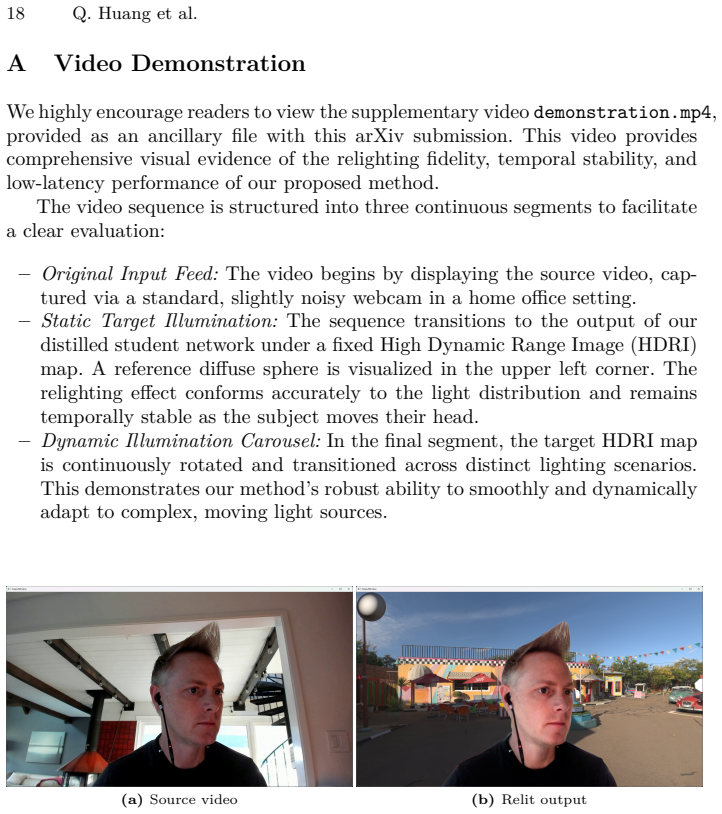
Zhang, R., et al.: The unreasonable effectiveness of deep features as a perceptual metric. In: CVPR (2018) 18 Q. Huang et al. A Video Demonstration Wehighlyencouragereaderstoviewthesupplementaryvideodemonstration.mp4, provided as an ancillary file with this arXiv submission. This video provides comprehensive visual evidence of the relighting fidelity, tem...
work page 2018
discussion (0)
Sign in with ORCID, Apple, or X to comment. Anyone can read and Pith papers without signing in.