Exact momentum-space analysis of small spin-1/2 J₁-J₂ rings
Pith reviewed 2026-05-08 07:17 UTC · model grok-4.3
The pith
A basis of exact few-magnon Bloch states block-diagonalizes the J1-J2 Hamiltonian for small rings and yields momentum-space forms of the Majumdar-Ghosh and HKNN ground states.
A machine-rendered reading of the paper's core claim, the machinery that carries it, and where it could break.
Core claim
With a set of exact few-magnon Bloch states the Hamiltonian of the N=6 and N=8 isotropic J1-J2 rings is block-diagonalized, and the Majumdar-Ghosh ground states together with the Hamada-Kane-Nakagawa-Natsume ground state are obtained in momentum space; their equivalence to the corresponding real-space states is shown explicitly for N=6. For the anisotropic six-site ring a subset of eigenstates are shown to be simultaneous eigenstates of the Hamiltonian and the total angular momentum operator even though the latter is not conserved. The HKNN state on small even-N rings displays a structure consistent with N/2 bound down spins.
What carries the argument
The set of exact few-magnon Bloch states, which supplies a symmetry-adapted basis that reduces the Hamiltonian to blocks of dimension at most four and exposes the momentum-space structure of the Majumdar-Ghosh and HKNN states.
If this is right
- For the anisotropic six-site ring certain eigenstates remain simultaneous eigenstates of the Hamiltonian and total angular momentum despite broken conservation.
- The Majumdar-Ghosh and HKNN states appear in explicit momentum-space form and match their real-space counterparts for N=6.
- The HKNN ground state on small even-N rings exhibits a structure that suggests N/2 successive down spins are bound together, potentially for any even N.
- Block sizes no larger than four dimensions allow partial analytical solution of the spectrum.
Where Pith is reading between the lines
- The same Bloch-state construction could be attempted for rings with N=10 or N=12 to test whether the bound-state pattern of the HKNN state persists.
- Spin-correlation measurements on the HKNN state would show clustering of down spins over N/2 consecutive sites, providing a testable signature in quantum simulators.
- The technique offers a route to benchmark variational or tensor-network methods on frustrated rings by supplying exact small-system reference states.
- The observation that some eigenstates remain simultaneous eigenstates of H and total angular momentum under anisotropy points to hidden symmetries that may appear in related models.
Load-bearing premise
The chosen few-magnon Bloch states form a complete enough basis to contain the ground states and the simultaneous eigenstates of H and total angular momentum that are claimed.
What would settle it
Full numerical diagonalization of the 64-dimensional Hamiltonian for the six-site ring (or 256-dimensional for eight sites) yields energy levels or eigenvectors that differ from those obtained from the block matrices constructed with the few-magnon Bloch states.
Figures

read the original abstract
This paper considers an $N$-site spin-1/2 $J_1$-$J_2$ ring with $N=6$ and $8$. With the help of a set of exact few-magnon Bloch states, we obtain the block-diagonalized Hamiltonian consisting of block matrices of at most four dimensions. Partial of the eigenstates are analytically solved. For the six-site anisotropic ring, we reveal a subset of eigenstates that are simultaneous eigenstates of the Hamiltonian and the total angular momentum operator, even though the latter is not conserved. For both the six- and eight-site isotropic rings, we achieve momentum-space manifestations of several important states, including the famous Majumdar-Ghosh (MG) ground states and the Hamada-Kane-Nakagawa-Natsume (HKNN) ground state. The equivalence of these states with their real-space counterparts is explicitly shown for $N=6$. The structure of the HKNN ground state for small rings suggests that for any even number $N$ this state might behave like a ``bound state" with $N/2$ successive down spins binding together.
Editorial analysis
A structured set of objections, weighed in public.
Referee Report
Summary. The manuscript develops a momentum-space formalism for the spin-1/2 J1-J2 Heisenberg ring on N=6 and N=8 sites. Symmetry-adapted few-magnon Bloch states are used to block-diagonalize the Hamiltonian into matrices of size at most 4×4, permitting analytical or semi-analytical eigenstates. For the isotropic cases the authors obtain momentum-space representations of the Majumdar-Ghosh dimer states and the Hamada-Kane-Nakagawa-Natsume (HKNN) state, with explicit equivalence to the known real-space wavefunctions demonstrated for N=6. For the anisotropic N=6 ring they identify a subset of states that remain simultaneous eigenstates of H and the total angular-momentum operator even though the latter is not conserved. The structure of the HKNN state on small rings is interpreted as suggesting a bound-state character with N/2 consecutive down spins for any even N.
Significance. If the few-magnon Bloch basis is complete within each momentum sector, the work supplies exact analytical expressions for several benchmark states of the J1-J2 model and demonstrates a practical route to block-diagonalization that could be useful for other small frustrated clusters. The explicit mapping between momentum-space and real-space MG/HKNN wavefunctions for N=6 is a concrete strength, as is the observation of simultaneous H and J eigenstates under broken rotational symmetry.
major comments (2)
- [Construction of the few-magnon Bloch basis and the subsequent block-diagonalization (sections describing N=6 and N=8)] The central claim that the block-diagonalized matrices yield the exact ground states (including the MG and HKNN states) rests on the assumption that the chosen few-magnon Bloch states span the entire Sz=0 subspace for each momentum k. The manuscript does not report an explicit dimension count of the retained Bloch basis versus the full Sz=0 Hilbert-space dimension per k-sector (for N=6 the total Sz=0 space has dimension 20; for N=8 it is 70). Without this verification it remains possible that additional configurations outside the few-magnon set project into the same k-block and lower the true ground-state energy.
- [Discussion of the HKNN ground state] The suggestion that the HKNN state behaves as a bound state of N/2 successive down spins for arbitrary even N is presented as a conjecture based solely on the N=6 and N=8 solutions. No general proof, variational argument, or numerical check for larger even N is supplied, yet the claim is used to interpret the physical character of the state.
minor comments (2)
- [Abstract] The abstract sentence 'Partial of the eigenstates are analytically solved' is grammatically incorrect; it should read 'A subset of the eigenstates is analytically solved' or 'Some eigenstates are solved analytically.'
- [Methods / basis construction] Notation for the Bloch wave-vector k and the magnon number should be introduced once with a clear definition before being used in the block-matrix expressions.
Simulated Author's Rebuttal
We thank the referee for the careful reading of our manuscript and the constructive comments. We address each major point below and will revise the manuscript to incorporate clarifications and additional details where appropriate.
read point-by-point responses
-
Referee: [Construction of the few-magnon Bloch basis and the subsequent block-diagonalization (sections describing N=6 and N=8)] The central claim that the block-diagonalized matrices yield the exact ground states (including the MG and HKNN states) rests on the assumption that the chosen few-magnon Bloch states span the entire Sz=0 subspace for each momentum k. The manuscript does not report an explicit dimension count of the retained Bloch basis versus the full Sz=0 Hilbert-space dimension per k-sector (for N=6 the total Sz=0 space has dimension 20; for N=8 it is 70). Without this verification it remains possible that additional configurations outside the few-magnon set project into the same k-block and lower the true ground-state energy.
Authors: We appreciate the referee pointing out the need for explicit verification of basis completeness. Our few-magnon Bloch states are constructed to be exact and symmetry-adapted within each momentum sector, and for N=6 we explicitly demonstrate equivalence between the momentum-space eigenstates and the known real-space Majumdar-Ghosh and HKNN ground states, which are established to be exact. This matching confirms that the ground states are captured. In the revised manuscript we will add an explicit dimension count comparing our retained Bloch basis size to the full Sz=0 dimension in each k-sector. For N=6 (total Sz=0 dimension 20) and N=8 (total 70), the blocks of size at most 4x4 will be shown to account for the relevant subspaces, with no lower energies possible outside this basis as the block-diagonalization is exact by construction within the symmetry sectors. revision: yes
-
Referee: [Discussion of the HKNN ground state] The suggestion that the HKNN state behaves as a bound state of N/2 successive down spins for arbitrary even N is presented as a conjecture based solely on the N=6 and N=8 solutions. No general proof, variational argument, or numerical check for larger even N is supplied, yet the claim is used to interpret the physical character of the state.
Authors: We agree that the interpretation of the HKNN state as potentially behaving like a bound state with N/2 successive down spins is based solely on our N=6 and N=8 results and is not accompanied by a general proof or checks for larger N. The manuscript already phrases this cautiously as a suggestion arising from the small-ring structure ('suggests that for any even number N this state might behave like...'). In the revision we will further emphasize that this is an observation and conjecture limited to the systems studied, and that extending it to arbitrary even N would require additional analysis beyond the scope of the present work on small rings. revision: partial
Circularity Check
No circularity in the momentum-space analysis of small J1-J2 rings
full rationale
The paper constructs a basis of exact few-magnon Bloch states via standard spin-operator algebra and momentum-space symmetry adaptation, then block-diagonalizes the Hamiltonian into matrices of dimension at most 4. Eigenstates are obtained by direct analytic or numeric solution of these blocks. Equivalence between momentum-space and real-space MG/HKNN states is shown by explicit wavefunction comparison for N=6. No step reduces by construction to its own input, no parameters are fitted and relabeled as predictions, and no load-bearing self-citations or uniqueness theorems imported from prior author work appear. The basis-completeness assumption is independently verifiable for these small systems by Hilbert-space dimension counting and is not circular.
Axiom & Free-Parameter Ledger
axioms (2)
- standard math Spin-1/2 operators obey the standard su(2) commutation relations [S^x, S^y] = i S^z (and cyclic).
- domain assumption The ring possesses discrete translational symmetry, allowing Bloch states labeled by total momentum.
Reference graph
Works this paper leans on
-
[1]
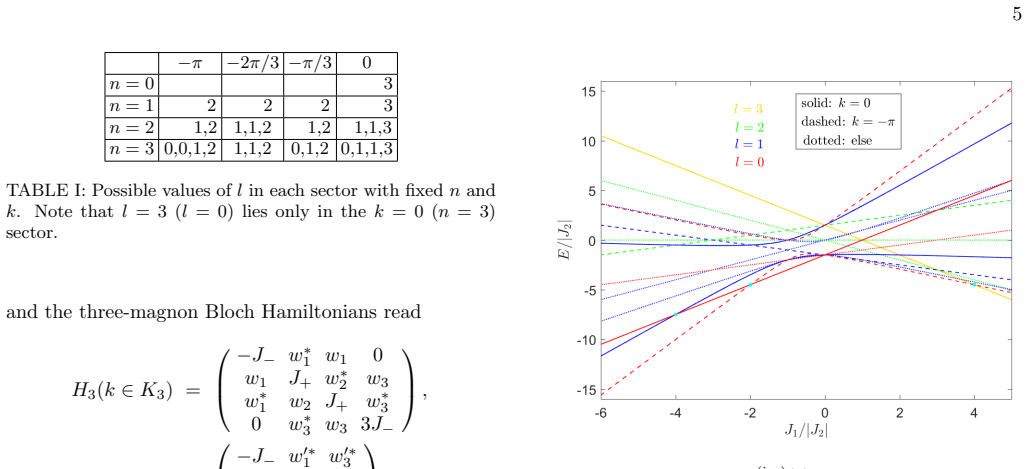
Note thatl= 3 (l= 0) lies only in thek= 0 (n= 3) sector
= ε1 t1 t1 ε+ 2 ,(9) where ε1 =−J − −J 2 cosk, ε ± 2 =J − ±J 2 cosk, t1 =−J 1 cos k 2 , t 2 =−J 2 cosk,(10) 5 −π −2π/3 −π/3 0 n= 0 3 n= 1 2 2 2 3 n= 2 1,2 1,1,2 1,2 1,1,3 n= 3 0,0,1,2 1,1,2 0,1,2 0,1,1,3 TABLE I: Possible values oflin each sector with fixednand k. Note thatl= 3 (l= 0) lies only in thek= 0 (n= 3) sector. and the three-magnon Bloch Hamilton...
-
[2]
= −J− w′∗ 1 w′∗ 3 w′ 1 J+ w′∗ 2 w′ 3 w′ 2 J+ ,(11) where w1 =− J1z 2 −J 2z−2, w 2 =−J 1z−J 2z−2, w 3 =− √ 3 2 J1z, w′ 1 =−z(J 1/2 +J 2 cosk), w ′ 2 =−(J 1z4 +J 2z−5) cosk, w′ 3 =−z 5 (J1/2 +J 2 cosk),(12) withz≡e −ik/3. The matrix representations of the total angular mo- mentum operator ⃗L2 in the Bloch basis can also be ob- tained by using the ru...
-
[3]
The two wave numbers satisfying the condition arek ∗ =±π/3
Zero-energy states We take ∆1 =−∆ 2 = 1/2 [withE F =−3(J 1 −J 2)/4] as an example to illustrate the emergence of ZESs in each magnetization sector. The two wave numbers satisfying the condition arek ∗ =±π/3. It is obvious that the one- magnon eigenstate|ψ 1(k∗)⟩is a ZES sinceE 1(k∗)−E F = −(J1 −J 2)/2−J + + 3J+ = 0. The two ZESs in the two-magnon sector c...
-
[4]
MG ground states It can be seen from Fig. 1 that at the MG pointJ 2 = J1/2<0 the two degenerate ground states are given by|ψ (1) 3,0(−π)⟩with energyE (1) 3,0(−π) =J 1 −A 3/2 (see Table IV) and|ψ 3(0)⟩with energyE 3(0) = 3(J1 +J 2)/2 (see Table III). FromA 3 =−5J 1/2 we haveE (1) 3,0(−π) = E3(0) = 9J1/4 =E MG|N=6 and |ψ(1) 3,0(−π)⟩= 1√ 10 0√ 3ei π 3 ...
-
[5]
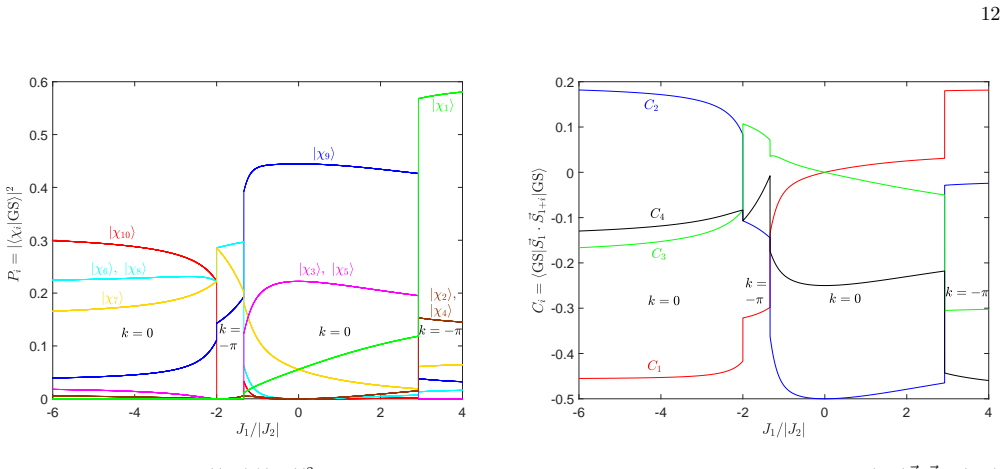
HKNN ground state From Fig. 1 we see that the HKNN ground state at J1 =−4J 2 >0 is also given by|ψ (1) 3,0(−π)⟩with energy E(1) 3,0(−π) =−9J 1/8 =E F [7]. From Eq. (C7), the cor- responding ground state is |ψ(1) 3,0(−π)⟩= 1√ 34 3 √ 3√ 3ei π 3 √ 3e−i π 3 1 .(17) Using the expressions for the dimer states given by Eq. (D1) and collecting all the...
-
[6]
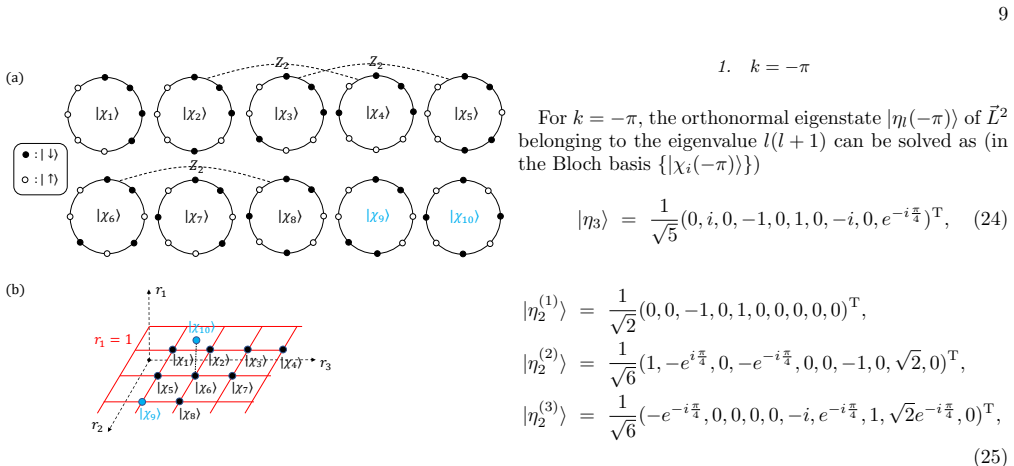
we get 9×9 (8×8) matrices since|χ 10(k)⟩ is (|χ9(k)⟩and|χ 10(k)⟩are) not well defined. The matrix representations of ⃗L2 can be directly solved by Mathematica. The resulting values oflin eachk- subspace are listed in the last row of Table VI. There are totally 45 columns in Table VI, which means that the number of distinct eigenenergies is at most 45. For...
-
[7]
Therefore,|ξ 1(−π)⟩and |ξ2(−π)⟩are two type-HL eigenstates
Two-magnon sector Fork=−π∈K ′ 2, bothH 2(−π) and ⃗L2 2(−π) are di- agonal, so the Bloch state|ξ 1(−π)⟩[|ξ 2(−π)⟩] is itself a simultaneous eigenstate ofHand ⃗L2 with eigenenergy E(1) 2 (−π) =−J − +J 2 [E(2) 2 (−π) =J − −J 2] and angu- lar momentuml= 1 (l= 2). Therefore,|ξ 1(−π)⟩and |ξ2(−π)⟩are two type-HL eigenstates. Fork=−π/3∈K ′ 2, diagonalization of t...
-
[8]
The corresponding eigenstate|ψ 3(−π)⟩= 0e −i π 3 1 0 T / √ 2 is a type-HL state belonging to l= 1
Three-magnon sector Fork=−π∈K 3, Mathematica can only output a single closed-form eigenvalue ofH 3(−π),E 3(−π) = J+ −J 1 +J 2. The corresponding eigenstate|ψ 3(−π)⟩= 0e −i π 3 1 0 T / √ 2 is a type-HL state belonging to l= 1. For ∆ 1 = ∆ 2 = 1, the remaining three eigen- values are E3,2(−π) = 1 2(J1 −3J 2), E(1) 3,0(−π) =J 1 − A3 2 , E (2) 3,0(−π) =J 1 + ...
-
[9]
C. Majumdar and D. Ghosh, On next-nearest-neighbor interaction in linear chain. I, J. Math. Phys.10, 1388 (1969); On next-nearest-neighbor interaction in linear chain. II, J. Math. Phys.10, 1399 (1969)
work page 1969
-
[10]
Niemeijer, Linear spin chain with nearest and next- nearest neighbor interactions, J
T. Niemeijer, Linear spin chain with nearest and next- nearest neighbor interactions, J. Math. Phys.12, 1487 (1971)
work page 1971
-
[11]
I. Ono, Ground state energies for a finite linear Heisen- berg chain with nearest and next-nearest neighbor inter- actions, Phys. Lett.38A, 327 (1972)
work page 1972
-
[12]
G. Ananthakrishna, Properties of the linear Heisenberg chain with nearest and next-nearest neighbor interac- tions, L. F. Weiss, D. C. Foyt, and D. J. Klein, Physica B81, 275 (1976)
work page 1976
-
[13]
H. P. Bader and R. Schilling, Conditions for a ferro- magnetic ground state of Heisenberg Hamiltonians, Phys. Rev. B19, 3556 (1979)
work page 1979
-
[14]
F. D. M. Haldane, Spontaneous dimerization in theS= 1 2 Heisenberg antiferromagnetic chain with competing in- teractions, Phys. Rev. B25, 4925 (1982)
work page 1982
- [15]
-
[16]
T. Tonegawa and I. Harada, Ground-state properties of the one-dimensional isotropic spin-1/2 Heisenberg anti- ferromagnet with competing interactions, J. Phys. Soc. Jpn.56, 2153 (1987)
work page 1987
-
[17]
T. Tonegawa and I. Harada, One-dimensional isotropic spin-1/2 Heisenberg magnet with ferromagnetic nearest- neighbor and antiferromagnetic next-nearest-neighbor in- teractions, J. Phys. Soc. Jpn.58, 2902 (1989)
work page 1989
-
[18]
K. Okamoto and K. Nomura, Fluid-dimer critical point inS= 1 2 antiferromagnetic Heisenberg chain with next nearest neighbor interactions, Phys. Lett. A169, 433(1992)
work page 1992
-
[19]
V. Ya. Krivnov and A. A. Ovchinnikov, Antiferromagnet- ferromagnet transition in the one-dimensional frustrated spin model, Phys. Rev. B53, 6435 (1996)
work page 1996
-
[20]
D. V. Dmitriev and V. Ya. Krivnov, Frustrated ferromag- netic spin- 1 2 chain in a magnetic field, Phys. Rev. B73, 024402 (2006)
work page 2006
-
[21]
F. Heidrich-Meisner, A. Honecker, and T. Vekua, Frus- trated ferromagnetic spin- 1 2 chain in a magnetic field: The phase diagram and thermodynamic properties, Phys. Rev. B74, 020403(R) (2006)
work page 2006
-
[22]
T. Hikihara, L. Kecke, T. Momoi, and A. Furusaki, Vec- tor chiral and multipolar orders in the spin- 1 2 frustrated ferromagnetic chain in magnetic field, Phys. Rev. B78, 144404 (2008)
work page 2008
- [23]
-
[24]
T. Hikihara, T. Momoi, A. Furusaki, and H Kawamura, Magnetic phase diagram of the spin- 1 2 antiferromagnetic zigzag ladder, Phys. Rev. B81, 224433 (2010)
work page 2010
-
[25]
S. Furukawa, M. Sato, S. Onoda, and A. Furusaki, Ground-state phase diagram of a spin- 1 2 frustrated fer- romagnetic XXZ chain: Haldane dimer phase and gapped/gapless chiral phases, Phys. Rev. B86, 094417 (2012)
work page 2012
- [26]
-
[27]
Z. G. Soos, A. Parvej, and M. Kumar, Numerical study of 17 incommensurate and decoupled phases of spin-1/2 chains with isotropic exchangeJ 1,J 2 between first and second neighbors, Journal of Physics: Condensed Matter28, 175603 (2016)
work page 2016
-
[28]
A. Parvej and M. Kumar, Multipolar phase in frustrated spin-1/2 and spin-1 chains, Phys. Rev. B96, 054413 (2017)
work page 2017
-
[29]
M Routh, S Ghosh, and M Kumar, Exploring quantum phases in frustrated spin- 1 2 chains and ladders: a detailed review, Journal of Physics: Condensed Matter 37, 403001 (2025)
work page 2025
-
[30]
R. R. dos Santos, L. A. Oliveira, N. C. Costa, Four in- teracting spins: Addition of angular momenta, spin-spin correlations, and entanglement, Am. J. Phys.92, 606 (2024)
work page 2024
-
[31]
J. Li, Y. Cao, and N. Wu, Few-magnon excitations in a frustrated spin-Sferromagnetic chain with single-ion anisotropy, Phys. Rev. B109, 174403 (2024)
work page 2024
- [32]
-
[33]
Bethe, Zur theorie der metalle, Z
H. Bethe, Zur theorie der metalle, Z. Phys.71, 205 (1931)
work page 1931
-
[34]
Hulth´ en,¨Uber das Austauschproblem eines Kristalles, Arkiv Mat
L. Hulth´ en,¨Uber das Austauschproblem eines Kristalles, Arkiv Mat. Astron. Fys.26A, 1 (1938)
work page 1938
-
[35]
R. Orbach, Antiferromagnetic magnon dispersion law and bloch wall energies in ferromagnets and antiferro- magnets, Phys. Rev.115, 1181 (1959)
work page 1959
-
[36]
L. F. Mattheiss, Antiferromagnetic linear chain, Phys. Rev.123, 1209 (1961)
work page 1961
-
[37]
J. des Cloizeaux and J. J. Pearson, Spin-wave spectrum of the antiferromagnetic linear chain, Phys. Rev.128, 2131 (1962)
work page 1962
-
[38]
J. C. Bonner and M. E. Fisher, Linear magnetic chains with anisotropic coupling, Phys. Rev.135, A640 (1964)
work page 1964
-
[39]
C. K. Majumdar, Problem of two spin deviaitons in a linear chain with next-nearest-neighbor interactions, J. Math. Phys.10, 177 (1969)
work page 1969
-
[40]
I. Ono, S. Mikado, and T. Oguchi, Two-magnon bound states in a linear Heisenberg chain with nearest and next nearest neighbor interactions, J. Phys. Soc. Japan30, 358 (1971)
work page 1971
-
[41]
A. A. Bahurmuz and P. D. Loly, The complete two- magnon spectrum of the ferromagnetic Heisenberg chain including NNN interactions, J. Phys. C: Solid State Phys. 19, 2241 (1986)
work page 1986
-
[42]
A. V. Chubukov, Chiral, nematic, and dimer states in quantum spin chains, Phys. Rev. B44, 4693 (1991)
work page 1991
-
[43]
R. O. Kuzian and S.-L. Drechsler, Exact one- and two- particle excitation spectra of acute-angle helimagnets above their saturation magnetic field, Phys. Rev. B75, 024401 (2007)
work page 2007
- [44]
-
[45]
N. Wu, H. Katsura, S.-W. Li, X. Cai, and X.-W. Guan, Exact solutions of few-magnon problems in the spin-S periodic XXZ chain, Phys. Rev. B105, 064419 (2022)
work page 2022
-
[46]
X. Lou, J. Li, and N. Wu, Evolution of two-magnon bound states in a higher-spin ferromagnetic chain with single-ion anisotropy: A complete solution, Phys. Rev. B 110, L100404 (2024)
work page 2024
-
[47]
L. D. Faddeev and L. A. Takhtajan, What is the spin of a spin wave?, Phys. Lett. A85, 375 (1981)
work page 1981
-
[48]
R. H. Dicke, Coherence in spontaneous radiation pro- cesses, Phys. Rev.93, 99 (1954)
work page 1954
-
[49]
E. B. Fel’dman, E. I. Kuznetsova, and A. I. Zenchuk, One-excitation spin dynamics in homogeneous closed chain governed by XX-Hamiltonian. Quantum Inf Pro- cess23, 39 (2024)
work page 2024
-
[50]
C. H. Zhang and Z. Song, Exact eigenstates with off- diagonal long-range order for interacting bosonic sys- tems, Phys. Rev. B111, 125126 (2025)
work page 2025
-
[51]
E. Lieb and D. Mattis, Ordering energy levels of inter- acting spin systems, J. Math. Phys.3, 749 (1962)
work page 1962
-
[52]
W. J. Caspers, K. M. Emmett, and W. Magnus, The Majumdar-Ghosh chain. Twofold ground state and ele- mentary excitations. J. Phys. A: Math. Gen.17, 2687 (1984)
work page 1984
-
[53]
Tasaki,Physics and Mathematics of Quantum Many- Body Systems(Springer, Cham, 2020)
H. Tasaki,Physics and Mathematics of Quantum Many- Body Systems(Springer, Cham, 2020)
work page 2020
-
[54]
X. Lou, D. Xu, and N. Wu, Some conclusions about Hermitian operators extended to non-Hermitian cases, Physics and Engineering35, 34 (2025)
work page 2025
discussion (0)
Sign in with ORCID, Apple, or X to comment. Anyone can read and Pith papers without signing in.