Dynamical dimer structure factor of the triangular S=1/2 Heisenberg antiferromagnet
Pith reviewed 2026-05-08 01:51 UTC · model grok-4.3
The pith
The dynamical dimer structure factor reveals dispersion minima at half Brillouin zone corners in the candidate quantum spin liquid phase of the triangular Heisenberg antiferromagnet.
A machine-rendered reading of the paper's core claim, the machinery that carries it, and where it could break.
Core claim
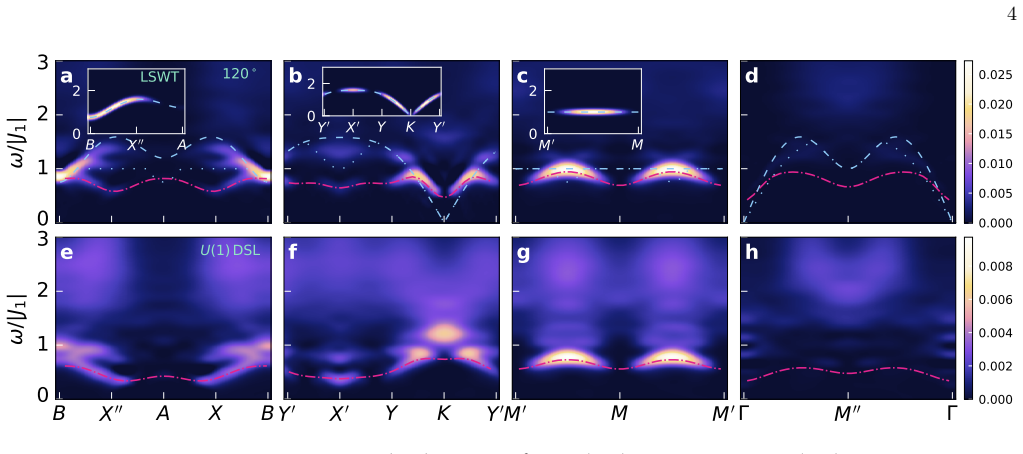
Within the candidate gapless QSL, absolute dispersion minima occur at momenta X ≡ K/2, in agreement with field-theory predictions that singlet monopole excitations of the U(1) Dirac spin liquid become gapless at these points; the high-resolution dynamical dimer response therefore supports a U(1) Dirac QSL with singlet monopole excitations.
What carries the argument
The dynamical dimer structure factor, computed via GPU-accelerated matrix-product-state simulations, which isolates spin-singlet excitations and their momentum-resolved dispersion.
If this is right
- The dimer response can distinguish U(1) Dirac QSLs from other candidate liquids by the location of singlet-excitation minima.
- Avoided quasiparticle decay below the two-magnon continuum appears systematically in all magnetically ordered phases.
- High-resolution access to singlet modes offers a new experimental window on excitations that are invisible to the usual spin structure factor.
Where Pith is reading between the lines
- Neutron or resonant X-ray scattering on triangular-lattice materials could search for the predicted dimer minima to test the QSL scenario.
- If the monopole picture holds, related signatures should appear in other singlet channels such as bond-bond correlations or scalar chirality fluctuations.
- Finite-temperature extensions of the same simulations could map how the minima evolve toward the chiral QSL regime at finite scalar-chirality coupling.
Load-bearing premise
The parameter regimes identified as candidate QSLs are correctly located by the simulations and the observed dispersion minima can be unambiguously attributed to the singlet monopole excitations rather than finite-size effects or truncation errors.
What would settle it
If larger-system simulations or independent methods move the minima away from X ≡ K/2 or eliminate them entirely, the identification with monopole excitations of the U(1) Dirac spin liquid would fail.
Figures




read the original abstract
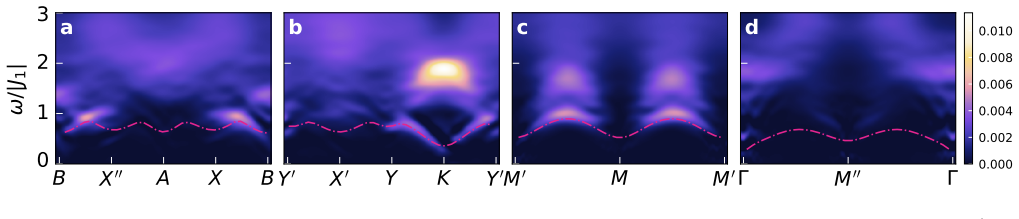
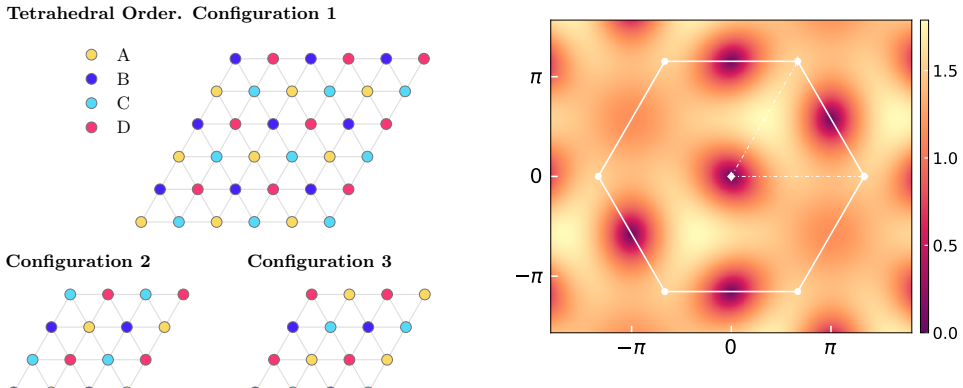
The dynamical dimer structure factor is an observable probing spin-singlet excitations of quantum magnets distinct from those commonly studied by the spin structure factor. We report the dimer response for the extended spin-$1/2$ antiferromagnetic Heisenberg model on the triangular lattice using large-scale GPU-accelerated matrix-product-state simulations. We investigate the ordered phases with $120^\circ$ coplanar, collinear stripe, and tetrahedral spin order, as well as candidate quantum spin-liquid (QSL) regimes, comprising an expected gapless $U(1)$ Dirac QSL and a chiral QSL at finite spin-scalar-chirality coupling. In the ordered phases, we find low-energy modes below the onset of the two-magnon continuum illustrating avoided quasiparticle decay. Within the candidate gapless QSL, we observe absolute dispersion minima at momenta of half the Brillouin zone corners, $X\equiv K/2$, in agreement with field-theory predictions that singlet monopole excitations of the $U(1)$ Dirac spin liquid become gapless at these points. Thus, the high-resolution dynamical dimer response provides support for a $U(1)$ Dirac QSL with singlet monopole excitations.
Editorial analysis
A structured set of objections, weighed in public.
Referee Report
Summary. The paper computes the dynamical dimer structure factor of the extended S=1/2 triangular-lattice Heisenberg antiferromagnet via large-scale GPU-accelerated matrix-product-state simulations. It examines the response across 120° ordered, stripe, and tetrahedral phases as well as candidate gapless U(1) Dirac and chiral QSL regimes, reporting absolute dispersion minima at the X≡K/2 points inside the gapless QSL that are interpreted as the singlet monopole excitations predicted by field theory.
Significance. If the reported minima survive proper extrapolation, the work supplies numerical evidence for the monopole spectrum of the U(1) Dirac spin liquid on a less-studied observable, complementing spin-structure-factor studies. The technical advance of high-resolution dynamical MPS data on 2D frustrated models is a clear strength.
major comments (2)
- [QSL regime results] The central claim that the absolute minima at X≡K/2 constitute support for gapless singlet monopoles rests on the assumption that the simulated parameter window lies inside the thermodynamic-limit QSL and that the minima are not shifted or filled by truncation. No bond-dimension values D, cylinder circumferences, time-step/broadening parameters, or explicit D→∞ and L→∞ extrapolations for the dimer structure factor are reported in the QSL regime (see the subsection presenting the candidate gapless QSL results).
- [Discussion of field-theory comparison] The attribution of the minima specifically to monopole excitations rather than other singlet modes or finite-size artifacts requires at least a qualitative overlay of the field-theory dispersion or intensity onto the numerical data; the present qualitative agreement alone does not rule out alternative explanations.
minor comments (2)
- [Abstract] The abstract states 'large-scale' simulations without quoting representative D or system sizes; adding these numbers would improve immediate readability.
- [Model and observables] Notation for the X point (X≡K/2) and its relation to the Brillouin zone should be illustrated with a figure or explicit reciprocal-space diagram for readers unfamiliar with the triangular lattice.
Simulated Author's Rebuttal
We thank the referee for the careful reading of our manuscript and the positive assessment of its technical contributions. We address each major comment below and will revise the manuscript to incorporate the requested clarifications and comparisons.
read point-by-point responses
-
Referee: [QSL regime results] The central claim that the absolute minima at X≡K/2 constitute support for gapless singlet monopoles rests on the assumption that the simulated parameter window lies inside the thermodynamic-limit QSL and that the minima are not shifted or filled by truncation. No bond-dimension values D, cylinder circumferences, time-step/broadening parameters, or explicit D→∞ and L→∞ extrapolations for the dimer structure factor are reported in the QSL regime (see the subsection presenting the candidate gapless QSL results).
Authors: We agree that the manuscript would benefit from more explicit documentation of the numerical parameters and extrapolation procedures in the QSL regime. In the revised version we will add a dedicated paragraph (or appendix) listing the bond dimensions D employed for the candidate gapless QSL data (with convergence checks), the cylinder circumferences used, the time-step and broadening parameters of the time-evolution algorithm, and finite-D and finite-size extrapolations of the dimer structure factor. These additions will confirm that the reported minima at X≡K/2 remain the lowest-energy features after extrapolation and that the parameter window lies inside the QSL phase in the thermodynamic limit. revision: yes
-
Referee: [Discussion of field-theory comparison] The attribution of the minima specifically to monopole excitations rather than other singlet modes or finite-size artifacts requires at least a qualitative overlay of the field-theory dispersion or intensity onto the numerical data; the present qualitative agreement alone does not rule out alternative explanations.
Authors: We accept that a direct visual comparison strengthens the interpretation. In the revised manuscript we will overlay the field-theory dispersion relation for the gapless singlet monopoles (which are predicted to become gapless at the X≡K/2 points) onto the numerical dimer-structure-factor intensity plot for the candidate U(1) Dirac QSL. This overlay will make the momentum locations and the gapless character more explicit and will help distinguish the monopole modes from other possible singlet excitations or finite-size artifacts, while preserving the qualitative nature of the comparison. revision: yes
Circularity Check
No significant circularity in numerical results or interpretation
full rationale
The paper computes the dynamical dimer structure factor via direct large-scale MPS simulations of the microscopic extended Heisenberg Hamiltonian on the triangular lattice. Dispersion minima at X≡K/2 are reported as computed observables in the candidate QSL regime, with the QSL identification and monopole attribution resting on external field-theory predictions rather than any self-referential definition, fitted parameter renamed as prediction, or load-bearing self-citation chain. No step in the provided abstract or description reduces the central claim to an input by construction; the derivation remains self-contained against external benchmarks.
Axiom & Free-Parameter Ledger
Reference graph
Works this paper leans on
-
[1]
C. Lacroix, P. Mendels, and F. Mila,Introduction to Frustrated Magnetism(Springer Berlin, Heidelberg, 2011)
work page 2011
-
[2]
P. Anderson, Resonating valence bonds: A new kind of insulator?, Materials Research Bulletin8, 153 (1973)
work page 1973
-
[3]
L. B. Ioffe and A. I. Larkin, Gapless fermions and gauge fields in dielectrics, Phys. Rev. B39, 8988 (1989)
work page 1989
-
[4]
X. G. Wen, Mean-field theory of spin-liquid states with finite energy gap and topological orders, Phys. Rev. B 44, 2664 (1991)
work page 1991
-
[5]
N. Read and S. Sachdev, Large-n expansion for frus- trated quantum antiferromagnets, Phys. Rev. Lett.66, 6 1773 (1991)
work page 1991
-
[6]
T. Senthil and M. P. A. Fisher,Z 2 gauge theory of electron fractionalization in strongly correlated systems, Phys. Rev. B62, 7850 (2000)
work page 2000
-
[7]
Wen, Quantum orders and symmetric spin liquids, Phys
X.-G. Wen, Quantum orders and symmetric spin liquids, Phys. Rev. B65, 165113 (2002)
work page 2002
-
[8]
M. Hermele, T. Senthil, M. P. A. Fisher, P. A. Lee, N. Nagaosa, and X.-G. Wen, Stability ofU(1)spin liq- uids in two dimensions, Phys. Rev. B70, 214437 (2004)
work page 2004
- [9]
-
[10]
Balents, Spin liquids in frustrated magnets, Nature 464, 199 (2010)
L. Balents, Spin liquids in frustrated magnets, Nature 464, 199 (2010)
work page 2010
-
[11]
J. Knolle and R. Moessner, A field guide to spin liquids, Annual Review of Condensed Matter Physics10, 451 (2019)
work page 2019
-
[12]
C. Broholm, R. J. Cava, S. A. Kivelson, D. G. Nocera, M. R. Norman, and T. Senthil, Quantum spin liquids, Science367, eaay0668 (2020)
work page 2020
-
[13]
S. Ito, N. Kurita, H. Tanaka, S. Ohira-Kawamura, K. Nakajima, S. Itoh, K. Kuwahara, and K. Kaku- rai, Structure of the magnetic excitations in the spin-1/2 triangular-lattice Heisenberg antiferromagnet Ba3CoSb2O9, Nature Communications8, 235 (2017)
work page 2017
-
[14]
K. M. Ranjith, D. Dmytriieva, S. Khim, J. Sichelschmidt, S. Luther, D. Ehlers, H. Yasuoka, J. Wosnitza, A. A. Tsirlin, H. K¨ uhne, and M. Baenitz, Field-induced instability of the quantum spin liquid ground state in theJ eff = 1 2 triangular-lattice compound NaYbO2, Phys. Rev. B99, 180401 (2019)
work page 2019
-
[15]
P.-L. Dai, G. Zhang, Y. Xie, C. Duan, Y. Gao, Z. Zhu, E. Feng, Z. Tao, C.-L. Huang, H. Cao, A. Podlesnyak, G. E. Granroth, M. S. Everett, J. C. Neuefeind, D. Voneshen, S. Wang, G. Tan, E. Morosan, X. Wang, H.-Q. Lin, L. Shu, G. Chen, Y. Guo, X. Lu, and P. Dai, Spinon fermi surface spin liquid in a triangular lattice antiferromagnet NaYbSe 2, Phys. Rev. X1...
work page 2021
- [16]
-
[17]
A. O. Scheie, E. A. Ghioldi, J. Xing, J. A. M. Paddison, N. E. Sherman, M. Dupont, L. D. Sanjeewa, S. Lee, A. J. Woods, D. Abernathy, D. M. Pajerowski, T. J. Williams, S.-S. Zhang, L. O. Manuel, A. E. Trumper, C. D. Pemmaraju, A. S. Sefat, D. S. Parker, T. P. Dev- ereaux, R. Movshovich, J. E. Moore, C. D. Batista, and D. A. Tennant, Proximate spin liquid ...
work page 2024
-
[18]
Y. Cao, A. Koda, M. D. Le, V. Pomjakushin, B. Liu, Z. Fu, Z. Li, J. Zhao, Z. Tian, and H. Guo, U(1) dirac quantum spin liquid candidate in triangular-lattice anti- ferromagnet CeMgAl11O19, Science China Physics, Me- chanics & Astronomy68, 10.1007/s11433-024-2634-9 (2025)
- [19]
-
[20]
R. Verresen, F. Pollmann, and R. Moessner, Quantum dynamics of the square-lattice Heisenberg model, Phys. Rev. B98, 155102 (2018)
work page 2018
-
[21]
F. Ferrari and F. Becca, Dynamical structure factor of theJ 1 −J 2 Heisenberg model on the triangular lattice: Magnons, spinons, and gauge fields, Phys. Rev. X9, 031026 (2019)
work page 2019
-
[22]
M. Mourigal, W. T. Fuhrman, A. L. Chernyshev, and M. E. Zhitomirsky, Dynamical structure factor of the triangular-lattice antiferromagnet, Phys. Rev. B88, 094407 (2013)
work page 2013
-
[23]
E. A. Ghioldi, M. G. Gonzalez, S.-S. Zhang, Y. Kamiya, L. O. Manuel, A. E. Trumper, and C. D. Batista, Dy- namical structure factor of the triangular antiferromag- net: Schwinger boson theory beyond mean field, Phys. Rev. B98, 184403 (2018)
work page 2018
-
[24]
N. E. Sherman, M. Dupont, and J. E. Moore, Spectral function of theJ 1 −J 2 Heisenberg model on the trian- gular lattice, Phys. Rev. B107, 165146 (2023)
work page 2023
-
[25]
M. Drescher, L. Vanderstraeten, R. Moessner, and F. Pollmann, Dynamical signatures of symmetry-broken and liquid phases in anS= 1 2 Heisenberg antiferromag- net on the triangular lattice, Phys. Rev. B108, L220401 (2023)
work page 2023
-
[26]
R. Bag, S. Xu, N. E. Sherman, L. Yadav, A. I. Kolesnikov, A. A. Podlesnyak, E. S. Choi, I. da Silva, J. E. Moore, and S. Haravifard, Evidence of dirac quan- tum spin liquid in YbZn 2GaO5, Phys. Rev. Lett.133, 266703 (2024)
work page 2024
-
[27]
A. O. Scheie, M. Lee, K. Wang, P. Laurell, E. S. Choi, D. Pajerowski, Q. Zhang, J. Ma, H. D. Zhou, S. Lee, S. M. Thomas, M. O. Ajeesh, P. F. S. Rosa, A. Chen, V. S. Zapf, M. Heyl, C. D. Batista, E. Dagotto, J. E. Moore, and D. A. Tennant, Spectrum and low-energy gap in triangular quantum spin liquid NaYbSe 2 (2024), arXiv:2406.17773 [cond-mat.str-el]
-
[28]
F. Ferrari, A. Parola, and F. Becca, Gapless spin liquids in disguise, Phys. Rev. B103, 195140 (2021)
work page 2021
-
[29]
D. S. Rokhsar and S. A. Kivelson, Superconductivity and the quantum hard-core dimer gas, Phys. Rev. Lett. 61, 2376 (1988)
work page 1988
-
[30]
R. Moessner and S. L. Sondhi, Resonating valence bond phase in the triangular lattice quantum dimer model, Phys. Rev. Lett.86, 1881 (2001)
work page 2001
-
[31]
L. J. P. Ament, M. van Veenendaal, T. P. Devereaux, J. P. Hill, and J. van den Brink, Resonant inelastic x-ray scattering studies of elementary excitations, Rev. Mod. Phys.83, 705 (2011)
work page 2011
-
[32]
J. Li, S. Jin, T. Datta, and D.-X. Yao, Raman spec- troscopy of bimagnon and trimagnon excitations and rotonlike points in a distorted triangular lattice antifer- romagnet, Phys. Rev. B107, 184402 (2023)
work page 2023
-
[33]
C. Luo, T. Datta, Z. Huang, and D.-X. Yao, Signatures of indirectk-edge resonant inelastic x-ray scattering on magnetic excitations in a triangular-lattice antiferro- magnet, Phys. Rev. B92, 035109 (2015)
work page 2015
-
[34]
J. Kim, J. c. v. Chaloupka, Y. Singh, J. W. Kim, B. J. Kim, D. Casa, A. Said, X. Huang, and T. Gog, Dynamic spin correlations in the honeycomb lattice Na2IrO3 mea- sured by resonant inelastic x-ray scattering, Phys. Rev. X10, 021034 (2020)
work page 2020
- [35]
-
[36]
M. Mitrano, S. Johnston, Y.-J. Kim, and M. P. M. Dean, Exploring quantum materials with resonant inelastic x- 7 ray scattering, Phys. Rev. X14, 040501 (2024)
work page 2024
-
[37]
H. Lu, W. Zhu, and W. Yao, Collective excitations in chiral spin liquid: chiral roton and long-wavelength ne- matic mode (2026), arXiv:2601.20702 [cond-mat]
work page internal anchor Pith review arXiv 2026
-
[38]
J. Knolle, G.-W. Chern, D. L. Kovrizhin, R. Moessner, and N. B. Perkins, Raman scattering signatures of ki- taev spin liquids inA 2IrO3 iridates withA=Na or Li, Phys. Rev. Lett.113, 187201 (2014)
work page 2014
-
[39]
G. B. Hal´ asz, N. B. Perkins, and J. van den Brink, Res- onant inelastic x-ray scattering response of the kitaev honeycomb model, Phys. Rev. Lett.117, 127203 (2016)
work page 2016
-
[40]
G. B. Hal´ asz, S. Kourtis, J. Knolle, and N. B. Perkins, Observing spin fractionalization in the kitaev spin liquid via temperature evolution of indirect resonant inelastic x-ray scattering, Phys. Rev. B99, 184417 (2019)
work page 2019
- [41]
-
[42]
X. G. Wen, F. Wilczek, and A. Zee, Chiral spin states and superconductivity, Phys. Rev. B39, 11413 (1989)
work page 1989
-
[43]
G. Baskaran, Novel local symmetries and chiral- symmetry-broken phases in S=1/2 triangular-lattice Heisenberg model, Phys. Rev. Lett.63, 2524 (1989)
work page 1989
-
[44]
A. Wietek and A. M. L¨ auchli, Chiral spin liquid and quantum criticality in extendedS= 1 2 Heisenberg mod- els on the triangular lattice, Phys. Rev. B95, 035141 (2017)
work page 2017
-
[45]
S.-S. Gong, W. Zhu, J.-X. Zhu, D. N. Sheng, and K. Yang, Global phase diagram and quantum spin liq- uids in a spin- 1 2 triangular antiferromagnet, Phys. Rev. B96, 075116 (2017)
work page 2017
- [46]
-
[47]
P. Fazekas and P. W. Anderson, On the ground state properties of the anisotropic triangular antiferromagnet, The Philosophical Magazine: A Journal of Theoretical Experimental and Applied Physics30, 423 (1974)
work page 1974
-
[48]
T. Jolicoeur, E. Dagotto, E. Gagliano, and S. Bacci, Ground-state properties of the S=1/2 Heisenberg anti- ferromagnet on a triangular lattice, Phys. Rev. B42, 4800 (1990)
work page 1990
-
[49]
A. V. Chubukov, S. Sachdev, and T. Senthil, Large-s expansion for quantum antiferromagnets on a triangular lattice, Journal of Physics: Condensed Matter6, 8891 (1994)
work page 1994
- [50]
-
[51]
L. Capriotti, A. E. Trumper, and S. Sorella, Long-range N´ eel order in the triangular Heisenberg model, Phys. Rev. Lett.82, 3899 (1999)
work page 1999
-
[52]
S. R. White and A. L. Chernyshev, Ne´ el order in square and triangular lattice Heisenberg models, Phys. Rev. Lett.99, 127004 (2007)
work page 2007
-
[53]
A. L. Chernyshev and M. E. Zhitomirsky, Magnon decay in noncollinear quantum antiferromagnets, Phys. Rev. Lett.97, 207202 (2006)
work page 2006
-
[54]
O. A. Starykh, A. V. Chubukov, and A. G. Abanov, Flat spin-wave dispersion in a triangular antiferromag- net, Phys. Rev. B74, 180403 (2006)
work page 2006
-
[55]
A. L. Chernyshev and M. E. Zhitomirsky, Spin waves in a triangular lattice antiferromagnet: Decays, spec- trum renormalization, and singularities, Phys. Rev. B 79, 144416 (2009)
work page 2009
- [56]
- [57]
- [58]
-
[59]
Y. Iqbal, W.-J. Hu, R. Thomale, D. Poilblanc, and F. Becca, Spin liquid nature in the HeisenbergJ 1 −J 2 triangular antiferromagnet, Phys. Rev. B93, 144411 (2016)
work page 2016
-
[60]
F. Wang and A. Vishwanath, Spin-liquid states on the triangular and kagom´ e lattices: A projective-symmetry- group analysis of schwinger boson states, Phys. Rev. B 74, 174423 (2006)
work page 2006
- [61]
-
[62]
M. Hermele, T. Senthil, and M. P. A. Fisher, Algebraic spin liquid as the mother of many competing orders, Phys. Rev. B72, 104404 (2005)
work page 2005
-
[63]
S. Hu, W. Zhu, S. Eggert, and Y.-C. He, Dirac spin liquid on the spin-1/2 triangular Heisenberg antiferro- magnet, Phys. Rev. Lett.123, 207203 (2019)
work page 2019
- [64]
-
[65]
V. Kalmeyer and R. B. Laughlin, Equivalence of the resonating-valence-bond and fractional quantum hall states, Phys. Rev. Lett.59, 2095 (1987)
work page 2095
-
[66]
V. Kalmeyer and R. B. Laughlin, Theory of the spin liquid state of the Heisenberg antiferromagnet, Phys. Rev. B39, 11879 (1989)
work page 1989
- [67]
-
[68]
Schollw¨ ock, The density-matrix renormalization group in the age of matrix product states, Ann
U. Schollw¨ ock, The density-matrix renormalization group in the age of matrix product states, Ann. Phys. 326, 96 (2011)
work page 2011
-
[69]
W. Li, J. Ren, and Z. Shuai, Numerical assessment for accuracy and GPU acceleration of TD-DMRG time evo- lution schemes, The Journal of Chemical Physics152, 024127 (2020)
work page 2020
- [70]
-
[71]
J. Unfried, J. Hauschild, and F. Pollmann, Fast time evolution of matrix product states using the QR de- composition, Phys. Rev. B107, 155133 (2023)
work page 2023
-
[72]
M. Drescher, L. Vanderstraeten, R. Moessner, and F. Pollmann, Spectral functions of an extended antifer- 8 romagneticS=1/2 Heisenberg model on the triangular lattice (2025), arXiv:2508.17292 [cond-mat.str-el]
-
[73]
X.-Y. Song, C. Wang, A. Vishwanath, and Y.-C. He, Unifying description of competing orders in two- dimensional quantum magnets, Nature Communica- tions10, 4254 (2019)
work page 2019
-
[74]
X.-Y. Song, Y.-C. He, A. Vishwanath, and C. Wang, From spinon band topology to the symmetry quantum numbers of monopoles in dirac spin liquids, Phys. Rev. X10, 011033 (2020)
work page 2020
-
[75]
U. F. P. Seifert, J. Willsher, M. Drescher, F. Pollmann, and J. Knolle, Spin-Peierls instability of the U(1) Dirac spin liquid, Nature Communications15, 7110 (2024)
work page 2024
-
[76]
F. Ferrari, J. Willsher, U. F. P. Seifert, R. Valent´ ı, and J. Knolle, Stability of algebraic spin liquids coupled to quantum phonons, Phys. Rev. Res.7, L042053 (2025)
work page 2025
-
[77]
See Supplemental Material for the dynamical dimer structure factors in additional phases, a discussion of the finite-circumference effects in the static dimer structure factor and details on the spin-wave calculation. (2026)
work page 2026
-
[78]
R. Verresen, R. Moessner, and F. Pollmann, Avoided quasiparticle decay from strong quantum interactions, Nature Physics15, 750 (2019)
work page 2019
-
[79]
T. Xie, A. A. Eberharter, J. Xing, S. Nishimoto, M. Brando, P. Khanenko, J. Sichelschmidt, A. A. Tur- rini, D. G. Mazzone, P. G. Naumov, L. D. Sanjeewa, N. Harrison, A. S. Sefat, B. Normand, A. M. L¨ auchli, A. Podlesnyak, and S. E. Nikitin, Complete field- induced spectral response of the spin-1/2 triangular- lattice antiferromagnet CsYbSe 2, npj Quantum...
work page 2023
-
[80]
O. Kovalska, E. P. Fontanella, B. Schneider, H.-H. Tu, and J. von Delft, Revisiting theJ 1-J2 Heisenberg model on a triangular lattice: Quasi-degenerate ground states and phase competition (2026), arXiv:2603.08650 [cond- mat.str-el]
discussion (0)
Sign in with ORCID, Apple, or X to comment. Anyone can read and Pith papers without signing in.