Symmetry-Protected Topological Phases in the Triangular Majorana-Hubbard Ladder
Pith reviewed 2026-05-08 01:39 UTC · model grok-4.3
The pith
The triangular Majorana-Hubbard model on a four-leg ladder hosts multiple symmetry-protected topological phases.
A machine-rendered reading of the paper's core claim, the machinery that carries it, and where it could break.
Core claim
The triangular-lattice Majorana-Hubbard model on a four-leg ladder exhibits a richer variety of phases than previously known. Analysis of entanglement-spectrum degeneracies and adiabatic connections identifies multiple symmetry-protected topological phases. These phases could be realized in arrays of vortex-bound Majorana modes on the surface of a topological superconductor.
What carries the argument
Entanglement-spectrum degeneracies of the ground-state wavefunction, used to diagnose the presence and type of symmetry-protected topological order in the Majorana-Hubbard ladder.
If this is right
- The phase diagram contains more distinct phases than reported in prior studies of the same model.
- Multiple symmetry-protected topological phases are separated by phase boundaries that can be crossed adiabatically.
- The identified phases remain stable under the symmetries of the triangular-lattice Majorana-Hubbard interaction.
- Arrays of vortex-bound Majorana modes provide a concrete physical setting in which the predicted phases could appear.
Where Pith is reading between the lines
- Ladder geometries may serve as useful minimal models for capturing essential features of two-dimensional Majorana lattices.
- The results suggest that similar numerical diagnostics could be applied to other interaction strengths or lattice geometries to locate additional protected phases.
- Confirmation of these phases would supply concrete targets for experiments that engineer Majorana modes on superconducting surfaces.
Load-bearing premise
Numerical results from DMRG and variational uniform matrix product states on the finite-width ladder faithfully represent the true ground states of the infinite system, with entanglement degeneracies remaining free of significant truncation or finite-size artifacts.
What would settle it
A larger-scale simulation or direct experimental probe that finds a non-degenerate entanglement spectrum in a parameter regime the paper identifies as symmetry-protected topological.
Figures






read the original abstract
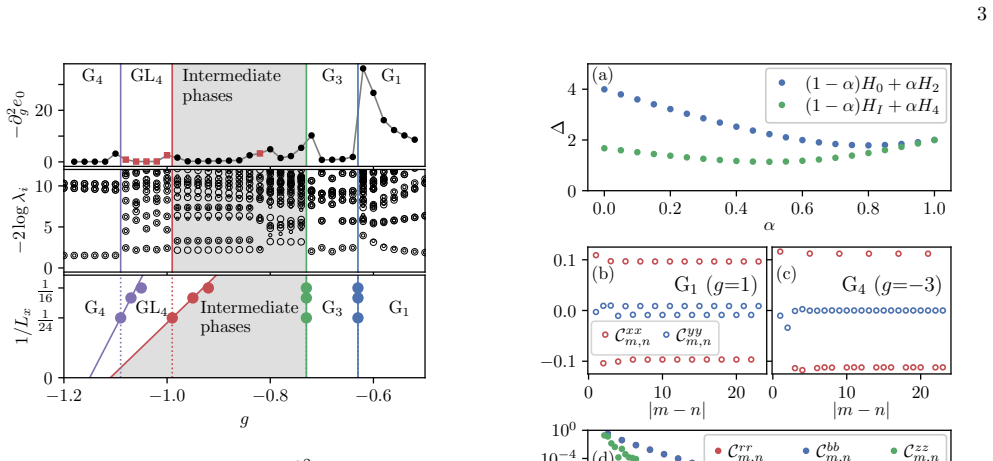
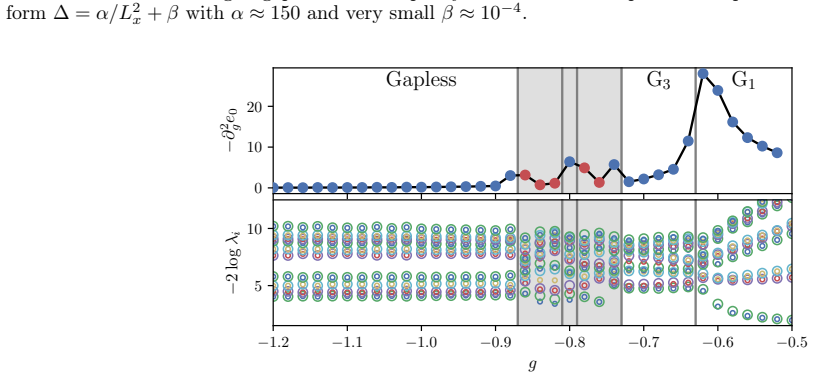
We uncover a family of symmetry-protected topological phases in a model of interacting Majorana fermions on triangular-lattice ladders. Included among these phases is one in which symmetry-protected topological order coexists with spontaneous symmetry breaking associated with an adiabatically evolving set of symmetries. Our results indicate a mechanism through which interactions among Majorana modes generate nontrivial symmetry-fractionalized orders. These phases may be realized in arrays of vortex-bound Majorana zero modes on the surface of topological superconductors.
Editorial analysis
A structured set of objections, weighed in public.
Referee Report
Summary. The manuscript maps the phase diagram of the triangular-lattice Majorana-Hubbard model on a four-leg ladder using DMRG and variational uniform matrix product states. It identifies multiple symmetry-protected topological (SPT) phases via entanglement-spectrum degeneracies and adiabatic connections, suggesting possible realization in vortex-bound Majorana mode arrays on topological superconductor surfaces.
Significance. If the numerical identifications hold, the work would advance understanding of interacting Majorana systems by revealing a richer set of SPT phases than previously reported. The tensor-network approach combined with symmetry diagnostics is a methodological strength, and the proposed experimental link to topological superconductors adds relevance.
major comments (2)
- [§3 (Numerical Methods)] §3 (Numerical Methods): The DMRG and VUMPS sections report entanglement spectrum degeneracies used to diagnose SPT order but omit explicit bond-dimension convergence data, truncation-error estimates, or finite-size scaling. In interacting Majorana models, finite bond dimension can split or fabricate low-lying entanglement levels, so these checks are load-bearing for the central SPT claims.
- [§4 (Phase identifications)] §4 (Phase identifications): The adiabatic connection arguments and four-leg ladder results do not address how quasi-1D wrapping or boundary effects might alter effective symmetries or whether the reported SPT degeneracies persist for wider ladders; this is required to confirm the phases are not geometry artifacts.
minor comments (2)
- [Abstract] Abstract: The claim of 'a richer variety of phases than previously known' would be clearer if the newly identified phases were named or briefly characterized.
- [Throughout] Notation: Define all symmetry labels (e.g., for the SPT phases) at first use to aid readers unfamiliar with the specific Majorana-Hubbard symmetries.
Simulated Author's Rebuttal
We thank the referee for their careful reading of our manuscript and for the constructive comments. We address each major point below and will revise the manuscript accordingly to strengthen the numerical evidence and clarify the geometric considerations.
read point-by-point responses
-
Referee: §3 (Numerical Methods): The DMRG and VUMPS sections report entanglement spectrum degeneracies used to diagnose SPT order but omit explicit bond-dimension convergence data, truncation-error estimates, or finite-size scaling. In interacting Majorana models, finite bond dimension can split or fabricate low-lying entanglement levels, so these checks are load-bearing for the central SPT claims.
Authors: We agree that explicit convergence checks are essential for validating the entanglement spectrum degeneracies. In the revised manuscript, we will add bond-dimension convergence data, truncation-error estimates, and finite-size scaling analysis for representative points in each phase to demonstrate that the reported degeneracies are robust against finite bond dimension. revision: yes
-
Referee: §4 (Phase identifications): The adiabatic connection arguments and four-leg ladder results do not address how quasi-1D wrapping or boundary effects might alter effective symmetries or whether the reported SPT degeneracies persist for wider ladders; this is required to confirm the phases are not geometry artifacts.
Authors: We acknowledge the concern about ladder geometry. Our calculations use both open and periodic boundary conditions, with SPT degeneracies appearing consistently. Adiabatic connections are performed within the four-leg geometry to maintain symmetries. In the revision, we will add discussion explaining why the four-leg results are representative based on symmetry analysis. However, simulations on wider ladders are computationally prohibitive at present and are noted as future work; we cannot fully rule out geometry-specific effects without them. revision: partial
Circularity Check
Numerical phase mapping via DMRG/VUMPS is self-contained with no circular reductions
full rationale
The paper maps the phase diagram of the triangular Majorana-Hubbard model on a four-leg ladder using direct DMRG and variational uniform matrix product state simulations. Phases are identified by computing entanglement-spectrum degeneracies and checking adiabatic connections between states. No analytical derivation chain exists that reduces predictions or first-principles results to fitted parameters, self-definitions, or load-bearing self-citations by construction. The methodology consists of numerical outputs interpreted through standard entanglement diagnostics, making the work self-contained against external benchmarks without any of the enumerated circularity patterns.
Axiom & Free-Parameter Ledger
axioms (1)
- domain assumption DMRG and variational uniform matrix product states provide accurate approximations to the ground states of the quantum lattice model
discussion (0)
Sign in with ORCID, Apple, or X to comment. Anyone can read and Pith papers without signing in.