Gap sets of random generalized numerical semigroups
Pith reviewed 2026-05-08 02:14 UTC · model grok-4.3
The pith
The gap set of a p-random generalized numerical semigroup in fixed dimension d is approximated by a shifted hyperboloid as p approaches zero.
A machine-rendered reading of the paper's core claim, the machinery that carries it, and where it could break.
Core claim
The authors show that with high probability as p tends to zero, the gap set is well approximated by the set of points where the product (x1 + log p^{-1}) through (xd + log p^{-1}) is much smaller than p^{-1} times (log p^{-1})^{d+1}. The same holds when replacing the semigroup with its subset sums.
What carries the argument
The shifted hyperboloid region given by the product inequality on the coordinates shifted by log of one over p.
Load-bearing premise
The probabilistic approximation to the hyperboloid region becomes accurate as the sampling probability p tends to zero while keeping the dimension fixed.
What would settle it
Numerical experiments sampling A with very small p in d=2 or 3 and checking whether the boundary of the actual gap set deviates substantially from the predicted product region.
Figures

read the original abstract
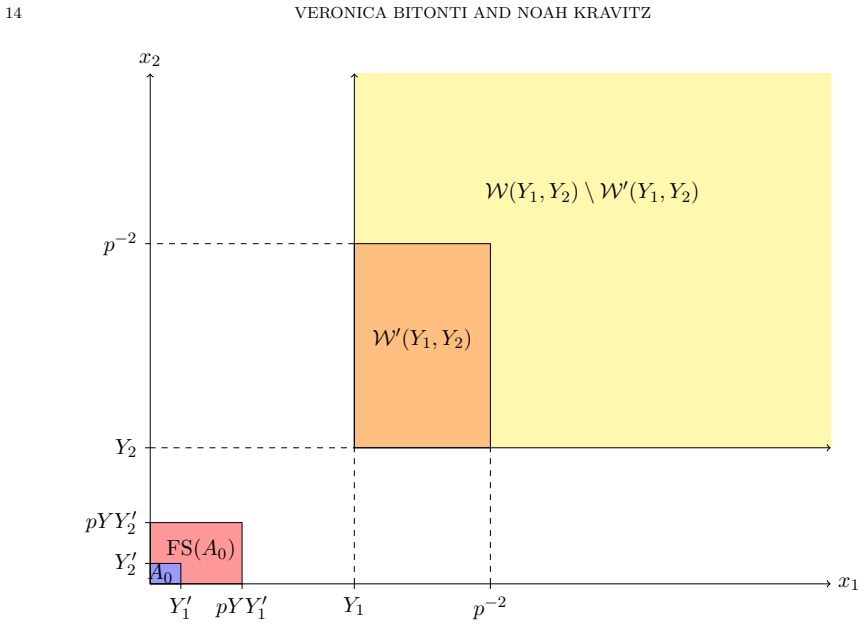
For a fixed positive integer $d$ and a small real $p>0$, sample a $p$-random subset $A \subseteq \mathbb{Z}_{\geq 0}^d$, and let $S:=\langle A \rangle$ be the generalized numerical semigroup generated by $A$. We show that with high probability (as $p \to 0$), the gap set $\mathbb{Z}_{\geq 0}^d \setminus S$ is well approximated by the shifted hyperboloid region $$\{(x_1, \ldots, x_d) \in \mathbb{R}_{\geq 0}^d: (x_1+\log p^{-1}) \cdots (x_d+\log p^{-1})\ll p^{-1}(\log p^{-1})^{d+1}\}.$$ This generalizes work of the second author, Morales, and Schildkraut on the $1$-dimensional setting. We also obtain the same result with $S$ replaced by the set of subset sums of $A$.
Editorial analysis
A structured set of objections, weighed in public.
Referee Report
Summary. The manuscript proves that for fixed d ≥ 1 and p → 0, if A is a random subset of ℤ≥0^d with each point included independently with probability p, then the gap set ℤ≥0^d ∖ ⟨A⟩ is asymptotically approximated (in a sense made precise in the paper) by the shifted hyperboloid region {(x1,…,xd) ∈ ℝ≥0^d : ∏(xi + log(1/p)) ≪ p^{-1} (log(1/p))^{d+1}} with high probability. An identical statement holds when ⟨A⟩ is replaced by the set of all subset sums of A. The argument generalizes the one-dimensional analysis of the second author et al. via direct probabilistic estimates on the reachability of lattice points.
Significance. If the stated high-probability approximation holds, the work supplies a concrete geometric description of the gaps in sparse random semigroups in any fixed dimension. The proof strategy—independent Bernoulli sampling together with scaling by log(1/p)—is standard for such models and yields a parameter-free limiting shape, which is a strength. The result is of interest to combinatorial number theory and probabilistic combinatorics on monoids.
major comments (2)
- [§4, Theorem 1.1] §4, Theorem 1.1 and the definition of 'well approximated': the precise metric (e.g., whether the symmetric difference has o(vol) measure, or whether the Hausdorff distance between the discrete gap set and the continuous region tends to zero after suitable scaling) is not stated explicitly in the theorem; without it the high-probability claim cannot be verified or falsified.
- [§5.2, Lemma 5.3] §5.2, Lemma 5.3 (the key reachability estimate): the error term in the probability that a lattice point outside the hyperboloid is reachable appears to be O(p^ε) for some ε>0, but the dependence on d is not tracked uniformly; when d is fixed this is harmless, yet the argument should record the d-dependence explicitly to confirm it remains o(1) as p→0.
minor comments (3)
- [Abstract and §2] Notation: the symbol ≪ is used without a quantitative definition; replace it by an explicit inequality involving a function ω(p)→∞ or state the implied constants.
- [§1] The 1-dimensional case is cited but the precise statement from Morales–Schildkraut is not recalled; a one-sentence reminder would help readers.
- [§6] Figure 1 (if present) or the illustrative plots in §6 should include the scaled hyperboloid boundary for visual comparison.
Simulated Author's Rebuttal
We are grateful to the referee for their thorough review and positive recommendation for minor revision. Below we address each major comment in turn, indicating the changes made to the manuscript.
read point-by-point responses
-
Referee: [§4, Theorem 1.1] §4, Theorem 1.1 and the definition of 'well approximated': the precise metric (e.g., whether the symmetric difference has o(vol) measure, or whether the Hausdorff distance between the discrete gap set and the continuous region tends to zero after suitable scaling) is not stated explicitly in the theorem; without it the high-probability claim cannot be verified or falsified.
Authors: We thank the referee for this observation. While the definition of 'well approximated' appears in the text preceding Theorem 1.1, we concur that the theorem statement would benefit from an explicit reference to the precise approximation metric. In the revised manuscript, we have modified the statement of Theorem 1.1 to include a parenthetical clarification of the sense in which the approximation holds (specifically, that the scaled symmetric difference has vanishing relative volume with high probability). This addresses the verifiability concern without altering the underlying result. revision: yes
-
Referee: [§5.2, Lemma 5.3] §5.2, Lemma 5.3 (the key reachability estimate): the error term in the probability that a lattice point outside the hyperboloid is reachable appears to be O(p^ε) for some ε>0, but the dependence on d is not tracked uniformly; when d is fixed this is harmless, yet the argument should record the d-dependence explicitly to confirm it remains o(1) as p→0.
Authors: We appreciate the referee's suggestion to make the d-dependence explicit. Although d is held fixed in the paper, recording the dependence clarifies that the error remains o(1) uniformly for fixed d. In the revised Lemma 5.3, we have added a remark tracking the constants' dependence on d, confirming that for any fixed d the probability bound is indeed o(1) as p → 0. No change to the main argument is required. revision: yes
Circularity Check
No significant circularity; derivation is self-contained probabilistic analysis
full rationale
The paper establishes the high-probability approximation of the gap set to the shifted hyperboloid region via direct probabilistic estimates on lattice-point reachability under independent Bernoulli sampling of A, with scaling by log(1/p). This extends the cited 1D case but does not reduce the d-dimensional claim to any fitted parameter, self-definition, or load-bearing self-citation chain. The prior work supplies only the base case; the new argument relies on standard sparse-random-model techniques that are independently verifiable and not equivalent to the target region by construction. No steps match the enumerated circularity patterns.
Axiom & Free-Parameter Ledger
axioms (2)
- standard math Standard properties of generalized numerical semigroups in d dimensions
- domain assumption High-probability convergence of gaps to the hyperboloid as p to 0
Reference graph
Works this paper leans on
- [1]
-
[2]
N. Alon and Y. Roichman, Random Cayley graphs and expanders.RSA,5.2(1994), 271–284
work page 1994
-
[3]
G. E. Andrews,The Theory of Partitions. Cambridge University Press, 1984
work page 1984
-
[4]
T. Bogart and S. Morales, Improved Upper Bounds on Key Invariants of Erd˝ os-R´ enyi Numerical Semigroups. PreprintarXiv:2411.13767v3 (2025)
-
[5]
J. De Loera, C. O’Neill, and D. Wilburne, Random numerical semigroups and a simplicial complex of irreducible semigroups.Electr. J. Combin.,25(4)(2018), #P4.37
work page 2018
-
[6]
P. Erd˝ os and A. R´ enyi, Probabilistic methods in group theory.J. Analyse Math.,14(1965), 127–138
work page 1965
-
[7]
G. H. Hardy and S. Ramanujan, Asymptotic Formulae in Combinatory Analysis.Proc. London Math. Soc.,17 (1918), 75–115
work page 1918
-
[8]
S. V. Kerov and A. M. Vershik, Asymptotics of the Plancherel measure of the symmetric group and the limiting form of Young tableaux.Dokl. Akad. Nauk,233.6(1977), 1024–1027
work page 1977
-
[9]
N. Kravitz, S. Morales, and C. Schildkraut, Statistics of Erd˝ os–R´ enyi random numerical semigroups.Preprint arXiv:2509.12862v1 (2025)
-
[10]
B. F. Logan and L. A. Shepp, A Variational Problem for Random Young Tableaux.Adv. Math.,26(1977), 206–222
work page 1977
- [11]
-
[12]
Meinardus, Asymptotische Aussagen ¨ uber Partitionen.Math
G. Meinardus, Asymptotische Aussagen ¨ uber Partitionen.Math. Z.,59(1954), 388–398
work page 1954
-
[13]
J. V. Uspensky, Asymptotic Formulae for Numerical Functions Which Occur in the Theory of Partitions.Bull. Acad. Sci. Russie,14(1920), 199–218. Veronica Bitonti, Merton College, Oxford and Mathematical Institute, University of Oxford; Merton Street, Oxford OX1 4JD, United Kingdom Email address:veronica.bitonti@maths.ox.ac.uk Noah Kravitz, St John’s College...
work page 1920
discussion (0)
Sign in with ORCID, Apple, or X to comment. Anyone can read and Pith papers without signing in.