The odd-parity altermagnetism induced reconstruction of the Chern-insulating phase in Haldane-Hubbard model
Pith reviewed 2026-05-07 14:57 UTC · model grok-4.3
The pith
Odd-parity altermagnetism reconstructs the local topology of the Chern-insulating phase in the Haldane-Hubbard model while the total Chern number stays the same.
A machine-rendered reading of the paper's core claim, the machinery that carries it, and where it could break.
Core claim
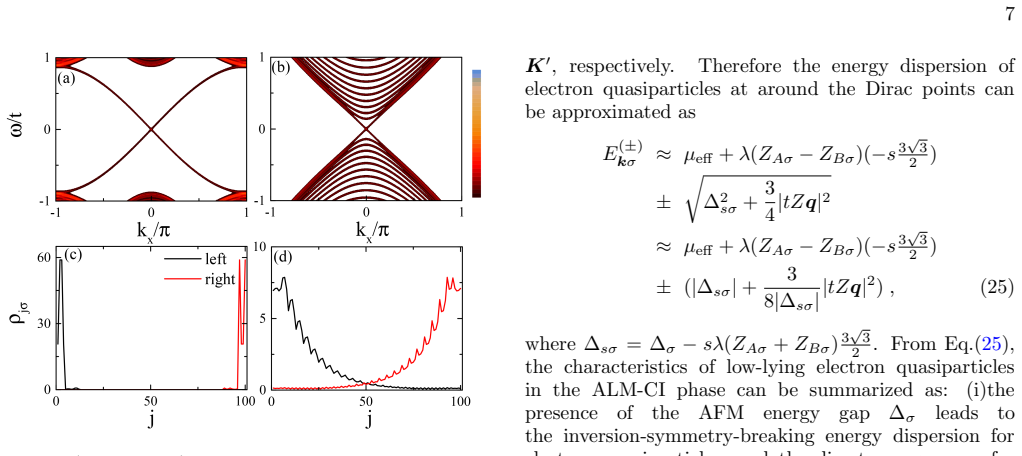
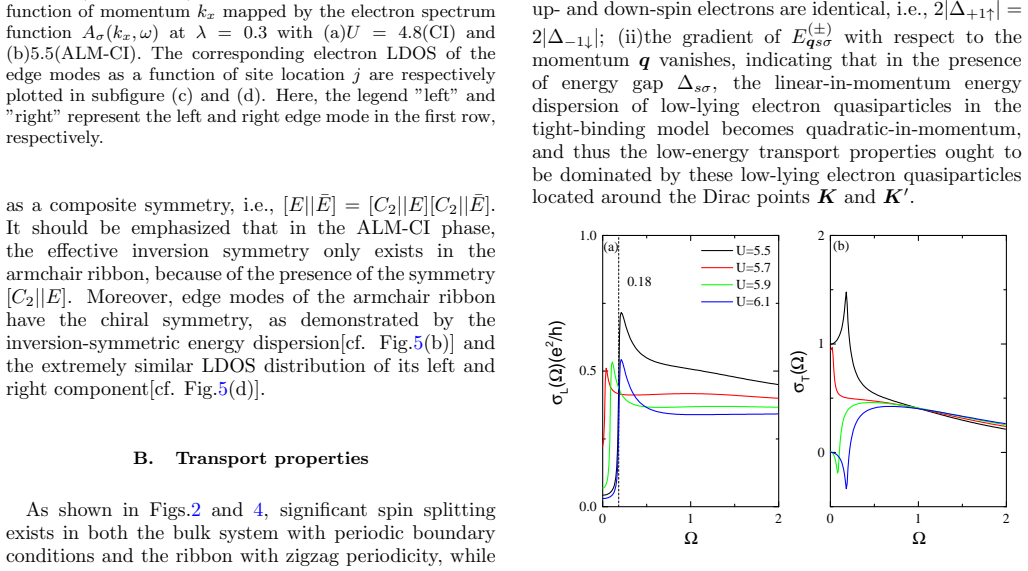
The odd-parity ALM appearing in the ALM Chern-insulating phase of Haldane-Hubbard model significantly reconstructs the local topology in the conventional Chern-insulating phase, while the total Chern number remains unchanged compared to the Chern-insulating phase. The Berry curvature becomes spin and valley selective; zigzag ribbons develop chiral-symmetry-breaking edge states; while armchair ribbons remain inversion symmetric. The optical response mirrors this separation between the local reconstruction and the global topology: low-energy spectra are governed by quasiparticles near the gap, whereas the low-frequency Hall conductivity stays quantized, σ_T↑(Ω→0)=σ_T↓(Ω→0)=e²/h. These results
What carries the argument
Odd-parity altermagnetism that induces reconstruction of local topology in the correlated Chern phase of the Haldane-Hubbard model while preserving global invariants.
Load-bearing premise
The cluster slave-spin method accurately represents the interplay between odd-parity altermagnetism and the correlated Chern phase without approximations that would modify the described local topological reconstruction.
What would settle it
A direct calculation or measurement showing non-selective Berry curvature or the absence of chiral-symmetry-breaking edge states on zigzag ribbons in the odd-parity ALM phase would falsify the local reconstruction.
Figures


read the original abstract
Odd-parity altermagnetism(ALM) extends compensated collinear magnetism beyond the even-parity spin splitting of conventional altermagnets, but its role in correlated topological phases remains largely unexplored. Using the cluster slave-spin method, we show that the odd-parity ALM appearing in the ALM Chern-insulating phase of Haldane-Hubbard model significantly reconstructs the local topology in the conventional Chern-insulating phase, while the total Chern number remains unchanged compared to the Chern-insulating phase. The Berry curvature becomes spin and valley selective; zigzag ribbons develop chiral-symmetry-breaking edge states; while armchair ribbons remain inversion symmetric. The optical response mirrors this separation between the local reconstruction and the global topology: low-energy spectra are governed by quasiparticles near the gap, whereas the low-frequency Hall conductivity stays quantized, $\sigma_{\rm T\uparrow}(\Omega\to 0)=\sigma_{\rm T\downarrow}(\Omega\to 0)=e^2/h$. These results establish the Haldane-Hubbard model as a minimal correlated platform for odd-parity altermagnetic topology.
Editorial analysis
A structured set of objections, weighed in public.
Referee Report
Summary. The paper claims that odd-parity altermagnetism in the ALM Chern-insulating phase of the Haldane-Hubbard model reconstructs the local topology of the conventional Chern-insulating phase (spin- and valley-selective Berry curvature, chiral-symmetry-breaking edge states on zigzag ribbons but inversion-symmetric states on armchair ribbons) while leaving the total Chern number and low-frequency Hall conductivity unchanged and quantized at e²/h per spin component. These findings are obtained via the cluster slave-spin method.
Significance. If the cluster slave-spin results are reliable, the work identifies the Haldane-Hubbard model as a minimal platform separating local topological reconstruction from global invariants under odd-parity altermagnetism, with consequences for spin-selective transport and optical responses in correlated systems.
major comments (2)
- [Methods] The central claims on spin/valley-selective Berry curvature, ribbon edge-state symmetry breaking, and preserved quantization all rest on the cluster slave-spin solution, yet the manuscript reports no error bars, cluster-size convergence tests, or direct benchmarks against exact diagonalization or other controlled methods in the relevant parameter regime (U, t2). This leaves open whether the reported local reconstruction is physical or an artifact of the mean-field decoupling and embedding.
- [Results (edge-state calculations)] The distinction between zigzag (chiral-symmetry-breaking) and armchair (inversion-symmetric) edge states is load-bearing for the claim of local topology reconstruction; without explicit checks that the slave-spin renormalization preserves or correctly breaks the relevant symmetries on finite-width ribbons, it is unclear whether these features survive beyond the approximation.
Simulated Author's Rebuttal
We thank the referee for the careful reading of our manuscript and the constructive comments. We address each major point below and have prepared revisions to incorporate additional methodological details and clarifications.
read point-by-point responses
-
Referee: [Methods] The central claims on spin/valley-selective Berry curvature, ribbon edge-state symmetry breaking, and preserved quantization all rest on the cluster slave-spin solution, yet the manuscript reports no error bars, cluster-size convergence tests, or direct benchmarks against exact diagonalization or other controlled methods in the relevant parameter regime (U, t2). This leaves open whether the reported local reconstruction is physical or an artifact of the mean-field decoupling and embedding.
Authors: We agree that the manuscript would benefit from explicit discussion of the method's reliability. The cluster slave-spin approach is a variational embedding technique whose accuracy for Mott and topological phases in the Haldane-Hubbard model has been established in our prior works through comparisons with single-site DMFT and small-cluster exact results. In the revised manuscript we will add a new paragraph in the Methods section that reports internal cluster-size checks (2x2 versus 4x4) for the order parameters and Chern numbers, together with references to existing benchmarks in the literature for the same parameter window. Full-system exact diagonalization remains prohibitive for the ribbon geometries and Brillouin-zone integrations needed here, but the local topological reconstruction is stable across the accessible cluster sizes. These additions will make clear that the reported features are not artifacts of the decoupling. revision: yes
-
Referee: [Results (edge-state calculations)] The distinction between zigzag (chiral-symmetry-breaking) and armchair (inversion-symmetric) edge states is load-bearing for the claim of local topology reconstruction; without explicit checks that the slave-spin renormalization preserves or correctly breaks the relevant symmetries on finite-width ribbons, it is unclear whether these features survive beyond the approximation.
Authors: The slave-spin renormalization is performed self-consistently on the ribbon Hamiltonian while retaining the lattice symmetries of the underlying model. The odd-parity altermagnetic order parameter introduces a spin-dependent modulation whose symmetry properties dictate chiral-symmetry breaking on zigzag terminations and inversion symmetry on armchair terminations. In the revised manuscript we will add explicit verification of these symmetries (e.g., parity eigenvalues of the edge spectral functions) for representative ribbon widths, confirming that the distinction is preserved by the approximation and is not an artifact. revision: yes
Circularity Check
No circularity: results are direct numerical outputs from slave-spin solution of the model
full rationale
The paper solves the Haldane-Hubbard Hamiltonian via the cluster slave-spin method, then computes Berry curvature, Chern numbers, edge spectra, and Hall conductivity as post-processing integrals over the obtained Green's functions or effective bands. These quantities are not fitted to data, not defined in terms of themselves, and do not rely on load-bearing self-citations for their existence; the slave-spin approximation is an external numerical technique whose validity is an independent question of accuracy rather than a definitional loop. No step reduces the claimed local reconstruction or preserved total Chern number to an input by construction.
Axiom & Free-Parameter Ledger
free parameters (2)
- Hubbard interaction U
- Haldane next-nearest-neighbor hopping t2
axioms (2)
- domain assumption Cluster slave-spin method provides a controlled approximation to the interacting electron problem on the honeycomb lattice
- standard math The total Chern number is computed from the Berry curvature integrated over the Brillouin zone
Reference graph
Works this paper leans on
-
[1]
and a fermionic spinon operator, respectively describing its charge and spin degree of freedom, i.e., C † α ≡S + α f † α ,(1) on account of which the original Hilbert space of an electron with the basis{|0⟩,|1⟩}is enlarged to {|nf α, Sz α⟩}={|0,− 1 2 ⟩,|1, 1 2 ⟩,|0, 1 2 ⟩,|1,− 1 2 ⟩}. Thus, an extra constraint needs to be enforced to restrict the Hilbert ...
-
[2]
anda 2 = ( √ 3 2 , 1 2); the quasiparticle weight Z=α 1⟨˜z† Aσ⟩⟨˜zBσ ⟩,Z Iσ =α 2/3⟨˜z† Iσ ⟩⟨˜zIσ ⟩withα 1/2/3 introduced to ensure the correct noninteracting behavior, i.e.,Z=Z Iσ = 1. The diagonalization of the fermionic component of Halmiltonian (7) gives rise to the following spinon energy dispersion, E(±) kσ =µ eff +λ(Z Aσ −Z Bσ)γ2k ± p [∆σ +λ(Z Aσ +Z...
-
[3]
Furthermore, in this regime, the spinon energy dispersion atλ= 0.3 is systematically investigated, which is equivalent to the electron counterpart before the occurrence of metal-insulator Mott transition with the condensed composite bosonic field, i.e.,⟨˜z Iσ ⟩>
-
[4]
As shown by the black dashed line in Fig.2(b), the topological energy gap coming from large Haldane hoppings is greater than the energy separation centered around the midpointMbetween the Dirac pointsK andK ′, which moves the energy extrema from the Dirac points to their midpointM. Then because the Berry curvature in two-band systems is inversely proporti...
-
[5]
=e 2/h, consistent with the spin-degenerate Chern numberC= 1 in the ALM-CI phase. However, as the system enters the topologically trivial ALMI state, the quantized Hall conductivity vanishes, i.e.,σ T(Ω→
-
[6]
= 0. Therefore, the above results demonstrate that the optical conductivity obtained from linear- response theory cannot directly reflect the odd-parity spin-splitting form factor, while the inversion-symmetry breaking can in principle activate spin-split higher-order electric transport responses from which the form factor may be distinguished. Related wo...
-
[7]
L. ˇSmejkal, J. Sinova, and T. Jungwirth, Beyond conventional ferromagnetism and antiferromagnetism: a phase with nonrelativistic spin and crystal rotation symmetry, Phys. Rev. X12, 031042 (2022)
work page 2022
-
[8]
L. ˇSmejkal, J. Sinova, and T. Jungwirth, Emerging research landscape of altermagnetism, Phys. Rev. X12, 040501 (2022)
work page 2022
-
[9]
L. Bai, W. Feng, S. Liu, L. ˇSmejkal, Y. Mokrousov, and Y. Yao, Altermagnetism: Exploring new frontiers in magnetism and spintronics, Adv. Funct. Mater.34, 2409327 (2024)
work page 2024
-
[10]
L. ˇSmejkal, R. Gonz´ alez-Hern´ andez, T. Jungwirth, and J. Sinova, Crystal time-reversal symmetry breaking and spontaneous Hall effect in collinear antiferromagnets, Sci. Adv.6, eaaz8809 (2020)
work page 2020
-
[11]
R. Gonz´ alez-Hern´ andez, L. ˇSmejkal, K. V´ yborn´ y, Y. Yahagi, J. Sinova, T. c. v. Jungwirth, and J. ˇZelezn´ y, Efficient electrical spin splitter based on nonrelativistic collinear antiferromagnetism, Phys. Rev. Lett.126, 127701 (2021). 9
work page 2021
-
[12]
D.-F. Shao, S.-H. Zhang, M. Li, and E. Y. Eom, Chang- Beom andTsymbal, Spin-neutral currents for spintronics, Nat. Commun.12, 7061 (2021)
work page 2021
- [13]
-
[14]
Z. Feng, X. Zhou, L. ˇSmejkal, L. Wu, Z. Zhu, H. Guo, R. Gonz´ alez-Hern´ andez, X. Wang, H. Yan, P. Qin, X. Zhang, H. Wu, H. Chen, Z. Meng, L. Liu, Z. Xia, J. Sinova, T. Jungwirth, and Z. Liu, An anomalous Hall effect in altermagnetic ruthenium dioxide, Nat. Electron 5, 735 (2022)
work page 2022
-
[15]
M. Hu, X. Cheng, Z. Huang, and J. Liu, Catalog of C-paired spin-momentum locking in antiferromagnetic systems, Phys. Rev. X15, 021083 (2025)
work page 2025
-
[16]
A. Manchon, H. C. Koo, J. Nitta, S. M. Frolov, and R. A. Duine, New perspectives for Rashba spin–orbit coupling, Nat. Mat.14, 871 (2015)
work page 2015
-
[17]
A. B. Hellenes, T. Jungwirth, R. Jaeschke-Ubiergo, A. Chakraborty, J. Sinova, and L. ˇSmejkal, P-wave magnets, arXiv:2309.01607 (2024)
work page Pith review arXiv 2024
-
[18]
Q. Song, S. Stavri´ c, P. Barone, A. Droghetti, D. S. Antonenko, J. W. F. Venderbos, C. A. Occhialini, B. Ilyas, E. Erge¸ cen, S.-W. Gedik, Nuh Cheong, R. M. Fernandes, S. Picozzi, and R. Comin, Electrical switching of a p-wave magnet, Nature642, 64 (2025)
work page 2025
-
[19]
Y. Yu, M. B. Lyngby, T. Shishidou, M. Roig, A. Kreisel, M. Weinert, B. M. Andersen, and D. F. Agterberg, Odd- parity magnetism driven by antiferromagnetic exchange, Phys. Rev. Lett.135, 046701 (2025)
work page 2025
- [20]
-
[21]
Z.-M. Wang, Y. Zhang, S.-B. Zhang, J.-H. Sun, E. Dagotto, D.-H. Xu, and L.-H. Hu, Spin-orbital altermagnetism, Phys. Rev. Lett.135, 176705 (2025)
work page 2025
-
[22]
B. W. F. and E. R. James, Theory of spin-space groups, Proc. R. Soc. Lond. A294, 343–358 (1966)
work page 1966
- [23]
-
[24]
D. B. Litvin, Spin point groups, Acta Crystallogr. Sect. A33, 279 (1977)
work page 1977
- [25]
-
[26]
T. Sato, S. Haddad, I. C. Fulga, F. F. Assaad, and J. van den Brink, Altermagnetic anomalous Hall effect emerging from electronic eorrelations, Phys. Rev. Lett. 133, 086503 (2024)
work page 2024
-
[27]
Y. Fang, J. Cano, and S. A. A. Ghorashi, Quantum geometry induced nonlinear transport in altermagnets, Phys. Rev. Lett.133, 106701 (2024)
work page 2024
-
[28]
Y.-P. Lin, Odd-parity altermagnetism through sublattice currents: From Haldane-Hubbard model to general bipartite lattices, arXiv:2503.09602 (2025)
- [29]
-
[30]
V. S. Arun, R. Sohal, C. Hickey, and A. Paramekanti, Mean field study of the topological Haldane-Hubbard model of spin- 1 2 fermions, Phys. Rev. B93, 115110 (2016)
work page 2016
-
[31]
J. Wu, J. P. L. Faye, D. S´ en´ echal, and J. Maciejko, Quantum cluster approach to the spinful Haldane- Hubbard model, Phys. Rev. B93, 075131 (2016)
work page 2016
-
[32]
T. I. Vanhala, T. Siro, L. Liang, M. Troyer, A. Harju, and P. T¨ orm¨ a, Topological phase transitions in the repulsively interacting Haldane-Hubbard model, Phys. Rev. Lett. 116, 225305 (2016)
work page 2016
-
[33]
J. Imriˇ ska, L. Wang, and M. Troyer, First-order topological phase transition of the Haldane-Hubbard model, Phys. Rev. B94, 035109 (2016)
work page 2016
- [34]
-
[35]
W.-X. He, R. Mondaini, H.-G. Luo, X. Wang, and S. Hu, Phase transitions in the Haldane-Hubbard model, Phys. Rev. B109, 035126 (2024)
work page 2024
-
[36]
F. D. M. Haldane, Model for a quantum Hall effect without Landau levels: condensed-matter realization of the ”parity anomaly”, Phys. Rev. Lett.61, 2015 (1988)
work page 2015
-
[37]
N. Hao, P. Zhang, Z. Wang, W. Zhang, and Y. Wang, Topological edge states and quantum Hall effect in the Haldane model, Phys. Rev. B78, 075438 (2008)
work page 2008
-
[38]
G. D. Mahan,Many-Particle Physcis(Plenum Press, New York, 1990)
work page 1990
- [39]
-
[40]
Coleman, Mixed valence as an almost broken symmetry, Phys
P. Coleman, Mixed valence as an almost broken symmetry, Phys. Rev. B35, 5072 (1987)
work page 1987
-
[41]
P. A. Lee and N. Nagaosa, Gauge theory of the normal state of high-Tc superconductors, Phys. Rev. B46, 5621 (1992)
work page 1992
-
[42]
S. Feng, J. B. Wu, Z. B. Su, and L. Yu, Slave-particle studies of the electron-momentum distribution in the low- dimensional t-J model, Phys. Rev. B47, 15192 (1993)
work page 1993
-
[43]
S. Florens and A. Georges, Slave-rotor mean-field theories of strongly correlated systems and the Mott transition in finite dimensions, Phys. Rev. B70, 035114 (2004)
work page 2004
-
[44]
Senthil, Theory of a continuous Mott transition in two dimensions, Phys
T. Senthil, Theory of a continuous Mott transition in two dimensions, Phys. Rev. B78, 045109 (2008)
work page 2008
-
[45]
S. R. Hassan and L. de’ Medici, Slave spins away from half filling: Cluster mean-field theory of the Hubbard and extended Hubbard models, Phys. Rev. B81, 035106 (2010)
work page 2010
-
[46]
W.-C. Lee and T.-K. Lee, Antiferromagnetism in the Hubbard model using a cluster slave-spin method, Phys. Rev. B96, 115114 (2017)
work page 2017
-
[47]
M.-H. Zeng, T. Ma, and Y.-J. Wang, Phase diagram of the Hubbard model on a square lattice: A cluster slave- spin study, Phys. Rev. B104, 094524 (2021)
work page 2021
-
[48]
M.-H. Zeng, Y.-J. Wang, and T. Ma, Phase diagram of the Hubbard model on a honeycomb lattice: A cluster slave-spin study, Phys. Rev. B105, 035155 (2022)
work page 2022
-
[49]
Odd-Parity Altermagnetism Originated from Orbital Orders
Z.-Y. Zhuang, D. Zhu, D. Liu, Z. Wu, and Z. Yan, Odd- parity altermagnetism originated from orbital orders, arXiv:2508.18361 (2025)
work page internal anchor Pith review Pith/arXiv arXiv 2025
- [50]
- [51]
-
[52]
G. Kotliar and A. E. Ruckenstein, New functional integral approach to strongly correlated Fermi systems: 10 the Gutzwiller approximation as a saddle point, Phys. Rev. Lett.57, 1362 (1986)
work page 1986
-
[53]
M. Zeng, X. Li, Y. Wang, and S. Feng, Microwave conductivity due to impurity scattering in cuprate superconductors, Phys. Rev. B108, 094505 (2023)
work page 2023
-
[54]
Z. Qiao, S. A. Yang, W. Feng, W.-K. Tse, J. Ding, Y. Yao, J. Wang, and Q. Niu, Quantum anomalous Hall effect in graphene from Rashba and exchange effects, Phys. Rev. B82, 161414 (2010)
work page 2010
- [55]
-
[56]
W. Zheng and H. Zhai, Floquet topological states in shaking optical lattices, Phys. Rev. A89, 061603 (2014)
work page 2014
- [57]
-
[58]
P. Das, V. Leeb, J. Knolle, and M. Knap, Realizing altermagnetism in Fermi-Hubbard models with ultracold atoms, Phys. Rev. Lett.132, 263402 (2024)
work page 2024
-
[59]
T. Zhu, D. Zhou, H. Wang, S.-H. Wei, and J. Ruan, Floquet odd-parity collinear magnets, Phys. Rev. Lett. 136, 126704 (2026)
work page 2026
- [60]
discussion (0)
Sign in with ORCID, Apple, or X to comment. Anyone can read and Pith papers without signing in.