Enumerating Multi-Operator Monomials in Commutative and Noncommutative Settings
Pith reviewed 2026-05-07 15:37 UTC · model grok-4.3
The pith
Noncommuting unary operators on one variable produce explicit multigraded counts that refine the Narayana numbers.
A machine-rendered reading of the paper's core claim, the machinery that carries it, and where it could break.
Core claim
When the unary operators do not commute, explicit multigraded generating functions and coefficient formulas are derived, including a multinomial refinement of the Narayana numbers, with combinatorial interpretations in terms of rooted trees, restricted lattice paths, and binary trees. When the unary operators commute, canonical representatives and effective recurrences are obtained together with monotonicity conditions on the associated combinatorial models. When multiplication is commutative the sequence decomposition becomes a multiset decomposition, producing exp-log generating functions and Euler-transform recurrences whose specializations include the Catalan numbers, the small Schröder
What carries the argument
The four regimes of commutativity for multiplication and for the unary operators, which dictate whether monomials are decomposed by sequences, multisets, or canonical forms.
If this is right
- The coefficient formulas allow direct computation of the number of distinct monomials graded by the number of times each unary operator appears.
- The bijections transfer enumerative results and structural properties between algebraic expressions and the three combinatorial models.
- The recurrences in the commuting regimes give polynomial-time algorithms for computing the counts.
- Specializations of the generating functions reproduce the known sequences for Catalan numbers, small Schröder numbers, and rooted trees, confirming internal consistency.
Where Pith is reading between the lines
- The tree and path models may be used to prove further identities satisfied by the monomials themselves.
- The same regime-based approach could be applied to count expressions that also involve binary operators of varying arities.
- The exp-log generating functions in the commutative-multiplication case suggest a possible species-theoretic formulation of the enumeration.
Load-bearing premise
All monomials are generated from one indeterminate solely by associative multiplication and the given unary operators, and the four commutativity regimes exhaust the relevant algebraic behaviors without further imposed relations.
What would settle it
A hand or computer enumeration of all monomials using two unary operators up to total degree five that produces coefficient sequences differing from those predicted by the claimed generating functions or the multinomial Narayana formula.
Figures


read the original abstract
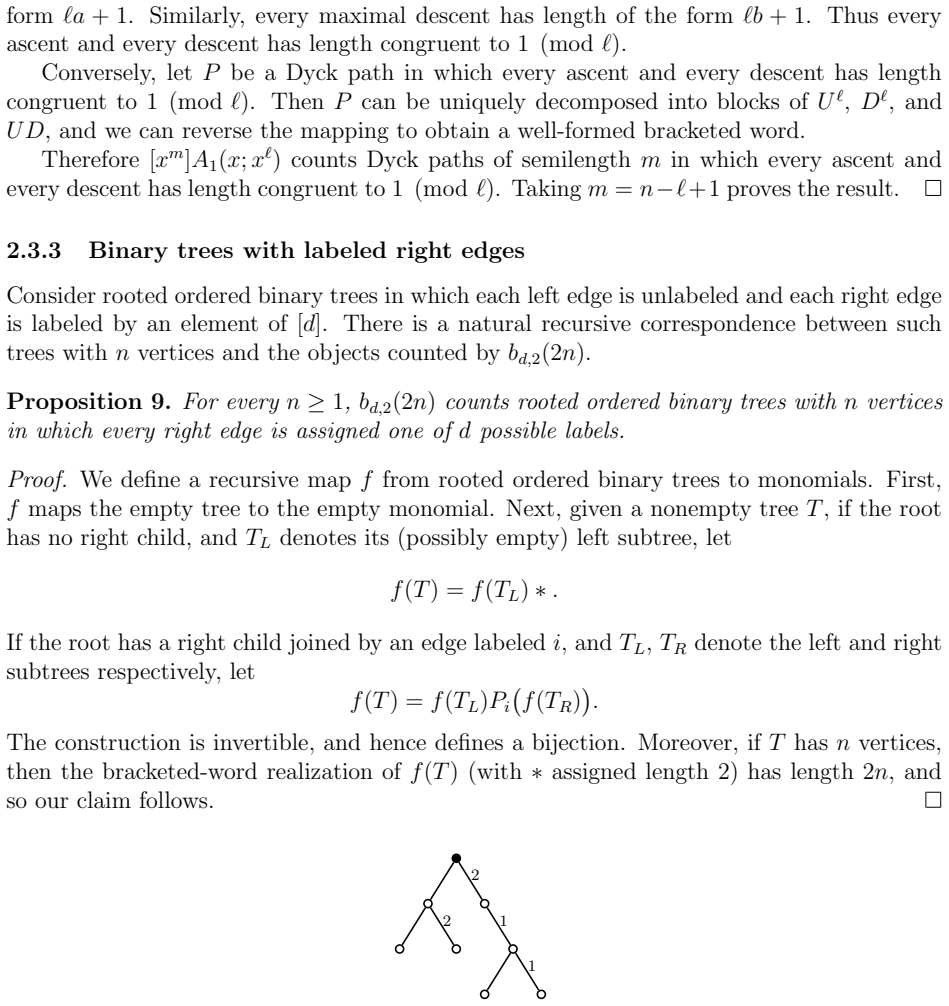
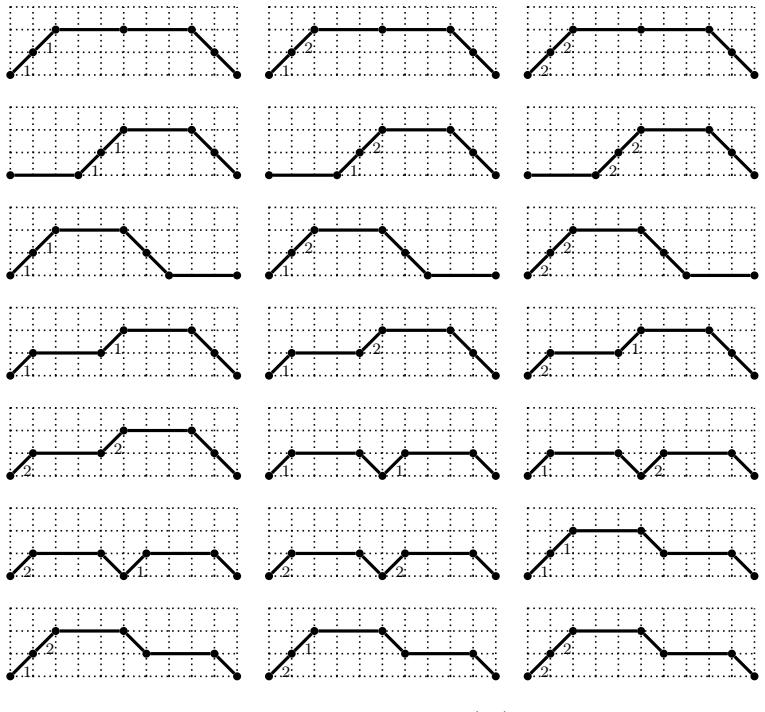
We study enumeration problems for multi-operator monomials generated from one indeterminate by an associative multiplication together with finitely many unary operators. We consider four regimes, according to whether multiplication is commutative and whether the unary operators commute. In the case where the unary operators do not commute, we obtain explicit multigraded generating functions and coefficient formulas, including a multinomial refinement of the Narayana numbers, together with interpretations in terms of rooted trees, restricted lattice paths, and binary trees. When the unary operators commute, we derive canonical representatives and effective recurrences, with corresponding monotonicity conditions in the combinatorial models. When multiplication is commutative, the sequence decomposition is replaced by a multiset decomposition, leading to exp--log generating functions and Euler-transform recurrences. In special cases, the resulting sequences recover classical families including the Catalan numbers, the small Schr\"oder numbers, and rooted-tree numbers.
Editorial analysis
A structured set of objections, weighed in public.
Referee Report
Summary. The paper enumerates monomials generated from a single indeterminate via associative multiplication and finitely many unary operators, across four regimes defined by commutativity of multiplication and of the unary operators. In the non-commuting unary operators regime it derives explicit multigraded generating functions and closed-form coefficient formulas (including a multinomial refinement of the Narayana numbers) together with bijections to rooted trees, restricted lattice paths, and binary trees. When the unary operators commute it supplies canonical representatives and effective recurrences with monotonicity conditions. Commutative multiplication replaces sequence decompositions by multiset decompositions, yielding exponential generating functions and Euler-transform recurrences. Special cases recover the Catalan numbers, small Schröder numbers, and rooted-tree counts.
Significance. If the derivations are correct, the work supplies a unified enumerative treatment of multi-operator monomials that cleanly separates the effects of the two commutativity choices and recovers several classical families as special cases. The explicit generating functions, coefficient formulas, and combinatorial interpretations (trees, paths, binary trees) constitute a concrete advance over ad-hoc treatments of individual operator sets; the recovery of known sequences serves as an internal consistency check.
minor comments (4)
- [§3] §3 (non-commutative unary case): the statement that the multigraded generating function is 'parameter-free' should be clarified by explicitly listing the variables that track the number of each unary operator; the current wording risks suggesting independence from the number of operators.
- [§4] The recurrence for the commuting-unary case (around Eq. (17)) is stated only for the total count; a brief remark on how the same recurrence lifts to the multigraded version would improve readability.
- [§5] In the commutative-multiplication regime the transition from ordinary to exponential generating functions is presented without an explicit comparison table of the four regimes; adding such a table would make the structural differences immediately visible.
- [§3.2] The bijection to binary trees in the non-commutative case is described via a recursive decomposition; a small diagram or explicit mapping for the first few sizes would help readers verify the correspondence.
Simulated Author's Rebuttal
We thank the referee for their careful reading and positive evaluation of the manuscript. The recommendation for minor revision is noted, and we appreciate the concise summary of the contributions across the four commutativity regimes.
Circularity Check
No significant circularity; standard combinatorial derivations
full rationale
The paper defines four regimes based on commutativity of multiplication and unary operators, then derives explicit multigraded generating functions, coefficient formulas, recurrences, and combinatorial interpretations (rooted trees, lattice paths, binary trees) for the non-commuting unary case, shifting to canonical representatives and multiset decompositions in the commuting cases. These rest on standard algebraic decompositions (sequences vs. multisets) and recover known sequences (Catalan, Schröder, rooted-tree numbers) as special cases without any self-definitional equations, fitted parameters renamed as predictions, or load-bearing self-citations. The central claims are self-contained against external combinatorial benchmarks and do not reduce to their inputs by construction.
Axiom & Free-Parameter Ledger
axioms (2)
- standard math Multiplication is associative
- domain assumption Unary operators act on the expressions
Reference graph
Works this paper leans on
-
[1]
Aguiar, Pre-Poisson algebras,Lett
M. Aguiar, Pre-Poisson algebras,Lett. Math. Phys.54(2000), 263–277. 33
work page 2000
-
[2]
M. Aguiar and J.-L. Loday, Quadri-algebras,J. Pure Appl. Algebra191(2004), 205–221
work page 2004
-
[3]
M. Aguiar and W. Moreira, Combinatorics of the free Baxter algebra,Electron. J. Combin.13(2006), Article R17
work page 2006
- [4]
-
[5]
E. Barcucci, E. Pergola, R. Pinzani, and S. Rinaldi, ECO method and hill-free general- ized Motzkin paths,S´ em. Lothar. Combin.46(2001), Article B46b
work page 2001
-
[6]
L. A. Bokut, Y. Chen, and J. Qiu, Gr¨ obner-Shirshov bases for associative algebras with multiple operators and free Rota-Baxter algebras,J. Pure Appl. Algebra214(2010), 89–100
work page 2010
-
[7]
M. R. Bremner and V. Dotsenko,Algebraic Operads: An Algorithmic Companion, Chap- man and Hall/CRC, 2016
work page 2016
-
[8]
M. R. Bremner and H. A. Elgendy, A new classification of algebraic identities for linear operators on associative algebras,J. Algebra596(2022), 177–199
work page 2022
-
[9]
C. Brennan and A. Knopfmacher, The height of two types of generalised Motzkin paths, J. Statist. Plann. Inference143(2013), 2112–2120
work page 2013
-
[10]
I. DeJager, M. Naquin, F. Seidl, and P. Drube, Colored Motzkin paths of higher order, J. Integer Seq.24(2021), Article 21.4.6
work page 2021
-
[11]
K. Ebrahimi-Fard and L. Guo, On products and duality of binary, quadratic, regular operads,J. Pure Appl. Algebra200(2005), 293–317
work page 2005
-
[12]
P. Flajolet and R. Sedgewick,Analytic Combinatorics, Cambridge University Press, 2009
work page 2009
-
[13]
R. P. Grimaldi,Fibonacci and Catalan Numbers: An Introduction, John Wiley & Sons, 2012
work page 2012
-
[14]
Guo, Operated semigroups, Motzkin paths and rooted trees,J
L. Guo, Operated semigroups, Motzkin paths and rooted trees,J. Algebraic Combin. 29(2009), 35–62
work page 2009
- [15]
- [16]
-
[17]
N. Haug, T. Prellberg, and G. Siudem, Area-width scaling in generalised Motzkin paths, Physica A501(2018), 425–436
work page 2018
-
[18]
P. Leroux, On some remarkable operads constructed from Baxter operators, arXiv preprint arXiv:math/0311214, 2003. Available athttps://arxiv.org/abs/math/ 0311214
-
[19]
Z. Liu, Z. Qi, Y. Qin, and G. Zhou, Gr¨ obner-Shirshov bases for free multi-operated algebras over algebras,J. Symbolic Comput.133(2026), 102489
work page 2026
-
[20]
Loday, Dialgebras, inDialgebras and Related Operads, Lecture Notes in Math., Vol
J.-L. Loday, Dialgebras, inDialgebras and Related Operads, Lecture Notes in Math., Vol. 1763, Springer, 2001, pp. 7–66
work page 2001
-
[21]
T. Mansour, M. Schork, and Y. Sun, Motzkin numbers of higher rank: generating function and explicit expression,J. Integer Seq.10(2007), Article 07.7.4
work page 2007
-
[22]
Published electronically athttps://oeis.org
OEIS Foundation Inc., The On-Line Encyclopedia of Integer Sequences, 2026. Published electronically athttps://oeis.org
work page 2026
-
[23]
T. K. Petersen,Eulerian Numbers, Birkh¨ auser, 2015
work page 2015
-
[24]
Rota, Baxter operators, an introduction, in J
G.-C. Rota, Baxter operators, an introduction, in J. P. S. Kung, ed.,Gian-Carlo Rota on Combinatorics: Introductory Papers and Commentaries, Contemp. Mathematicians, Birkh¨ auser, 1995, pp. 504–512
work page 1995
-
[25]
P. R. Stein and M. S. Waterman, On some new sequences generalizing the Catalan and Motzkin numbers,Discrete Math.26(1979), 261–272
work page 1979
-
[26]
R. A. Sulanke, Moments of generalized Motzkin paths,J. Integer Seq.3(2000), Article 00.1.1
work page 2000
-
[27]
L. Yang and S.-L. Yang, A relation between Schr¨ oder paths and Motzkin paths,Graphs Combin.36(2020), Article 128
work page 2020
-
[28]
J. Zhang and X. Gao, Free operated monoids and rewriting systems,Semigroup Forum 97(2018), 435–456. 2020Mathematics Subject Classification: Primary 05A15; Secondary 05A19, 05C05, 18M65. Keywords: multi-operator monomial, unary operator, Narayana number, Catalan number, Motzkin path, Schr¨ oder path, rooted tree, Euler transform, nonsymmetric operad. (Conc...
work page 2018
discussion (0)
Sign in with ORCID, Apple, or X to comment. Anyone can read and Pith papers without signing in.